

Building a successful business is one of the toughest leadership challenges anyone can undertake. Founders create opportunities where none exist, make difficult decisions with limited information, and carry the responsibility of turning vision into reality. It is no surprise, then, that many assume business success naturally translates into boardroom readiness.
It doesn’t.
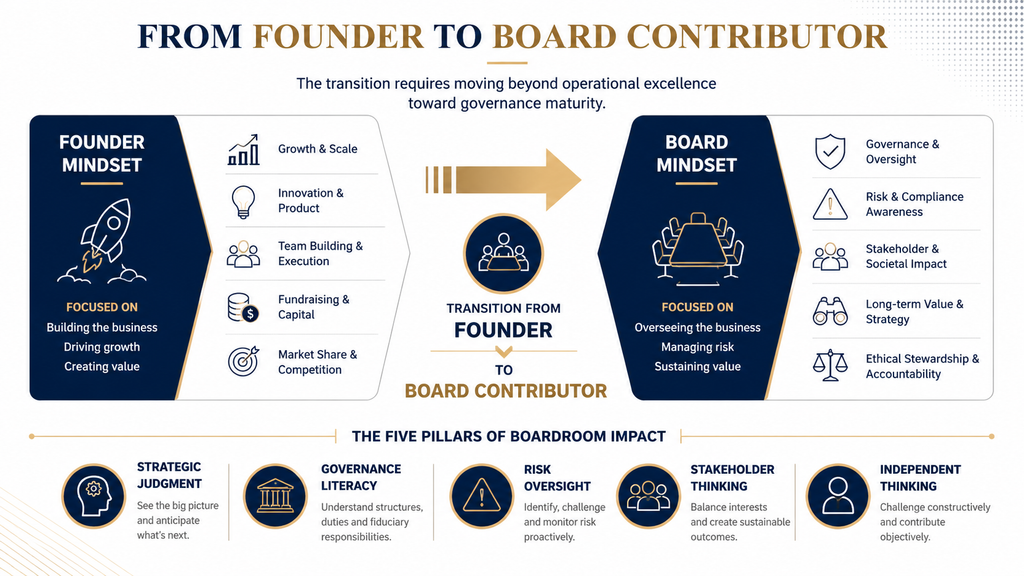
The boardroom evaluates leaders through a different lens. Investors, independent directors, and Nomination and Remuneration Committees aren’t simply interested in how effectively a founder can grow a company. They want to understand how that founder thinks about governance, balances competing stakeholder interests, approaches strategic risk, and contributes to decisions without becoming involved in day-to-day management.
This distinction has become increasingly important as governance expectations continue to evolve. Regulatory oversight is stronger, stakeholder expectations are broader, and boards are expected to navigate issues ranging from cybersecurity and artificial intelligence to ESG, succession planning, and long-term value creation. In this environment, operational success alone is no longer enough. Board credibility depends on a founder’s ability to demonstrate governance maturity.
That is where corporate governance for founders becomes essential.
Founders who aspire to serve on boards or simply become more effective board participants, must learn to communicate in the language of governance rather than the language of growth. Revenue milestones, fundraising rounds, and expansion stories remain valuable, but they are only part of the conversation. Boards are equally interested in judgment, oversight, accountability, and the ability to see beyond immediate business outcomes.
This article explores why many successful founders still appear unprepared in governance discussions and introduces a practical framework for closing that gap. More importantly, it explains how founders can build boardroom credibility by developing the capabilities that boards consistently value.
Table of Contents
- Introduction
- Table of Contents
- Why Corporate Governance for Founders Matters More Than Ever
- Founder Success Doesn’t Automatically Create Boardroom Credibility
- Corporate Governance for Founders: The Governance Gaps That Hold Founders Back
- How to Build Boardroom Credibility as a Founder
- Practical Action Plan for Founders
- Conclusion
- Ready to Build a Founder Profile That Boards Trust? (CTA)
- FAQs
Why Corporate Governance for Founders Matters More Than Ever
Over the last decade, the role of corporate boards has changed significantly. Once focused primarily on financial oversight and compliance, boards are now expected to guide organizations through technological disruption, geopolitical uncertainty, evolving regulations, cybersecurity threats, and rising stakeholder expectations. As responsibilities have expanded, so have expectations from those who occupy board seats.
For founders, this shift presents both an opportunity and a challenge. Entrepreneurial experience brings valuable qualities to the boardroom—innovation, resilience, customer focus, and the ability to navigate uncertainty. Yet these strengths alone do not establish board credibility. Directors are expected to provide independent oversight, challenge assumptions objectively, and safeguard long-term organizational interests. That requires a governance mindset, not just an entrepreneurial one.
Understanding corporate governance for founders is therefore no longer optional. It is an essential step in transitioning from building a business to helping govern one.
Founder Success Doesn’t Automatically Create Boardroom Credibility
Many founders have exceptional stories to tell.
They have scaled businesses, raised capital, entered new markets, and built high-performing teams from the ground up. These achievements deserve recognition, but they do not automatically answer the questions boards ask when evaluating potential directors.
A board isn’t simply interested in what a founder has accomplished. It wants to understand how those accomplishments were achieved. Was risk managed thoughtfully? Were governance processes respected? Were stakeholder interests balanced? Could difficult decisions withstand independent scrutiny?
This is where many founders unintentionally weaken their board positioning. They continue presenting themselves as operators when boards are looking for governors. The conversation shifts from execution to oversight, from growth to sustainability, and from individual leadership to collective decision-making.
Understanding that shift is the first step toward building lasting boardroom credibility.
Corporate Governance for Founders: The Governance Gaps That Hold Founders Back
By the time founders begin exploring board opportunities, most have already built impressive businesses. They’ve hired teams, raised capital, entered new markets, and overcome challenges that many organizations never face.
Yet boardrooms often evaluate them differently.
The reason isn’t a lack of leadership experience. It’s that boards look for evidence of governance thinking, not just entrepreneurial success. They want leaders who can move beyond building a business to protecting its long-term future.
Understanding these governance gaps is the first step towards building lasting boardroom credibility.
Growth Language vs. Governance Language
Founders naturally tell stories about growth. They talk about funding rounds, product launches, customer acquisition, market expansion, and revenue milestones. Those achievements are important because they reflect vision, resilience, and execution.
Boardrooms appreciate those accomplishments—but they rarely stop there.
Directors want to know how growth was achieved. Was risk managed responsibly? Were governance processes strengthened as the business scaled? How were difficult trade-offs handled? Did the company build systems that could sustain growth over the long term?
Consider these two statements:
“We grew our business by 250% in three years.”
Now compare it with:
“We scaled rapidly while strengthening governance, improving internal controls, and preparing the organisation for sustainable growth.”
Both describe success.
Only one demonstrates governance maturity.
Founders who learn to communicate through the language of oversight, accountability, and long-term value creation naturally strengthen their corporate governance for founders journey.
Founder Executive Presence Is More Than Confidence
Confidence is almost part of every founder’s DNA.
Without it, convincing investors, customers, and employees to believe in an idea would be nearly impossible. But confidence alone isn’t what boards remember.
They remember composure.
True founder executive presence isn’t about speaking the loudest or dominating discussions. It’s about remaining calm when opinions differ, asking thoughtful questions, and helping the room reach better decisions.
Experienced directors don’t feel the need to prove themselves in every conversation. They create confidence through clarity, objectivity, and balanced judgment.
Ironically, founders often become more influential in boardrooms when they speak a little less and listen a little more.
| Founder Leadership | Board Leadership |
| Drives execution | Provides oversight |
| Makes quick decisions | Encourages thoughtful decisions |
| Leads through authority | Influences through judgment |
| Focuses on growth | Balances growth with governance |
Strategic Judgment Matters More Than Operational Excellence
Building a successful business proves you can execute.
Serving on a board requires something different.
It requires judgment.
Boards spend far less time discussing operational details than many founders expect. Their conversations revolve around risk, succession planning, regulatory developments, capital allocation, stakeholder expectations, and long-term strategy.
That means directors are valued less for having immediate answers and more for asking the right questions.
- Can this strategy withstand changing regulations?
- Have we considered the downside risks?
- What assumptions are we making?
- How will today’s decision affect the business five years from now?
These are governance questions.
Founders who consistently demonstrate this broader perspective begin to position themselves as strategic advisors rather than operational leaders.
Independent Thinking Is a Boardroom Expectation
One of the hardest transitions for founders is moving away from complete ownership of decisions.
For years, they have been the final decision-maker.
Boardrooms operate differently.
Strong directors challenge ideas—including their own. They welcome different viewpoints, encourage constructive disagreement, and evaluate decisions through evidence rather than emotion.
That doesn’t weaken leadership.
It strengthens governance.
Independent thinking shows a board that a founder can separate personal attachment from organisational responsibility—one of the strongest indicators of board readiness.
Stakeholder Thinking Replaces Founder-Centric Decisions
Every founder begins by solving problems for customers.
As the organisation grows, the responsibility grows too.
Boardrooms expect leaders to think beyond customers and investors. Employees, regulators, suppliers, shareholders, communities, and future leadership teams all become part of the decision-making process.
Balancing these interests isn’t always easy.
But it is one of the defining responsibilities of governance.
Founders who consistently demonstrate this wider perspective build trust because they show they understand stewardship, not just entrepreneurship.
| Entrepreneurial Mindset | Governance Mindset |
| Build the business | Protect the business |
| Focus on opportunity | Balance opportunity with risk |
| Think like an owner | Think like a steward |
| Prioritise execution | Prioritise long-term value |
Governance Evidence Builds More Trust Than Success Stories
A successful exit.
A large funding round.
Rapid business growth.
These achievements certainly attract attention, but they don’t automatically convince a board that someone is ready to govern.
Boards look for evidence that a founder has already started developing governance capability.
That evidence could include serving on advisory boards, contributing to governance discussions, mentoring founders, participating in industry bodies, publishing thought leadership, or strengthening governance practices within their own company.
These experiences tell a different story.
They demonstrate that the founder is preparing for responsibilities beyond running a business.
Boardroom Credibility Is Built Long Before the Invitation
Many founders believe board preparation starts when an opportunity appears.
In reality, it starts years earlier.
Every leadership decision, every governance discussion, every article you publish, and every industry conversation you participate in contributes to your professional reputation.
Over time, those small signals become something much bigger.
They become your board brand.
And that’s what how to build boardroom credibility is really about.
It isn’t about replacing your entrepreneurial mindset. It’s about expanding it. The founders who make the strongest directors are those who continue thinking like builders while learning to lead with the judgment, independence, and governance perspective that modern boards expect.
How to Build Boardroom Credibility as a Founder
By this stage, one thing becomes clear: boardroom credibility isn’t built overnight, nor is it earned simply because you’ve built a successful company. It develops through consistent actions that demonstrate maturity, governance awareness, and the ability to think beyond day-to-day operations.
The encouraging part is that these qualities can be developed intentionally. Founders who invest in governance capability early often find themselves better prepared—not only for board opportunities but also for leading their own organisations more effectively.
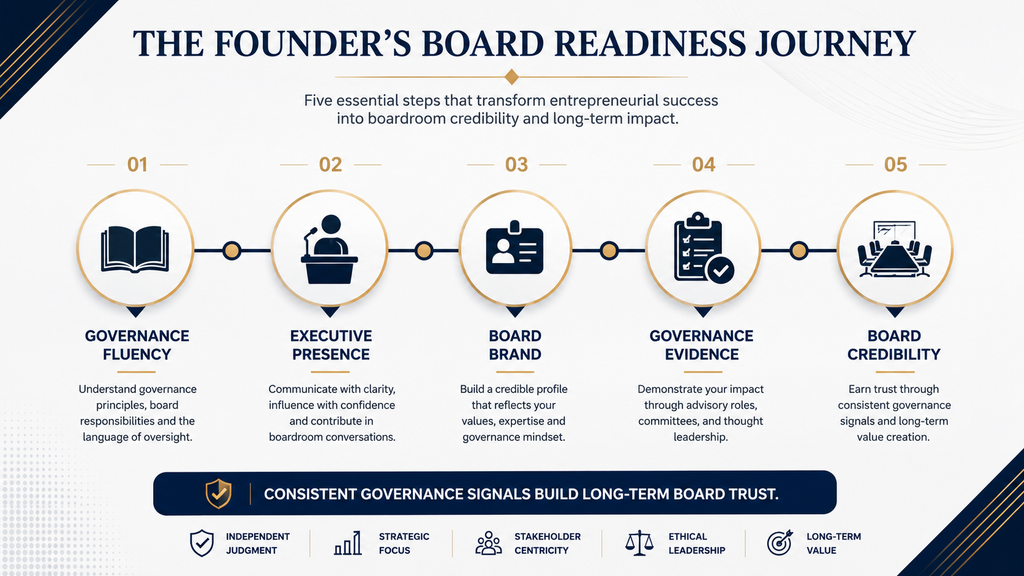
Develop Governance Fluency
Every profession has its own language, and the boardroom is no different.
Founders are naturally comfortable discussing growth metrics, customer acquisition, fundraising strategies, and product innovation. Those conversations are important, but directors are equally interested in governance topics such as risk oversight, board effectiveness, succession planning, compliance, stakeholder accountability, and long-term value creation.
Developing governance fluency doesn’t mean replacing your entrepreneurial mindset. It means expanding it.
Reading governance reports, attending director development programmes, participating in board workshops, and staying informed about regulatory developments can significantly improve the quality of your boardroom conversations. More importantly, they help you ask better questions—something every effective director is expected to do.
The strongest founders don’t stop being entrepreneurs. They simply become entrepreneurs who understand governance.
Build a Board-Ready Personal Brand
Your reputation reaches the boardroom before you do.
When investors, search firms, or Nomination and Remuneration Committees consider potential directors, they rarely start with an interview. They start by asking, “What do we already know about this person?”
That is why your professional brand matters.
A board-ready profile isn’t built around titles or awards. It’s built around the ideas you’re known for, the leadership principles you consistently demonstrate, and the way others describe your contribution.
Publishing thoughtful articles, speaking at leadership forums, contributing to governance discussions, and sharing perspectives on emerging business challenges all strengthen your professional visibility. They signal that your thinking extends beyond your own organisation and that you’re capable of contributing to broader strategic conversations.
Board opportunities often follow visibility—not because visibility replaces capability, but because it makes capability easier to recognise.
| Operational Brand | Board-Ready Brand |
| Known for delivering results | Known for sound judgment |
| Talks about growth | Talks about governance and long-term value |
| Builds businesses | Helps organisations make better decisions |
| Focuses on execution | Demonstrates strategic oversight |
Demonstrate Governance Through Action
Governance credibility isn’t built by saying you’re board-ready.
It’s built by showing it.
One of the most effective ways to strengthen your profile is by gaining experience that reflects board-level responsibilities. This doesn’t necessarily require an immediate board appointment. There are many opportunities to demonstrate governance capability before joining a formal board.
You might mentor founders, serve on advisory boards, participate in industry associations, contribute to governance committees, or support non-profit organisations through strategic guidance. Each of these experiences develops the skills boards value while providing tangible evidence of your governance mindset.
Equally important is the way you lead your own company. Strong internal governance, transparent decision-making, succession planning, independent advisory structures, and thoughtful risk management all send powerful signals about your leadership maturity.
Boards trust leaders whose actions consistently reflect the principles they advocate.
Practical Action Plan for Founders
Understanding governance is valuable.
Putting it into practice is what creates momentum.
Rather than trying to transform your profile overnight, focus on making steady improvements over the next twelve months. Small, consistent actions often have a greater impact than one major initiative.
| Timeline | Focus Area | Key Actions |
| Months 1–3 | Build governance knowledge | Study corporate governance frameworks, understand board responsibilities, and strengthen your knowledge of oversight and risk. |
| Months 4–6 | Refine your board narrative | Update your professional profile to highlight governance experience, strategic judgment, and long-term leadership impact. |
| Months 7–9 | Increase visibility | Publish thought leadership, speak at industry events, join governance communities, and expand your professional network. |
| Months 10–12 | Create governance evidence | Serve on advisory boards, mentor entrepreneurs, participate in governance initiatives, and build experiences that demonstrate board readiness. |
The journey from founder to board contributor doesn’t happen through a single certification or networking event. It happens through repeated evidence that you’re capable of guiding organisations with independence, judgment, and a long-term perspective.
Every governance conversation you participate in, every strategic decision you communicate thoughtfully, and every opportunity you take to contribute beyond your own business adds another layer to your boardroom credibility.
Over time, those signals become your strongest qualification—not just as a founder, but as a trusted future director.
Conclusion
The journey from founder to board member isn’t defined by the success of your business alone. It is shaped by how your leadership evolves as your responsibilities grow. Building a company proves that you can create value. Contributing in a boardroom proves that you can protect and sustain that value over the long term.
That is why corporate governance for founders deserves far more attention than it often receives. Modern boards are looking beyond growth stories and entrepreneurial achievements. They want founders who can think independently, challenge ideas constructively, understand governance responsibilities, and balance the interests of every stakeholder. Those qualities inspire confidence long before a board appointment is made.
The encouraging part is that boardroom credibility is not reserved for a select few. It is built through consistent learning, thoughtful leadership, stronger governance practices, and a willingness to see the business from a broader perspective. Every governance discussion you participate in, every strategic decision you communicate clearly, and every effort you make to strengthen oversight adds another layer to your board-ready profile.
If you’re serious about serving on a board one day, don’t wait until an opportunity appears to prepare. Start building the governance mindset today. Because the founders who make the strongest directors aren’t simply known for building successful companies—they’re trusted for helping organisations make better decisions.
If you’re preparing for your first board role, now is the right time to start building the reputation that boards remember—not just the company you’ve built.
FAQs
1. What is corporate governance for founders?
Corporate governance for founders refers to the principles, practices, and leadership mindset that help founders oversee organisations responsibly while balancing the interests of shareholders, employees, regulators, and other stakeholders.
2. Why do successful founders struggle in the boardroom?
Many founders excel at execution and business growth, but boardrooms evaluate leaders on governance, strategic judgment, oversight, and long-term decision-making rather than operational performance alone.
3. How can founders build boardroom credibility?
Founders can build boardroom credibility by strengthening governance knowledge, developing thought leadership, improving executive visibility, gaining advisory experience, and consistently demonstrating sound judgment.
4. Does business success automatically qualify a founder for a board position?
No. Business success is valuable, but boards also look for governance maturity, stakeholder awareness, independence, and the ability to contribute strategically without managing daily operations.
5. What is founder executive presence?
Founder executive presence is the ability to communicate with confidence, remain composed under pressure, encourage meaningful discussions, and influence decisions through credibility rather than authority.
6. Why is governance language important for founders?
Governance language demonstrates that a founder understands oversight, accountability, enterprise risk, and long-term value creation—qualities that boards actively seek.
7. What are the biggest governance mistakes founders make?
Common mistakes include focusing only on growth, overlooking governance processes, resisting independent viewpoints, and treating board discussions like operational meetings.
8. How do boards evaluate founder leadership?
Boards assess strategic thinking, ethical leadership, governance awareness, stakeholder management, risk oversight, and the founder’s ability to contribute independently.
9. Can founders become effective independent directors?
Yes. With governance experience, board education, strategic visibility, and a board-ready profile, founders can become highly effective independent directors.
10. Why is strategic judgment important in corporate governance?
Strategic judgment helps directors evaluate long-term opportunities, manage uncertainty, balance stakeholder interests, and make decisions that support sustainable growth.
11. How can thought leadership improve board opportunities?
Publishing articles, speaking at industry events, and contributing to governance discussions demonstrate expertise and strengthen professional credibility among board recruiters.
12. What role does stakeholder management play in governance?
Strong stakeholder management ensures decisions consider the interests of investors, employees, regulators, customers, suppliers, and society rather than focusing on a single group.
13. How long does it take to become board-ready?
There is no fixed timeline. Board readiness develops through continuous governance learning, strategic leadership experience, professional visibility, and consistent credibility over time.
14. What skills do boards expect from founders?
Boards value strategic thinking, governance awareness, independent judgment, ethical leadership, communication skills, stakeholder sensitivity, and effective risk oversight.
15. Why is corporate governance becoming more important for founders today?
As businesses face increasing regulatory expectations, technological disruption, ESG responsibilities, and stakeholder scrutiny, founders who understand governance are better equipped to lead sustainably and contribute effectively in the boardroom.
Ready to Strengthen Your Board Presence and Unlock New Board Opportunities?
Your entrepreneurial journey has already demonstrated your ability to create and grow a business. The next step is demonstrating that you can guide it with the perspective, judgment, and governance mindset that modern boards expect.
Whether you’re an aspiring Independent Director, CXO, Founder, or senior executive, a well-positioned board profile can make all the difference in today’s competitive board landscape.
Book a complimentary strategy session with Your Board Profile today.