

Introduction
Becoming an Independent Director in India is not simply about reaching a senior position, accumulating decades of executive experience, or having an impressive professional network. Those elements may create visibility, but boardroom effectiveness depends on what a professional can contribute once the meeting begins. Can you understand a strategic issue quickly? Can you ask the question that management has not considered? Can you challenge an assumption without becoming confrontational? Can you distinguish between a business risk that should be monitored and one that requires immediate board attention? These are the practical dimensions of governance aptitude and skills.
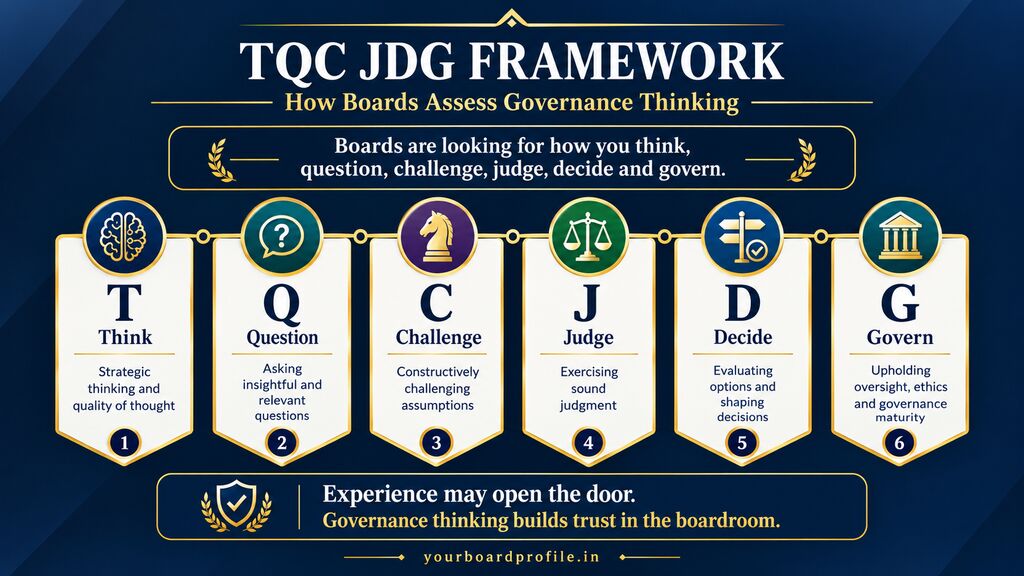
The image accompanying this article presents the TQC JDG Framework: Think, Question, Challenge, Judge, Decide and Govern. It offers a useful way to understand the mental journey an effective director follows. The framework moves beyond technical knowledge and focuses on the quality of thinking behind boardroom interventions. This is particularly relevant for senior executives and CXOs transitioning from an operating role to a governance role because the two environments require different forms of contribution.
The legal framework reinforces this distinction. Schedule IV of the Companies Act, 2013 expects independent directors to exercise objective and constructive judgment, devote sufficient time and attention to their responsibilities, safeguard stakeholder interests and contribute to good corporate governance. It also specifically refers to independent judgment in matters such as strategy, performance, risk management, resources, key appointments and standards of conduct.
For listed companies, SEBI’s current LODR Regulations, last amended on July 14, 2026, provide an additional governance framework covering areas such as board responsibilities, independent-director evaluation, information flow, risk management and board effectiveness.
So, if you are asking how to become an Independent Director in India, the question should not stop at eligibility. A more useful question is: Are you developing the governance thinking that a board can rely upon?
Table of Contents
The TQC JDG Framework for Independent Directors
The TQC JDG framework for board governance can be viewed as a practical six-stage model of boardroom thinking. It begins with Think and ends with Govern, creating a progression from cognitive ability to governance responsibility. This is important because an Independent Director is not expected to replicate the role of the CEO or operating executive. The board’s responsibility is different: it provides oversight, strategic guidance, challenge, judgment and accountability while management remains responsible for running the business.
The framework also explains why boardroom conversations can feel different from executive meetings. In an operating role, a leader may be rewarded for moving quickly from problem to solution. At board level, the quality of the process matters just as much as the speed of the decision. Directors need to understand the context, test assumptions, identify consequences, consider stakeholders and then exercise independent judgment. SEBI’s board-governance framework similarly emphasizes strategic guidance, effective monitoring, informed decision-making, ethical standards and objective independent judgment.
The six dimensions are therefore not six isolated skills. They work like links in a chain: Think → Question → Challenge → Judge → Decide → Govern. If one link is weak, the quality of governance can suffer.
Think — Strategic Thinking for Directors
The first governance aptitude is the ability to think beyond the immediate business issue. Senior executives often have deep functional expertise, but a board requires a wider lens. A CFO may naturally focus on financial sustainability, a technology leader on digital transformation, an HR leader on talent, and a marketing leader on customers and brand. An effective director must connect these perspectives and ask how they collectively influence enterprise value, resilience and stakeholder interests.
Strategic thinking for directors means seeing the second- and third-order effects of a decision. Consider a company planning a major acquisition. Management may present projected revenue synergies, integration costs and expected returns. A board-level thinker should also consider cultural integration, leadership bandwidth, regulatory exposure, customer concentration, capital allocation, technology integration and what could happen if the assumptions behind the transaction prove wrong.
This is why professional experience becomes more valuable when it is translated into board-level thinking rather than simply presented as a list of achievements. Schedule IV specifically describes the independent director’s role as bringing independent judgment to board deliberations, particularly around strategy, performance, risk management, resources, key appointments and standards of conduct.
Question — Asking Better Boardroom Questions
Good directors do not ask questions merely to demonstrate that they are knowledgeable. They ask questions to improve the quality of the board’s understanding. A question such as “What is the revenue target?” may be useful, but a governance-oriented question could be “What assumptions must remain true for this revenue target to be achievable, and which of those assumptions are most vulnerable?”
That difference is significant. The first question requests information; the second tests the quality of management’s thinking. The ability to ask such questions is one of the most practical boardroom readiness skills in India because board papers rarely contain every insight required for a decision. Directors have to identify gaps, inconsistencies, dependencies and emerging risks.
An aspiring Independent Director can develop this skill by reading annual reports, investor presentations, risk disclosures and board-level case studies and then writing five questions before attempting to form an opinion. The discipline changes the mindset from “What do I think about this?” to “What does the board need to understand before deciding?”
Challenge — Constructively Testing Assumptions
Challenge is often misunderstood. A director who challenges everything is not necessarily demonstrating strong governance. Effective challenge is constructive, evidence-based and relevant to the company’s interests. The objective is not to defeat management’s proposal; it is to ensure that the board understands the proposal sufficiently before supporting, modifying or rejecting it.
Imagine management proposes entering a new international market. A weak challenge might simply be, “I don’t think this will work.” A stronger intervention could be: “The growth opportunity appears attractive, but what assumptions have been made about regulatory approvals, local competition and working-capital requirements? What is our contingency if the market takes twice as long to reach break-even?”
That is governance thinking in practice. SEBI’s board framework specifically recognizes the importance of the board being able to step back and challenge assumptions underlying strategy, strategic initiatives, risk appetite and exposures.
For an Independent Director, challenge must also remain independent. The objective is neither to become management’s opponent nor its supporter. The director’s value lies in providing a perspective that management may not naturally have.
Judge — Exercising Sound Judgment in Boardrooms
Judgment is where experience, information, ethics and context meet. A board rarely operates with perfect information. Directors may face incomplete data, conflicting stakeholder interests, uncertain market conditions and decisions where every option carries some degree of risk.
Exercising sound judgment in boardrooms therefore requires more than intelligence or industry knowledge. It requires understanding what information is material, recognizing what remains uncertain, distinguishing manageable risk from unacceptable risk, and considering whether the proposed course of action is consistent with the company’s long-term interests.
Schedule IV requires independent directors to act objectively and constructively, devote sufficient attention to their professional obligations and avoid extraneous considerations that could compromise independent judgment.
Judgment also involves knowing when to say, “I need more information before I can support this.” That sentence can be more valuable than a confident opinion formed too quickly. In governance, disciplined uncertainty is often preferable to false certainty.
Decide — Turning Analysis into Board Decisions
The boardroom is not a seminar. Eventually, directors have to make decisions. Once the relevant facts, risks, alternatives and stakeholder implications have been considered, the board must determine an appropriate course of action.
For an Independent Director, decision-making requires balancing different interests without losing sight of fiduciary responsibilities. A decision may benefit shareholders in the short term but create material long-term risk. Another may involve near-term expenditure but strengthen resilience. A third may be commercially attractive but create an unacceptable conflict of interest.
The quality of the decision depends partly on the quality of the discussion preceding it. This is why preparation matters so much. Directors who arrive having read the board papers, understood the business context and identified their questions can participate meaningfully rather than reacting to presentations in real time.
The Companies Act framework expects independent directors to bring an independent judgment to board deliberations and to safeguard stakeholder interests, while listed-company governance requirements also emphasize informed decision-making and oversight.
Govern — From Decision-Making to Oversight
The final letter in the framework is G — Govern. Governance is not a single decision; it is the continuing discipline of ensuring that the organization is being directed and overseen appropriately.
This means asking whether agreed strategic priorities are being executed, whether risks are being monitored, whether management information is reliable, whether internal controls remain effective and whether the board receives the information it needs. It also means paying attention to culture, succession, ethics, stakeholder interests and the quality of the relationship between the board and management.
SEBI’s framework requires independent directors of listed entities to have a separate meeting at least once in a financial year without non-independent directors and management, and those directors review matters including board performance and the quality, quantity and timeliness of information flowing from management to the board.
That last point is especially important. Information quality is governance quality. A director cannot exercise meaningful oversight if the information reaching the board is incomplete, excessively technical, delayed or presented without sufficient context.
How Boards Assess Governance Thinking
So, how boards assess governance thinking in practice? There is no single universal interview question or one standardized scorecard applicable to every board. However, formal board evaluation frameworks and corporate governance disclosures commonly look at areas such as preparation, participation, independent judgment, effectiveness, board processes, information flow, risk, governance and board dynamics.
For example, disclosed evaluation criteria from companies can include qualifications and experience, board composition, board processes, information flow, board culture, relationships between board and management, discussion and dissent, corporate culture and values, governance, compliance and risk evaluation.
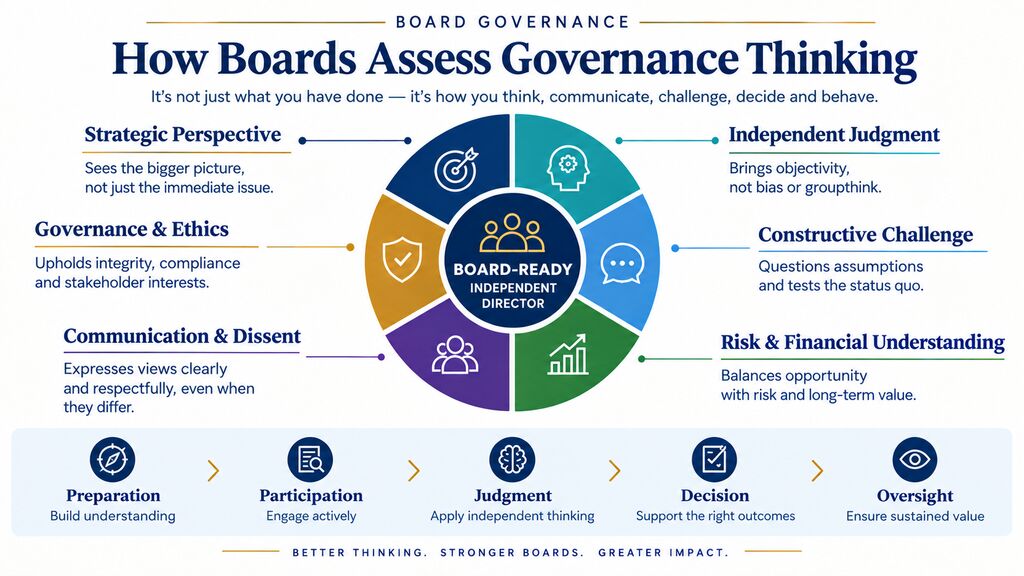
This provides an important clue for aspiring directors: board readiness is multidimensional. A strong professional reputation may establish credibility, but governance competence is demonstrated through how a person thinks, communicates, challenges, decides and behaves in the boardroom.
Strategic Thinking and Board-Level Perspective
A board does not need another executive presenting an operational dashboard. It needs directors capable of seeing patterns across the dashboard.
A senior executive preparing for an Independent Director role should therefore learn to move from functional questions to enterprise questions. Instead of asking only “Are we achieving the sales target?”, consider “Is the growth economically attractive, sustainable and consistent with the company’s risk appetite?” Instead of asking only “Are we hiring enough technology talent?”, ask “What capabilities will the business need three years from now, and what could prevent us from building them?”
This shift from functional expertise to enterprise perspective is central to governance aptitude and skills. Your professional background remains important, but the board needs to understand how that background can improve collective judgment.
Infosys, for example, has publicly described independent-director performance indicators that include contributing to and monitoring corporate governance, introducing relevant best practices, participating in long-term strategic planning and fulfilling fiduciary responsibilities.
Exercising Sound Judgment Under Uncertainty
Board decisions often involve uncertainty rather than complete answers. A director may need to evaluate a major investment when economic conditions are changing, consider a technology strategy when the technology itself is evolving, or review a succession plan when the organization is entering a new phase.
The practical skill is not predicting the future perfectly. It is understanding the assumptions behind a decision and ensuring that the board has considered plausible downside scenarios. This is one reason why independent director evaluation criteria increasingly need to be understood as more than attendance and participation.
The quality of judgment can be demonstrated through questions such as:
- What evidence supports the recommendation?
- Which assumptions are most critical?
- What could invalidate the business case?
- What risks are difficult to reverse?
- What information would change our decision?
- What happens if the expected outcome does not materialize?
- Are we considering the interests of affected stakeholders?
- Is there any conflict that could compromise objectivity?
These questions do not guarantee a correct decision. They improve the decision-making process.
Financial, Risk and Stakeholder Understanding
Not every Independent Director needs to be a finance professional, but every director needs sufficient financial literacy to understand the implications of board decisions. The ability to read financial statements, understand cash flow, identify material risks and question unusual movements is increasingly part of effective board participation.
The Companies Act’s Schedule IV specifically expects independent directors to satisfy themselves regarding the integrity of financial information and the robustness of financial controls and risk-management systems.
Risk thinking should also extend beyond financial risk. Cybersecurity, regulatory changes, reputation, succession, supply chains, technology dependence, climate-related exposure and stakeholder expectations can all influence enterprise resilience. A governance-oriented director does not necessarily become the subject-matter expert in every area. Instead, the director knows when deeper expertise is required and whether management has appropriate systems, controls and accountability around the issue.
Building Governance Aptitude and Skills
The transition from executive leadership to board leadership is a change in operating system. In management, the question is often “How do we execute this?” In governance, the question may be “Should we do this, under what conditions, with what safeguards, and how will the board know whether the decision remains appropriate?”
That shift can be deliberately developed. Aspiring directors can study the Companies Act and SEBI requirements, participate in director-development programmes, analyse real board cases, practice board-paper reviews and conduct simulated board discussions. The Indian Institute of Corporate Affairs ecosystem and Independent Directors Databank were created in part to support knowledge development, capacity building and assessment of understanding around corporate governance and board practices.
The development process should also include self-assessment. Ask yourself whether your professional story demonstrates only what you achieved as an executive or whether it also demonstrates how your experience could contribute to strategy, oversight, risk, governance, stakeholder management and independent judgment.
Communication, Dissent and Boardroom Influence
A boardroom is a high-context environment. Directors may disagree strongly while maintaining professional relationships. Therefore, boardroom communication is not about speaking the most; it is about adding the most useful perspective at the right time.
Constructive dissent is an important part of this. Schedule IV emphasizes objective and constructive conduct and independent judgment. A director who disagrees should be able to explain why, identify the evidence supporting the concern and remain open to information that could change the position.
The language used matters. Compare “This proposal is wrong” with “I understand the strategic rationale, but I would like us to examine the downside case before we approve it.” The second formulation does not weaken the challenge. It makes the challenge easier for the board to consider.
This is particularly important for senior executives who are accustomed to having decision-making authority. On a board, influence comes less from hierarchy and more from credibility, preparation, judgment and the ability to frame important questions.
Independence, Ethics and Objectivity
Independence is more than a legal status. It is also a behavioral discipline.
A director may formally satisfy independence requirements and still need to consciously protect objectivity in every board interaction. Personal relationships, professional history, commercial interests, loyalty to a particular executive or attachment to a previous strategic position can all affect how an issue is perceived. The legal framework addresses objective conditions of independence, while the director’s professional responsibility requires independent judgment in practice.
For aspiring Independent Directors, this means building a reputation for integrity before receiving a board appointment. The boardroom does not begin when the appointment letter arrives. It begins with how a professional handles conflicts, confidential information, difficult conversations, professional disagreements and accountability throughout their career.
SEBI’s current framework also requires independent directors of listed entities to provide declarations concerning their independence and their ability to discharge duties with objective independent judgment without external influence.
Governance Competency Framework for Aspiring Independent Directors
The TQC JDG framework can be converted into a practical development map for senior professionals.
| TQC JDG dimension | What the board needs to see | Skill to develop | Practical preparation |
| Think | Enterprise-level perspective | Strategic thinking | Analyse business models and long-term trends |
| Question | Relevant, insightful questions | Curiosity and analytical thinking | Prepare questions before reviewing a case |
| Challenge | Constructive testing of assumptions | Critical thinking | Identify risks, alternatives and weak assumptions |
| Judge | Balanced independent judgment | Decision quality | Practise evaluating incomplete information |
| Decide | Clear, reasoned board contribution | Decision-making | Compare options and consequences |
| Govern | Consistent oversight | Governance maturity | Study controls, risk, ethics and stakeholder issues |
This framework can also help reshape a board-ready CV. Instead of presenting only functional achievements, senior professionals can demonstrate situations where they managed ambiguity, challenged strategic assumptions, handled stakeholders, improved controls, navigated risk or influenced important decisions.
That distinction matters because board recruiters and Nomination and Remuneration Committees are not simply looking for successful executives. They are looking for people whose experience is relevant to the governance needs of a particular organization. SEBI’s board-evaluation guidance recognizes evaluation of the board, individual directors and committees and highlights criteria, feedback, action plans and periodic review as important components of effective evaluation.
If you are building your board profile, you can explore board profile and portfolio examples and review board-focused services for senior professionals to understand how executive experience can be translated into a clearer boardroom narrative.
You can also continue the series through How to Become an Independent Director in India – Part 2, Part 3 and Part 4, which build on different dimensions of the Independent Director journey.
For regulatory reading, the Companies Act, 2013 provides the statutory foundation, while SEBI’s LODR Regulations, updated July 2026 provide the current listed-company framework. The SEBI Master Circular on LODR compliance also contains guidance concerning board evaluation.
The ICSI Independent Directors resources provide another useful professional reference point, including guidance on Independent Directors and board meetings.
Conclusion
The journey to becoming an Independent Director in India is ultimately a journey from executive capability to governance capability. Your career achievements may demonstrate that you can lead a function, manage people, build businesses or deliver transformation. But the boardroom asks a different question: Can you exercise independent, informed and constructive judgment in the collective interest of the company and its stakeholders?
The TQC JDG Framework — Think, Question, Challenge, Judge, Decide and Govern — provides a practical way to develop that capability. It reminds aspiring directors that governance is not about having an opinion on everything. It is about knowing what to ask, what to challenge, when to seek more information, how to evaluate competing interests and when to exercise independent judgment.
For senior executives and CXOs, the next step is therefore not simply adding “Independent Director” to a career aspiration. It is building evidence of governance aptitude and skills. Strengthen your understanding of corporate governance, financial information, risk, stakeholder interests, board processes and regulatory expectations. At the same time, work on the less visible capabilities: listening, questioning, constructive dissent, judgment, ethical courage and the ability to see beyond your own functional lens.
Experience may open the door. Governance thinking builds trust in the boardroom.
If you are preparing for a board-level transition, start by assessing whether your current professional narrative demonstrates the six TQC JDG capabilities. Your next board opportunity may depend not only on what you have achieved, but on how clearly you can demonstrate the governance value you can bring to the table.
For more resources, explore the Your Board Profile blog and learn more about Independent Director governance in India. You can also read about the broader shift from executive leadership to Independent Director governance.
Frequently Asked Questions
1. What skills are important for an Independent Director in India?
Important skills include strategic thinking, financial literacy, risk awareness, independent judgment, questioning ability, constructive challenge, stakeholder understanding, ethical decision-making and boardroom communication. The Companies Act specifically expects independent directors to exercise objective and constructive judgment and contribute to areas such as strategy, risk management, performance and governance.
2. What is the TQC JDG Framework?
The TQC JDG Framework stands for Think, Question, Challenge, Judge, Decide and Govern. It is a practical framework for understanding how governance thinking can progress from analysing an issue to exercising oversight after a board decision.
3. How do boards assess governance thinking?
Board evaluation can consider areas such as preparation, participation, independent judgment, effectiveness, information flow, board processes, risk, governance, culture, discussion and dissent. Specific evaluation criteria vary between organizations.
4. Is strategic thinking important for an Independent Director?
Yes. Independent directors are expected to bring independent judgment to board deliberations, including strategy, performance, risk management and resources. Strategic thinking enables a director to look beyond operational details and understand longer-term consequences.
5. What does constructive challenge mean in a boardroom?
Constructive challenge means testing management’s assumptions, evidence, alternatives and risks without turning disagreement into personal confrontation. The objective is to improve the quality of the board’s decision-making.
6. Does an Independent Director need financial expertise?
Not every Independent Director needs to be a finance specialist, but directors need sufficient financial understanding to evaluate financial information, controls and risks. Schedule IV specifically refers to satisfying oneself regarding the integrity of financial information and the robustness of financial controls and risk-management systems.
7. Why is independent judgment important for directors?
Independent judgment helps directors evaluate proposals objectively rather than simply accepting management recommendations or external pressure. Both the Companies Act framework and SEBI’s listed-company framework emphasize objective independent judgment.
8. What is boardroom readiness?
Boardroom readiness is the combination of knowledge, judgment, governance understanding, communication ability, strategic perspective and professional conduct required to contribute effectively at board level.
9. Can a CXO become an Independent Director?
A CXO can pursue an Independent Director role if the individual meets the applicable legal and eligibility requirements and can demonstrate relevant governance capability. Executive experience can provide valuable expertise, but it needs to be translated into board-level contribution.
10. How can senior executives improve governance aptitude?
Senior executives can study corporate governance frameworks, analyse annual reports and board cases, practise board-level questioning, develop financial and risk literacy, participate in director-development programmes and seek opportunities to understand board processes.
11. What is the difference between executive leadership and board leadership?
Executive leadership focuses heavily on execution and operational accountability. Board leadership focuses on oversight, strategic guidance, risk, accountability, governance and independent judgment while management remains responsible for running the organization.
12. Why is questioning important for an Independent Director?
Questions help directors identify missing information, challenge assumptions and understand the potential consequences of a proposal. The quality of the question can materially improve the quality of the board discussion.
13. How can an Independent Director handle disagreement with management?
A director can express disagreement using evidence, questions and alternative perspectives while maintaining professional conduct. The objective is to protect the quality of board deliberation rather than win an argument.
14. Does board evaluation measure an individual Independent Director?
Yes. Applicable governance frameworks provide for evaluation of individual directors, including Independent Directors. Under SEBI’s LODR framework, the performance evaluation of Independent Directors is undertaken by the entire board, with the directors being evaluated not participating in their own evaluation.
15. How can I build a board-ready profile?
Begin by identifying your strongest governance-relevant capabilities: strategic expertise, risk understanding, financial knowledge, stakeholder management, transformation experience, ethics, leadership and independent judgment. Then convert those experiences into a board-focused narrative that explains what governance value you can bring, rather than simply listing your executive responsibilities.
Ready to Strengthen Your Governance Aptitude for the Independent Director Journey?
Your professional experience can become meaningful boardroom value when it is supported by the ability to think strategically, ask insightful questions, challenge assumptions, exercise sound judgment, make informed decisions, and govern with independence.
Becoming board-ready is not just about your years of experience or professional achievements. It is about developing the governance aptitude and skills that help you contribute with confidence, credibility, and an independent perspective in the boardroom.
Whether you are a CXO, senior executive, entrepreneur, or aspiring Independent Director, take the time to assess your strategic thinking, governance understanding, financial awareness, questioning ability, decision-making, and boardroom communication.
Don’t wait for a board appointment to develop your governance capabilities. Start building your board readiness today and learn how to translate your executive experience into credible, governance-focused boardroom value.
Schedule your complimentary session here:
https://calendly.com/dramitnagpal
Share this post: Facebook | X | LinkedIn