

Many senior executives believe that visibility is the key to securing board appointments. They focus on speaking at conferences, posting regularly on LinkedIn, appearing in media interviews, and building an impressive public profile. Visibility certainly helps. It creates awareness and opens doors. But visibility alone rarely earns a board seat.
Think about it from the perspective of a board. When directors appoint a new board member, they are not hiring a marketer or selecting a keynote speaker. They are choosing someone who will influence strategic decisions, oversee governance, manage risk, and protect stakeholder interests. The stakes are simply too high for popularity to be the deciding factor.
This is why board seats are often awarded to professionals who may not be the most visible people in the room but are unquestionably the most trusted. Their reputation for integrity, judgment, independence, and governance maturity makes them attractive candidates for board positions.
If you aspire to serve on a corporate board, understanding this distinction can change your entire approach to board readiness and executive branding.
Table of Contents
- Why Visibility Alone Does Not Secure Board Seats
- The Trust Equation Behind Board Appointments
- What Boards Actually Look For in Candidates
- Visibility vs Trustworthiness
- The Role of Reputation Capital
- How Trust Is Built Over Time
- Strategic Personal Branding for Board Aspirants
- The Hidden Signals Boards Evaluate
- Building a Board-Ready Reputation
- Conclusion
- FAQs
Why Visibility Alone Does Not Secure Board Seats
Visibility is often misunderstood in the boardroom context. Being known and being trusted are two very different things.
A professional may have thousands of LinkedIn followers, frequent media appearances, and a strong online presence. Yet when a Nomination and Remuneration Committee evaluates candidates, social visibility is rarely the primary consideration. The committee wants evidence that the individual can exercise sound judgment, remain objective under pressure, and contribute meaningfully to governance discussions.
The reality is that many board appointments happen quietly. They occur through recommendations, trusted networks, governance circles, and long-standing professional relationships. Board members often ask themselves a simple question before recommending a candidate: “Would I trust this person with a critical decision affecting the future of the company?”
That question cannot be answered through visibility alone.
The Trust Equation Behind Board Appointments
Trust in the boardroom is not built overnight. It is the result of years of professional conduct, ethical decision-making, leadership consistency, and demonstrated expertise.
When organizations evaluate potential directors, they are assessing a combination of factors that collectively create trust.
| Factor | Why It Matters |
| Integrity | Ensures ethical decision-making |
| Governance Knowledge | Supports effective board oversight |
| Industry Expertise | Adds strategic value |
| Independence | Protects stakeholder interests |
| Judgment | Improves decision quality |
| Reputation | Reflects long-term credibility |
A candidate who consistently demonstrates these qualities develops what can be called “boardroom trust capital.” This trust capital often becomes far more valuable than public visibility when board opportunities emerge.
Professionals who stay aligned with governance expectations outlined by the Ministry of Corporate Affairs (MCA) are often better prepared for board responsibilities.
What Boards Actually Look For in Candidates
Governance Maturity
One of the strongest indicators of board readiness is governance maturity. Boards want individuals who understand oversight, accountability, fiduciary duties, and stakeholder responsibility.
They are looking for professionals who can balance growth ambitions with risk management and governance discipline.
Many aspiring directors focus heavily on operational achievements while overlooking governance capabilities. Yet governance maturity often becomes the differentiating factor between a successful executive and a successful board member.
Independent Thinking
Boards value individuals who can challenge assumptions respectfully and constructively.
An independent director is not expected to agree with management at all times. Instead, they are expected to provide objective viewpoints that improve decision-making quality.
This ability requires confidence, critical thinking, and emotional intelligence. Directors must know when to support a proposal and when to ask difficult questions.
Reputation and Character
Professional reputation travels faster than most executives realize.
Board committees often conduct extensive reference checks, informal conversations, and background reviews before making appointments. They want reassurance that a candidate’s character aligns with the organization’s values and governance expectations.
A strong reputation becomes a silent advocate long before formal interviews begin.
Insights from Harvard Business Review (HBR) frequently highlight the growing importance of board effectiveness and leadership judgment.
Visibility vs Trustworthiness
Many professionals assume visibility automatically creates opportunities. Sometimes it does. However, visibility without credibility can create skepticism rather than confidence.
Consider the following comparison:
| Visibility | Trustworthiness |
| Creates awareness | Creates confidence |
| Attracts attention | Earns recommendations |
| Builds recognition | Builds credibility |
| Opens conversations | Opens board opportunities |
| Can be achieved quickly | Requires time and consistency |
The most successful board candidates understand that visibility should support trustworthiness, not replace it.
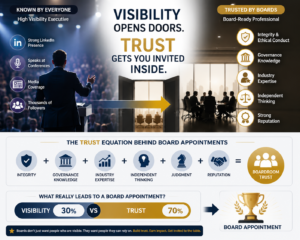
A visible executive with low trust capital will struggle to secure meaningful board appointments. A trusted executive with moderate visibility often receives opportunities through referrals and professional networks.
The Role of Reputation Capital
Every executive accumulates what can be called reputation capital throughout their career.
This capital is built through:
- Ethical leadership
- Consistent performance
- Professional relationships
- Governance involvement
- Industry contributions
- Thoughtful decision-making
Reputation capital functions much like financial capital. It grows through consistent investment and can be damaged through poor decisions.
When board opportunities arise, organizations frequently rely on reputation capital as a proxy for future behavior. Past conduct becomes an indicator of how a candidate may perform as a director.
That is why seasoned board members often say that your reputation enters the boardroom before you do.
If you are actively preparing for board opportunities, consider evaluating whether your current executive profile reflects board-level credibility or merely professional visibility. Building a board-focused personal brand can significantly strengthen long-term board readiness.
For more insights on executive positioning and governance-focused branding, explore resources available on Your Board Profile.
How Trust Is Built Over Time
Trust is rarely created through a single achievement. Instead, it develops through consistent actions over many years.
Think about the executives you trust most. Chances are, you trust them because they repeatedly demonstrated integrity, delivered results, respected commitments, and handled challenges responsibly. The same principle applies to board appointments.
Board members observe how professionals behave during difficult situations. They notice whether an executive accepts accountability, manages stakeholder relationships effectively, and demonstrates sound judgment during periods of uncertainty.
Trust is also reinforced through governance involvement. Serving on advisory boards, industry associations, nonprofit boards, or governance committees can provide valuable opportunities to demonstrate board-level capabilities before securing a formal corporate board position.
The professionals who eventually secure the best board seats are often those who spent years quietly building credibility long before they started pursuing board opportunities.
Many executives strengthen their governance capabilities through programs offered by the Indian Institute of Corporate Affairs (IICA).
Strategic Personal Branding for Board Aspirants
Visibility Should Support Trust
Personal branding remains important. However, many executives approach personal branding incorrectly.
The goal is not to become famous. The goal is to become trusted.
Board-focused personal branding should communicate:
- Governance awareness
- Strategic thinking
- Industry expertise
- Ethical leadership
- Risk management understanding
- Stakeholder sensitivity
Every article, LinkedIn post, speaking engagement, and interview should reinforce these attributes.
Become Known for Something Specific
Generalists often struggle to differentiate themselves.
Boards increasingly seek expertise in areas such as:
- ESG and Sustainability
- Artificial Intelligence
- Cybersecurity
- Digital Transformation
- Risk Management
- Corporate Governance
- Regulatory Affairs
Professionals who develop recognized expertise in one or more of these areas often create stronger board positioning.
If someone asks, “What is this executive known for?” the answer should be clear and memorable.
For additional perspectives on executive branding and board positioning, readers may explore Executive Brand Strategy for Board Roles
The Hidden Signals Boards Evaluate
Many aspiring directors focus exclusively on qualifications and certifications. While these matter, boards often evaluate less obvious factors.
Executive Presence
Executive presence is not about appearance or confidence alone.
It reflects how effectively an individual communicates, influences discussions, manages disagreements, and demonstrates leadership maturity.
Directors must often navigate complex conversations involving investors, regulators, management teams, and stakeholders.
Boards therefore pay close attention to communication style and interpersonal effectiveness.
Judgment Under Pressure
Corporate boards frequently face difficult decisions.
Whether dealing with cybersecurity incidents, regulatory scrutiny, market disruptions, or governance challenges, directors must exercise sound judgment under pressure.
Past experiences often provide evidence of how a candidate may respond in future situations.
Commitment to Governance
Strong candidates demonstrate genuine interest in governance.
They invest time in learning governance frameworks, understanding regulatory expectations, and participating in governance-related initiatives.
This commitment signals long-term seriousness about board service rather than short-term career advancement.
Recent perspectives published through PwC Governance Insights show that boards increasingly focus on risk oversight and stakeholder accountability.
Building a Board-Ready Reputation
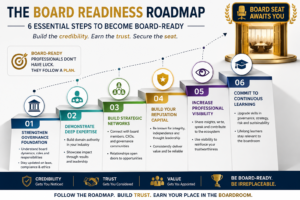
Creating a board-ready reputation requires intentional effort.
The following framework can help aspiring directors focus on the areas that matter most:
| Area | Key Action |
| Governance | Build governance knowledge and certifications |
| Expertise | Develop a recognized niche |
| Networking | Build relationships within governance circles |
| Reputation | Maintain integrity and professionalism |
| Visibility | Share relevant insights consistently |
| Learning | Stay updated on emerging board trends |
Notice that visibility appears on the list, but it is only one component.
Trust remains the foundation that connects every element.
Research available through Deloitte Governance Resources highlights how board expectations continue to evolve in a rapidly changing business environment.
Executives who focus solely on visibility may gain attention. Executives who combine visibility with credibility, expertise, and governance maturity are more likely to gain board appointments.
Conclusion
The pursuit of board seats often begins with a simple misconception: that visibility is the ultimate advantage.
In reality, boards rarely appoint directors based on popularity. They appoint individuals they trust to guide strategy, oversee risk, uphold governance standards, and protect stakeholder interests.
Visibility can help people discover you. Trust determines whether they recommend you.
For senior executives, aspiring directors, and board candidates, the path forward is clear. Invest in governance expertise. Build meaningful professional relationships. Develop a strong reputation. Demonstrate integrity consistently. Create a personal brand that reflects boardroom readiness rather than personal promotion.
The professionals who ultimately secure the most meaningful board seats are rarely those chasing attention. They are the ones earning trust.
If you are preparing for board opportunities and want to strengthen your board profile, governance positioning, or executive brand, now is the right time to invest in building long-term boardroom credibility.
FAQs
- Why are board seats based on trust rather than visibility?
Because directors are responsible for governance, oversight, and strategic decisions that require credibility and sound judgment.
- Do board seats require prior board experience?
Not always, but governance exposure and leadership experience can strengthen your candidacy.
- What qualities do boards value most in candidates?
Integrity, expertise, independence, judgment, and governance awareness.
- Can personal branding help secure board seats?
Yes, when it supports credibility and professional trust rather than self-promotion.
- How important is networking for board appointments?
Networking is often a significant factor because many board opportunities arise through trusted relationships.
- Are certifications necessary for board positions?
Certifications can help demonstrate governance knowledge but are rarely the sole deciding factor.
- What industries currently need more board expertise?
Technology, cybersecurity, ESG, digital transformation, and risk management are in high demand.
- How can executives build boardroom credibility?
By demonstrating expertise, ethical leadership, governance understanding, and consistent professional conduct.
- What is reputation capital?
It is the trust and credibility accumulated through years of professional behavior and leadership.
- Do boards review a candidate’s online presence?
Yes, many organizations assess digital reputation alongside professional achievements.
- How long does it take to become board-ready?
For most executives, building a strong board profile is a multi-year process.
- Can startup founders become board directors?
Yes, provided they bring relevant expertise and governance maturity.
- Why is independent thinking important in the boardroom?
It helps improve decision quality and strengthens governance oversight.
- What role does governance knowledge play in board appointments?
Governance knowledge helps directors fulfill their oversight and fiduciary responsibilities effectively.
- What is the biggest mistake aspiring board directors make?
Focusing only on visibility while neglecting trust, reputation, and governance readiness.