
Introduction
Independent Director Roles and Responsibilities: Why Great Directors Are Edgewalkers
Corporate boardrooms are changing faster than ever. Regulators are tightening governance expectations, investors are questioning oversight quality, and stakeholders are demanding accountability beyond financial performance. In this environment, the Independent Director Roles and Responsibilities have evolved from symbolic oversight to strategic leadership, governance influence, and long-term stakeholder protection.
A strong Independent Director is not simply someone who attends meetings and approves resolutions. The real value of an Independent Director lies in their ability to challenge management constructively, protect long-term institutional interests, and strengthen governance without creating unnecessary conflict. That balancing act is what makes great directors “edgewalkers.”
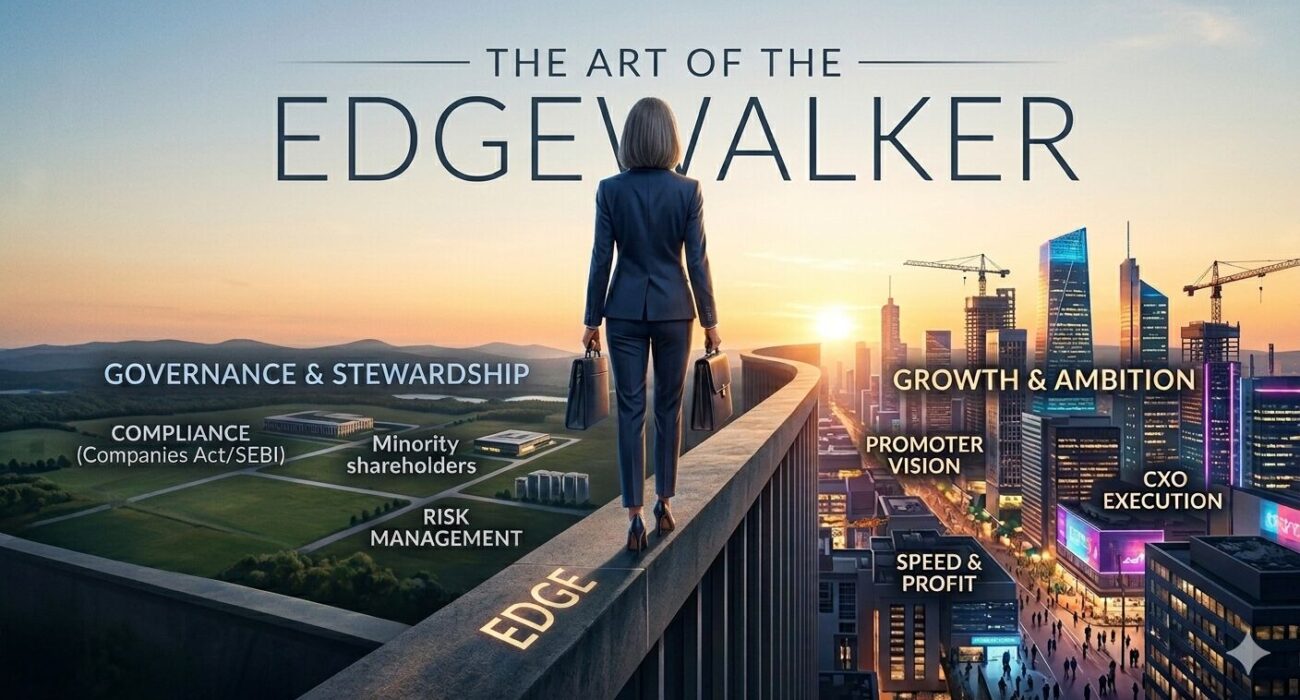
Think about a tightrope walker balancing high above the ground. Lean too far on one side, and the system loses stability. Lean too far on the other, and influence disappears completely. Independent Directors face a similar challenge. They must remain close enough to management to understand the business deeply, yet independent enough to question assumptions, identify blind spots, and raise difficult governance concerns.
This article explores the evolving nature of Independent Director roles and responsibilities, the growing importance of constructive challenge in the boardroom, and how modern governance leaders can create influence without becoming disruptive. Whether you are a CXO preparing for a board role, a sitting Independent Director, or a promoter-led company strengthening governance maturity, this guide offers practical insights grounded in today’s Indian governance landscape.
Table of Contents
- Why Independent Directors Matter More Than Ever
- The Edgewalker Philosophy in Modern Boardrooms
- Independent Director Roles and Responsibilities Under Indian Law
- The EDGE Framework for Effective Governance
- Constructive Challenge in the Boardroom
- Managing Governance in Promoter-Led Companies
- The Language of High-Influence Directors
- Common Mistakes Independent Directors Make
- Strategic Checklist for Boardroom Success
- How CXOs Can Transition into Board Roles
- Conclusion
- FAQs
Why Independent Directors Matter More Than Ever
The growing importance of Independent Director Roles and Responsibilities reflects how modern governance now depends on constructive boardroom oversight rather than passive participation. Corporate governance used to be viewed as a defensive mechanism. Today, it has become a strategic advantage. Investors increasingly evaluate governance quality before making long-term decisions, and regulators are strengthening accountability frameworks for listed companies. Recent discussions from SEBI and Indian governance experts have emphasized that effective Independent Directors are critical to closing governance gaps in Indian corporations.
The modern boardroom is no longer just a place where approvals happen. It is where difficult questions must be asked before risks become crises. Independent Directors play a central role in that process. They provide an external perspective that management teams often lack because executives are deeply involved in operational execution. This external perspective becomes especially valuable when companies face aggressive expansion plans, succession transitions, regulatory scrutiny, or stakeholder conflicts.
The pressure on boards has also increased because corporate failures are now amplified instantly through media coverage, social media conversations, and investor activism. One weak governance decision can destroy years of institutional trust. That is why boards increasingly need directors who can challenge assumptions intelligently rather than simply agreeing with dominant voices inside the room.
This shift has transformed the Independent Director roles and responsibilities from passive oversight to active governance leadership. Modern boards expect Independent Directors to contribute strategic thinking, governance maturity, risk awareness, and balanced judgment — not ceremonial participation.
Modern boards need directors who can:
- Ask difficult questions
- Identify blind spots early
- Balance ambition with discipline
- Protect minority shareholders
- Strengthen governance culture
- Improve decision quality without damaging trust
In many companies, especially promoter-led businesses, management teams can become emotionally invested in their own strategy. Optimism increases. Internal assumptions go unchallenged. Growth narratives dominate discussions.
That is where Independent Directors create value.
They shift the room from presentation mode to reflection mode.

The Edgewalker Philosophy in Modern Boardrooms
The concept of the “edgewalker” perfectly describes how effective Independent Directors operate. They do not sit comfortably inside consensus, nor do they isolate themselves from management completely. Instead, they work on the edge between challenge and support.
Imagine a board meeting where management presents a highly optimistic expansion strategy. Revenue projections look attractive. Market demand appears strong. The promoter is enthusiastic. Most directors are ready to approve the proposal immediately. Then one Independent Director calmly asks, “Which assumption in this strategy creates the highest downside risk if it fails?”
That single question changes the room.
The conversation shifts from excitement to examination. Nobody feels attacked, yet everyone begins thinking more critically. This is what great governance looks like. It is not loud confrontation. It is thoughtful intervention.
Strong Independent Directors understand that governance influence comes from timing, language, and credibility. Challenging every issue creates resistance. Challenging nothing destroys relevance. The best directors know how to identify the one issue that matters most in a particular meeting and focus the board’s attention there.
This is also why silence has become dangerous in modern governance. A director who avoids difficult conversations may preserve temporary harmony, but they increase long-term institutional risk. Regulators, investors, and stakeholders increasingly expect directors to demonstrate independent judgment rather than passive agreement.
The best Independent Directors know:
- Which issue matters most
- When to raise concern
- How to frame challenge intelligently
- How to protect governance without triggering unnecessary defensiveness
This is the essence of constructive challenge in the boardroom.
Independent Director Roles and Responsibilities Under Indian Law
The legal framework in India clearly supports the active role of Independent Directors. Under Schedule IV of the Companies Act, 2013, Independent Directors are expected to bring objective judgment to board deliberations, particularly on strategy, risk management, performance evaluation, ethical conduct, and stakeholder protection. Under Indian corporate law, the scope of Independent Director Roles and Responsibilities extends far beyond compliance monitoring.
The law specifically states that Independent Directors should:
- Uphold integrity and probity
- Exercise objective judgment
- Safeguard stakeholder interests
- Monitor management performance
- Ensure robust financial controls
- Balance conflicting stakeholder concerns
This legal expectation fundamentally changes how Independent Directors should approach boardroom participation. The law does not expect them to be silent observers. It expects them to act as thoughtful challengers.
At the same time, SEBI LODR Regulations continue to strengthen governance obligations for listed entities. Recent amendments and governance discussions have emphasized compliance reviews, board effectiveness, and stronger oversight responsibilities.
The combination of Companies Act requirements and SEBI LODR regulations compliance has raised expectations for boardroom accountability across India. Independent Directors are now expected to evaluate not only whether decisions are legal, but whether they are strategically wise, ethically sound, and reputationally sustainable.
| Governance Area | Independent Director Responsibility |
| Strategy | Evaluate long-term sustainability |
| Risk Management | Identify downside exposure |
| Compliance | Monitor governance standards |
| Stakeholder Protection | Safeguard minority interests |
| Board Oversight | Ensure accountability |
| Ethics | Strengthen governance culture |
The EDGE Framework for Effective Governance
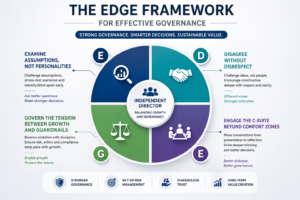
One practical way to understand modern governance leadership is through the EDGE Framework.
| EDGE Framework | Governance Meaning |
| E | Examine assumptions, not personalities |
| D | Disagree without disrespect |
| G | Govern the tension between growth and guardrails |
| E | Engage the C-Suite beyond comfort zones |
This framework reflects how influential Independent Directors strengthen governance without creating unnecessary friction.
The Edge Framework provides a practical model for effective governance leadership. This Framework simplifies how modern Independent Director Roles and Responsibilities should operate in high-stakes boardrooms.
Examine Assumptions, Not Personalities
Weak boardroom discussions often become personal. Strong governance discussions remain analytical. Instead of criticizing individuals, effective directors challenge assumptions.
For example, saying “Management has not thought this through” immediately creates defensiveness. But asking “What assumptions have we stress-tested here?” opens the door for reflection instead of resistance.
This distinction matters enormously in Indian promoter-led businesses where personal identity and business decisions are often deeply connected. Independent Directors who understand this dynamic can challenge effectively without damaging relationships.
Disagree Without Disrespect
One of the biggest misconceptions about independence is that it requires visible opposition. It does not. Independence requires clarity, courage, and composure.
A strong director might say:
“I support the strategic direction, but I would like deeper validation of the downside scenario.”
This language preserves boardroom trust while strengthening governance discipline. Influence grows when directors lower defensiveness and raise reflection.
Govern the Tension Between Growth and Governance
Promoters often focus on speed, ambition, and market opportunity. Management focuses on execution and performance metrics. Independent Directors must focus on sustainability, ethics, stakeholder trust, and long-term resilience.
This naturally creates tension inside boardrooms. But tension itself is not unhealthy. Poorly managed tension is the real danger.
Strong governance does not slow growth. It protects growth from avoidable damage.
Engage the C-Suite Beyond Comfort Zones
Management teams can become emotionally attached to their own strategies. They may underestimate external threats or overestimate internal capabilities. An effective Independent Director helps management move from presentation mode into reflection mode.
Questions like these create strategic value:
- What are we not seeing?
- What would competitors attack first?
- What part of this plan depends on perfect execution?
- How would regulators view this decision three years later?
These are governance questions, not hostile questions.
Constructive Challenge in the Boardroom
The phrase constructive challenge in the boardroom sounds simple. One of the most critical Independent Director governance responsibilities is asking difficult questions without damaging boardroom trust.
In reality, it is one of the most difficult leadership skills to master.
Poorly delivered challenge creates resistance.
Well-designed challenge creates reflection.
The difference usually lies in communication.
Consider the contrast:
| Weak Boardroom Language | Strong Boardroom Language |
| “This is a bad idea.” | “What could cause this idea to fail?” |
| “Management is overconfident.” | “Can we stress-test downside assumptions?” |
| “The promoter is taking too much risk.” | “How much risk concentration is acceptable?” |
| “This strategy will fail.” | “What vulnerabilities should we prepare for?” |
This communication style is not about politeness alone.
It is an influence design.
Strong Independent Directors lower defensiveness while increasing analytical depth.
That is how governance influence is built.
Managing Governance in Promoter-Led Companies
Promoter-led businesses dominate India’s corporate landscape. These companies often benefit from entrepreneurial speed, long-term commitment, and strong founder vision. At the same time, promoter concentration can create governance blind spots.
Independent Directors in promoter-led companies face unique challenges. They must protect institutional governance without appearing anti-promoter. That balance requires strategic communication and relationship management.
One of the biggest risks is founder dominance. When promoters hold significant influence, other board members may hesitate to challenge decisions openly. Independent Directors must create space for objective analysis without triggering ego-driven conflict.
Protecting minority shareholder interests is another critical responsibility. Under Indian governance standards, Independent Directors are expected to balance stakeholder interests rather than simply supporting majority control.
This is why governance maturity matters. Strong directors know how to question assumptions respectfully while still protecting institutional integrity.
The Language of High-Influence Directors
Great directors understand something many professionals miss:
Language shapes governance outcomes.
The right question often creates more impact than direct criticism.
Strong Independent Directors intentionally use language that:
- Encourages reflection
- Protects dignity
- Maintains trust
- Improves decision quality
Instead of saying:
“Management has not thought this through.”
They ask:
“Can we examine alternate scenarios more deeply?”
This approach keeps the conversation analytical rather than emotional.
It also helps preserve boardroom relationships, which are essential for long-term governance influence.
Common Mistakes Independent Directors Make
Many professionals misunderstand the real responsibilities of Independent Directors and confuse visibility with governance effectiveness.
Confusing Aggression with Independence
Constant opposition does not create governance strength.
It creates fatigue.
Directors who challenge everything eventually lose influence because the board stops listening carefully.
Becoming Too Close to Management
Excessive familiarity weakens independence.
Directors must remain engaged with the business without becoming emotionally aligned with management thinking.
Focusing Only on Compliance
Governance is not just about paperwork.
It is about ethics, culture, incentives, and institutional behaviour.
Boards that focus only on compliance checklists often miss strategic risk.
Asking Vague Questions
Weak governance conversations remain generic.
Strong governance conversations focus on specific assumptions, risks, and stakeholder implications.
Strategic Checklist for Independent Directors
Effective execution of Independent Director Roles and Responsibilities requires preparation before every board meeting.
Governance Checklist
- Which issue deserves deeper questioning?
- What assumptions remain untested?
- What stakeholder risk may be overlooked?
- What governance implications exist?
- Does this decision remain defensible long term?
Communication Checklist
- Am I challenging respectfully?
- Am I improving judgment or displaying intelligence?
- Is my concern evidence-based?
- Am I preserving trust while protecting governance?
Leadership Checklist
- Am I thinking independently?
- Am I sufficiently informed about the business?
- Am I balancing support with scrutiny?

How CXOs Can Transition into Board Roles
The transition into Independent Director Roles and Responsibilities requires far more than operational leadership experience. Senior executives entering board roles must shift from execution leadership to governance leadership.
A CXO is trained to deliver results. An Independent Director is expected to evaluate decisions from a broader institutional perspective. This requires a different mindset.
Executives preparing for board roles should focus on:
- Governance expertise
- Stakeholder awareness
- Strategic questioning ability
- Boardroom communication
- Regulatory understanding
- Executive branding
If you are preparing for board-level opportunities, strengthening your governance positioning and executive brand can significantly improve your boardroom credibility.
👉 Why many Board CVs hurt your Independent Director career (https://yourboardprofile.in/why-many-board-cvs-hurt-your-independent-director-career/)
Conclusion
The future of governance belongs to directors who can challenge intelligently without creating unnecessary boardroom friction. The most effective Independent Director roles and responsibilities are not based on aggression, visibility, or constant opposition. They are built on thoughtful judgment, strategic questioning, and governance maturity.
Great Independent Directors are edgewalkers. They stand between ambition and accountability, growth and governance, optimism and realism. They ask difficult questions without humiliating management. They protect stakeholders without becoming anti-promoter. They strengthen institutions without creating chaos.
That balance is what modern boardrooms need most.
At Your Board Profile, senior executives and aspiring board leaders can strengthen their governance positioning through strategic board advisory, executive branding, and boardroom readiness services designed for today’s evolving corporate landscape.
https://www.ifc.org/en/what-we-do/sector-expertise/corporate-governance
https://www.oecd.org/en/topics/policy-issues/corporate-governance.html
FAQs
- What are Independent Director roles and responsibilities?
Independent Directors oversee governance, strategy, compliance, risk management, and stakeholder protection.
- Why are Independent Directors important in modern companies?
They improve accountability, governance quality, and institutional decision-making.
- What is constructive challenge in the boardroom?
It is the ability to question decisions thoughtfully without creating unnecessary conflict.
- What does Schedule IV of the Companies Act cover?
It defines the duties, ethics, and governance responsibilities of Independent Directors.
- What is SEBI LODR regulations compliance?
It refers to governance and disclosure obligations applicable to listed entities in India.
- How can CXOs become Independent Directors?
By building governance expertise, strategic visibility, and boardroom credibility.
- What skills are important for Independent Directors?
Strategic thinking, communication, governance understanding, and risk assessment.
- What is the EDGE Framework?
A governance model focused on strategic challenge, respectful disagreement, and governance oversight.
- Why is governance culture important?
Because strong governance protects long-term institutional trust and sustainability.
- What mistakes do Independent Directors commonly make?
Over-aggression, passivity, and excessive focus on compliance paperwork.
- How do Independent Director roles and responsibilities protect shareholders?
They promote fairness and transparency inside the organization.
- Why are promoter-led companies governance-sensitive?
Because concentrated authority can sometimes create oversight blind spots.
- What makes a strong Independent Director?
Balanced judgment, strategic courage, and governance maturity.
- How can directors improve boardroom influence?
By combining thoughtful questioning with respectful communication.
- What are Independent Director roles and responsibilities?
Independent Directors ensure governance, compliance, and oversight.
1 Comment