

Introduction
Boardrooms are changing faster than ever. Regulatory scrutiny is increasing, investors are demanding transparency, and organizations are looking for directors who can bring strategic thinking instead of simply attending meetings. This shift has created a growing demand for qualified independent directors across listed companies, startups, family businesses, and large enterprises.
If you are wondering how to become an independent director in India, the journey is no longer limited to retired CEOs or former bureaucrats. Today, senior executives, finance professionals, legal experts, HR leaders, technology specialists, cybersecurity experts, ESG professionals, and entrepreneurs are increasingly being considered for board positions.
The challenge, however, is that board appointments rarely happen by chance. Companies seek individuals who combine governance knowledge, business credibility, industry expertise, and professional visibility. Understanding regulatory requirements is only one part of the equation. Building a recognizable board profile is equally important.
According to the Indian Institute of Corporate Affairs (IICA), every aspiring independent director must register in the official databank and comply with prescribed eligibility requirements. The regulatory framework is governed primarily through Sections 149 and 150 of the Companies Act, 2013.
Table of Contents
- Why Independent Directors Matter More Than Ever
- Understanding the Role of an Independent Director
- Companies Act 2013 Independent Director Requirements
- Assess Your Board Readiness
- Build Governance Knowledge
- Register in MCA Independent Director Databank
- Clear the IICA Proficiency Test
- Build a Powerful Executive Brand
- Strategic Networking for Board Opportunities
- Understanding Board Selection Processes
- Strategic Framework for Board Readiness
- Common Mistakes to Avoid
- Future Trends in Independent Directorship
- Conclusion
- FAQs
Why Independent Directors Matter More Than Ever
Independent directors are often described as the guardians of corporate governance. While promoters and executive directors focus on business growth and operations, independent directors bring objective judgment to critical board decisions. Their presence strengthens transparency, accountability, risk oversight, and stakeholder confidence.
Modern boards face challenges that did not exist a decade ago. Cybersecurity threats, AI governance, ESG reporting, regulatory compliance, geopolitical risks, and reputation management have become board-level concerns. Because of this, companies increasingly seek independent directors who bring domain expertise rather than generic management experience.
An independent director is expected to challenge assumptions, evaluate risks objectively, and protect the interests of shareholders and stakeholders. They are not merely advisors. They are strategic contributors who influence the direction of an organization while maintaining professional independence.
Understanding the Role of an Independent Director
Strategic Responsibilities on the Board
The role extends far beyond attending quarterly meetings. Independent directors contribute to long-term strategy, succession planning, governance frameworks, mergers and acquisitions, risk oversight, and organizational sustainability.
They often serve on key committees such as:
- Audit Committee
- Nomination and Remuneration Committee
- Risk Management Committee
- CSR Committee
- Stakeholder Relationship Committee
Their recommendations can directly impact corporate performance, investor confidence, and regulatory compliance.
Governance and Compliance Expectations
The Companies Act, 2013 places significant responsibilities on independent directors. They must act diligently, avoid conflicts of interest, maintain confidentiality, and ensure ethical conduct throughout theorganization.
An independent director’s effectiveness depends on balancing independence with constructive engagement. Boards value individuals who can ask difficult questions without creating unnecessary friction.
Companies Act 2013 Independent Director Requirements
The companies act 2013 independent director requirements establish who can qualify for these positions.
| Requirement | Description |
| Integrity | Individual must possess integrity and relevant expertise |
| Independence | No material relationship with company promoters or management |
| Professional Competence | Relevant experience in management, finance, law, governance, technology, or related domains |
| No Conflict of Interest | Must remain unbiased and objective |
| Databank Registration | Registration in Independent Directors Databank is mandatory |
The framework is primarily governed under Sections 149 and 150 of the Companies Act, 2013.
Eligibility Criteria
While there is no single academic qualification mandated, boards typically prefer professionals with significant leadership experience. CXOs, business owners, senior consultants, governance professionals, finance leaders, and legal experts often have stronger board prospects.
Independence Standards Under Law
The essence of independent directorship is independence itself. Any significant financial, managerial, or familial relationship with promoters can affect eligibility. Companies carefully evaluate these factors before making appointments.
Step 1 – Assess Your Board Readiness
Many professionals assume that decades of experience automatically qualify them for board positions. Unfortunately, boards look for something more specific.
Ask yourself:
- Do you have expertise that boards need?
- Can you contribute beyond operational execution?
- Have you handled governance or strategic responsibilities?
- Are you recognized within your industry?
Board readiness is about perspective. Companies are not hiring managers. They are appointing strategic thinkers who can contribute at the governance level.
Step 2 – Build Governance Knowledge
Corporate Law Fundamentals
A strong understanding of company law is non-negotiable. Independent directors must understand board responsibilities, director liabilities, shareholder rights, disclosures, committee structures, and governance obligations.
Useful resources include:
- Ministry of Corporate Affairs
- Indian Institute of Corporate Affairs
- SEBI Official Website
Risk Management and ESG Expertise
Today’s boardrooms increasingly value specialists in:
- ESG and sustainability
- Digital transformation
- Cybersecurity
- Risk governance
- Corporate finance
- Human capital strategy
Professionals who combine industry expertise with governance understanding often stand out during board evaluations.
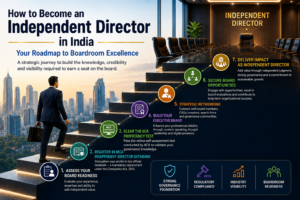
Step 3 – Register in MCA Independent Director Databank
One of the most important requirements is registration in the official databank maintained under the Independent Directors framework.
How to Register in MCA Independent Director Databank
If you’re searching for how to register in MCA independent director databank, the process generally involves:
- Visit the official Independent Directors Databank portal.
- Create your profile.
- Upload professional information.
- Select membership duration.
- Pay applicable fees.
- Complete onboarding formalities.
The databank acts as a searchable repository for companies seeking qualified independent directors. Registration significantly improves visibility among organizations and search committees.
Step 4 – Clear the IICA Proficiency Test
After registration, many professionals are required to clear the Online Proficiency Self-Assessment Test conducted through IICA.
Independent Director Exam Passing Marks 2026
One of the most frequently searched questions is regarding independent director exam passing marks 2026.
Current examination structure includes:
| Component | Details |
| Questions | 50 MCQs |
| Duration | 75 Minutes |
| Passing Score | 50% |
| Attempts | Unlimited |
| Negative Marking | No |
The test covers:
- Companies Law
- Securities Law
- Basic Accountancy
- Corporate Governance
Candidates generally have two years from registration to clear the examination unless exempt under applicable provisions.
Step 5 – Create a Strong Executive Brand
This is where many highly qualified professionals fall behind.
Technical competence alone does not guarantee board appointments. Visibility matters.
Think about it this way: if a Nomination and Remuneration Committee searches your name today, what will they find?
An executive brand should clearly communicate:
- Domain expertise
- Leadership achievements
- Governance perspective
- Industry credibility
- Thought leadership
Publishing articles, speaking at conferences, participating in governance forums, appearing on podcasts, and sharing strategic insights can significantly strengthen board positioning.
Executive Brand Strategy for Board Roles
If your board profile currently reads like a traditional resume, consider developing a dedicated board-focused positioning strategy. Many qualified executives miss opportunities because their expertise is not presented in a boardroom-friendly format.
Step 6 – Develop Strategic Networking Channels
Board appointments often happen through trusted networks rather than public job advertisements.
Strategic networking should focus on:
- Existing independent directors
- Board advisory firms
- Governance institutes
- Startup founders
- Investors
- Nomination and Remuneration Committee members
Networking is not about asking for board seats. It is about building credibility and relationships over time.
According to discussions within governance communities, networking remains one of the strongest drivers of independent director appointments alongside databank visibility and professional reputation.
Step 7 – Position Yourself for Board Opportunities
Many professionals wait for opportunities to appear. Effective board candidates actively position themselves.
Practical approaches include:
- Maintaining a board-focused LinkedIn profile
- Building governance thought leadership
- Joining industry forums
- Engaging with search consultants
- Creating a board biography
- Showcasing committee-level expertise
Companies increasingly seek specialists in technology, cybersecurity, sustainability, risk, and digital transformation. Positioning yourself around a clear niche can create a stronger competitive advantage.
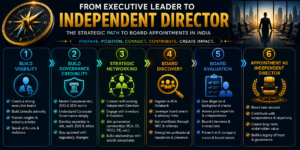
Step 8 – Understand the Selection Process
Most appointments go through the Nomination and Remuneration Committee (NRC).
A typical selection process includes:
- Candidate identification
- Background review
- Governance assessment
- Board interviews
- Due diligence
- Shareholder approval
What boards evaluate extends beyond qualifications. They assess judgment, independence, reputation, communication ability, and cultural alignment.
Strong candidates demonstrate both strategic insight and governance maturity.
Step 9 – Commit to Continuous Learning and Compliance Excellence
Board responsibilities do not end after securing an appointment. The regulatory and governance landscape continues to evolve, making continuous learning an essential part of being an effective independent director.
Areas that require regular attention include:
- Changes in the Companies Act, 2013
- SEBI regulations and disclosure requirements
- ESG and sustainability frameworks
- Corporate governance best practices
- Emerging compliance and risk management trends
Step 10 – Engage in Board Meetings and Contribute Effectively
The real value of an independent director is reflected in the quality of their contribution during board discussions.
To contribute effectively:
- Prepare thoroughly before meetings
- Review board papers and reports in advance
- Ask insightful and objective questions
- Provide independent perspectives on strategic matters
- Support informed and balanced decision-making
Independent directors are expected to challenge assumptions when necessary while maintaining a constructive approach. Their role is not simply to approve management recommendations but to provide oversight, strategic guidance, and independent judgment.
Step 11 – Stay Updated and Maintain Boardroom Relevance
Modern boardrooms require directors to stay informed about emerging business trends and evolving stakeholder expectations.
Key areas to monitor include:
- Artificial Intelligence (AI)
- Cybersecurity and data privacy
- Digital transformation
- ESG and sustainability
- Industry-specific developments
- Regulatory and governance updates
Reading governance publications, boardroom newsletters, industry reports, and thought leadership content can help you stay ahead of change. Directors who combine governance expertise with digital awareness and continuous learning are often the most effective contributors in today’s boardrooms.
Strategic Framework for Becoming Board-Ready
The BOARD Framework
| Element | Meaning |
| B | Build Governance Knowledge |
| O | Optimize Executive Brand |
| A | Acquire Relevant Certifications |
| R | Relationship-Based Networking |
| D | Demonstrate Strategic Expertise |
This framework helps aspiring directors focus on both regulatory requirements and market positioning.
Many professionals complete certifications but neglect visibility. Others focus on branding but lack governance depth. Sustainable board readiness requires both.
Common Mistakes Aspiring Independent Directors Make
The biggest misconception is believing that experience alone is enough.
Other common mistakes include:
- Ignoring personal branding
- Weak LinkedIn presence
- Limited governance knowledge
- No board biography
- Poor networking strategy
- Lack of specialization
- Failure to understand compliance responsibilities
Boards increasingly seek directors who bring measurable strategic value, not just impressive titles.
Future Trends Shaping Independent Directorship
The next generation of board appointments will look very different from the past.
High-demand expertise areas include:
- Artificial Intelligence Governance
- Cybersecurity Oversight
- ESG and Sustainability
- Digital Transformation
- Global Expansion Strategy
- Risk Management
- Data Privacy
Independent directors who continuously learn and adapt will remain relevant in increasingly complex board environments.
Conclusion
Understanding how to become an independent director in India requires much more than completing compliance formalities. Registration in the databank, passing the proficiency assessment, and meeting legal requirements are essential foundations. Yet the professionals who secure board appointments consistently combine governance expertise with strong executive branding, strategic networking, and visible thought leadership.
Today’s boards are searching for individuals who can guide organizations through uncertainty, digital disruption, regulatory complexity, and stakeholder expectations. If you position yourself strategically, build governance credibility, and actively cultivate your board profile, independent directorship can become a realistic and rewarding next step in your leadership journey.
Ready to strengthen your board positioning? Explore executive branding, governance advisory, and board profile development services through Your Board Profile and build a board presence that attracts meaningful opportunities.
15 FAQs
- Who can become an independent director in India?
Senior professionals with relevant expertise, integrity, and compliance with Companies Act requirements can become independent directors.
- Is registration in the databank mandatory?
Yes, registration in the Independent Directors Databank is mandatory for eligible individuals.
- What is the independent director exam passing marks 2026?
The passing score is currently 50%.
- How many attempts are allowed for the proficiency test?
Unlimited attempts are permitted.
- What subjects are covered in the examination?
Companies Law, Securities Law, Basic Accountancy, and Corporate Governance.
- How long is the exam?
The examination duration is 75 minutes.
- Is there negative marking?
No, there is no negative marking.
- How to register in MCA independent director databank?
Register through the official Independent Directors Databank portal and complete profile verification.
- Do retired executives have an advantage?
Yes, but domain expertise and governance knowledge matter more than age.
- What is the tenure of an independent director?
Typically up to five years per term, subject to applicable provisions.
- Does personal branding matter for board roles?
Absolutely. Visibility often influences board opportunities.
- Can startup founders become independent directors?
Yes, provided they meet eligibility and independence requirements.
- What skills are most in demand today?
Cybersecurity, ESG, AI governance, finance, risk management, and digital transformation.
- Do companies recruit directly from the databank?
Yes, many organizations use the databank as a discovery platform.
- Is networking important for board appointments?
Yes, strategic networking significantly improves board opportunities.