

Many senior executives believe that decades of leadership experience automatically qualify them for a board seat. Unfortunately, board appointments rarely work that way. A stellar career may open doors, but it does not guarantee entry into the boardroom. The harsh reality is simple: the Nomination and Remuneration Committee (NRC) is not buying your career history. It is buying your judgement.
That distinction changes everything about Board Positioning. Boards do not recruit executives merely because they have held impressive titles. They recruit individuals capable of asking difficult questions, challenging assumptions, balancing risk, and exercising independent judgement during uncertainty. The boardroom is not an operating arena; it is a governance arena.
Today’s boards face unprecedented complexity. According to the OECD Corporate Governance Factbook 2025, 90% of jurisdictions now require sustainability disclosure, while digital risks and governance expectations continue to rise rapidly. Boards are increasingly expected to oversee cybersecurity, AI governance, stakeholder expectations, and long-term value creation. As governance complexity rises, judgement becomes the ultimate differentiator.
For aspiring directors, effective Board Positioning means demonstrating how you think, challenge, decide, and govern—not simply showcasing what you have done.
Table of Contents
- Why Traditional Board Branding No Longer Works
- Understanding Modern Board Positioning
- How NRCs Assess Potential Directors
- The Five Signals That Strengthen Board Positioning
- Why the Digital Footprint for Board Directors Matters
- Creating a Judgement-Based Board Narrative
- Practical Framework for Better Board Positioning
- Conclusion
- FAQs
Why Traditional Board Branding No Longer Works
The Shift From Career Achievements to Governance Capability
Many executives still approach board applications as though they are applying for another C-suite role. They focus extensively on revenue growth, market expansion, operational excellence, or transformation achievements. While these accomplishments matter, they rarely answer the board’s central question: “Can this person govern effectively?”
Board service requires a fundamental shift in mindset. Executives run businesses; directors oversee businesses. Executives solve problems directly. Directors ensure the right questions are asked and appropriate oversight exists.
Recent research from Deloitte highlights that risk management expertise, cybersecurity oversight, and global leadership capabilities are increasingly sought after in board candidates. In fact, new directors often bring stronger risk oversight skills than incumbent board members.
A successful board candidate therefore positions themselves not as an accomplished executive, but as a credible governance professional.
What Nomination and Remuneration Committees Really Evaluate
The NRC evaluates several dimensions beyond experience:
| Evaluation Area | What NRCs Look For |
| Strategic Judgement | Ability to see long-term implications |
| Governance Mindset | Understanding of fiduciary responsibilities |
| Independence | Willingness to challenge management constructively |
| Risk Oversight | Capability to identify emerging threats |
| Stakeholder Stewardship | Balancing competing interests |
| Board Dynamics | Collaborative and respectful influence |
This explains why executives with exceptional careers sometimes fail to secure board appointments, while others with comparatively modest operating backgrounds succeed.
Understanding Modern Board Positioning
Board Positioning Is About How You Think
Strong Board Positioning communicates your intellectual framework. Directors are appointed because boards trust their thinking process.
Ask yourself:

- How do you approach ambiguity?
- How do you challenge management respectfully?
- How do you assess strategic risk?
- How do you respond when incomplete information exists?
- How do you balance short-term performance against long-term sustainability?
Your answers shape your board identity.
A compelling board profile should consistently demonstrate examples of judgement. Instead of saying, “Led a $500M transformation,” say, “Advised executive teams through complex transformation while balancing operational continuity, stakeholder confidence, and long-term strategic priorities.”
The difference is subtle yet powerful.
Why Judgement Has Become a Strategic Governance Asset
Boards increasingly operate amid geopolitical instability, AI disruption, cybersecurity threats, regulatory scrutiny, and stakeholder activism.
According to PwC’s 2025 Annual Corporate Directors Survey, directors believe accountability, candid board assessment, and confronting underperformance are essential priorities for modern boards. More than half of directors surveyed believe at least one member of their board should be replaced.
This environment rewards directors capable of exercising sound judgement under pressure. Consequently, judgement itself has become a Strategic Governance Asset.
How NRCs Assess Potential Directors
The Questions Directors Must Answer
Whether through networking conversations, board interviews, or executive search assessments, candidates are often evaluated through implicit questions:
- Does this individual think strategically?
- Can they challenge without creating conflict?
- Do they demonstrate independent thinking?
- Can they oversee risk effectively?
- Will they contribute to board dynamics?
- Can they govern rather than operate?
Executives frequently underestimate how heavily these qualitative dimensions influence selection decisions.
The Role of Executive Search for Directors
Increasingly, Executive Search for Directors firms play a significant role in identifying board talent. Executive search professionals do not simply match resumes with vacancies. They evaluate governance readiness, judgement credibility, and board fit.
Search consultants often ask:
- Describe a difficult board-level challenge
- Explain a time you challenged prevailing thinking
- Discuss a major strategic decision with uncertain outcomes
- Explain how you balance competing stakeholder interests
Candidates unable to articulate thoughtful governance perspectives often struggle despite impressive careers.
The Five Signals That Strengthen Board Positioning
Strategic Thinking
Strong directors think beyond quarterly results. They identify emerging trends, second-order consequences, and long-term implications.
Harvard governance research consistently highlights that boards increasingly prioritize future-oriented oversight, particularly regarding disruption and resilience. Strategic foresight therefore strengthens Board Positioning significantly.
Constructive Challenge
Boards require healthy tension. Directors must challenge assumptions without undermining management.
Constructive challenge includes:
- Asking clarifying questions
- Testing assumptions
- Exploring alternative scenarios
- Highlighting overlooked risks
- Encouraging broader discussion
Effective directors challenge ideas, not individuals.
Decision-Making Under Uncertainty
Boardrooms rarely enjoy perfect information. Whether dealing with acquisitions, cyber incidents, CEO succession, or crises, uncertainty is inevitable.
Candidates should demonstrate situations where they made difficult decisions amid ambiguity while balancing multiple risks.
Risk Oversight and Governance Mindset
Cybersecurity, enterprise risk management, and AI governance rank among today’s highest board priorities. Deloitte research identifies cybersecurity as a leading oversight concern for audit committees globally.
Executives seeking board roles should therefore demonstrate governance fluency around:
- Cyber risk
- AI oversight
- ESG considerations
- Regulatory compliance
- Enterprise resilience
Stakeholder Stewardship
Modern boards govern for diverse stakeholder groups including shareholders, employees, customers, regulators, and communities.
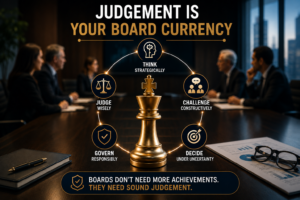
Directors who demonstrate nuanced stakeholder judgement are increasingly valued.
Why the Digital Footprint for Board Directors Matters
Building Visible Governance Credibility
Your Digital Footprint for Board Directors increasingly influences board opportunities.
Search firms, NRC members, and fellow directors routinely review:
- LinkedIn profiles
- Published articles
- Interviews
- Conference participation
- Governance commentary
- Professional associations
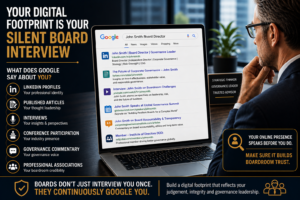
A weak or inconsistent digital presence creates doubt about board readiness.
To strengthen visibility, consider publishing governance-focused thought leadership discussing risk oversight, strategy, sustainability, or board effectiveness.
You may also enhance credibility through resources such as About Us and specialized board services designed for aspiring directors.
Mistakes That Damage Board Positioning
Common errors include:
| Mistake | Impact |
| Executive-only LinkedIn profile | Signals operator mindset |
| Absence of governance content | Low visibility |
| Excessive self-promotion | Weakens credibility |
| Generic board aspirations | Lacks differentiation |
| No evidence of judgement | Reduces trust |
Your digital reputation should consistently reinforce your governance identity.
Creating a Judgement-Based Board Narrative
From Executive Resume to Board Story
A board biography should not resemble a traditional executive CV.
Instead, it should demonstrate:
- Strategic contribution
- Governance experience
- Risk oversight capability
- Independent judgment
- Stakeholder stewardship
Developing a compelling Board Value Proposition and Board Bio helps directors communicate these capabilities effectively.
Evidence-Based Positioning
Claims alone rarely persuade NRCs.
Strong evidence includes:
- Committee leadership experience
- Crisis oversight examples
- Transformation governance
- M&A oversight
- Succession planning involvement
- Risk committee participation
Candidates should also showcase examples of strategic judgement throughout their profiles and conversations.
Board Positioning Framework for Aspiring Directors
A Comparison Table
| Traditional Positioning | Modern Board Positioning |
| Revenue growth achievements | Governance outcomes |
| Operational expertise | Strategic oversight |
| Functional leadership | Independent judgment |
| Execution capability | Risk stewardship |
| Personal achievements | Board contribution |
Practical Framework for Better Board Positioning
- Clarify your governance niche
- Develop governance-focused thought leadership
- Strengthen your Digital Footprint for Board Directors
- Build relationships within governance ecosystems
- Pursue board education and certifications
- Reframe executive achievements into governance insights
- Seek advisory and committee experience
- Demonstrate judgement consistently
Conclusion
Exceptional careers create credibility, but credibility alone does not secure board appointments. Modern Board Positioning requires a clear demonstration of judgement, governance capability, strategic thinking, and oversight maturity.
The NRC is not purchasing decades of experience. It is investing in a trusted advisor capable of guiding organizations through uncertainty, challenging management constructively, and safeguarding long-term value creation.
When your profile consistently communicates how you think, question, challenge, decide, and govern, you stop looking like an executive seeking a board seat and start looking like a director already prepared for one.
FAQs
- What is Board Positioning?
Board Positioning is the deliberate process of presenting yourself as a credible governance professional rather than merely an accomplished executive.
- Why is judgement important in board appointments?
Boards appoint individuals who can oversee strategy, challenge management, and make sound decisions under uncertainty.
- How does a Digital Footprint for Board Directors influence appointments?
Search firms and NRC members frequently review digital profiles to assess governance credibility and thought leadership.
- What is a Strategic Governance Asset?
A Strategic Governance Asset refers to expertise, judgement, or experience that enhances board effectiveness and long-term oversight.
- How do Executive Search for Directors firms assess candidates?
They evaluate governance readiness, board fit, strategic thinking, and independent judgement alongside career achievements.
- Can senior executives transition directly to boards?
Yes, but they must demonstrate governance capability rather than relying solely on executive accomplishments.
- What type of content should aspiring directors publish?
Governance insights, strategy commentary, risk perspectives, and board effectiveness discussions are valuable.
- Does industry expertise matter for board roles?
Yes, sector expertise remains important, but governance judgement often carries greater weight.
- What are common Board Positioning mistakes?
Overemphasizing operational achievements, lacking governance evidence, and maintaining weak digital visibility.
- Why do boards value constructive challenge?
Constructive challenge improves decision quality and strengthens oversight.
- How important is cybersecurity knowledge for directors?
Cyber oversight has become one of the most critical board competencies.
- Should executives rewrite their biographies for board opportunities?
Absolutely. Board biographies should focus on governance contributions and strategic oversight.
- How can executives gain governance experience?
Advisory boards, nonprofit boards, committee assignments, and governance education programs provide experience.
- What qualities define effective directors?
Strategic thinking, independence, integrity, judgement, and stakeholder stewardship.
- How often should aspiring directors review their Board Positioning?
At least annually or whenever career transitions, governance experiences, or strategic priorities evolve.
Ready to Strengthen Your Board Presence and Unlock New Board Opportunities?
Ready to position yourself for meaningful board opportunities? Start building a board profile that showcases not just your achievements, but your judgement, governance capability, and strategic value. The boardroom does not appoint resumes—it appoints trusted thinkers.
Whether you’re an aspiring Independent Director, CXO, Founder, or senior executive, a well-positioned board profile can make all the difference in today’s competitive board landscape.
Book a complimentary strategy session with Your Board Profile today.