

For many senior executives aspiring to board positions, there is a common misconception that visibility alone creates board opportunities. The reality is quite different. Boardrooms do not reward the loudest voice in the room. They reward the person who consistently demonstrates Strategic Judgement.
Independent Directors are expected to bring clarity, perspective, foresight, and balanced decision-making. Boards are looking for individuals who can assess risks, challenge assumptions constructively, and guide organizations toward sustainable growth. According to recent governance research, more than 60% of directors believe improving strategy execution is a top board priority, while organizations increasingly seek directors who can contribute meaningful strategic oversight.
The challenge for aspiring directors is simple: how do you prove Strategic Judgement before you ever enter the boardroom?
The answer lies in your content, conversations, and conduct. Every article you publish, every discussion you participate in, and every professional interaction sends powerful Governance Signals about your readiness for board responsibilities.
Table of Contents
- What Strategic Judgement Really Means
- Why Boards Value Strategic Judgement Over Visibility
- Governance Signals That Boards Observe
- How Content Demonstrates Strategic Thinking
- Thought Leadership for Board Positions
- Strategic Conversations and Board Credibility
- The Role of Conduct in Board Readiness
- Common Mistakes That Undermine Strategic Judgement
- Building a Board-Level Personal Brand
- Measuring Your Board Readiness
- Strategic Judgement vs Operational Expertise
- How Independent Directors Create Value
- Digital Presence and Governance Signals
- Strategic Judgement in a Rapidly Changing World
- Action Plan for Aspiring Directors
- Conclusion
- FAQs
What Strategic Judgement Really Means
Strategic Judgement is the ability to make sound decisions based on long-term implications rather than short-term outcomes. It involves evaluating opportunities, understanding risks, balancing stakeholder interests, and making choices that create sustainable value.
Many executives possess operational expertise. They know how to manage teams, improve processes, and achieve quarterly targets. Strategic judgement goes beyond execution. It requires the ability to see patterns before others do, recognize emerging risks, and assess how decisions today will impact the organization years into the future.
Recent board governance studies show that directors increasingly focus on strategic execution, leadership readiness, and long-term resilience rather than simply reviewing historical performance.
The boardroom rewards individuals who consistently ask thoughtful questions, identify blind spots, and contribute balanced perspectives. That is the essence of Strategic Judgement.
Why Boards Value Strategic Judgement Over Visibility
There is a difference between being visible and being valuable.
Many professionals invest heavily in personal branding, social media activity, and networking events. Visibility may help people notice you, but it does not automatically create trust.
Boards appoint directors because they can contribute meaningful oversight and guidance. A recent survey found that only 17% of boards actively participate in shaping company strategy, highlighting a growing need for directors capable of strategic thinking and informed governance.
Visibility without insight can actually hurt credibility. Excessive self-promotion often signals ego rather than wisdom. Strategic judgement, on the other hand, demonstrates maturity, restraint, and thoughtful leadership.
When organizations assess potential directors, they look for evidence that the candidate can contribute constructively to board discussions rather than dominate them.
Governance Signals That Boards Observe
Every aspiring director sends signals to the market.
These Governance Signals often determine how seriously boards perceive an executive’s readiness for board responsibilities.
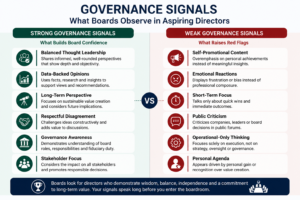
| Strong Governance Signals | Weak Governance Signals |
| Balanced thought leadership | Self-promotional content |
| Data-backed opinions | Emotional reactions |
| Long-term perspective | Short-term focus |
| Respectful disagreement | Public criticism |
| Governance awareness | Operational-only thinking |
| Stakeholder focus | Personal agenda |
Boards continuously evaluate professional reputation through public visibility, industry contributions, and leadership behaviour.
Constructive dissent and independent thinking are increasingly viewed as essential board capabilities. Recent comments from governance leaders emphasize that independent directors must move beyond compliance and contribute diverse perspectives and thoughtful challenge.
How Content Demonstrates Strategic Thinking
Content has become one of the most powerful tools for demonstrating Strategic Judgement.
Every article, LinkedIn post, podcast appearance, or industry commentary creates an opportunity to showcase how you think.
Instead of discussing only personal achievements, aspiring directors should focus on broader business issues. Topics such as governance, risk management, leadership succession, digital transformation, ESG oversight, AI governance, and board effectiveness are particularly relevant.
For example, rather than posting about a successful project, consider analysing why strategic execution succeeds in some organizations and fails in others.
This approach shifts attention from what you have done to how you think.
Professionals looking to strengthen their board positioning can benefit from understanding the key elements of Board Readiness before pursuing director opportunities.
Thought Leadership for Board Positions
Thought Leadership for Board Positions differs significantly from executive thought leadership.
Executive thought leadership often focuses on operational excellence and business growth. Board-level thought leadership emphasizes governance, oversight, strategic risk, stakeholder value, and long-term sustainability.
A useful framework is asking three questions before publishing content:
- Does this topic affect long-term business outcomes?
- Does it demonstrate strategic perspective?
- Would a board find this insight valuable?
When content consistently answers these questions, it begins to establish board credibility.
For broader governance insights, professionals often reference resources such as Harvard Business Review and McKinsey & Company.
Strategic Conversations and Board Credibility
Board readiness is often revealed through conversations rather than credentials.
When executives engage in industry discussions, they reveal how they process information, evaluate alternatives, and approach uncertainty.
Strong board candidates ask thoughtful questions. They seek understanding before offering opinions. They challenge assumptions respectfully and support arguments with evidence.
Weak candidates often rush to conclusions, dominate discussions, or treat every conversation as an opportunity for self-promotion.
Strategic conversations build credibility because they demonstrate intellectual maturity. They show that an individual can contribute constructively to boardroom dialogue.
The Role of Conduct in Board Readiness
Conduct often speaks louder than expertise.
Aspiring directors frequently underestimate how their behaviour influences perceptions of Board Readiness.
Boardrooms require discretion, professionalism, and sound judgement. Public controversies, impulsive social media activity, and emotionally charged commentary can damage board prospects significantly.
Every interaction contributes to your reputation. People observe how you handle disagreements, respond to criticism, and engage with diverse viewpoints.
Professional conduct consistently reinforces strategic credibility.
Common Mistakes That Undermine Strategic Judgement
Many capable executives unintentionally weaken their board positioning.
Focusing Only on Personal Achievements
Boards are interested in organizational impact rather than personal recognition.
Reacting Instead of Reflecting
Strategic judgement requires measured responses rather than emotional reactions.
Ignoring Governance Topics
Candidates who discuss only operations often appear unprepared for board responsibilities.
Chasing Visibility
Board opportunities emerge from credibility, not popularity.
Building a Board-Level Personal Brand
A board-level brand should communicate trust, expertise, independence, and strategic thinking.
Professionals preparing for board opportunities should ensure that their online presence reflects governance awareness and long-term business perspective.
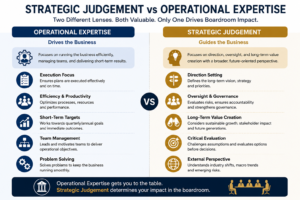
Useful areas to highlight include:
- Risk oversight
- Leadership development
- Governance expertise
- Strategic transformation
- Stakeholder management
- Innovation governance
Those exploring board opportunities can strengthen their positioning by developing a compelling Board Branding Strategy that highlights governance expertise and strategic value.
Measuring Your Board Readiness
Assessing Board Readiness requires honest evaluation.
Consider the following questions:
| Assessment Area | Key Question |
| Governance | Do I understand board responsibilities? |
| Risk | Can I evaluate emerging risks effectively? |
| Strategy | Do I think beyond operational execution? |
| Leadership | Can I challenge management constructively? |
| Reputation | Does my public profile reflect board readiness? |
Recent governance studies suggest that leadership succession planning and strategic oversight remain key areas where boards seek improvement.
Strategic Judgement vs Operational Expertise
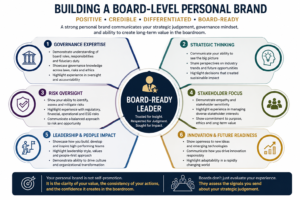
Operational expertise focuses on execution.
Strategic Judgement focuses on direction.
An executive may excel at improving efficiency, reducing costs, or managing teams. A director must evaluate whether the organization is pursuing the right strategy in the first place.
This distinction explains why not every successful executive becomes an effective director.
Board service requires broader perspective and greater emphasis on oversight.
How Independent Directors Create Value
Independent Directors contribute value through objective thinking and informed challenge.
They provide external perspectives, identify blind spots, assess strategic risks, and support effective governance.
Research continues to highlight the importance of board independence and thoughtful oversight in strengthening governance quality.
The strongest Independent Directors combine expertise with humility. They influence outcomes through thoughtful questions rather than authoritative declarations.
Digital Presence and Governance Signals
Your digital footprint has become a modern board reference check.
Before appointing directors, many organizations review online activity, published content, and professional profiles.
A well-maintained digital presence communicates credibility. A poorly managed one creates doubt.
Executives should periodically review their online profiles and ensure alignment with their desired board positioning.
Helpful governance insights can also be found through World Economic Forum and Institute of Directors.
Strategic Judgement in a Rapidly Changing World
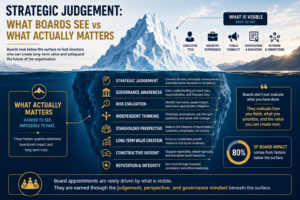
Today’s directors face increasingly complex challenges.
AI governance, cybersecurity, geopolitical uncertainty, workforce transformation, and regulatory changes require deeper strategic oversight.
Research indicates that many boards are still developing capabilities around AI governance and technology oversight.
This environment makes Strategic Judgement even more valuable. Organizations need directors capable of navigating ambiguity while maintaining focus on long-term value creation.
Action Plan for Aspiring Directors
To strengthen your board positioning:
- Publish thoughtful governance-focused content.
- Participate in strategic industry discussions.
- Build a board-oriented professional profile.
- Expand knowledge of governance frameworks.
- Demonstrate independent thinking.
- Develop expertise in emerging board priorities.
- Strengthen your reputation through consistent conduct.
These actions create visible evidence of Strategic Judgement, Governance Signals, and genuine Board Readiness.
Conclusion
The boardroom has never rewarded noise. It rewards clarity, perspective, and sound judgement.
Aspiring Independent Directors often focus heavily on credentials, experience, and networking. While these factors matter, they are rarely enough on their own. Boards want evidence that a candidate can think strategically, contribute constructively, and guide organizations through complexity.
The most powerful way to demonstrate Strategic Judgement is through consistent behaviour. Your content reveals how you think. Your conversations reveal how you engage. Your conduct reveals how you lead.
When all three align, they create strong governance signals that communicate board readiness long before a board seat becomes available.
If you are serious about pursuing board opportunities, start building that evidence today. The boardroom is always watching.
FAQs
- What is Strategic Judgement in the context of board roles?
Strategic Judgement is the ability to evaluate complex situations, balance competing priorities, assess risks, and make decisions that support long-term organizational success.
- Why is Strategic Judgement important for Independent Directors?
Independent Directors are expected to provide oversight, challenge assumptions, and contribute objective perspectives that improve decision-making.
- How can executives demonstrate Board Readiness?
Through governance-focused content, strategic conversations, professional conduct, and a strong board-oriented personal brand.
- What are Governance Signals?
Governance Signals are indicators that demonstrate an individual’s understanding of governance, oversight, risk management, and board responsibilities.
- Does thought leadership help secure board positions?
Yes. Thought leadership can showcase strategic thinking, governance expertise, and industry knowledge.
- What topics should aspiring directors write about?
Governance, risk oversight, ESG, leadership succession, AI governance, strategy execution, and board effectiveness.
- How important is digital presence for board opportunities?
Very important. Many organizations review digital profiles before considering director appointments.
- How can aspiring Independent Directors demonstrate Strategic Judgement before joining a board?
By consistently sharing governance-focused insights, engaging in strategic discussions, and demonstrating sound professional conduct.
- How does board-level thinking differ from executive thinking?
Board-level thinking focuses on oversight, risk, and long-term value creation rather than day-to-day execution.
- Why is Strategic Judgement more important than industry expertise in board roles?
Strategic Judgement helps directors assess risks, evaluate opportunities, and guide long-term organizational success beyond technical knowledge.
- What qualities define strong Independent Directors?
Objectivity, integrity, strategic thinking, governance awareness, and effective communication.
- What are the best ways to develop Strategic Judgement for board readiness?
- Why do boards value constructive dissent?
Constructive dissent helps identify risks, challenge assumptions, and improve decision quality.
- What role does reputation play in board appointments?
Reputation significantly influences board selection decisions because trust is essential in governance roles.
- How can professionals accelerate their board readiness journey?
By investing in governance education, building strategic visibility, strengthening board profiles, and demonstrating consistent strategic judgement.
Ready to Strengthen Your Board Presence and Unlock New Board Opportunities?
Board opportunities rarely come from being the most visible executive—they come from demonstrating strategic judgement, governance awareness, and the ability to create long-term value. If your experience is board-ready but your professional positioning does not reflect it, now is the time to bridge that gap.
Whether you’re an aspiring Independent Director, CXO, Founder, or senior executive, a well-positioned board profile can make all the difference in today’s competitive board landscape.
Book a complimentary strategy session with Your Board Profile today.