

Introduction
Senior executives often spend decades building experience, leading teams, handling crises, driving growth, and shaping businesses. Yet when it comes to securing board opportunities, many still rely on a traditional CV and assume it is enough. It is not. A board CV may tell people what you have done, but your board brand tells them why you belong in the boardroom and it is answered by Executive Brand Strategy for Board Roles.
That distinction matters more today than ever before. Executive recruiters, nomination committees, investors, and founders no longer evaluate leaders only through static resumes. They evaluate digital presence, public positioning, thought leadership, governance alignment, media visibility, and professional credibility across multiple channels. Your reputation is no longer confined to a PDF attachment sitting in someone’s inbox. It lives online, breathes through your content, and shapes perception before you even enter a conversation.
This shift has completely changed how executives must approach their transition into board roles. A polished CV alone cannot compete against leaders who actively manage their boardroom digital footprint, position themselves strategically online, and communicate a clear governance narrative. The modern board ecosystem rewards visibility, clarity, trust, and relevance.
That is exactly where an intentional Executive Brand Strategy for Board Roles becomes critical.
Whether you are a CXO planning your first independent director role or a seasoned executive aiming for global board visibility, your board brand is now your strategic differentiator.
Table of Contents
- What Is Executive Brand Strategy for Board Roles?
- Why Board CVs Alone No Longer Work
- The Difference Between a Board Profile and Board Resume
- The Rise of Boardroom Digital Footprint
- How Executive Search Firms Evaluate Directors Today
- Why Visibility Creates Opportunity
- Building Trust Before the First Conversation
- Personal Branding vs Executive Board Branding
- Key Elements of a Strong Board Brand
- Leadership Narrative and Strategic Positioning
- Thought Leadership and Industry Authority
- Digital Presence Across Professional Platforms
- The Role of LinkedIn in Board Visibility
- Common Mistakes Executives Make
- How Governance Positioning Impacts Board Selection
- Creating a Future-Focused Board Identity
- Executive Search Visibility for Directors
- The Importance of Consistency Across Platforms
- How to Build an Authentic Board Brand
- Final Thoughts for Aspiring Board Leaders
What Is Executive Brand Strategy for Board Roles?
An Executive Brand Strategy for Board Roles is the deliberate process of positioning yourself as a credible, trusted, and board-ready leader in the eyes of decision-makers. It goes far beyond writing achievements on paper. It is about shaping how the professional world perceives your leadership value.
Think about it this way. A CV tells people your job history. Your board brand tells them your strategic relevance.
Board appointments are based heavily on trust, perception, and alignment. Companies want directors who not only possess experience but also demonstrate judgment, governance maturity, industry foresight, and strategic thinking. Your online presence, published insights, interviews, speaking engagements, and leadership narrative collectively communicate whether you fit that expectation.
This is why modern executives are investing in professional board positioning services such as those offered by Your Board Profile. A professionally structured board identity helps leaders move beyond operational branding into governance branding.
The shift is subtle but powerful. Operational executives are known for execution. Board leaders are known for perspective. Your branding strategy must communicate that evolution clearly.
Why Board CVs Alone No Longer Work
A traditional resume was designed for recruitment processes. Board appointments work differently. They involve relationships, reputation, long-term trust, and strategic alignment.
When executive search firms review candidates, they are not only scanning qualifications. They are assessing signals. What does this leader represent publicly? Do they have industry influence? Have they demonstrated governance understanding? Are they visible in conversations shaping the future of business?
A static document cannot answer all these questions effectively.
According to Harvard Business Review, leadership visibility and thought leadership increasingly influence executive credibility in modern organizations. Similarly, executive recruiters frequently review LinkedIn profiles, published articles, interviews, conference appearances, and online mentions before initiating discussions.
This creates a major gap between executives who merely possess experience and executives who strategically communicate that experience.
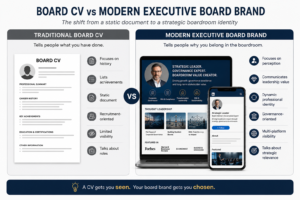
Board CV vs Board Brand
| Board CV | Board Brand |
| Focuses on history | Focuses on perception |
| Lists achievements | Communicates leadership value |
| Static document | Dynamic professional identity |
| Recruitment-oriented | Governance-oriented |
| Limited visibility | Multi-platform visibility |
| Talks about roles | Talks about strategic relevance |
That difference explains why many highly capable executives remain invisible to board opportunities while others consistently attract attention.
The Difference Between a Board Profile and Board Resume
Many executives use the terms interchangeably, but they are fundamentally different.
A board resume summarizes career experience. A board profile strategically positions you for governance opportunities.
A board profile is more nuanced. It highlights governance competencies, strategic capabilities, industry relevance, transformation experience, risk oversight, ESG understanding, and boardroom value creation. It frames your career through the lens of stewardship rather than management.
This is where services like Your Board Profile’s Executive Positioning Solutions become especially valuable for senior leaders seeking board visibility.
Key Differences
| Board Resume | Board Profile |
| Career chronology | Strategic positioning |
| Operational focus | Governance focus |
| Achievement listing | Leadership narrative |
| Internal achievements | External perception |
| Recruitment format | Board-centric storytelling |
The reality is simple. Board committees are not hiring managers. They are looking for advisors, risk overseers, strategic thinkers, and trusted voices.
Your presentation must reflect that shift.
The Rise of Boardroom Digital Footprint in Executive Brand Strategy for Board Roles
Your boardroom digital footprint is the collection of professional signals you leave online. It includes your LinkedIn profile, published articles, interviews, podcast appearances, event participation, panel discussions, media mentions, and leadership content.
Today, silence online can unintentionally create invisibility.
Executives sometimes assume discretion means avoiding visibility. That worked years ago. It no longer works in a digitally connected executive ecosystem.
Search firms increasingly conduct digital due diligence before considering candidates. According to Forbes, executive visibility strongly influences credibility and authority in leadership markets.
If someone searches your name online today, what do they find?
- A generic LinkedIn profile?
- Outdated career information?
- Minimal strategic content?
- No visible thought leadership?
Or do they discover a credible governance voice with clarity, authority, and perspective?
That first impression matters enormously.
How Executive Search Firms Evaluate Directors Today
The process of identifying board talent has evolved dramatically.
Executive search consultants no longer depend solely on referrals and resumes. They actively monitor executive visibility, strategic relevance, and digital positioning.
This shift has accelerated due to increasing governance complexity. Boards now seek directors with expertise in:
- Digital transformation
- Cybersecurity
- ESG governance
- AI oversight
- Risk management
- Regulatory strategy
- Global expansion
- Stakeholder communication
Search firms want leaders who appear informed, current, and forward-looking.
What Recruiters Look For
| Evaluation Area | What It Signals |
| LinkedIn Presence | Professional credibility |
| Thought Leadership | Strategic thinking |
| Media Mentions | Industry authority |
| Public Speaking | Communication skills |
| Governance Content | Board readiness |
| Network Quality | Influence and reach |
This is why Executive search visibility for directors has become a serious strategic priority.
Executives who proactively shape their positioning gain a competitive advantage long before opportunities become public.
Why Visibility Creates Opportunity
Opportunities often come to leaders who remain visible in the right circles.
Board appointments are relationship-driven. Visibility increases familiarity. Familiarity builds trust. Trust creates opportunity.
This does not mean posting motivational quotes every day or becoming a social media influencer. Executive visibility is different. It is strategic, thoughtful, and value-oriented.
A well-positioned executive might:
- Publish governance insights
- Share industry observations
- Participate in panel discussions
- Write about leadership transitions
- Contribute to business publications
- Comment thoughtfully on emerging trends
Over time, these activities shape professional perception.
The board world is surprisingly small. Decision-makers pay attention to executives who consistently demonstrate clarity and strategic insight.
Building Trust Before the First Conversation
One of the most powerful aspects of executive branding is that it builds trust before introductions even happen.
Imagine two candidates.
The first submits a board CV with excellent credentials but almost no visible professional footprint.
The second has similar credentials but also demonstrates governance insight through articles, interviews, thought leadership, and strategic positioning online.
Who appears more board-ready?
Most committees naturally lean toward familiarity and visible credibility.
That is why a strong digital identity is no longer optional. It acts as social proof.
Executives aiming for board opportunities should treat their online presence as carefully as they treat investor communication. Every touchpoint contributes to perception
Personal Branding vs Executive Board Branding
There is a major difference between generic personal branding and board-focused executive branding.
Personal branding often emphasizes personality, lifestyle, or career growth. Board branding emphasizes governance capability, judgment, strategic oversight, and leadership maturity.
Executive Board Branding Focus Areas
| Personal Branding | Executive Board Branding |
| Individual personality | Governance credibility |
| Career growth | Strategic oversight |
| General networking | Board-level visibility |
| Broad audience | Decision-makers & recruiters |
| Informal engagement | Professional authority |
Board branding should feel refined, intelligent, and credible. It should communicate wisdom rather than self-promotion.
That balance is critical.
Key Elements of a Strong Board Brand
A compelling board brand combines multiple strategic elements into one cohesive identity.
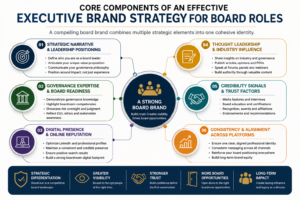
Core Components of an Effective Executive Brand Strategy for Board Roles
Strategic Narrative
Your career story must communicate progression, transformation, and governance relevance.
Digital Presence
Your online visibility should align with board-level professionalism.
Thought Leadership
Publishing meaningful insights builds authority.
Governance Positioning
Your content and profile should reflect boardroom understanding.
Consistency
Your messaging across platforms must remain aligned.
Credibility Signals
Awards, media mentions, speaking engagements, and certifications strengthen trust.
Strong brands are not loud. They are clear.
Leadership Narrative and Strategic Positioning
Executives often underestimate the power of narrative.
Facts alone rarely inspire trust. Stories do.
Your leadership narrative should answer questions like:
- What kind of leader are you?
- What transformations have you led?
- What governance value do you bring?
- What industries or challenges define your expertise?
Board committees are drawn toward leaders with clear positioning.
For example:
- A transformation specialist
- A governance strategist
- A digital disruption leader
- An ESG-focused executive
- A scaling expert
- A crisis management leader
Clarity creates memorability.
Thought Leadership and Industry Authority
Thought leadership is not about self-promotion. It is about demonstrating perspective.
When executives consistently share intelligent observations, they become associated with expertise.
This is particularly important for leaders targeting independent director opportunities.
Publishing content on:
- Governance trends
- AI oversight
- Board diversity
- Risk management
- Digital transformation
- ESG accountability
…can significantly improve executive positioning.
Publications such as McKinsey & Company Insights and Deloitte Insights regularly emphasize how modern governance expectations are evolving rapidly.
Executives who contribute meaningfully to these conversations naturally increase their visibility.
Digital Presence Across Professional Platforms
Your board brand should exist consistently across professional ecosystems.
Important Platforms for Executive Visibility
| Platform | Strategic Purpose |
| Executive credibility | |
| Company Website | Professional authority |
| Business Publications | Thought leadership |
| Podcasts | Humanized expertise |
| Industry Panels | Visibility and networking |
| Executive Forums | Peer credibility |
A fragmented online presence creates confusion. Consistency creates confidence.
The Role of LinkedIn in Board Visibility
LinkedIn has quietly become one of the most powerful executive discovery platforms in the world.
Search consultants regularly use LinkedIn filters to identify directors, CXOs, governance experts, and transformation leaders.
An optimized profile dramatically improves discoverability.
A Strong Board-Focused LinkedIn Profile Should Include
- Governance-oriented headline
- Strategic executive summary
- Board competencies
- Industry expertise
- Thought leadership activity
- Featured articles/interviews
- Awards and recognitions
Executives who neglect LinkedIn often underestimate how frequently they are evaluated there.
Common Mistakes Executives Make
Many senior leaders unintentionally damage their board visibility without realizing it.
Frequent Branding Mistakes
| Mistake | Impact |
| Using outdated resumes | Weak positioning |
| Ignoring digital presence | Low visibility |
| Generic LinkedIn profiles | Poor discoverability |
| No thought leadership | Limited authority |
| Inconsistent messaging | Reduced trust |
| Overly operational branding | Weak governance identity |
These mistakes are surprisingly common, even among accomplished executives.
How Executive Brand Strategy for Board Roles Impacts Governance Positioning and Board Selection
Governance positioning refers to how effectively you communicate board-level thinking.
Boards are responsible for oversight, not execution.
This distinction matters deeply.
Executives transitioning into board roles must shift language from:
- Managing teams → guiding organizations
- Delivering operations → overseeing strategy
- Solving problems → governing risk
Your positioning should reflect maturity, perspective, and stewardship.
That transformation is often what separates executives from true board candidates.
Creating a Future-Focused Board Identity
Modern boards are changing rapidly.
Organizations now prioritize directors who understand:
- Artificial intelligence
- Sustainability
- Cybersecurity
- Stakeholder governance
- Digital ecosystems
- Regulatory transformation
Executives must demonstrate future relevance.
A future-focused board identity communicates adaptability, curiosity, and strategic awareness.
Boards are not just hiring for yesterday’s experience. They are preparing for tomorrow’s uncertainty.
Executive Search Visibility for Directors
One of the smartest investments senior leaders can make is improving Executive search visibility for directors.
Visibility is not vanity. It is accessibility.
Search consultants cannot consider leaders they cannot discover.
This is why board-focused branding services, governance networking, strategic publishing, and executive profile optimization have become increasingly important.
Executives who intentionally manage visibility often receive opportunities organically because they remain discoverable and relevant.
The Importance of Consistency Across Platforms
Imagine reading an executive’s LinkedIn profile that emphasizes innovation leadership, then visiting their website and finding outdated information from five years ago.
That inconsistency weakens credibility immediately.
Consistency across:
- Executive bios
- LinkedIn profiles
- Board profiles
- Published articles
- Media appearances
…creates trust and professionalism.
Strong board brands feel aligned everywhere.
How to Build an Authentic Board Brand
Authenticity matters enormously in executive positioning.
Board committees quickly recognize forced branding or exaggerated positioning.
The strongest executive brands are built on:
- Genuine expertise
- Clear leadership philosophy
- Real governance insights
- Consistent communication
- Long-term credibility
Practical Steps to Strengthen Your Board Brand
- Optimize your LinkedIn profile
- Publish governance-focused insights
- Participate in executive discussions
- Build visibility in industry ecosystems
- Create a professional board profile
- Align your narrative with future board needs
For executives serious about board opportunities, professional positioning platforms like Your Board Profile can help structure and elevate that identity strategically.
Conclusion
Your board CV may open a door, but your board brand and Executive Brand Strategy for Board Roles determine whether you are invited into the room.
The board landscape has evolved beyond static credentials. Today’s decision-makers evaluate visibility, perception, governance maturity, digital presence, and strategic positioning before they evaluate resumes.
Executives who understand this shift gain a substantial advantage.
A strong Executive Brand Strategy for Board Roles helps leaders communicate relevance, authority, and trust in a highly competitive governance ecosystem. It transforms years of experience into a compelling professional identity that resonates with nomination committees, investors, founders, and executive recruiters alike.
The future of board appointments belongs to executives who are not only accomplished but also visible, credible, and strategically positioned.
If you are preparing for board opportunities, this is the right time to build a board brand that reflects the level of leadership you have already earned.
Ready to Position Yourself for Board Opportunities?
Your experience deserves more than a traditional resume.
Build a compelling board-ready executive identity with Your Board Profile and strengthen your visibility where modern board opportunities actually happen.
FAQs
- What is an Executive Brand Strategy for Board Roles?
It is the strategic process of positioning senior executives as credible, visible, and board-ready leaders through digital presence, thought leadership, governance positioning, and professional branding.
- Why is a board brand important today?
Board committees and executive recruiters increasingly evaluate online visibility, strategic positioning, and leadership perception before considering candidates for board appointments.
- What is the difference between a board CV and a board brand?
A board CV lists experience, while a board brand communicates leadership value, governance capability, and strategic relevance.
- What does boardroom digital footprint mean?
It refers to the professional signals executives leave online, including LinkedIn presence, articles, interviews, media mentions, and leadership visibility.
- How can LinkedIn improve board visibility?
LinkedIn helps executive recruiters discover leaders through optimized profiles, governance-focused content, and strategic networking.
- Do board recruiters check online presence?
Yes. Executive search firms frequently review digital visibility, thought leadership, and online credibility during board candidate evaluation.
- What should a board profile include?
A board profile should include governance competencies, strategic expertise, leadership achievements, industry relevance, and future-focused positioning.
- How does thought leadership help executives?
Thought leadership establishes authority, demonstrates strategic thinking, and increases visibility among decision-makers.
- What industries currently need modern board expertise?
Industries prioritizing digital transformation, ESG governance, cybersecurity, AI oversight, and global risk management actively seek future-ready directors.
- Can executives build a board brand without social media?
Yes, but professional platforms like LinkedIn significantly improve discoverability and credibility.
- Why is an Executive Brand Strategy for Board Roles important?
An Executive Brand Strategy for Board Roles improves visibility, credibility, and boardroom positioning among recruiters and decision-makers.
- How long does it take to build a strong board brand?
Building a credible board brand is an ongoing process, but visible improvements can often be achieved within a few months through strategic positioning.
- Why is governance positioning important?
Governance positioning communicates board-level thinking, oversight capability, and strategic maturity.
- How does an Executive Brand Strategy for Board Roles create board opportunities?
An Executive Brand Strategy for Board Roles increases executive visibility, credibility, and strategic boardroom positioning.
- How can leaders strengthen their Executive Brand Strategy for Board Roles?
Leaders can improve their Executive Brand Strategy for Board Roles through thought leadership, LinkedIn optimization, and strategic digital presence.
2 Comments