

Board appointments rarely happen because someone repeatedly claims they are ready. They happen because the evidence already exists.
Many senior executives spend years building operational expertise, leading large teams, managing budgets, and driving growth. Yet when they begin pursuing board opportunities, they often make a common mistake: they focus on telling people they are board-ready rather than demonstrating it.
In the boardroom, credibility comes from visible proof. Directors are expected to make informed decisions, provide strategic oversight, challenge assumptions, and contribute independent perspectives. As a result, nomination committees and board recruiters look for board readiness evidence rather than self-declared readiness.
The strongest board candidates understand this distinction. They know that examples, governance exposure, thought leadership, and ecosystem participation communicate readiness far more effectively than statements on a résumé or LinkedIn profile.
If your goal is to secure a board seat, the question is not whether you can say you are prepared. The real question is whether your professional footprint already proves it.
Table of Contents
- What Is Board Readiness Evidence?
- Why Claims Alone Fail in Board Recruitment
- The Different Types of Board Readiness Evidence
- Building Board Readiness Evidence Through Governance Experience
- Demonstrating Board Readiness Evidence Through Thought Leadership
- How Ecosystem Participation Signals Board Potential
- Turning Executive Achievements into Board-Relevant Evidence
- Common Mistakes That Weaken Board Readiness Evidence
- Board Readiness Evidence Checklist
- Conclusion
What Is Board Readiness Evidence?
Board readiness evidence refers to the visible and verifiable indicators that demonstrate your ability to contribute effectively at the board level.
Unlike executive performance metrics, board readiness evidence focuses on governance, strategic thinking, risk oversight, stakeholder management, and long-term value creation.
Examples include:
- Serving on advisory boards
- Participating in governance committees
- Speaking on industry and governance topics
- Contributing to policy discussions
- Publishing board-focused thought leadership
- Mentoring senior leaders
- Leading enterprise-wide transformation initiatives
The key difference is that evidence can be observed and evaluated. Claims cannot.
A nomination committee reviewing candidates will naturally place greater confidence in documented experience than personal declarations.
Professionals working on their board positioning often begin by strengthening their overall board profile through structured governance branding and visibility initiatives available through board profile development services.
Why Claims Alone Fail in Board Recruitment
The board appointment process differs significantly from executive hiring.
When organizations recruit executives, they often assess operational capabilities and functional expertise. Board recruitment, however, focuses heavily on judgment, governance maturity, independence, and strategic contribution.
A statement such as “I am board-ready” provides no tangible proof.
By contrast, evidence-based signals create confidence.
Consider the following comparison:
| Self-Declared Claim | Evidence-Based Signal |
| I understand governance | Served on governance committees |
| I can contribute strategically | Led enterprise transformation initiatives |
| I manage risk effectively | Oversaw risk frameworks across business units |
| I understand board dynamics | Participated in advisory boards |
| I bring independent thinking | Published industry and governance insights |
This is why experienced board recruiters focus on demonstrated behavior rather than aspirational statements.
According to governance guidance published by NACD, boards increasingly seek directors who can demonstrate practical governance value rather than simply possess executive credentials.
The Different Types of Board Readiness Evidence
Not all evidence carries the same weight.
The strongest board readiness evidence combines experience, visibility, governance exposure, and industry influence.
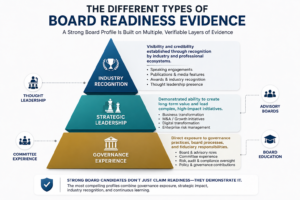
Governance Experience as Board Readiness Evidence
Governance exposure remains one of the most valuable indicators of board readiness.
This may include:
- Non-profit board service
- Advisory board participation
- Audit committee involvement
- Risk committee responsibilities
- Compliance oversight roles
These experiences demonstrate familiarity with governance frameworks, board processes, and fiduciary responsibilities.
Even limited governance exposure can significantly strengthen a candidate’s board narrative when presented effectively.
Strategic Leadership as Board Readiness Evidence
Boards are interested in leaders who understand long-term value creation.
Examples include:
- Business transformation initiatives
- Market expansion programs
- Mergers and acquisitions
- Digital transformation projects
- Enterprise risk management implementation
Such initiatives demonstrate the ability to think beyond day-to-day operations.
Industry Recognition as Board Readiness Evidence
Visibility matters.
Recognition through industry publications, conferences, and expert commentary reinforces professional credibility.
Useful signals include:
- Keynote speaking engagements
- Published articles
- Podcast appearances
- Panel discussions
- Industry awards
For example, publishing thought leadership on governance trends through respected platforms can significantly strengthen board visibility.
Resources available from World Economic Forum and governance-focused discussions published by Harvard Business Review often provide valuable perspectives that directors can reference and engage with.
Building Board Readiness Evidence Through Governance Experience
One of the fastest ways to strengthen board readiness evidence is through practical governance involvement.
Many aspiring directors believe they need a corporate board seat before they can build board credibility. In reality, governance exposure often comes first.
Join Advisory Boards
Advisory boards provide valuable opportunities to contribute strategic insights without the legal responsibilities associated with formal directorships.
Benefits include:
- Exposure to board-level discussions
- Strategic decision-making experience
- Stakeholder engagement opportunities
- Governance understanding
Participate in Committee Structures
Committee participation demonstrates readiness for specialized board responsibilities.
Areas include:
- Audit oversight
- Risk management
- ESG governance
- Technology governance
- Compensation oversight
Boards increasingly seek directors with committee-level expertise.
Pursue Governance Education
Formal governance education enhances credibility and strengthens board readiness evidence.
Programs from institutions such as OECD governance resources and governance-focused executive education providers can help professionals deepen their understanding of director responsibilities.
For executives looking to accelerate their transition, exploring board-focused resources through board leadership insights and governance articles can also help refine positioning.
Demonstrating Board Readiness Evidence Through Thought Leadership
Many executives underestimate the power of visible expertise.
Board candidates who consistently share informed perspectives establish credibility before opportunities arise.
Publish Strategic Insights
Articles focused on:
- Governance
- Risk oversight
- Industry disruption
- Digital transformation
- Leadership challenges
help showcase strategic thinking.
The objective is not self-promotion. It is demonstrating the ability to analyze complex issues from a board-level perspective.
Speak at Industry Events
Speaking engagements provide evidence of influence and expertise.
Board recruiters often view conference participation as a positive signal because it demonstrates industry relevance and communication capability.
Contribute to Professional Communities
Participation in executive and governance communities expands visibility and creates opportunities for board-related conversations.
The most successful board candidates become known before they become available.
How Ecosystem Participation Signals Board Potential
Board opportunities frequently emerge through professional ecosystems rather than formal applications.
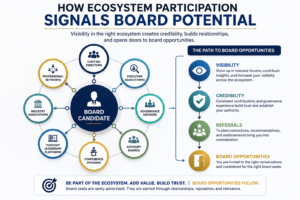
This makes ecosystem participation a powerful source of board readiness evidence.
Build Relationships Within Governance Networks
Many board appointments originate through trusted referrals.
Active participation in governance-focused communities increases visibility among:
- Existing directors
- Governance advisors
- Executive search firms
- Industry leaders
Relationships often become opportunities.
Engage With Industry Associations
Industry associations provide opportunities to:
- Serve on committees
- Influence industry discussions
- Demonstrate leadership
- Expand professional networks
These activities create visible indicators of board-level engagement.
Become a Recognized Contributor
The strongest candidates contribute consistently rather than appearing only when they need a board seat.
Boards value professionals who already participate in shaping industry conversations.
As leadership experts discussed in various articles published by Forbes, visible expertise often creates opportunities before formal recruitment begins.
Turning Executive Achievements into Board-Relevant Evidence
Many executives already possess substantial board readiness evidence.
The challenge lies in presenting achievements through a governance lens.
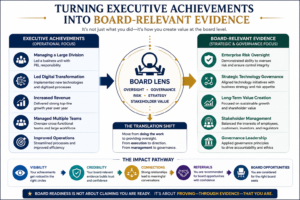
Instead of saying:
“I managed a large division.”
Frame it as:
“I provided oversight for a multi-market business unit, managed enterprise risk exposure, and contributed to long-term growth strategy.”
Instead of saying:
“I led digital transformation.”
Frame it as:
“I guided strategic technology investments while balancing innovation, risk, and stakeholder expectations.”
This shift transforms executive accomplishments into board-relevant signals.
A well-developed board narrative highlights governance relevance rather than operational execution alone.
Current corporate governance insights also emphasize the growing importance of strategic oversight capabilities among modern directors.
Many aspiring directors strengthen this positioning through a structured executive board branding strategy.
Common Mistakes That Weaken Board Readiness Evidence
Even highly accomplished executives can undermine their positioning.
Focusing Only on Operational Success
Operational excellence is valuable, but boards seek strategic oversight capabilities.
Waiting Until a Board Search Begins
Board positioning should start years before pursuing appointments.
Neglecting Visibility
Exceptional leaders often assume results speak for themselves.
Unfortunately, invisible achievements rarely influence board selection decisions.
Overusing the Phrase “Board-Ready”
The more frequently someone claims readiness, the more likely decision-makers are to question the evidence.
Strong candidates allow their track record to communicate readiness naturally.
Ignoring Governance Education
Continuous learning demonstrates commitment to board effectiveness and modern governance expectations.
Board Readiness Evidence Checklist
Before pursuing board opportunities, evaluate whether your professional profile demonstrates the following forms of board readiness evidence.
| Board Readiness Area | Evidence Present? |
| Governance exposure | ✓ / ✗ |
| Advisory board experience | ✓ / ✗ |
| Risk oversight involvement | ✓ / ✗ |
| Enterprise-wide strategic leadership | ✓ / ✗ |
| Thought leadership publications | ✓ / ✗ |
| Industry speaking engagements | ✓ / ✗ |
| Professional governance network participation | ✓ / ✗ |
| Board-focused personal brand | ✓ / ✗ |
| Committee experience | ✓ / ✗ |
| Ongoing governance education | ✓ / ✗ |
The more boxes you can confidently check, the stronger your board positioning becomes.
Conclusion
The reality of board recruitment is simple: evidence wins.
Directors are not appointed because they say they are board-ready. They are appointed because their experience, visibility, governance exposure, and professional reputation make that conclusion obvious.
Strong board readiness evidence is built over time through strategic leadership, governance participation, thought leadership, and meaningful engagement within the broader business ecosystem. Every advisory role, committee contribution, industry presentation, published article, and governance initiative adds another layer of credibility.
For senior executives pursuing board opportunities, the objective should not be to convince others of readiness. The objective should be to create a professional footprint that demonstrates readiness without explanation.
When your track record consistently reflects governance capability, strategic judgment, and board-level contribution, decision-makers no longer need to be persuaded. The evidence speaks for itself.
FAQs
- What is board readiness evidence?
Board readiness evidence refers to the visible experiences, achievements, governance exposure, and strategic contributions that demonstrate suitability for board roles.
- Why is board readiness evidence important?
It provides tangible proof of governance capability and helps boards evaluate candidates beyond self-declared qualifications.
- How can executives build board readiness evidence?
Executives can build board readiness evidence through governance experience, advisory boards, thought leadership, committee participation, and strategic leadership initiatives.
- Is executive experience alone enough for a board seat?
Not always. Boards typically seek governance exposure and strategic oversight experience in addition to executive leadership credentials.
- What are examples of board readiness evidence?
Examples include advisory board service, committee participation, governance certifications, industry speaking engagements, and published thought leadership.
- How does governance experience strengthen board readiness evidence?
Governance experience demonstrates familiarity with fiduciary responsibilities, board dynamics, oversight functions, and decision-making processes.
- Can nonprofit board service improve board readiness evidence?
Yes. Nonprofit board service provides valuable governance experience that can strengthen a candidate’s board profile.
- Does thought leadership contribute to board readiness evidence?
Yes. Publishing articles, speaking at events, and sharing strategic insights can enhance visibility and credibility.
- How do board recruiters evaluate board readiness evidence?
Recruiters assess governance exposure, strategic expertise, leadership impact, reputation, and industry relevance.
- What role does networking play in board readiness evidence?
Strong governance networks increase visibility and create opportunities to demonstrate board-level expertise.
- How can professionals showcase board readiness evidence on LinkedIn?
They can highlight governance experience, strategic achievements, advisory roles, board education, and thought leadership contributions.
- Is governance education necessary for board readiness?
While not always mandatory, governance education strengthens knowledge and demonstrates commitment to board effectiveness.
- How long does it take to build board readiness evidence?
Building credible board readiness evidence is typically a long-term process that develops through continuous leadership and governance involvement.
- What mistakes weaken board readiness evidence?
Overemphasizing operational achievements, lacking visibility, neglecting governance exposure, and relying solely on self-promotion can weaken board positioning.
- How can a board-focused personal brand support board readiness evidence?
A strong personal brand helps communicate governance expertise, strategic thinking, and board-level value to decision-makers.
Ready to Strengthen Your Board Presence and Unlock New Board Opportunities?
If your executive experience deserves greater board-ready personal brand, now is the time to turn your accomplishments into compelling board readiness evidence.
At Your Board Profile, we help senior leaders, CXOs, and aspiring directors build a board-focused professional brand that attracts the right opportunities. From board CV development and LinkedIn positioning to governance branding and board-readiness strategy, our solutions are designed to help your experience stand out where it matters most.
Whether you’re an aspiring Independent Director, CXO, Founder, or senior executive, a well-positioned board profile can make all the difference in today’s competitive board landscape.
Book a complimentary strategy session with Your Board Profile today.