
Introduction:
Leadership inside the modern boardroom has changed dramatically. Technical expertise, financial intelligence, and operational efficiency are still important, but they are no longer enough to inspire confidence at the highest level. Today, Strategic Storytelling in the Boardroom has become one of the most powerful leadership tools for CEOs, board directors, founders, and governance professionals.
Why? Because people no longer connect with corporate language alone. Investors want transparency. Employees want purpose. Stakeholders want authenticity. Boards now operate in an environment where reputation can shift overnight, and trust has become one of the most valuable forms of corporate capital.
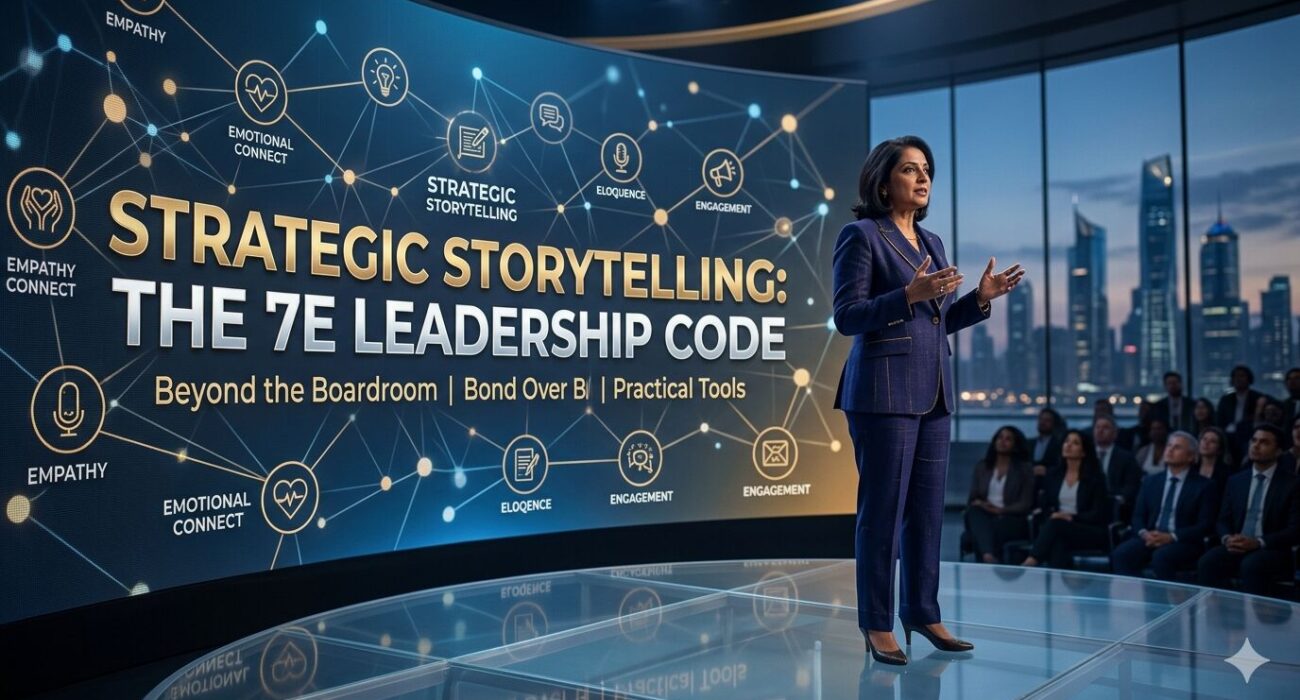
This is exactly where the 7E Framework for Leaders creates a competitive advantage. It transforms leadership communication from transactional messaging into meaningful influence. Instead of simply presenting numbers and strategies, leaders learn how to connect emotionally, communicate vision clearly, and create lasting alignment across organizations.
The modern boardroom is no longer just a place for governance discussions. It has become a stage where narratives shape perception, confidence, and long-term credibility.

Table of Contents
- Why Leadership Communication Has Become a Boardroom Priority
- Understanding Strategic Storytelling in the Boardroom
- The Rise of Human-Centric Leadership
- The 7E Framework for Leaders
- Strategic Framework Comparison Table
- Benefits of Strategic Storytelling in the Boardroom
- Common Mistakes Leaders Make
- Executive Checklist for Leadership Storytelling
- How Leaders Can Apply the 7E Model
- Conclusion
- FAQs
Why Leadership Communication Has Become a Boardroom Priority
Corporate governance is no longer limited to compliance reports and quarterly meetings. The expectations placed on leaders today are far broader and more demanding. A board director is expected to inspire confidence during uncertainty, communicate vision during transformation, and maintain trust during crises.
That shift explains why Leadership Communication Frameworks are becoming central to executive success. Organizations are increasingly realizing that communication is not a soft skill anymore. It is a governance asset.
When leaders fail to communicate effectively, confusion spreads quickly across stakeholders. Investors begin questioning strategic clarity. Employees lose alignment with company goals. Media narratives start defining the organization instead of the leadership team itself.
On the other hand, leaders who communicate with authenticity and clarity build stronger institutional trust. They create emotional alignment that numbers alone cannot achieve. A well-crafted narrative often influences decision-making more effectively than endless presentations filled with data.
Research from Harvard Business Review consistently highlights that emotionally connected organizations outperform competitors in trust, engagement, and long-term loyalty. Similarly, insights from McKinsey & Company show that organizations with strong communication cultures adapt faster during periods of disruption.
The message is simple: the future belongs to leaders who can connect strategy with storytelling.
Understanding Strategic Storytelling in the Boardroom
At its core, Strategic Storytelling in the Boardroom is the ability to communicate vision, governance priorities, and organizational direction through narratives that inspire action and trust.
This is not about motivational speeches or theatrical presentations. Strategic storytelling is about translating complexity into clarity. It helps leaders simplify difficult decisions, explain strategic transformations, and align diverse stakeholders around a common purpose.
Think about the most respected global leaders in business and governance. What makes them memorable is rarely just intelligence. It is their ability to make people believe in a larger vision.
Stories create emotional retention. Facts inform people, but stories move them. In governance and corporate leadership, that distinction matters immensely.
For example, when a company announces a sustainability transformation, stakeholders do not only want statistics about carbon reduction. They want to understand the purpose behind the initiative. They want to know how leadership sees the future. They want conviction.
This is where storytelling becomes a governance instrument rather than a communication tactic.
To strengthen your governance positioning and executive communication strategy, explore Your Board Profile’s executive branding services designed specifically for board directors, founders, and senior leadership professionals.
The Rise of Human-Centric Leadership
The traditional image of leadership was built around authority, hierarchy, and distance. Modern leadership is moving in the opposite direction. Today’s influential leaders prioritize connection over control.
This evolution is reshaping Governance and Corporate Leadership globally. Boards are now expected to demonstrate empathy, transparency, and emotional intelligence alongside financial stewardship.
The reason is straightforward. Human beings naturally trust leaders who appear authentic and relatable. A boardroom filled with polished corporate jargon may sound impressive, but it rarely creates emotional trust.
The strongest leaders today understand how to communicate with humanity while maintaining executive authority. They know how to balance logic with emotional resonance.
Leadership communication now requires emotional intelligence because organizations themselves have become emotionally driven ecosystems. Employees seek purpose-driven workplaces. Investors evaluate leadership credibility beyond financial performance. Customers increasingly support brands aligned with values and ethics.
According to PwC Global Insights, trust and transparency are among the top factors influencing stakeholder confidence in leadership teams. This trend is pushing storytelling closer to the center of modern governance.
The 7E Framework for Leaders

The most practical aspect of Strategic Storytelling in the Boardroom is the 7E Leadership Framework. It provides executives with a structured communication model designed specifically for high-stakes leadership environments.
Empathy
Empathy is the foundation of influential communication. Great leaders do not start with what they want to say. They start with what the audience needs to hear.
Board directors who practice empathy understand stakeholder concerns before presenting solutions. They recognize emotional dynamics inside organizations and adapt communication accordingly.
Empathy creates psychological trust, and trust is the foundation of governance credibility.
Emotional Connect
People rarely remember presentations filled with spreadsheets. They remember moments that made them feel something.
An emotional connection transforms leadership from management into inspiration. This does not mean becoming overly dramatic. It means communicating with authenticity, vulnerability, and human relevance.
When leaders share meaningful experiences, stakeholders become emotionally invested in the vision itself.
Edutainment
Complex ideas often fail because they are communicated poorly. Edutainment combines education with engagement.
The best boardroom communicators simplify difficult concepts through relatable examples, storytelling techniques, and memorable narratives. They make strategy understandable rather than intimidating.
This skill is particularly valuable during mergers, organizational transformation, or crisis communication.
Evocation
Evocation is the ability to paint a vivid picture of the future. Strong leaders help stakeholders visualize success before it happens.
Whether discussing innovation, governance reform, or long-term strategy, evocative communication creates emotional anticipation and collective alignment.
Eloquence
Eloquence is not about sounding sophisticated. It is about communicating clearly, precisely, and persuasively.
Great boardroom communication avoids unnecessary jargon. It delivers clarity with confidence.
Energizing
Leadership energy is contagious. Teams mirror the emotional state of leadership.
An energizing communicator creates optimism even during uncertainty. They inspire action instead of fear.
Engaging Across Multiple Platforms
Modern leadership communication extends far beyond board meetings. Leaders now communicate through interviews, social media, shareholder letters, podcasts, and digital platforms.
Each platform requires a different storytelling approach while maintaining a consistent leadership identity.
Leaders looking to enhance their boardroom presence and strategic narrative can also explore the structured positioning methodology followed by Your Board Profile’s board readiness process for governance-focused leadership branding.
Strategic Storytelling Framework Comparison Table
| Communication Style | Traditional Leadership | Strategic Storytelling Leadership |
| Communication Focus | Information Delivery | Emotional Connection |
| Stakeholder Trust | Transactional | Relational |
| Governance Impact | Reactive | Proactive |
| Employee Alignment | Limited | High |
| Brand Reputation | Controlled Messaging | Authentic Influence |
| Crisis Management | Defensive | Trust-Centered |
| Investor Confidence | Data-Based | Narrative + Data |
Benefits of Strategic Storytelling in the Boardroom
True Boardroom Excellence is not created by intelligence alone. It is created when leadership vision becomes understandable, believable, and actionable across the organization.
Storytelling strengthens strategic clarity because it creates alignment. When people understand the “why” behind decisions, resistance decreases significantly.
This is especially important during organizational change. Employees are far more likely to support transformation when leaders communicate a compelling future vision rather than issuing top-down directives.
Boards that prioritize communication culture often experience stronger stakeholder engagement, healthier reputations, and more resilient organizational trust.
A study from Deloitte Insights found that organizations with transparent leadership communication outperform competitors during periods of uncertainty and disruption.
Common Mistakes Leaders Make in Boardroom Communication
Even highly experienced executives make communication mistakes that weaken leadership influence.
One major mistake is overloading stakeholders with data while ignoring emotional connection. Numbers provide evidence, but stories create meaning.
Another mistake is using excessive corporate jargon. Sophisticated language often creates distance instead of credibility.
Some leaders also communicate only during crises. Effective storytelling should be continuous, not reactive.
Perhaps the biggest mistake is failing to adapt communication across audiences. Investors, employees, regulators, and media stakeholders require different messaging approaches.
Leaders who understand audience psychology communicate far more effectively.
Executive Checklist for Strategic Leadership Storytelling
Use this checklist before your next board presentation or executive communication:
- Define the emotional objective behind your message
- Understand stakeholder concerns beforehand
- Simplify complex ideas into relatable language
- Include real-world examples or narratives
- Align storytelling with governance values
- Maintain authenticity and transparency
- Adapt messaging for different communication platforms
- End with a clear strategic vision
Executives preparing for board-level opportunities can further strengthen their governance visibility through Your Board Profile’s board leadership and profile optimization solutions focused on strategic storytelling, executive positioning, and boardroom credibility.
How CEOs and Board Directors Can Apply the 7E Model
The 7E model becomes powerful when applied consistently across leadership interactions.
A CEO leading organizational transformation can use empathy to address employee uncertainty. Emotional connection can reinforce shared purpose. Evocation can help teams visualize long-term success.
Similarly, board directors can use storytelling during investor meetings to create strategic confidence instead of merely reporting financial performance.
Entrepreneurs seeking board-level credibility can also benefit enormously from strategic storytelling. Investors often evaluate founders based on communication clarity as much as business models.
Leadership today is no longer only about decision-making authority. It is about narrative leadership.
This is why executive branding and governance storytelling are becoming inseparable.
If you are building your executive presence for board-level opportunities, investing in your communication strategy can significantly strengthen your leadership positioning and governance credibility.

Conclusion
The future of leadership belongs to communicators who can inspire trust, articulate vision, and build meaningful human connection inside the boardroom and beyond. Strategic Storytelling in the Boardroom is becoming one of the most essential leadership capabilities for modern executives and governance professionals.
Strategic Storytelling in the Boardroom is no longer optional for modern executives. It has become a critical leadership advantage in an era shaped by reputation, transparency, and stakeholder scrutiny.
The 7E Leadership Framework offers more than communication techniques. It provides a blueprint for authentic influence, stronger governance, and long-term credibility.
Boards today do not simply need intelligent leaders. They need leaders who can unite people around a shared mission, simplify complexity, and create emotional alignment during moments of uncertainty.
The organizations that will dominate the future are the ones led by storytellers who understand strategy, governance, and humanity equally well.
If you are preparing for board-level leadership, executive branding, or governance advisory roles, this is the moment to strengthen your communication legacy and leadership narrative.
FAQs
- What is Strategic Storytelling in the Boardroom?
It is the practice of using storytelling techniques to communicate leadership vision, governance priorities, and strategic direction effectively.
- Why is storytelling important for board directors?
Strategic Storytelling in the Boardroom is important because it helps leaders build trust, communicate vision clearly, and strengthen stakeholder engagement.
- What is the 7E Framework for Leaders?
The framework includes Empathy, Emotional Connect, Edutainment, Evocation, Eloquence, Energizing, and Engaging Across Platforms.
- How does storytelling improve governance?
It enhances transparency, alignment, and credibility among stakeholders.
- Can storytelling help during organizational change?
Yes. Storytelling reduces resistance by helping employees understand the purpose behind change.
- Is storytelling useful for investor relations?
Absolutely. Investors trust leaders who communicate vision with clarity and confidence.
- What are common communication mistakes in leadership?
Overusing jargon, lacking emotional connection, and failing to adapt messaging are major mistakes.
- How can executives improve boardroom communication?
By practicing clarity, empathy, authenticity, and audience-focused messaging.
- Does storytelling strengthen executive branding?
Yes. It helps leaders establish authority, trust, and memorability.
- Can storytelling improve employee engagement?
Strong storytelling creates emotional alignment and organizational purpose.
- How does emotional intelligence affect leadership communication?
It helps leaders connect authentically with stakeholders.
- What role does authenticity play in storytelling?
Authenticity creates trust and credibility.
- Can startups benefit from strategic storytelling?
Yes. Founders often attract investors through compelling narratives.
- Why is human-centric leadership becoming important?
Modern stakeholders expect transparency, empathy, and purpose-driven leadership.
- What is the biggest benefit of strategic storytelling?
It transforms leadership communication into lasting influence.
1 Comment