
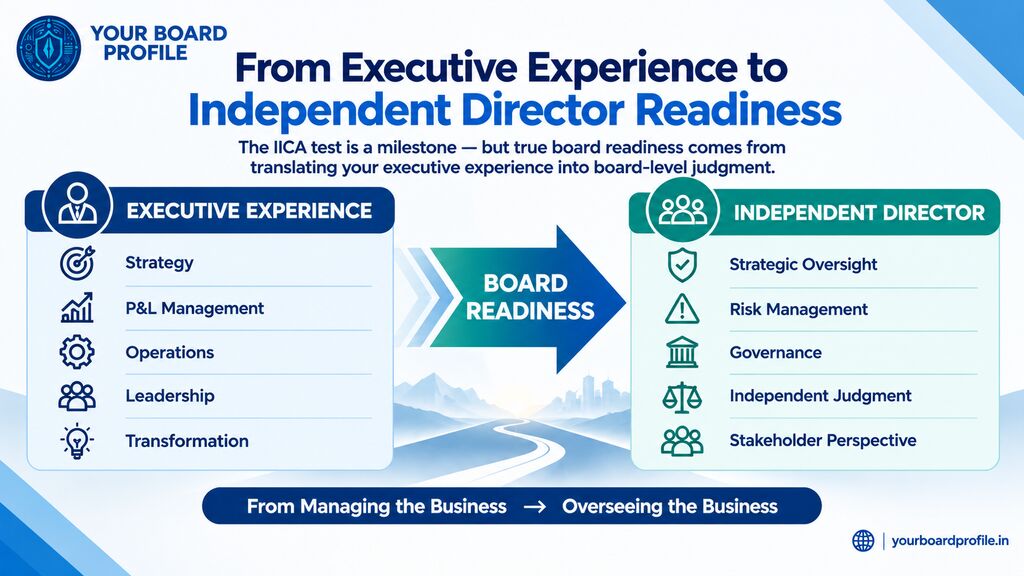
For many senior executives, becoming an Independent Director looks like a natural next step. You may have spent two decades building businesses, managing P&Ls, leading transformation, handling investors, navigating difficult stakeholders, or making high-stakes decisions. Yet the boardroom operates by a different rhythm. A strong executive is expected to deliver; an Independent Director is expected to question, oversee, challenge constructively, exercise judgment and protect the long-term interests of the company and its stakeholders. That is why the Indian regulatory framework places importance not only on professional experience but also on an individual’s understanding of corporate law, securities regulation, finance, governance and board responsibilities.
The IICA online proficiency self-assessment test sits within this broader framework. It should therefore be viewed less as a bureaucratic hurdle and more as a structured checkpoint: Do you understand the language, responsibilities and governance environment in which an Independent Director must operate? The Indian Institute of Corporate Affairs (IICA) states that its Independent Directors Databank was created under the framework of Section 150 of the Companies Act, 2013, and that it provides learning resources and the online proficiency self-assessment test.
For an experienced CXO, the interesting part is that the test is not really about starting your career again. It is about translating existing business judgment into board-level governance judgment. Think of your professional experience as the engine of a car and governance knowledge as the steering and braking system. A powerful engine without control can create risk; similarly, impressive executive experience without board-level governance understanding can leave gaps when you are expected to challenge management, evaluate disclosures, understand committee responsibilities or assess risk.
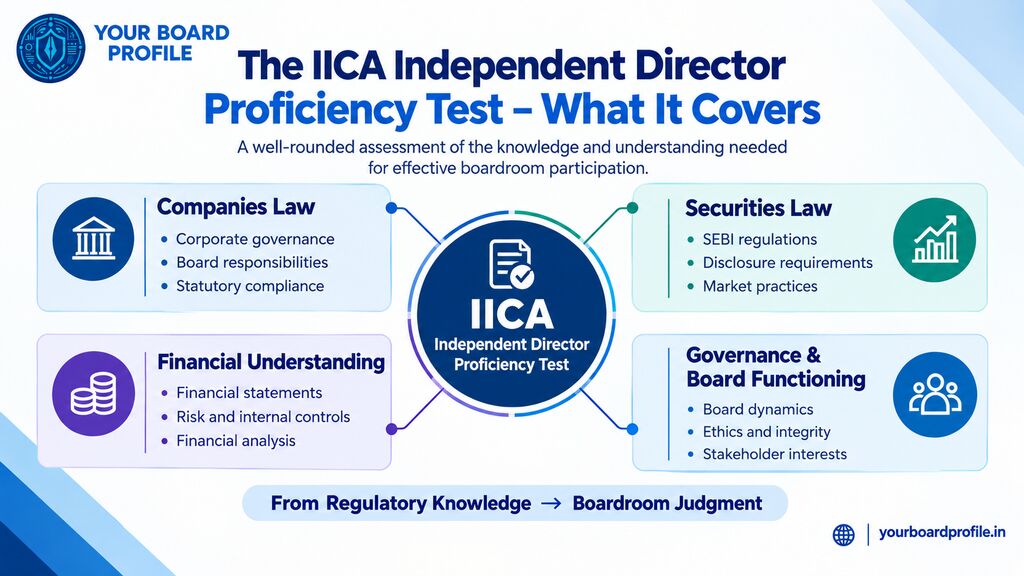
The IICA framework covers areas such as company law, securities law and basic accountancy, along with other areas relevant to the functioning of an independent director. For professionals preparing for a board career, the real opportunity is to use the preparation process to strengthen both regulatory knowledge and practical boardroom thinking.
Table of Contents
Understanding the Legal Framework for an Independent Director
The first mistake many aspiring directors make is to treat the IICA test as an isolated examination. It is better understood as one component of a larger statutory and professional framework governing an Independent Director in India. Section 149 of the Companies Act, 2013 establishes the framework for independent directors, while Section 150 deals specifically with the manner of selection and the maintenance of a databank of eligible and willing individuals. Section 150 allows an independent director to be selected from a databank maintained by a body, institute or association notified by the Central Government, while the company retains responsibility for carrying out its own due diligence before making an appointment.
This distinction is important. Being listed in the databank does not mean that an individual has been appointed to a board, nor does passing the proficiency test guarantee an appointment. It establishes regulatory compliance and creates a platform through which board-ready professionals can become visible to companies seeking independent director talent.
The framework has also evolved since the original 2019 rules. The Companies (Appointment and Qualification of Directors) Rules were amended in December 2020, including changes to the time available for passing the test and the experience-based exemption. Under the amended Rule 6(4), the relevant period became two years from inclusion in the databank, while the exemption was revised around a minimum of three years of qualifying experience as a director or key managerial personnel in specified companies or bodies corporate, subject to the conditions in the rules.
This is precisely why candidates should avoid relying on old blog posts, coaching notes or social-media explanations that still describe the earlier one-year or ten-year thresholds. The regulatory position should always be checked against the latest applicable MCA/IICA material before you make decisions about registration, exemption or test preparation.
Section 150 of the Companies Act, 2013 and the Databank
Section 150 is central to understanding the Independent Directors Databank. The law provides for a databank containing the names, addresses and qualifications of people who are eligible and willing to act as independent directors. It also makes an important point that is sometimes overlooked: the company making the appointment remains responsible for due diligence. In other words, the databank is not a shortcut around the company’s assessment process. A candidate still needs to demonstrate independence, relevant experience, credibility, competence and fit with the company’s requirements.
The IICA explains that its Independent Directors Databank is intended to support capacity building and help create an ecosystem connecting individuals who are willing and eligible to act as independent directors with companies looking for suitable board talent. For an aspiring director, this means registration should be viewed as one part of a broader board-readiness journey. Your statutory eligibility answers the question, “Can I be considered?” Your board profile, governance capability and professional positioning help answer the much more competitive question, “Why should this company consider me?” That distinction becomes increasingly important as senior professionals move from executive visibility toward board-level visibility.
Rule 6(4) and the Online Proficiency Self-Assessment Test
Rule 6 of the Companies (Appointment and Qualification of Directors) Rules, 2014 sets out compliance requirements for individuals eligible and willing to be appointed as independent directors. The 2019 framework introduced the online proficiency self-assessment test, with a passing score originally defined as at least 60% in aggregate and no limit on the number of attempts. The subsequent amendment changed the period for passing the test and revised the qualifying experience exemption. The practical message for candidates is straightforward: check your current databank status, determine whether you fall within an exemption, and verify the applicable timeline before beginning your preparation.
The test itself should not be confused with a conventional professional qualification such as a CA, CS, CMA or law degree. Its purpose is to assess whether an individual has sufficient knowledge across areas relevant to serving as an independent director. The IICA databank framework specifies that the proficiency self-assessment covers companies law, securities law, basic accountancy and other relevant areas. For a senior executive, the most effective preparation therefore combines conceptual study with application. Instead of memorising isolated provisions, ask yourself how a particular rule would affect a board agenda, committee discussion, related-party transaction, financial disclosure, governance decision or director’s responsibility.
Who Needs to Take the Independent Director Proficiency Test?
If you are planning to become an Independent Director, do not assume that your seniority automatically removes the test requirement. The applicable rules distinguish between registration with the databank and exemption from the online proficiency test. IICA’s current information explains that professionals aspiring to become independent directors are required to apply online for inclusion in the databank, while qualifying experience can affect whether the proficiency test itself is required. This is particularly relevant for experienced CXOs because a candidate may have significant corporate experience but still need to examine whether that experience satisfies the specific statutory exemption conditions.
A useful way to approach the question is to create a personal compliance checklist before you begin studying. First, establish whether you are eligible and willing to act as an independent director under the applicable provisions. Next, review your career history against the experience conditions in Rule 6. Then verify your databank registration requirements and the current IICA process. Finally, if the test applies to you, create a preparation schedule rather than leaving the assessment until the end of your registration window. Regulatory preparation becomes much easier when treated as a project with milestones rather than as an exam that you will “somehow get around to.”
Independent Director Proficiency Test Exemption
The phrase “Independent Director proficiency test exemption” is often searched by CAs, CSs, CMAs, advocates and experienced corporate professionals. However, professional qualification by itself should not be treated as a blanket exemption. The applicable Rule 6(4) exemption is based on specified professional experience and corporate roles rather than simply holding a CA, CS, CMA or Advocate qualification. The 2020 amendment specifies qualifying experience of at least three years, as on the date of inclusion in the databank, in specified roles and entities, including as a director or KMP in a listed public company, an unlisted public company with paid-up share capital of at least ₹10 crore, or specified qualifying bodies corporate, subject to the detailed rule conditions.
That makes it important to distinguish between professional expertise and statutory exemption. A practising Chartered Accountant may bring excellent financial expertise to a board but should not automatically conclude that the CA qualification itself eliminates the test. Similarly, an advocate may have exceptional knowledge of corporate law without that qualification alone establishing exemption. Before relying on an exemption, candidates should review the current text of Rule 6(4), their actual corporate roles and dates, and the latest IICA instructions. If there is uncertainty, professional regulatory advice is preferable to relying on an online article or informal interpretation.
Understanding the IICA Independent Director Exam Syllabus
There is no substitute for understanding what you are actually expected to know. The IICA independent director exam syllabus is best approached through the areas identified in the databank framework rather than through random collections of multiple-choice questions. IICA’s framework identifies companies law, securities law, basic accountancy and other areas relevant to the functioning of an independent director. The IICA e-learning platform also provides courses covering subjects such as incorporation, share capital, general meetings, accounts, debentures, related-party transactions, audit, mergers and acquisitions, directors’ duties, director liability, board meetings, board committees and SEBI LODR-related topics.
For an experienced executive, this breadth can initially appear intimidating. The solution is to organise the material around boardroom decisions. Ask: What would I need to understand before voting on this? What question should I ask management? What disclosure would matter? Which committee should examine this? What could expose the company or directors to regulatory, financial or reputational risk? This approach transforms preparation from textbook learning into governance learning. You are not simply trying to remember provisions; you are building the mental model required to participate intelligently in a board discussion.
Core Areas Covered in the Test
A practical preparation map can be built around five broad knowledge clusters:
| Knowledge area | What an aspiring Independent Director should understand |
| Companies law | Directors’ duties, meetings, appointments, liabilities, related-party matters and key statutory requirements |
| Securities law | Listed-company obligations, disclosures, investor protection and relevant SEBI requirements |
| Financial understanding | Basic accounts, financial statements, financial prudence and the ability to ask informed questions |
| Governance | Board committees, oversight, accountability, risk and stakeholder considerations |
| Board functioning | Board processes, decision-making, responsibilities and the role of an independent director |
This is where senior executives often have an advantage—but only if they use it properly. Someone from finance may find accountancy relatively comfortable but need more preparation in securities regulation. A lawyer may be strong in statutory interpretation but need to refresh financial concepts. A technology leader may understand risk, transformation and cyber issues exceptionally well but need structured preparation in board processes and securities law. The goal is not to become an expert in every discipline. The goal is to develop sufficient governance fluency to understand what is being discussed, identify what is missing and ask the right questions.
Independent Directors Databank and E-Learning Modules
The Independent Directors Databank e-learning modules can be particularly useful because they turn preparation into a structured learning journey. IICA describes the databank as an integrated learning management system containing interactive e-learning resources designed to refresh knowledge and improve the effectiveness of non-executive and independent directors. The courses cover a wide range of board-relevant topics, including company law, director duties, liabilities, board meetings, board committees, audit and auditors, related-party transactions and SEBI LODR.
Do not make the mistake of treating these modules merely as material to consume before an examination. Use them as a governance refresher. When you encounter a topic such as related-party transactions, pause and connect it with situations you have encountered during your executive career. When studying board committees, think about how an Audit Committee or Nomination and Remuneration Committee operates differently from an executive management meeting. When reviewing director duties, consider how the concept of independence changes the way you evaluate information supplied by management. This habit of connecting rules with real board situations is what turns preparation into capability.
How to Prepare for the IICA Proficiency Test
Preparing for the IICA proficiency test becomes much easier when you stop trying to cover everything at once. Start by identifying your strongest and weakest knowledge areas. A finance professional may need only a refresh of financial reporting concepts but considerably more time on securities law and governance. A legal professional may find company law familiar but need deliberate preparation around accounting and board-level financial interpretation. An operations or technology executive may benefit from building a foundation across several regulatory areas before moving to practice questions.
A sensible preparation cycle is to divide your study into three phases. The first phase is foundation, where you learn the terminology and understand the basic regulatory framework. The second is application, where you connect those concepts to board scenarios and practical questions. The third is assessment, where you use practice questions and mock tests to identify recurring weaknesses. This approach also helps reduce the anxiety that often comes with a regulatory examination. You are not attempting to memorise the entire corporate law universe; you are progressively developing the knowledge required to operate responsibly as an Independent Director.
Build a Practical Study Strategy
A strong study plan should be realistic for a working senior professional. Instead of scheduling four or five hours every day and abandoning the plan after a week, consider shorter, consistent sessions. For example, dedicate specific blocks to company law, securities law, financial understanding and governance, then reserve separate sessions for revision and testing. Maintain a simple error log: every time you answer a question incorrectly, record the concept behind the mistake rather than simply noting the correct answer.
| Preparation stage | Primary objective | Practical action |
| Foundation | Understand the framework | Study core IICA material and relevant provisions |
| Consolidation | Connect concepts | Relate rules to boardroom situations |
| Practice | Improve accuracy | Attempt topic-wise questions |
| Mock assessment | Test readiness | Take timed mock tests |
| Revision | Eliminate recurring errors | Review the error log and weak topics |
This method is particularly valuable for CXOs because your professional experience can create a false sense of familiarity. You may recognise a concept but interpret it through an executive lens rather than a director’s lens. A board member cannot simply say, “Management will handle it.” The independent director’s responsibility is to exercise appropriate oversight and diligence. Preparation should therefore train you to think beyond operational ownership and toward governance accountability.
Use Mock Tests for Independent Director Exam Preparation
Mock tests for independent director exam preparation are useful because they reveal the difference between knowing a topic and being able to answer questions accurately under assessment conditions. A candidate can read company law for weeks and still lose marks because two provisions appear similar, a question is worded negatively, or the candidate selects the answer that sounds commercially sensible rather than legally correct. Mock assessments expose these patterns early. They also help you understand where your preparation is genuinely weak.
Use mock tests strategically rather than repeatedly taking them without reviewing mistakes. After each attempt, classify errors into three categories: knowledge gap, interpretation error, or careless mistake. A knowledge gap requires study. An interpretation error requires more scenario-based practice. A careless mistake requires better test discipline. This simple classification can improve preparation much faster than endlessly collecting more study material. Remember, the objective is not to accumulate hundreds of questions; it is to become increasingly accurate and confident in the concepts that matter.
The Online Test Process and What Candidates Should Expect
The online proficiency self-assessment test is part of the compliance architecture surrounding the Independent Directors Databank. Under the original 2019 framework, an individual whose name was included in the databank was required to pass the online test within the prescribed period, with a minimum aggregate score of 60%, and there was no limit on the number of attempts. The later amendment extended the applicable period to two years and modified the exemption conditions. Because procedural details can change, candidates should rely on the current IICA portal and applicable rules for their specific registration status rather than treating historical timelines as current instructions.
Before attempting the assessment, check that your registration details are accurate and that you understand the current test instructions. Keep sufficient time for preparation rather than treating the final weeks as your only study window. It is also sensible to familiarise yourself with the platform, technical requirements and examination instructions in advance. The more administrative uncertainty you remove beforehand, the more attention you can devote to the actual questions.
What to Do on Test Day
Test-day performance is usually less about last-minute studying and more about disciplined execution. Read each question carefully, especially questions containing words such as “not,” “except,” “only,” “all” or “most appropriate.” Do not let your executive experience push you toward an answer that feels commercially attractive if the question is testing a specific legal or regulatory principle. When two answers appear plausible, return to the precise concept being tested rather than making an assumption based on how your own organisation handled a similar situation.
The larger lesson is useful beyond the IICA assessment. A boardroom often presents directors with incomplete information, competing viewpoints and decisions where the obvious answer is not necessarily the correct one. The discipline you develop while preparing for the test—reading carefully, distinguishing fact from assumption, checking the applicable rule and resisting overconfidence—is itself relevant to effective board participation. Passing the assessment is therefore an important milestone, but the habits developed during preparation can be even more valuable.
What Happens After You Clear the Proficiency Test?
Passing the test is a significant compliance milestone, but it is not the finish line for becoming an Independent Director. The databank framework creates a platform for eligible and willing professionals, while companies remain responsible for conducting due diligence before selecting a candidate. A successful test result does not automatically produce a board appointment. Companies will still look at your career, sector experience, governance understanding, independence, reputation, strategic perspective and the specific skills required on their board.
This is where many accomplished professionals underestimate the importance of positioning. Your executive CV may explain what you achieved as a CEO, CFO, CHRO, CTO or business leader, but a board profile must answer a different question: What value can you bring to a board without becoming part of management? Your experience needs to be translated into board-relevant themes such as strategic oversight, risk perspective, financial understanding, stakeholder management, transformation, technology, ESG, international markets or sector expertise. If you are building this transition deliberately, resources such as a board-ready portfolio and board-focused professional services can help you present your experience in a way that is relevant to board selection conversations.
Becoming Board-Ready Beyond the IICA Test
The best board candidates understand that board readiness is broader than regulatory compliance. Passing the IICA proficiency test demonstrates that you have addressed an important knowledge requirement. It does not demonstrate how you communicate in a board meeting, how you challenge a CEO without becoming operational, how you interpret a strategic risk, how you handle disagreement or how clearly you articulate your unique board value proposition. Those capabilities have to be developed and demonstrated separately.
Consider the difference between an executive résumé and a board narrative. An executive résumé might say that you increased revenue by 40%, led a transformation programme and managed a large team. A board narrative asks what those achievements reveal about your capacity for strategic oversight, risk assessment, capital allocation, stakeholder management or organisational transformation. This is why your executive personal branding beyond the job title becomes relevant when you start preparing for board opportunities. Your boardroom branding journey should make your governance perspective visible without overstating your experience.
Your board profile should also make your board value proposition easy to understand. What problems can you help a board think through? Which sectors or situations are you particularly equipped to understand? What perspective would you bring that complements existing directors? A well-developed board value proposition and board bio can help convert a long executive career into a concise governance story.
For senior executives, this transition is ultimately about changing the way the market sees you. You are moving from “I have successfully run functions and businesses” to “I can contribute independent judgment, oversight and strategic perspective at board level.” That shift requires substance first and communication second—but both matter. If you want to explore more perspectives on board careers, governance and executive visibility, you can also follow the Your Board Profile blog.
Conclusion
Becoming an Independent Director in India is not simply a matter of adding your name to a databank or passing an online examination. The IICA proficiency test is an important part of the regulatory pathway, but it should be viewed as one building block in a much larger board-readiness journey. Understanding Section 150 of the Companies Act, 2013, the Independent Directors Databank, Rule 6 requirements, the applicable exemption provisions and the knowledge areas covered by the proficiency assessment gives you a stronger foundation. IICA’s own framework makes clear that the databank is intended not only for empanelment but also for capacity building through learning resources and assessment.
For a senior executive, the smartest approach is therefore two-dimensional. Prepare seriously for the test by studying company law, securities law, financial concepts and governance, and use mock assessments to identify weaknesses. At the same time, start building the board-facing narrative that explains why your experience matters at board level. A passing score may open the compliance door, but board credibility, governance judgment, independence, visibility and a clearly articulated value proposition are what can help you move toward meaningful board opportunities.
Disclaimer: Please refer to MCA/ IICA Website for latest updates.
A Practical Next Step for Aspiring Independent Directors
If you are preparing for the Independent Director journey, do not wait until after the test to think about your board profile. Start translating your executive experience into governance themes now—strategic thinking, financial understanding, risk oversight, stakeholder perspective, questioning ability and boardroom communication. Your regulatory preparation and professional positioning can progress together.
Your experience may have taken decades to build. Your board story should be deliberate enough to make that experience understood.
Frequently Asked Questions
1. Is the IICA proficiency test compulsory for every Independent Director?
Not necessarily. The applicable rules provide an experience-based exemption from the online proficiency self-assessment test subject to specified conditions. However, candidates should distinguish between exemption from the test and the separate requirement relating to inclusion in the Independent Directors Databank. The current Rule 6 requirements and IICA instructions should be checked before relying on an exemption.
2. What is the passing score for the Independent Director proficiency test?
The 2019 rules stated that an individual obtaining at least 60% in aggregate in the online proficiency self-assessment test would be deemed to have passed. The same framework also stated that there was no limit on the number of attempts. Candidates should nevertheless verify the current IICA instructions applicable to their registration.
3. Do CAs, CSs, CMAs and Advocates automatically get an exemption?
No. Holding a professional qualification such as CA, CS, CMA or an advocacy qualification should not by itself be treated as an automatic exemption. The applicable exemption under Rule 6(4) is connected with specified experience and corporate roles. The 2020 amendment revised the qualifying experience requirement to three years for the specified categories, subject to the conditions contained in the rules.
4. What is the IICA Independent Director exam syllabus?
The proficiency assessment framework covers companies law, securities law, basic accountancy and other areas relevant to the functioning of an independent director. IICA’s e-learning resources additionally cover areas such as directors’ duties, board meetings, board committees, audit, related-party transactions and SEBI LODR.
5. What is Section 150 of the Companies Act, 2013?
Section 150 deals with the manner of selection of independent directors and maintenance of an Independent Directors Databank. It allows eligible and willing individuals to be included in a databank maintained by a notified body or institution, while the company remains responsible for conducting its own due diligence before making an appointment.
6. How long do I have to pass the proficiency test after registering?
The rules have changed over time. The original 2019 framework referred to one year, while the December 2020 amendment changed the relevant period to two years from inclusion in the databank. Always verify your current status and applicable timeline through the latest IICA information.
7. Can I become an Independent Director immediately after passing the test?
Passing the test does not guarantee a board appointment. The test addresses an important compliance and knowledge requirement, while companies continue to conduct their own due diligence and evaluate candidates for suitability, independence, experience, skills and board requirements.
8. Are Independent Directors required to register in the databank?
The databank framework requires eligible individuals seeking to serve as independent directors to follow the applicable registration process. IICA describes the databank as a repository of existing independent directors as well as individuals eligible and willing to be appointed as independent directors.
9. Are IICA e-learning modules useful for test preparation?
Yes. IICA describes its databank as an integrated learning management system with e-learning courses designed to refresh knowledge and improve the effectiveness of non-executive and independent directors. The modules cover a broad range of board and governance topics.
10. How should a CXO prepare for the IICA proficiency test?
A CXO should begin by assessing existing knowledge, then study the regulatory framework systematically, connect concepts to real board situations and use mock tests to identify weak areas. The objective should be understanding rather than memorising isolated provisions.
11. Are mock tests necessary for the Independent Director exam?
They are not a substitute for studying the underlying material, but they can be highly useful. Mock tests help identify knowledge gaps, interpretation errors and careless mistakes while also improving familiarity with question patterns and time management.
12. Does extensive corporate experience make the IICA test easier?
It can help, particularly where your experience overlaps with finance, governance, compliance, strategy or board processes. However, practical executive experience does not necessarily mean you are familiar with every relevant statutory provision. A structured revision is therefore valuable even for highly experienced professionals.
13. What should I do after clearing the IICA proficiency test?
Continue developing your board readiness. Review your board CV, board biography, LinkedIn positioning, governance knowledge, boardroom communication and board value proposition. Your objective should be to demonstrate not just that you meet a compliance requirement but also why your experience is relevant to a board.
14. Can a strong executive profile be used directly as a board profile?
It can provide the foundation, but the positioning usually needs to change. A board profile should emphasise strategic oversight, governance, risk, stakeholder perspective and areas of board-level contribution rather than simply listing operational responsibilities and career achievements.
15. What is the most important thing to remember about becoming an Independent Director?
Do not treat the IICA proficiency test as the destination. Treat it as one milestone in becoming genuinely board-ready. Regulatory knowledge, independent judgment, financial understanding, strategic thinking, governance capability, effective questioning and a credible board narrative together create a stronger foundation for a board career.
Ready to Take the Next Step Toward Your Independent Director Journey?
Passing the IICA Proficiency Test is an important milestone—but true board readiness goes beyond compliance. Strengthen your governance understanding, strategic thinking, risk oversight, independent judgment, and boardroom positioning to turn your professional experience into meaningful board-level value.
Whether you are a CXO, senior executive, entrepreneur, or aspiring Independent Director, start building a credible and board-ready profile today.
Schedule your complimentary session here:
https://calendly.com/dramitnagpal
Share this post: Facebook | X | LinkedIn