

Many senior executives assume that a board bio is simply a shorter version of their executive biography. That assumption quietly undermines countless board aspirations. The truth is that a board bio serves a completely different purpose. It is not a historical record of your professional journey. It is a strategic trust document designed to communicate your Board Value Proposition to nomination committees, board chairs, investors, and governance stakeholders.
Today’s boards operate in a far more complex environment than ever before. Directors are expected to contribute strategic insight, risk oversight, digital literacy, governance expertise, stakeholder management, and long-term value creation. Recent governance research from the Harvard Law School Forum on Corporate Governance shows that boards are increasingly prioritizing skills alignment, resilience planning, digital fluency, and strategic communication when evaluating directors. Boards are no longer looking for impressive résumés alone; they are searching for individuals who can contribute meaningfully to governance and strategic decision-making.
This shift means your board bio must answer one critical question: “Why should this individual be trusted to contribute value at the board level?” The strongest board bios communicate governance confidence, strategic relevance, and measurable impact. They present a compelling case that the executive can help guide organizations through complexity while safeguarding stakeholder interests.
Table of Contents
- Understanding the Real Purpose of a Board Bio
- What Is a Board Value Proposition?
- Why Trust Matters More Than Achievements
- Key Elements of a High-Impact Board Bio
- Common Mistakes That Weaken a Board Value Proposition
- How to Write a Board Bio That Signals Strategic Relevance
- Board Bio Example Framework
- Measuring the Strength of Your Board Value Proposition
- The Future of Board Bios in Modern Governance
- Conclusion
- FAQs
Understanding the Real Purpose of a Board Bio
Why a Board Bio Is Not a Biography
The phrase Why a Board Bio Is Not a Biography captures one of the biggest misconceptions among aspiring board directors. A traditional biography focuses on where you worked, what positions you held, and how your career evolved over time. A board bio, however, is not interested in your professional timeline. It is interested in your governance relevance.
Think of it this way. A biography tells people where you have been. A board bio tells people what value you bring to the boardroom today. It shifts the conversation from credentials to contribution. Rather than listing every promotion, award, or role, a board bio highlights experiences that demonstrate strategic oversight, governance maturity, risk management capability, and stakeholder leadership.
Board selection committees often review dozens of highly accomplished executives. Most candidates have impressive careers. The differentiator is not the number of years in leadership but the ability to articulate a clear Board Value Proposition. That proposition becomes the foundation of trust and confidence. Professionals looking to sharpen this positioning can explore board bio development resources that are specifically designed for aspiring directors.
The Shift from Career History to Board Relevance
Modern boards increasingly focus on future-oriented capabilities. Governance experts at the National Association of Corporate Directors emphasize the importance of board members possessing skills aligned with emerging risks, digital transformation, resilience planning, and strategic growth initiatives.
As a result, your board bio should emphasize experiences that demonstrate board-level thinking. Did you oversee transformation initiatives? Guide organizations through crises? Manage complex stakeholder relationships? Lead governance reforms? These are the stories that matter. Many executives find it useful to review board profile examples to understand how peers are framing their board narratives.
What Is a Board Value Proposition?
The Difference Between Expertise and Board Value
Many executives confuse expertise with value. Expertise refers to what you know. Value refers to how that knowledge helps a board make better decisions.
A CFO may possess deep financial expertise. However, their Board Value Proposition lies in helping boards improve capital allocation, strengthen governance controls, and evaluate strategic investments. Similarly, a technology executive’s value is not merely understanding technology but helping boards navigate digital disruption, cybersecurity oversight, and innovation strategy.
Boards are looking for directors who can connect their expertise to organizational outcomes. That connection creates relevance.

How Boards Evaluate Potential Directors
Boards increasingly assess candidates based on strategic alignment rather than reputation alone. Governance research from McKinsey & Company indicates that boards regularly review skill matrices to ensure director capabilities align with evolving organizational priorities.
| Executive Attribute | Board-Level Interpretation |
| Industry Expertise | Strategic market insight |
| Financial Knowledge | Risk and capital oversight |
| Operational Experience | Performance governance |
| Technology Experience | Digital transformation oversight |
| Leadership Experience | Stakeholder confidence and influence |
This evaluation framework highlights why a compelling Board Value Proposition matters so much.
Why Trust Matters More Than Achievements
Governance Confidence as a Selection Factor
Board appointments are fundamentally trust decisions. Directors are entrusted with oversight responsibilities that affect shareholders, employees, regulators, and communities.

Governance experts at the Institute of Directors consistently emphasize that effective boards rely on trust, transparency, accountability, and constructive challenge. Directors must demonstrate sound judgment and the ability to navigate uncertainty with confidence.
Your board bio should therefore showcase situations where you exercised judgment under pressure, managed risk, or contributed to long-term organizational success. If you are still building your board credentials, guidance on board readiness can help you identify the right governance experiences to pursue.
The Psychology of Board-Level Trust
Trust is built through evidence. A nomination committee reading your board bio wants signals that you understand governance responsibilities. They want confidence that you can challenge management constructively, contribute strategic insight, and uphold fiduciary obligations.
Every sentence in your board bio should reinforce credibility. Rather than saying you are a strong leader, demonstrate leadership through specific outcomes and governance contributions.
Key Elements of a High-Impact Board Bio
Strategic Leadership Evidence
Strategic leadership remains one of the strongest indicators of board readiness. Boards seek directors who can help shape long-term organizational direction while balancing risk and opportunity. Research published in Harvard Business Review continues to show that boards create the greatest value when actively contributing to strategy development.
Highlight transformational initiatives, market expansion efforts, growth strategies, and organizational turnarounds.
Governance and Risk Oversight Experience
Governance oversight is no longer optional. Cybersecurity, AI governance, regulatory complexity, and stakeholder scrutiny require directors who understand risk at a strategic level, as increasingly recognized by the World Economic Forum.
Demonstrate how you participated in governance committees, risk reviews, compliance initiatives, or enterprise risk management programs.
Industry and Functional Expertise
Specific expertise still matters. The difference is that it should be framed through a governance lens. Explain how your expertise informs strategic decisions rather than simply listing competencies. You can explore industry-specific board positioning strategies on platforms dedicated to board career development.
Stakeholder Management Credentials
Boards increasingly recognize communication as a strategic advantage. Directors must engage with investors, regulators, customers, employees, and communities. Effective stakeholder management, as highlighted in the Edelman Trust Barometer, demonstrates maturity and board readiness.
Common Mistakes That Weaken a Board Value Proposition
Writing a Resume Instead of a Board Bio
One of the most common mistakes is creating a board bio that resembles a résumé. Long employment histories, extensive operational details, and exhaustive achievement lists dilute board relevance.
A board bio should focus on governance impact rather than career chronology. Understanding how to reframe executive achievements into governance narratives is a skill that many aspiring directors actively develop.
Focusing on Titles Instead of Outcomes
Titles do not automatically create board value. What matters is the impact generated through those roles.
Compare these examples:
Weak: Served as Chief Operating Officer.
Strong: Led enterprise transformation initiatives that improved operational resilience and supported sustainable growth across multiple markets.
The second statement clearly strengthens the Board Value Proposition.
How to Write a Board Bio That Signals Strategic Relevance
Positioning Your Unique Value
Start by identifying the intersection of your expertise, governance experience, and strategic contribution. Ask yourself:
- What challenges can I help boards solve?
- Which risks do I understand deeply?
- What strategic perspectives do I bring?
- How have I created long-term value?
Your answers form the foundation of your Board Value Proposition.
Demonstrating Boardroom Readiness
Board readiness is demonstrated through evidence, not aspiration. Highlight experiences involving governance oversight, enterprise risk, strategic planning, transformation leadership, regulatory engagement, and stakeholder communication.
For executives pursuing board opportunities, resources available through your board profile development efforts can be valuable. Many professionals strengthen their positioning through specialized board branding resources and related governance-focused guidance available on platforms like Your Board Profile.
Board Bio Example Framework
Before and After Comparison
| Traditional Executive Bio | Board-Focused Bio |
| Lists job history | Highlights governance contribution |
| Focuses on responsibilities | Focuses on outcomes |
| Career-oriented | Board-oriented |
| Achievement-centric | Value-centric |
| Historical narrative | Strategic positioning |
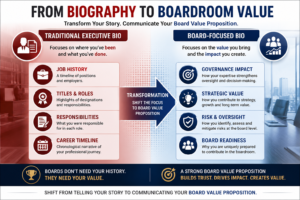
A board-focused version consistently reinforces the candidate’s Board Value Proposition rather than simply recounting professional milestones.
Measuring the Strength of Your Board Value Proposition
A strong board bio should answer five questions within the first few paragraphs:
- What strategic expertise does this executive bring?
- What governance capabilities are evident?
- What risks can this individual help oversee?
- What stakeholder perspectives do they understand?
- Why should a board trust their judgment?
If your bio answers these questions clearly, your positioning is likely strong.
Recent governance studies from Spencer Stuart suggest that many boards still struggle to maximize value creation and director effectiveness, making it even more important for candidates to communicate tangible governance contributions.
The Future of Board Bios in Modern Governance
Board governance continues evolving rapidly. Digital transformation, AI oversight, cybersecurity risks, ESG expectations, and stakeholder activism are reshaping board priorities, as highlighted in BlackRock’s stewardship guidance. Directors must demonstrate adaptability, continuous learning, and strategic foresight.
As boards become increasingly skills-focused, the board bio will become even more important. It will serve not only as a professional introduction but as evidence of governance readiness. Executives who clearly communicate their Board Value Proposition will enjoy a significant advantage in securing board opportunities.
Conclusion
A board bio is not a shortened biography. It is a strategic trust document that communicates why a board should have confidence in your judgment, expertise, and governance capabilities. While biographies celebrate career journeys, board bios emphasize future contribution.
The most effective board bios focus on strategic relevance, governance oversight, stakeholder leadership, and measurable impact. They transform executive achievements into evidence of boardroom value. When crafted correctly, your board bio becomes a powerful expression of your Board Value Proposition, helping nomination committees understand not just what you have done, but how you can help shape the future of the organizations you serve.
FAQs
- Why is a Board Value Proposition more important than a career summary?
Because boards care more about the value you can bring than the roles you have held.
- How can executives communicate their Board Value Proposition effectively?
By focusing on strategic impact, governance experience, and board-level contributions.
- How long should a board bio be?
Most effective board bios range between 150 and 300 words.
- What should be included in a board bio?
Strategic leadership, governance experience, risk oversight, industry expertise, and stakeholder management capabilities.
- Why is governance confidence important in a board bio?
Boards appoint directors they trust to exercise sound judgment and oversight.
- How often should a board bio be updated?
At least annually or whenever significant leadership or governance experience is gained.
- Can a resume be used as a board bio?
No. A resume and board bio serve different purposes.
- Should board committee experience be included?
Yes, especially audit, risk, governance, and compensation committee involvement.
- Can a board bio help strengthen my Board Value Proposition?
Yes, a strong board bio showcases the expertise and insights that make you board-ready.
- How important is industry expertise?
Industry expertise matters when connected to board-level value creation.
- Should achievements be quantified?
Yes, measurable outcomes strengthen credibility.
- Can first-time directors create a strong board bio?
Absolutely, if they effectively communicate governance readiness and strategic value.
- What makes a strong Board Value Proposition for aspiring board directors?
It clearly connects your leadership experience and governance capabilities to boardroom needs.
- What is the biggest board bio mistake?
Treating it like a career biography rather than a value proposition document.
- How can executives improve their Board Value Proposition?
By gaining governance exposure, strengthening strategic oversight experience, and clearly articulating board-level contributions.
Ready to Strengthen Your Board Presence and Unlock New Board Opportunities?
If you’re preparing for board opportunities, don’t let your executive biography do the job of a board bio. Build a profile that communicates governance confidence, strategic insight, and a compelling Board Value Proposition that resonates with nomination committees and board chairs.
Whether you’re an aspiring Independent Director, CXO, Founder, or senior executive, a well-positioned board profile can make all the difference in today’s competitive board landscape.
Book a complimentary strategy session with Your Board Profile today.