

Most executives assume that board appointments are driven primarily by impressive titles, decades of leadership experience, or a high-profile corporate background. While those achievements certainly open doors, they are rarely the deciding factor when a board evaluates potential directors. The reality is far more nuanced. Boards increasingly focus on subtle board-governance signals that reveal how a candidate thinks, exercises judgment, handles complexity, and contributes to long-term organizational success.
As governance expectations continue to evolve, organizations are looking beyond executive resumes. Recent governance research highlights that boards are placing greater emphasis on accountability, board effectiveness, independent thinking, and meaningful board evaluations. Directors themselves increasingly recognize that effective governance requires challenging complacency, embracing self-assessment, and aligning oversight with stakeholder expectations.
For aspiring directors, the most powerful indicators of board readiness are often the least obvious. Committee exposure, risk awareness, stakeholder sensitivity, and independence of judgment quietly communicate a candidate’s ability to contribute at the board level. These signals may not dominate a LinkedIn profile, but they often shape boardroom decisions behind closed doors.
Table of Contents
- Why Board-Governance Signals Matter More Than Board Titles
- Understanding the Hidden Language of Board-Level Credibility
- Committee Exposure as a Powerful Board-Governance Signal
- Risk Thinking Reflects a Strategic Governance Mindset
- Stakeholder Sensitivity and Governance Effectiveness
- Independence of Judgment as a Director Evaluation Criterion
- How Director Evaluation Criteria Are Evolving
- Building Board-Level Credibility Before Joining a Board
- Key Governance Signals Compared
- Conclusion
- FAQs
Why Board-Governance Signals Matter More Than Board Titles
The Shift from Credentials to Credibility
For many years, board recruitment focused heavily on executive status. Former CEOs, CFOs, and business unit leaders naturally became prime candidates for board seats. Today, that approach is changing. Organizations are recognizing that leadership experience alone does not guarantee effective governance.
A growing number of governance studies indicate that boards are becoming more rigorous in evaluating director effectiveness, board refreshment, and governance contributions. Some surveys even reveal that many executives believe current boards require stronger expertise, better evaluation processes, and greater accountability.
This shift means candidates must demonstrate genuine Board-Level Credibility. Credibility comes from evidence of thoughtful oversight, governance discipline, and sound decision-making rather than simply holding senior positions.
What Modern Boards Actually Evaluate
Today’s boards are increasingly interested in how candidates approach uncertainty, challenge assumptions, and contribute to strategic oversight. Governance organizations emphasize qualities such as integrity, leadership, independent judgment, accountability, and informed decision-making.
As a result, subtle board-governance signals often reveal more about a potential director than a list of executive achievements.
Understanding the Hidden Language of Board-Level Credibility
Visible Achievements vs. Invisible Signals
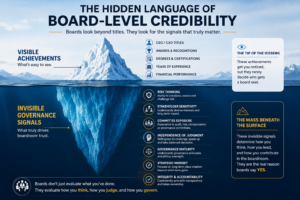
Think of board readiness like an iceberg. The visible portion includes job titles, awards, certifications, and career milestones. Beneath the surface lies a much larger body of evidence that demonstrates governance capability.
Invisible signals include how an executive approaches risk discussions, interacts with stakeholders, contributes to governance committees, and responds to conflicting viewpoints. These behaviours reveal whether an individual possesses the maturity required for board service.
Why Subtle Indicators Influence Director Selection
Board appointments involve trust. Directors must oversee strategy, risk, compliance, executive performance, and long-term value creation. Because the stakes are high, nominating committees look for signals that indicate sound judgment under pressure.
Organizations such as the National Association of Corporate Directors emphasize integrity, leadership, informed judgment, and accountability as essential characteristics of effective directors.
The strongest candidates often demonstrate these qualities long before they ever sit on a board.
Committee Exposure as a Powerful Board-Governance Signal
Audit Committee Experience
Committee exposure is one of the most overlooked yet influential board-governance signals. Participation in audit committees demonstrates familiarity with financial oversight, internal controls, compliance processes, and accountability frameworks.
Executives who contribute to audit-related discussions gain valuable insight into how boards evaluate risk, transparency, and performance. This experience develops governance instincts that are difficult to acquire elsewhere.
Risk and Compliance Committee Participation
Modern governance extends far beyond financial reporting. Regulatory complexity, cybersecurity threats, AI oversight, and reputational risks have expanded board responsibilities dramatically.
Research indicates that emerging risks such as AI governance are becoming increasingly important areas of board oversight. Boards continue developing stronger approaches to managing these challenges.
Executives who participate in risk committees demonstrate an ability to think strategically about uncertainty and long-term consequences.
Nomination and Governance Committee Contributions
Governance committees shape board composition, succession planning, and board effectiveness. Exposure to these discussions helps future directors understand how governance systems function at the highest level.
Such experience signals readiness to contribute meaningfully to board evaluation processes and governance improvement initiatives.
Risk Thinking Reflects a Strategic Governance Mindset
Looking Beyond Operational Risk
One defining characteristic of a Strategic Governance Mindset is the ability to view risk through a broader lens. Effective directors do not simply identify threats. They evaluate interconnected risks, emerging trends, stakeholder expectations, and strategic implications.
For example, AI adoption creates opportunities for innovation while introducing governance concerns related to ethics, compliance, accountability, and transparency. Boards increasingly expect directors to understand these multidimensional challenges.
How Boards Evaluate Risk-Oriented Leaders
Directors who consistently ask thoughtful questions about risk tend to stand out. Rather than focusing solely on immediate performance, they consider long-term resilience and sustainability.
Risk-oriented leaders often demonstrate:
| Traditional Executive Thinking | Governance-Oriented Risk Thinking |
| Quarterly results focus | Long-term value focus |
| Operational efficiency | Strategic resilience |
| Problem solving | Risk anticipation |
| Immediate outcomes | Stakeholder impact |
| Functional expertise | Enterprise-wide perspective |
This broader perspective strengthens Board-Level Credibility significantly.
Stakeholder Sensitivity and Governance Effectiveness
Understanding Diverse Stakeholder Interests
Governance is fundamentally about balancing interests. Shareholders remain important, but modern boards must also consider employees, customers, regulators, communities, and business partners.
Stakeholder sensitivity does not mean pleasing everyone. It means understanding how decisions affect different groups and identifying potential consequences before they become governance issues.
Building Trust Through Balanced Decision-Making
Organizations increasingly operate in environments characterized by transparency and public scrutiny. Governance failures often emerge when boards overlook stakeholder concerns or fail to recognize conflicting expectations.
Executives who consistently demonstrate empathy, listening skills, and balanced judgment send powerful board-governance signals. They show that they can navigate complexity without sacrificing accountability.
Independence of Judgment as a Director Evaluation Criterion
The Difference Between Agreement and Independence
One of the most important Director Evaluation Criteria is independence of judgment. Effective directors are not selected because they agree with management. They are selected because they can think independently while remaining constructive.
True independence requires courage. It means asking difficult questions, challenging assumptions, and raising concerns when necessary.
Constructive Dissent in the Boardroom
Governance experts consistently highlight the importance of diverse perspectives and constructive dissent. Recent governance discussions in India have similarly emphasized moving beyond compliance toward encouraging independent viewpoints within boards.
Constructive dissent strengthens governance by preventing groupthink and improving decision quality. Directors who demonstrate independent thinking often become highly valued board contributors.
How Director Evaluation Criteria Are Evolving
Performance Over Prestige
Board evaluations are becoming increasingly sophisticated. Instead of focusing solely on reputation, boards now assess actual contributions, engagement levels, expertise relevance, and oversight effectiveness.
Governance research shows that board assessment processes are receiving greater attention as organizations seek stronger accountability and improved performance.
Governance Readiness Signals Boards Notice
Common Director Evaluation Criteria increasingly include:
- Strategic thinking capability
- Risk oversight competence
- Independence of judgment
- Stakeholder awareness
- Governance literacy
- Board engagement quality
- Committee participation experience
- Ethical leadership
These qualities collectively strengthen a candidate’s governance profile.
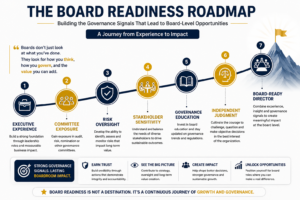
Building Board-Level Credibility Before Joining a Board
Practical Ways to Demonstrate Governance Maturity
Executives aspiring to board roles often ask how they can strengthen their governance credentials before receiving their first board appointment.
Several approaches stand out:
- Participate in governance-related committees.
- Gain exposure to enterprise risk discussions.
- Develop expertise in emerging governance topics.
- Contribute to succession planning initiatives.
- Pursue director education programs.
- Practice independent and strategic thinking.
- Build experience working with diverse stakeholders.
Professional governance education and director certification programs are increasingly viewed as credibility enhancers because they demonstrate commitment to governance excellence.
For executives preparing for board opportunities, resources available through Your Board Profile can help strengthen board positioning, governance visibility, and director readiness.
Key Governance Signals Compared
| Governance Signal | Why It Matters | Impact on Board Readiness |
| Committee Exposure | Demonstrates governance involvement | High |
| Risk Thinking | Shows strategic oversight capability | High |
| Stakeholder Sensitivity | Reflects balanced judgment | High |
| Independence of Judgment | Prevents groupthink | Very High |
| Governance Education | Signals commitment to learning | Medium |
| Board Evaluation Experience | Shows governance maturity | High |
| Ethical Leadership | Builds trust and credibility | Very High |
Conclusion
The strongest board-governance signals rarely appear as bold headlines on an executive resume. They emerge through behaviours, decisions, and experiences that reveal how an individual thinks when faced with complexity and uncertainty.
Committee exposure demonstrates governance engagement. Risk thinking reflects a genuine Strategic Governance Mindset. Stakeholder sensitivity highlights mature decision-making. Independence of judgment proves that a leader can contribute meaningfully rather than simply conform. Together, these subtle indicators create authentic Board-Level Credibility.
As boards continue raising expectations around effectiveness, accountability, and oversight, aspiring directors should focus less on collecting titles and more on developing the governance behaviours that boards truly value. The quietest signals often speak the loudest in the boardroom.
FAQs
- What are board-governance signals?
Board-governance signals are subtle indicators that demonstrate governance readiness, strategic thinking, and boardroom effectiveness.
- Why is committee exposure important for aspiring directors?
Committee experience provides practical exposure to governance oversight, compliance, risk management, and accountability.
- What is Board-Level Credibility?
Board-Level Credibility refers to the trust and confidence a candidate earns through governance-related experience and judgment.
- How does risk thinking improve board readiness?
Risk thinking demonstrates an ability to anticipate challenges and evaluate long-term consequences.
- What is a Strategic Governance Mindset?
It is the ability to balance strategy, risk, oversight, and stakeholder interests for sustainable success.
- Why is independence of judgment important?
Independent judgment helps boards avoid groupthink and improve decision quality.
- What do boards evaluate when selecting directors?
Boards evaluate expertise, governance experience, judgment, integrity, and stakeholder awareness.
- Why are governance signals important for aspiring board directors?
Governance signals help boards assess a candidate’s readiness, judgment, and boardroom potential.
- How do stakeholders influence governance decisions?
Stakeholders affect reputation, performance, compliance, and long-term organizational success.
- What role do board evaluations play?
Board evaluations help improve effectiveness, accountability, and director performance.
- Which governance signals do boards notice most during director selection?
Boards often value governance signals such as committee exposure, risk thinking, stakeholder sensitivity, and independent judgment.
- How can executives strengthen their governance signals before pursuing board roles?
Executives can strengthen their governance signals through governance experience, committee involvement, and strategic leadership.
- How does constructive dissent help boards?
It encourages better discussions and more informed decisions.
- What are the most important Director Evaluation Criteria?
Independence, strategic thinking, governance literacy, risk oversight, and engagement.
- Can strong governance signals improve board-level credibility?
Yes, strong governance signals demonstrate governance maturity and enhance board-level credibility.
Ready to Strengthen Your Board Presence and Unlock New Board Opportunities?
The strongest board candidates are rarely the loudest. They are the professionals who consistently demonstrate sound judgment, strategic thinking, stakeholder awareness, and governance maturity long before a board seat becomes available.
Whether you’re an aspiring Independent Director, CXO, Founder, or senior executive, a well-positioned board profile can make all the difference in today’s competitive board landscape.
Book a complimentary strategy session with Your Board Profile today.