

Many senior executives spend years building a strong personal brand. They speak at conferences, publish thought leadership content, grow their professional networks, and establish themselves as respected leaders within their industries. These efforts are valuable. In fact, a strong personal brand can often be the reason someone gets noticed in the first place.
However, when it comes to board opportunities, visibility alone rarely secures a seat at the table.
This is where many aspiring directors encounter an unexpected challenge. They assume that because they are well-known, highly accomplished, and professionally respected, boards will naturally view them as strong candidates. Yet board appointments are not simply about reputation. They are about trust, oversight, judgment, and governance capability.
A board may notice your achievements, but it evaluates your governance signals.
Governance signals are the indicators that demonstrate whether an executive understands board responsibilities, can exercise independent judgment, appreciates fiduciary duties, and is capable of contributing to effective governance. These signals influence how decision-makers perceive your readiness for the boardroom long before a formal conversation begins.
The reality is simple. Your personal brand may help open the door. Your governance signals determine whether you are invited into the room.
Table of Contents
- Why Governance Signals Matter More Than Personal Branding
- Understanding Governance Signals
- The Governance Signals Boards Look For
- Why Self-Promotion Alone Is Not Enough
- How Governance Signals Influence Director Credibility
- Board Readiness Is More Than Experience
- Common Governance Signals Missing From Executive Profiles
- Building Strong Governance Signals Through Your Boardroom Digital Footprint
- Practical Steps to Strengthen Governance Signals
- Conclusion
- FAQs
Why Governance Signals Matter More Than Personal Branding
Personal branding has become an important part of executive leadership. Professionals are encouraged to share insights, increase visibility, and establish authority within their industries. While these activities can help build recognition, they do not necessarily demonstrate board readiness.
Boards operate differently from executive hiring committees. An executive recruiter may be impressed by revenue growth, operational excellence, and leadership achievements. A board, however, evaluates candidates through a governance lens. It wants to understand how an individual thinks, how they approach oversight, how they manage risk, and whether they can contribute independent judgment.
This distinction is important because many accomplished leaders unknowingly position themselves as executives seeking opportunities rather than governance contributors prepared for board responsibilities. Research into executive branding consistently shows that the strongest candidates understand board appointments are built on signals rather than self-promotion.
Understanding Governance Signals
Governance signals are the subtle yet powerful indicators that communicate board readiness and governance capability. They go beyond titles, achievements, and personal accomplishments.
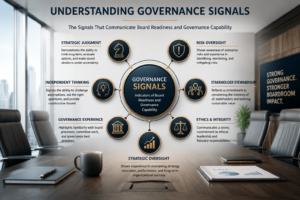
Examples of governance signals include:
| Strong Governance Signals | Weak Governance Signals |
| Board committee experience | Only operational achievements |
| Governance certifications | Generic leadership content |
| Risk oversight exposure | Promotion-focused messaging |
| Stakeholder stewardship | Self-promotional narratives |
| Strategic oversight contributions | Purely management-focused positioning |
Strong governance signals communicate that an executive understands the distinction between managing a business and governing an organization. Professionals looking to evaluate where they stand can explore assessment test to identify gaps in their current positioning.
The Governance Signals Boards Look For
Boards look for evidence that a candidate can contribute effectively to oversight and governance functions.
Strong governance signals are often aligned with globally accepted frameworks such as the OECD Corporate Governance Principles, which emphasize accountability, transparency, and responsible oversight.
Strategic Judgment
Boards rely on directors to make sound decisions under uncertainty. Candidates who demonstrate strategic thinking, long-term vision, and balanced judgment send powerful governance signals.
Risk Oversight Awareness
Modern boards spend significant time discussing enterprise risk, cybersecurity, regulatory developments, and stakeholder concerns. Executives who have experience evaluating and mitigating risks often stand out during board evaluations.
Independent Thinking
Boards require directors who can challenge assumptions constructively. Governance signals become stronger when candidates demonstrate an ability to ask thoughtful questions rather than simply support management decisions.
Why Self-Promotion Alone Is Not Enough
Many executives have become exceptionally skilled at promoting achievements. They discuss growth metrics, leadership accomplishments, transformation projects, and organizational success stories.
These achievements matter. However, governance decisions are rarely based solely on accomplishments.
A board is not looking for another executive manager. It is looking for someone who can strengthen oversight, governance quality, and strategic accountability. Excessive self-promotion can sometimes create the impression that a candidate is focused on personal recognition rather than organizational stewardship.
As leading board recruitment platforms note, executive branding is not a vanity play — it is a visibility strategy. In today’s boardroom-driven economy, your professional presence determines your access to leadership roles, but it must be paired with genuine governance depth. Explore how to build a boardroom digital footprint that reflects both.
How Governance Signals Influence Director Credibility
Director credibility is one of the most important factors influencing board appointments.
Research from the Harvard Law School Forum on Corporate Governance regularly highlights the importance of credibility, independent judgment, and effective oversight in board appointments. Survey data shows that integrity is considered the most important quality by directors (96.67%), followed by reliability (90.68%) and critical thinking (84.87%).
Credibility Is Earned Through Evidence
Boards trust evidence more than claims. Candidates who demonstrate governance involvement through committee work, advisory roles, governance education, and strategic oversight responsibilities build stronger credibility. Learn more about strengthening your governance profile through consistent, evidence-based positioning.
Consistency Matters
Governance signals become more persuasive when they appear consistently across professional profiles, thought leadership content, speaking engagements, and networking conversations.
When a candidate consistently communicates governance awareness, boards gain confidence in their readiness.
Board Readiness Is More Than Experience
One of the most common misconceptions among aspiring directors is that extensive executive experience automatically translates into board readiness. While experience certainly matters, boards evaluate candidates based on much more than the positions they have held or the organizations they have led.
Board readiness is ultimately about demonstrating the ability to contribute effectively within a governance environment. Directors are expected to provide oversight rather than management. They must evaluate strategic decisions without becoming involved in day-to-day execution. This shift requires a different mindset, different communication style, and different priorities.
Professionals working on their board readiness can benefit from the practical guidance available through the IFC Corporate Governance Board Leadership Training Resources, a globally recognized toolkit designed to help directors strengthen governance capabilities.
Experience Alone Is Not a Governance Signal
Many executives have impressive résumés, but boards want evidence that they understand governance responsibilities. Experience becomes a meaningful governance signal only when it is connected to strategic oversight, risk management, stakeholder accountability, and long-term organizational stewardship.
Board Readiness Requires Perspective
The most effective directors are able to see beyond quarterly targets and operational performance. They think about sustainability, resilience, succession planning, and stakeholder trust. These qualities demonstrate genuine board readiness and distinguish governance-minded leaders from purely operational executives. You can begin assessing your own readiness through Your Board Profile’s board readiness resources.
Common Governance Signals Missing From Executive Profiles
Many executive profiles unintentionally focus almost entirely on career achievements. Revenue growth, transformation projects, operational leadership, and team management dominate the narrative. While these accomplishments are important, they often fail to communicate governance capability.
As highlighted by Deloitte’s 2026 Board Governance Trends, boards are increasingly looking for directors who can contribute governance expertise — not simply operational experience — and who can provide forward-looking oversight in a complex risk landscape.
Missing Governance Language
One of the clearest signals missing from many executive profiles is governance-focused language.
Consider the difference:
| Executive Language | Governance Language |
| Managed | Oversaw |
| Executed | Guided |
| Delivered | Governed |
| Implemented | Evaluated |
| Directed | Advised |
The words you use influence how decision-makers perceive your board readiness. Revisiting how you describe your experience is one of the first steps in repositioning your executive profile for boardroom relevance.
Lack of Risk and Oversight References
Profiles that never mention governance, risk, compliance, stakeholder engagement, or oversight often fail to send strong governance signals. Boards want evidence that candidates understand these responsibilities. According to Deloitte’s analysis of Fortune 100 boards, only 38 of 100 companies have directors with technology leadership backgrounds — illustrating how specific skill gaps directly affect board composition decisions.
Building Strong Governance Signals Through Your Boardroom Digital Footprint
Today, a board candidate’s reputation extends far beyond a résumé or biography. Decision-makers frequently review online content, speaking engagements, published articles, interviews, and professional profiles before initiating conversations.
Every Online Presence Sends a Signal
Your LinkedIn profile, published content, professional website, conference appearances, and interviews collectively shape how boards perceive you. Whether intentional or not, they create governance signals.

If your digital presence focuses exclusively on personal achievements, promotions, and operational success stories, it may communicate executive capability but not necessarily board readiness.
Resources such as PwC’s Board Effectiveness Survey can help aspiring directors better understand the evolving expectations of modern boards — including the finding that 93% of executives advocate for replacing at least one director, signaling the high bar placed on governance contribution.
Thought Leadership Matters
Board candidates who regularly share insights on governance, risk, strategy, stakeholder management, ESG considerations, succession planning, and board effectiveness strengthen their governance signals over time.
Thought leadership helps others see how you think — not just what you have accomplished. Consider how NACD’s board readiness curriculum frames it: completing governance education is not just preparation, it is a signal — to nominating committees, search firms, and the boards you want to serve.
Practical Steps to Strengthen Governance Signals
Building stronger governance signals does not happen overnight. It requires intentional positioning and consistent communication.
Audit Your Current Positioning
Start by reviewing your professional profiles, executive biography, speaker profiles, and published content.
Ask yourself:
- Does this profile sound like a board candidate?
- Does it communicate governance awareness?
- Does it highlight oversight experience?
- Does it demonstrate strategic judgment?
Honest answers often reveal significant opportunities for improvement. You can use Your Board Profile to evaluate and strengthen your board-facing digital presence.
Highlight Governance-Relevant Experience
Many executives possess governance-relevant experience without realizing it. Examples include:
- Audit committee interaction
- Risk management oversight
- Regulatory engagement
- Stakeholder communication
- Strategic planning involvement
- Succession planning participation
When framed correctly, these experiences become valuable governance signals.
Invest in Governance Education
Governance-focused certifications, director education programs, and board development initiatives demonstrate commitment to continuous learning. They also help strengthen director credibility. Programs such as NACD Directorship Certification, the IMD Board Readiness Diploma, and Wharton’s Board Readiness Program are among the most respected pathways for aspiring directors globally.
Build a Governance-Focused Content Strategy
Instead of sharing only leadership or career-related content, consider discussing:
- Governance trends
- Board effectiveness
- Risk oversight
- Stakeholder accountability
- Corporate governance developments
- Strategic oversight challenges
This approach gradually shifts your positioning from executive leader to governance contributor. Your thought leadership presence is one of the most powerful governance signals you can build over time.
Governance Signals vs Personal Branding: A Quick Comparison
| Personal Branding | Governance Signals |
| Builds visibility | Builds credibility |
| Focuses on achievements | Focuses on oversight capability |
| Creates awareness | Creates trust |
| Highlights career success | Highlights governance value |
| Attracts attention | Influences board decisions |
The strongest board candidates understand that both matter. Personal branding creates awareness. Governance signals create confidence.
Conclusion
A strong personal brand can absolutely create opportunities. It can help executives gain visibility, build influence, and expand professional networks. However, visibility alone rarely secures a board appointment.
Boards are ultimately evaluating something deeper.
They are looking for evidence of judgment, oversight capability, fiduciary awareness, stakeholder stewardship, and governance maturity. These indicators form the governance signals that shape boardroom perceptions long before formal discussions begin.
For aspiring directors, the goal is not simply to become more visible. The goal is to become more credible from a governance perspective.
Your personal brand may open the door. Your governance signals decide what happens next.
Ready to Strengthen Your Governance Signals?
The difference between being noticed and being selected often comes down to the governance signals you communicate.
If you are serious about strengthening your Board Readiness, enhancing Director Credibility, and building a Boardroom Digital Footprint that reflects genuine governance value, now is the time to evaluate the signals your professional presence sends.
Start positioning yourself as a governance contributor — not just a successful executive.
FAQs
- What exactly are Governance Signals?
Governance Signals are the professional cues that tell a board you understand oversight, not just operations. - Why do Governance Signals matter more than my job title?
Because boards aren’t hiring you to manage — they’re evaluating whether you can govern, and your title alone doesn’t prove that. - Can I have a strong personal brand but weak Governance Signals?
Absolutely — and it’s more common than most executives realize. - How do I know if my profile is sending the right Governance Signals?
If your profile reads like a résumé full of revenue numbers and team sizes, it probably isn’t. - Do Governance Signals actually influence board selection decisions?
Yes — nominating committees actively look for them before a conversation even begins. - Is board committee experience the only way to build Governance Signals?
No — regulatory engagement, audit exposure, and risk oversight all count when framed correctly. - How long does it take to build credible Governance Signals?
Most aspiring directors see meaningful progress within 12 to 18 months of consistent, intentional effort. - Do Governance Signals apply to non-executive director roles too?
Yes — in fact, strong Governance Signals are arguably even more critical for NED candidacy. - Can thought leadership content count as a Governance Signal?
Only if it focuses on oversight, risk, or board effectiveness — not just general leadership advice. - Are Governance Signals different across industries?
The core signals are universal, but the specific language and context will naturally vary by sector. - What’s the biggest mistake executives make with their Governance Signals?
Using operational language — “managed,” “delivered,” “executed” — where governance language is expected. - Can a governance certification really improve my Governance Signals?
Yes — it’s one of the clearest, most visible signals of intentional board preparation you can show. - Is LinkedIn a good place to build Governance Signals?
It’s one of the first places boards and search firms look, so yes — it matters more than most people think. - Are Governance Signals relevant for first-time board candidates?
Especially for first-timers — because without a prior board seat, signals are all you have to show readiness. - Where do I start if I want to improve my Governance Signals today?
Start by auditing how your current profile reads to a board member — not to a recruiter.
A strong personal brand may create visibility, but governance signals create boardroom credibility. Demonstrating strategic judgment, oversight capability, and governance maturity can significantly strengthen your board readiness.
Ready to Strengthen Your Board Presence and Unlock New Board Opportunities?
Whether you’re an aspiring Independent Director, CXO, Founder, or senior executive, a strong board profile can help you stand out in today’s competitive board ecosystem.
Book a complimentary strategy session with Your Board Profile today.