

Many senior executives spend decades building successful careers. They lead large teams, drive revenue growth, manage complex operations, and navigate challenging business environments. Yet when they begin exploring board opportunities, they often discover a surprising reality: an impressive executive career does not automatically translate into board-relevant experience.
This realization can be frustrating. After all, if you’ve successfully run a business unit, served as a CXO, or led organizational transformation, shouldn’t that be enough to secure a board position? Not necessarily. Boards evaluate candidates through a different lens. They look beyond operational achievements and focus on whether an individual can contribute to governance, risk oversight, strategic guidance, stakeholder accountability, and long-term value creation.
The gap between executive success and board readiness is where many aspiring directors struggle. The challenge isn’t a lack of accomplishments. The challenge is translating those accomplishments into evidence of boardroom capabilities, governance signals, and strategic oversight value.
This article explores how executives can reposition their experience for board opportunities and demonstrate the kind of value that modern boards seek.
Table of Contents
- What Does Board-Relevant Experience Actually Mean?
- Why Executive Success Doesn’t Automatically Equal Board Readiness
- Understanding Governance Signals
- Boardroom Capabilities That Matter Most
- Strategic Oversight Value Versus Operational Excellence
- How Boards Evaluate Executive Candidates
- Translating Executive Achievements into Board-Relevant Experience
- Common Mistakes Professionals Make When Positioning for Boards
- Building a Strong Board Narrative
- Conclusion
What Does Board-Relevant Experience Actually Mean?
The phrase board-relevant experience is often misunderstood. Many professionals assume it simply refers to having held a senior leadership position. While executive leadership is valuable, boards look for something much broader.
Board members are expected to provide independent oversight, challenge assumptions, evaluate strategic risks, and guide long-term organizational direction. They are not responsible for running daily operations. This distinction is crucial because many executives spend most of their careers focused on execution rather than oversight.
When a nomination committee reviews a potential director, they are looking for evidence that the candidate can operate at a governance level. They want to know whether the individual understands fiduciary responsibilities, risk management, regulatory expectations, stakeholder engagement, and strategic decision-making.
A useful way to think about board-relevant experience is through the lens of contribution rather than responsibility. Boards ask a simple question: “How will this individual help us make better decisions?” If your career achievements demonstrate that ability, your profile becomes significantly more attractive.
For professionals preparing for board roles, developing a clear board narrative is equally important. Resources such as the board profile development services offered by Your Board Profile can help executives align their experience with board expectations.
Why Executive Success Doesn’t Automatically Equal Board Readiness
Many highly accomplished executives assume that their career progression alone qualifies them for board positions. Unfortunately, boards don’t always see it that way.
An executive may have successfully managed a multi-billion-dollar business unit, but if their achievements are presented solely through operational metrics, they may appear too execution-focused. Boards are looking for leaders who can step back from daily management and evaluate the bigger picture.
Consider the difference between these two statements:
- Increased annual revenue by 30% through operational improvements.
- Guided enterprise-wide strategic transformation while strengthening governance and risk oversight frameworks.
The first statement highlights execution. The second demonstrates governance thinking and strategic perspective.
This distinction matters because boards operate at a higher altitude. Directors must assess market trends, evaluate risks, oversee executive leadership, and ensure sustainable organizational performance.
Research from organizations such as the National Association of Corporate Directors (NACD) suggests that boards increasingly prioritize expertise in strategy, cybersecurity, risk oversight, ESG considerations, and digital transformation.
Professionals who understand this shift can position themselves more effectively by emphasizing board-oriented contributions rather than operational achievements alone.
Understanding Governance Signals

Why Governance Signals Matter in Board Selection
One of the strongest indicators of board-relevant experience is the presence of credible governance signals throughout a professional’s career.
Governance signals are experiences, responsibilities, and achievements that demonstrate a candidate’s ability to think beyond operational execution and contribute at the oversight level.
These signals may include:
- Participation in board committees
- Risk management leadership
- Regulatory compliance oversight
- Stakeholder governance initiatives
- ESG leadership
- Enterprise risk management programs
- Mergers and acquisitions oversight
- Audit and financial governance involvement
When boards review candidate profiles, governance signals provide reassurance that the individual understands the responsibilities associated with directorship.
Executives looking to strengthen their governance credentials should also understand the key principles of board governance and how they influence director selection decisions.
Examples of Strong Governance Signals
The table below highlights how executives can identify governance signals within their existing experience.
| Executive Achievement | Governance Signal |
| Led digital transformation initiative | Technology governance oversight |
| Managed enterprise risk program | Risk governance expertise |
| Oversaw regulatory compliance | Governance and compliance leadership |
| Participated in acquisition due diligence | Strategic oversight capability |
| Led ESG initiatives | Stakeholder governance experience |
| Worked with board committees | Boardroom exposure |
Organizations such as the OECD Corporate Governance Principles provide useful insights into global governance standards.
Governance experience alone is not enough if it is not clearly communicated. Many executives struggle to showcase governance signals in a way that resonates with nomination committees. Learning how to position governance achievements within a board-focused profile can significantly improve board visibility.
Boardroom Capabilities That Matter Most

Strategic Thinking Beyond Daily Operations
One of the most valuable boardroom capabilities is the ability to think strategically over long time horizons.
Boards focus on where the organization will be in five, ten, or even twenty years. Directors must understand market disruptions, competitive threats, emerging technologies, and evolving stakeholder expectations.
Executives who consistently demonstrate strategic thinking are often viewed as stronger board candidates because they can contribute to future-focused discussions.
Independent Judgment and Constructive Challenge
Boards do not need additional executives who simply agree with management. They need directors who can ask thoughtful questions and challenge assumptions when necessary.
Strong directors balance support with accountability. They encourage management while also ensuring that decisions align with organizational objectives and governance responsibilities.
According to guidance published by the Financial Reporting Council in the UK, effective boards rely heavily on independent thinking and constructive challenge.
Risk Oversight Expertise
Risk oversight has become one of the most important responsibilities of modern boards.
Whether the issue involves cybersecurity, geopolitical uncertainty, supply chain disruptions, or regulatory changes, directors are expected to evaluate risks before they become crises.
Executives who have managed enterprise risk frameworks or major transformation initiatives often possess highly valuable boardroom capabilities.
Strategic Oversight Value Versus Operational Excellence
Understanding the Difference
Many executives inadvertently position themselves as operators when they should be positioning themselves as strategic advisors.
Operational excellence focuses on execution:
- Managing teams
- Delivering projects
- Improving processes
- Driving revenue
Strategic oversight value focuses on governance:
- Evaluating organizational direction
- Assessing enterprise risk
- Monitoring leadership effectiveness
- Protecting stakeholder interests
Boards generally hire executives for the second category, not the first.
How to Demonstrate Strategic Oversight Value
The key is reframing accomplishments to highlight enterprise-level impact.
Instead of saying:
“Managed a team of 500 employees.”
Consider saying:
“Provided leadership across multiple business functions while strengthening organizational governance, risk management, and long-term strategic planning.”
The second statement demonstrates strategic oversight value, which resonates much more strongly with board recruiters.
For professionals seeking to reposition their executive experience, reviewing board-focused branding strategies can be extremely beneficial.
How Boards Evaluate Executive Candidates
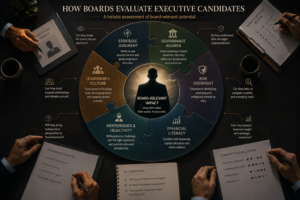
Board nomination committees typically assess candidates across several dimensions.
| Evaluation Area | What Boards Look For |
| Governance Knowledge | Understanding of director responsibilities |
| Strategic Thinking | Long-term business perspective |
| Industry Expertise | Relevant sector knowledge |
| Risk Oversight | Ability to identify and evaluate risks |
| Financial Literacy | Understanding of financial performance |
| Independence | Objective decision-making |
| Stakeholder Management | Ability to balance competing interests |
A candidate may have an exceptional executive résumé, but without demonstrating these qualities, their profile may not stand out in a competitive board search.
Resources from institutions like the Harvard Law School Forum on Corporate Governance provide useful perspectives on evolving board expectations.
Translating Executive Achievements into Board-Relevant Experience
The most successful board candidates learn how to translate operational achievements into governance-focused contributions.
This process requires a shift in language, positioning, and storytelling.
For example:
| Traditional Executive Statement | Board-Focused Statement |
| Increased sales by 40% | Guided strategic growth initiatives while overseeing risk and capital allocation |
| Managed global operations | Provided enterprise-wide leadership and governance oversight across multiple markets |
| Led technology implementation | Strengthened digital governance and transformation strategy |
| Improved profitability | Enhanced long-term shareholder value through strategic decision-making |
These subtle changes help decision-makers recognize the candidate’s board-relevant experience and ability to contribute at the governance level.
Professionals can also benefit from specialized board CV and executive branding services to ensure their achievements are framed appropriately.
Common Mistakes Professionals Make When Positioning for Boards
Several recurring mistakes prevent highly qualified executives from securing board opportunities.
The first mistake is focusing exclusively on operational achievements. While impressive, operational metrics alone rarely demonstrate governance readiness.
The second mistake is ignoring governance signals. Many executives possess relevant governance experience but fail to highlight it effectively.
The third mistake is using an executive résumé instead of a board-focused profile. Board recruiters expect a different narrative, one that emphasizes oversight, judgment, and strategic value.
The fourth mistake is underestimating the importance of visibility and thought leadership. Publishing insights, participating in governance discussions, and building a credible board brand can significantly enhance board candidacy.
Organizations such as the Institute of Directors offer guidance on governance best practices and board preparation.
Building a Strong Board Narrative
A compelling board narrative connects executive accomplishments with governance outcomes.
The most effective board profiles answer three key questions:
- What strategic expertise do you bring?
- What governance signals support your candidacy?
- How can you create strategic oversight value for the board?
When these elements are clearly articulated, executives become far more attractive to nomination committees and board recruiters.
A strong narrative should consistently reinforce your board-relevant experience, demonstrate meaningful boardroom capabilities, showcase credible governance signals, and highlight measurable strategic oversight value.
Those who master this transition position themselves not just as successful executives, but as future-ready directors capable of contributing at the highest level of organizational leadership.
For executives exploring opportunities as independent directors, understanding how boards assess governance readiness and strategic oversight can significantly improve board appointment prospects.
A strong board narrative should also be supported by a well-structured board CV and executive biography. These documents help boards quickly understand a candidate’s governance expertise, strategic leadership experience, and potential contribution to long-term value creation.
Conclusion
A successful executive career is a powerful foundation, but boards are not simply looking for accomplished operators. They are searching for individuals who can contribute to governance, challenge assumptions, oversee risk, and help shape long-term organizational success. That is why board-relevant experience has become one of the most important factors in board selection today.
The good news is that many senior leaders already possess the experience boards value. The challenge lies in identifying and communicating it effectively. By highlighting meaningful governance signals, demonstrating strong boardroom capabilities, and showcasing measurable strategic oversight value, executives can reposition themselves as credible board candidates rather than simply successful managers.
If your goal is to secure a board role, start looking at your career through a governance lens. The achievements that got you to the executive suite may not be the same achievements that earn you a seat in the boardroom. Learning how to bridge that gap can be the difference between being overlooked and being invited to contribute at the highest level of organizational leadership.
FAQs
- What is board-relevant experience?
Board-relevant experience refers to professional achievements and responsibilities that demonstrate governance, strategic oversight, risk management, and board-level decision-making capabilities.
- Why is board-relevant experience important for board appointments?
Boards seek directors who can provide strategic guidance and governance oversight rather than operational management expertise alone.
- Can a senior executive have board-relevant experience without serving on a board?
Yes. Participation in governance initiatives, risk oversight, compliance leadership, and strategic transformation projects can all demonstrate board-relevant experience.
- What are governance signals?
Governance signals are indicators that show an executive understands board responsibilities, oversight functions, stakeholder accountability, and risk management.
- What boardroom capabilities do boards value most?
Boards often prioritize strategic thinking, financial literacy, risk oversight, governance expertise, independent judgment, and stakeholder management.
- How can executives demonstrate strategic oversight value?
Executives can highlight enterprise-wide decision-making, long-term strategic initiatives, governance leadership, and risk management contributions.
- Is operational success enough to secure a board position?
Not always. Boards typically seek candidates who can provide governance oversight and strategic guidance beyond operational execution.
- How do nomination committees evaluate board candidates?
They assess governance knowledge, strategic expertise, industry experience, financial understanding, leadership capabilities, and independence.
- What is the difference between executive leadership and board leadership?
Executive leadership focuses on managing operations, while board leadership focuses on governance, oversight, accountability, and long-term strategy.
- How can I improve my board profile?
You can strengthen your board profile by emphasizing governance experience, developing thought leadership, and creating a board-focused CV and biography.
- Do board recruiters look for governance experience?
Yes. Governance experience is often considered a critical factor when evaluating prospective directors.
- What role does risk management play in board readiness?
Risk oversight is one of the board’s core responsibilities, making risk management experience highly valuable.
- Can board-relevant experience help independent director candidates?
Absolutely. Demonstrating board-relevant experience helps independent directors establish credibility and governance readiness.
- How important are governance signals in board recruitment?
Governance signals help nomination committees identify candidates capable of fulfilling director responsibilities effectively.
- How can professionals transition from executive roles to board positions?
By repositioning their achievements around governance, oversight, strategic value creation, and boardroom capabilities rather than operational management alone.
Ready to Strengthen Your Board Presence and Unlock New Board Opportunities?
Whether you’re a CXO, senior executive, or aspiring independent director, the way you present your experience can significantly influence board opportunities. Explore the board branding, board CV, and executive positioning solutions available at Your Board Profile and start building a profile that reflects true board-level value.
Whether you’re an aspiring Independent Director, CXO, Founder, or senior executive, a well-positioned board profile can make all the difference in today’s competitive board landscape.
Book a complimentary strategy session with Your Board Profile today.