

Why Becoming an Independent Director in India Requires More Than Visibility
Becoming an Independent Director in India is often described as the next step for experienced CEOs, CXOs, entrepreneurs, finance leaders, lawyers and senior professionals. Yet the transition is more nuanced than simply reaching a certain level of seniority or adding a few governance credentials to a résumé. A successful executive is generally evaluated on the ability to deliver results through an organisation, while an independent director has a different responsibility: bringing objective judgment to decisions that can affect shareholders, employees, customers, regulators and other stakeholders. Schedule IV of the Companies Act describes the independent director’s role around objective judgment, strategy, performance, risk management, financial information, stakeholder interests and governance.
That distinction changes the way an aspiring director should prepare. Visibility can open a conversation, but governance capability determines whether the conversation becomes a serious board opportunity. A senior professional may have spent twenty-five years managing P&Ls, leading transformations or building businesses, but a board asks a different question: can this person step away from management and provide thoughtful, independent oversight? That is why developing a governance mindset should become a deliberate part of an executive’s career transition. For professionals exploring the journey, this earlier guide on how to become an Independent Director in India provides useful background, while this article focuses on the mindset required after the initial aspiration is established.
Table of Contents
From executive success to boardroom judgment
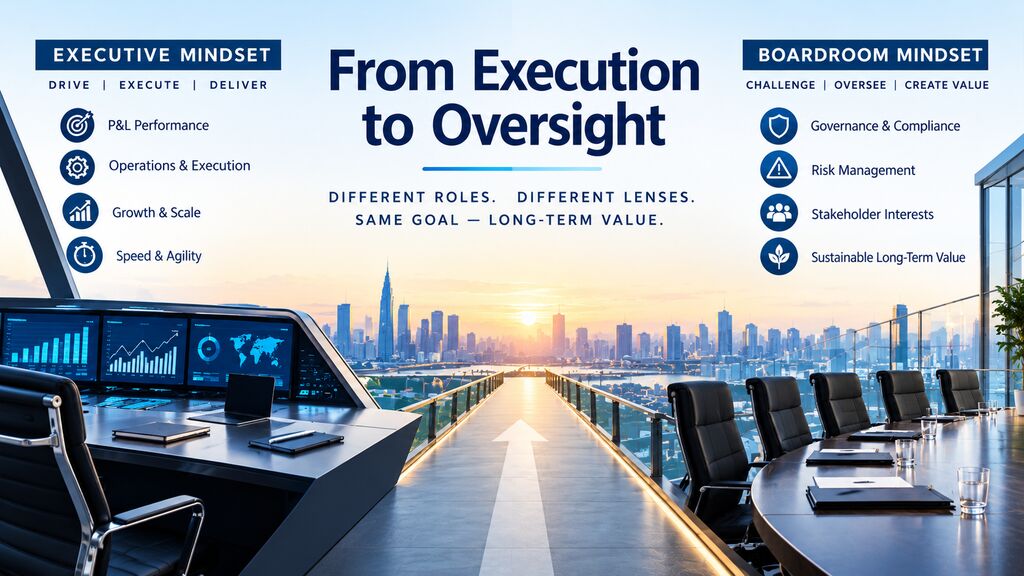
Think of the transition as moving from the cockpit to the control tower. In the cockpit, you make decisions, allocate resources, solve problems and execute rapidly. In the control tower, your job is to understand the wider system, identify risks, challenge assumptions and make sure the right decisions are being made by the right people. Both require experience, but they require different forms of judgment.
This is particularly important because an independent director is not simply an adviser who tells management what to do. The role requires independence, preparation, questioning, oversight and accountability. SEBI’s current LODR framework also requires independent directors of listed entities to make declarations concerning their independence and ability to exercise objective judgment without external influence.
What Developing a Governance Mindset Really Means
Developing a governance mindset means learning to view an organisation from the perspective of stewardship rather than operational ownership. The question changes from “How would I solve this?” to “What should the board understand before management proceeds?” That subtle shift can dramatically change how an experienced executive behaves in a board meeting. Instead of immediately presenting solutions, the director examines assumptions, alternatives, consequences, controls and stakeholder implications.
The governance mindset is therefore not an academic concept. It is a practical decision-making discipline. IICA describes independent directors as playing an important role at board level and highlights the need for knowledge across governance, law, markets, finance, investment, technology and stakeholder considerations.
Thinking beyond the operating role
An executive can be rewarded for speed. A board director is often required to create space for considered judgment. An executive may ask, “How quickly can we launch?” A director may ask, “What assumptions are behind the launch plan, what risks have been tested, and what would make us reconsider?”
That difference is central to boardroom maturity. It does not mean becoming slow or excessively cautious. It means understanding when speed creates value and when speed can hide risk. A governance-minded director can support management while still asking questions that management may not naturally ask.
Balancing stakeholders, risk and long-term value
A board decision rarely affects only one group. A strategic acquisition, related-party transaction, technology investment, executive succession decision or major restructuring can have implications for multiple stakeholders. Schedule IV specifically assigns independent directors responsibilities connected with safeguarding stakeholder interests and balancing conflicting interests.
For an aspiring Independent Director in India, this means developing the ability to see beyond the immediate financial outcome. A governance mindset considers reputation, regulatory exposure, culture, succession, capital allocation, cyber risk, sustainability, customer trust and long-term resilience alongside financial performance.
Independent Director in India: Understanding the Regulatory Foundation
The regulatory foundation matters because board readiness is not only about personal credibility. An aspiring Independent Director in India needs to understand the legal architecture surrounding the role. The Companies Act, 2013 and related rules provide the foundation for independent directorship, while listed companies also operate within SEBI’s LODR framework. SEBI’s LODR regulations were most recently amended in July 2026, making it important for aspiring directors to work with current regulatory material rather than relying entirely on older courses or articles.
The Independent Directors’ Databank is another important part of the ecosystem. IICA states that the databank was established under the regulatory framework to maintain information on existing and aspiring independent directors and support capacity building. Its current Centre for Independent Directors page reports approximately 22,000 directors, including more than 6,000 women directors, and more than 2,700 companies in the databank ecosystem.
Companies Act, Schedule IV and fiduciary responsibilities
One of the most important preparation areas is understanding fiduciary duties of independent directors in India. Schedule IV sets out professional conduct, role, functions and duties. These include acting objectively, protecting independence, giving sufficient time and attention to responsibilities, scrutinising management performance, considering financial controls and risk systems, and safeguarding stakeholder interests.
The regulatory framework should not be treated as a compliance checklist. A director who memorises provisions but cannot apply them to a business situation remains underprepared. The real capability develops when legal requirements become part of practical judgment: What information should I request? What should I challenge? What constitutes a conflict? When should a concern be escalated? How do I document dissent or ensure that a significant risk receives appropriate board attention?
| Board-readiness area | What an aspiring director should develop |
| Corporate law | Understanding Companies Act provisions relevant to directors |
| Securities regulation | Familiarity with SEBI LODR and listed-company governance |
| Finance | Ability to read financial statements and identify unusual signals |
| Risk | Understanding enterprise, operational, cyber and strategic risks |
| Governance | Ability to distinguish oversight from management |
| Independence | Ability to exercise objective judgment without inappropriate influence |
| Stakeholders | Understanding competing interests and long-term consequences |
| Board conduct | Preparation, questioning, documentation and constructive challenge |
IICA also states that its proficiency self-assessment is conducted through the Independent Directors’ Databank platform under Rule 6 and covers the relevant assessment framework.
Boardroom Maturity and Judgment: The Hidden Differentiator
Boardroom maturity and judgment are difficult to capture on a résumé because they reveal themselves through behaviour. A mature director knows when to speak, when to ask a question, when to seek more information and when to disagree. They do not confuse confidence with certainty. They can challenge management without turning the boardroom into an adversarial environment.
Consider a hypothetical example. Management presents an ambitious five-year expansion plan supported by strong projected demand. An inexperienced board participant might either approve it enthusiastically or oppose it because the projections look aggressive. A mature director might instead ask how demand assumptions were stress-tested, what capital commitments are irreversible, what downside scenario has been modelled, whether management has the talent to execute the plan and what indicators the board should monitor quarterly. That is governance judgment in action.
Asking difficult questions without becoming operational
The strongest board questions often sound deceptively simple. “What has changed?” “What are we assuming?” “What could make this plan fail?” “What information are we missing?” “Who owns the risk?” These questions are powerful because they create clarity without taking operational authority away from management.
An aspiring Independent Director in India should practise this distinction. The board should challenge management, but it should not become management. The objective is not to demonstrate how much the director knows; it is to improve the quality of the board’s collective decision-making.
Strategic Mindset for Board Members
A strategic mindset for board members is different from strategic planning performed by management. Management develops and executes strategy. The board evaluates whether the strategy is coherent, appropriately ambitious, sufficiently funded, aligned with risk appetite and capable of creating sustainable value.
This requires directors to look at patterns rather than isolated events. A 5% decline in one quarter may not be a strategic concern. But a recurring decline in customer retention combined with rising acquisition costs and increasing employee attrition could signal a structural issue. The board’s role is to connect these signals and ask whether management is seeing the same pattern.
The governance mindset also requires directors to understand uncertainty. No board receives perfect information. Good governance is not about eliminating uncertainty; it is about ensuring that important uncertainty is visible, discussed and appropriately managed.
Governance Signaling for Directors
Governance signaling for directors refers to the visible evidence that communicates whether a professional is genuinely prepared for board responsibilities. A long executive résumé is one signal. Board committee experience is another. Governance certifications, thought leadership, sector expertise, advisory work, investor exposure and demonstrated understanding of risk can also contribute to the overall picture.
But signals work only when they are consistent. A LinkedIn profile describing someone as a “strategic board leader” will have limited value if the person’s experience does not demonstrate governance-related judgment. Similarly, a board CV packed with operational achievements may fail to communicate what the individual can contribute at board level.
The better approach is to build evidence around several themes: governance, strategy, risk, stakeholder management, transformation, financial understanding and independent judgment. These themes should appear consistently across the professional’s CV, LinkedIn profile, speaker profile, articles, interviews and professional conversations.
Boardroom Branding and Credibility
Boardroom branding and credibility should not be confused with personal promotion. For an aspiring director, boardroom branding is essentially the process of making relevant professional value easy for decision-makers to understand. A Nomination and Remuneration Committee, promoter, investor or search professional needs to quickly understand what board-level problem a candidate can help address.
This is where conventional executive branding often falls short. A CEO may be positioned around growth, execution and leadership. A potential independent director may need to communicate governance perspective, sector knowledge, risk oversight, strategic judgment and committee relevance.
A useful starting point is to review the boardroom branding approach and then examine the broader services available for board-ready professionals. The objective is not to manufacture a new identity. It is to translate existing experience into a language that makes sense at board level.
Why a board CV is not an executive résumé
An executive résumé tells a story of what you did. A board CV needs to communicate what you can contribute through governance. That may include experience with capital allocation, regulatory environments, digital transformation, risk management, mergers and acquisitions, international expansion, human capital, cybersecurity or stakeholder relationships.
For example, “increased revenue by 40%” is an executive achievement. “Led a complex transformation across multiple markets while managing regulatory, capital and stakeholder considerations” begins to communicate board-relevant context. The numbers still matter, but the governance relevance must become visible.
You can explore examples of professional positioning through Your Board Profile’s portfolio, particularly if you are evaluating how your executive track record can be translated into a board-oriented narrative.
Independent Director Readiness Framework
A practical independent director readiness framework can be built around four dimensions: knowledge, judgment, independence and visibility. These dimensions are interconnected. Knowledge without judgment can become technical compliance. Judgment without independence can become compromised advice. Independence without visibility can remain invisible to the market.
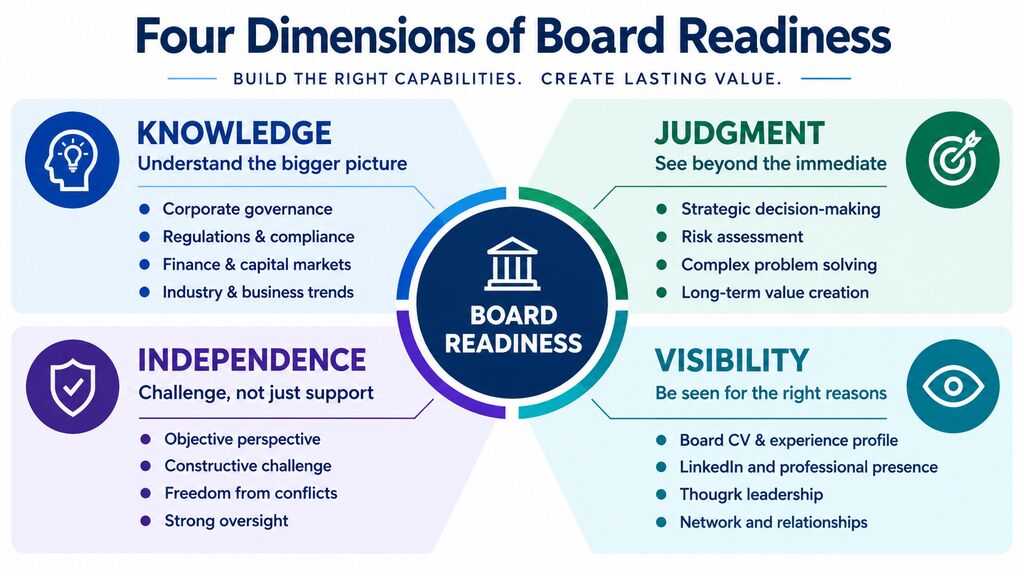
| Dimension | Key question | Evidence to build |
| Knowledge | Do I understand governance and regulation? | Courses, reading, certifications, board exposure |
| Judgment | Can I evaluate complex decisions? | Strategic, risk and governance experience |
| Independence | Can I challenge constructively? | Examples of objective decision-making |
| Visibility | Can relevant people understand my board value? | Board CV, LinkedIn, thought leadership |
| Sector relevance | Where can my expertise matter? | Industry track record and domain knowledge |
| Committee readiness | Where can I contribute immediately? | Audit, risk, NRC, CSR or other relevant expertise |
Knowledge, judgment, independence and visibility
The four dimensions should develop together. IICA’s learning ecosystem includes board-essentials subjects such as duties of directors, liability, related-party transactions, audit, risk-related areas, board committees and SEBI LODR-related topics.
At the same time, professional readiness cannot be reduced to completing modules. A director must continuously update skills, knowledge and familiarity with the company and its environment. Schedule IV explicitly includes induction and ongoing updating of skills and knowledge among the duties of independent directors.
Building Readiness Through Continuous Learning
The governance environment changes rapidly. Artificial intelligence, cybersecurity, climate-related risks, digital regulation, geopolitical shifts, changing consumer behaviour and new capital structures are reshaping board agendas. A director who relies only on knowledge acquired ten years ago risks becoming less useful to a board facing today’s challenges.
Continuous learning does not mean attempting to become an expert in every subject. It means becoming sufficiently informed to ask intelligent questions. A finance leader may not need to become a cybersecurity specialist, but should understand the strategic implications of a major cyber incident. A technology leader may not need to become a securities lawyer, but should understand how technology-related decisions intersect with regulation, privacy, risk and governance.
This is why governance mindset is ultimately a learning mindset. The boardroom rewards curiosity backed by preparation.
How Dr. Amit Nagpal Approaches Board Governance and Director Readiness
The Dr. Amit Nagpal board governance perspective can be understood through the intersection of governance readiness and professional visibility. The underlying idea is that senior professionals should not wait until a board opportunity appears before thinking about how their experience translates into board value.
For an aspiring Independent Director in India, that translation involves identifying the governance themes within an existing career. Has the professional managed a regulatory transformation? Navigated a crisis? Led a digital shift? Built stakeholder trust? Managed enterprise risk? Worked with investors? Led succession planning? These experiences can become meaningful board signals when they are articulated in the context of governance rather than merely operational achievement.
This is also where storytelling matters. A board candidate’s story should make it easy for decision-makers to understand the relationship between experience, judgment and governance contribution. The goal is not to exaggerate experience; it is to reveal its relevance.
A Practical Roadmap for Aspiring Independent Directors
The journey becomes more manageable when broken into stages. Start by conducting a board readiness assessment of your current career. Map your experience against governance, strategy, finance, risk, technology, people, regulation and stakeholder management. Then identify the gaps that could limit your board contribution.
Next, strengthen formal governance knowledge. Review the Companies Act, Schedule IV, SEBI requirements where relevant and the Independent Directors’ Databank framework. IICA notes that the databank ecosystem exists both for aspiring professionals and companies seeking independent director profiles.
Then build your board narrative. Rewrite your CV from a board perspective, strengthen your LinkedIn positioning, develop relevant thought leadership and make your sector expertise clear. Finally, build relationships with the wider governance ecosystem: existing directors, CXOs, promoters, investors, professional advisers, search professionals and governance institutions.
A useful resource for professionals who want to explore the broader journey is this guide to becoming an Independent Director in India. The important point is that board readiness is a process rather than a single application.
Common Mistakes Professionals Make Before Entering the Boardroom
One common mistake is assuming that seniority automatically translates into board readiness. Twenty years of experience can be valuable, but boards need to understand the specific governance value behind those years. Another mistake is treating the Independent Directors’ Databank registration or a governance certification as the destination. These can be useful components of preparation, but they do not replace judgment, independence and credibility.
A third mistake is over-branding. Calling yourself a “future board leader” repeatedly does not create board credibility. Demonstrated governance thinking does. Publishing thoughtful perspectives on risk, strategy, regulation, technology or stakeholder governance can be more meaningful than generic claims of leadership.
The final mistake is failing to prepare for the actual boardroom. Read annual reports. Study board committees. Understand how agendas are structured. Practise reading financial statements. Review governance controversies and ask what questions an effective board should have asked earlier. The best preparation often happens before anyone puts the board pack in front of you.
Conclusion: From Visibility to Governance Value
The journey to becoming an Independent Director in India is ultimately a transition from professional visibility to professional stewardship. Your executive career gives you the raw material: experience, relationships, expertise, decisions and lessons. A governance mindset turns that raw material into board-level value.
The strongest board candidates do not simply communicate that they are experienced. They demonstrate that they understand how boards work, why independence matters, how risk should be challenged, how stakeholder interests can conflict and how strategic decisions should be evaluated. They also understand that credibility is built through consistency: the same governance story should appear in their board CV, LinkedIn presence, professional conversations and thought leadership.
For senior executives and CXOs considering this transition, the question is therefore not simply, “How do I get a board seat?” A more productive question is, “What kind of governance value can I bring when I get into the boardroom?” That question changes preparation, positioning and ultimately the quality of the board career being built.
If you are assessing your own readiness, explore the Your Board Profile blog for additional perspectives on boardroom branding, director readiness and governance-oriented professional positioning.
FAQs About Becoming an Independent Director in India
1. What is an Independent Director in India?
An Independent Director in India is a non-executive director who is expected to exercise objective and independent judgment and meet the applicable statutory independence criteria. The role includes oversight of strategy, performance, risk, financial information and stakeholder interests, among other responsibilities under the applicable framework.
2. Is executive experience enough to become an Independent Director in India?
Executive experience can provide valuable board-relevant expertise, but it is not the same as board readiness. An aspiring director also needs governance knowledge, independent judgment, awareness of director responsibilities and the ability to contribute without taking over management’s role.
3. What is a governance mindset?
A governance mindset is the ability to evaluate decisions from the perspective of oversight, accountability, risk, stakeholder interests and long-term value rather than focusing only on operational execution.
4. What are the fiduciary duties of independent directors in India?
The duties and responsibilities are set out through applicable corporate law and governance frameworks. Schedule IV includes professional conduct, objective judgment, adequate preparation, protection of independence, oversight of performance and attention to financial controls and risk management.
5. Is registration with the Independent Directors’ Databank important?
The regulatory framework provides for the Independent Directors’ Databank and related requirements for eligible and willing individuals. IICA maintains the databank and provides capacity-building resources and assessment mechanisms.
6. Does an aspiring director need to pass a proficiency test?
The applicable rules provide for an online proficiency self-assessment through the Independent Directors’ Databank framework, subject to the applicable exemptions and requirements. IICA provides the assessment platform and related learning resources.
7. What skills should an Independent Director develop?
Important areas include governance and corporate law, financial literacy, strategic thinking, risk oversight, stakeholder management, technology awareness, regulatory understanding and boardroom communication. The exact mix should also reflect the skills a particular board needs.
8. Why is boardroom judgment important?
Boards frequently make decisions under uncertainty and with incomplete information. Boardroom judgment helps a director identify assumptions, ask relevant questions, understand consequences and challenge management constructively without becoming operational.
9. What is boardroom branding?
Boardroom branding is the process of communicating your professional experience in terms of the governance value you can bring to a board. It is broader than personal promotion because it connects your expertise with board-level responsibilities and needs.
10. How is a board CV different from an executive CV?
An executive CV normally emphasises operational leadership and measurable business results. A board CV should additionally highlight governance exposure, strategic oversight, risk, stakeholder management, committee relevance, sector expertise and experiences demonstrating independent judgment.
11. Can a finance professional become an Independent Director?
Yes, where the individual satisfies the applicable legal eligibility and independence requirements. Finance professionals can potentially bring relevant expertise in financial reporting, capital allocation, audit, risk and governance, depending on their background and the board’s needs.
12. How can a CXO prepare for board responsibilities?
A CXO can begin by studying director duties, understanding governance frameworks, strengthening financial and risk oversight knowledge, developing board-level communication skills and practising the distinction between strategic oversight and operational management.
13. What does governance signaling mean?
Governance signaling for directors means creating credible evidence that demonstrates board relevance. This can include governance experience, committee exposure, thought leadership, relevant qualifications, sector expertise and a professionally positioned board profile.
14. How can professionals improve their board visibility?
Professionals can improve visibility by clearly articulating their board-relevant expertise, maintaining a credible LinkedIn presence, developing governance-oriented thought leadership, participating in relevant professional networks and creating a focused board CV.
15. What is the most important mindset shift for an aspiring Independent Director?
The key shift is from “I know how to run this business” to “I know how to help the board ask the right questions, exercise oversight and make better-informed decisions.” That shift sits at the heart of boardroom maturity.