

Becoming an Independent Director in India is no longer simply about reaching a senior position, having a long corporate career, or adding “board member” to a professional profile. The real transition is deeper. It is a shift from managing a business to helping govern one, from owning execution to challenging assumptions, and from being responsible for a function to contributing to the long-term interests of the company and its stakeholders. That is why professionals who want to build a board career need more than impressive designations. They need governance aptitude, boardroom judgement, independence of thought, financial understanding, strategic perspective and the ability to ask difficult questions constructively.
The opportunity is significant, but so is the responsibility. Under Section 149 of the Companies Act, 2013, listed public companies are required to have at least one-third of their board as independent directors, while Section 149 also establishes substantive requirements around independence, integrity, expertise and experience. The Ministry of Corporate Affairs framework also provides for an Independent Directors Databank, administered by the Indian Institute of Corporate Affairs (IICA), as part of the wider ecosystem for independent director capacity building.
So, how to become an independent director in a meaningful sense? Start by asking a different question: What kind of value can I bring to a board when I am no longer responsible for running the business myself?
That question changes everything.
Table of Contents
- Why an Independent Director in India Is More Than a Board Position
- Independent Director Eligibility India: What the Law Requires
- How to Become an Independent Director: The Career Path
- Developing a Corporate Governance Mindset
- Governance Aptitude for Board Members
- Board Room Readiness Skills That Matter
- Understanding the Role of Independent Directors Companies Act
- Building a Board Career in India
- Director Development Program: What to Look For
- Building Your Board Value Proposition
- Board CV and Executive Visibility
- Networking and Board-Level Relationships
- Common Mistakes Aspiring Independent Directors Make
- A Practical Roadmap to Board Readiness
- How Your Board Profile Can Support Your Board Journey
- Conclusion
Why an Independent Director in India Is More Than a Board Position
The most common misconception about becoming an Independent Director in India is that it is the natural next step after becoming a CEO, CFO, CHRO, entrepreneur or senior functional leader. Seniority certainly helps, but it does not automatically translate into board readiness. A board operates differently from an executive management team. An executive is generally expected to make decisions and execute them; a director must evaluate management decisions, understand risk, protect stakeholder interests, test strategy and exercise judgement without becoming part of day-to-day management. The distinction may appear subtle, but in the boardroom it is fundamental.
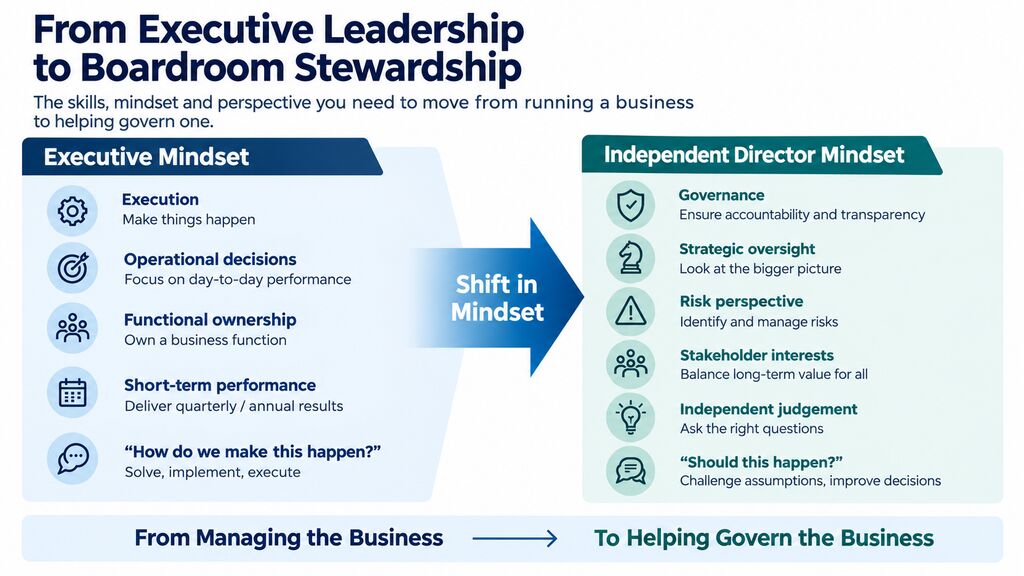
Think of the difference between being the driver of a car and being responsible for ensuring that the journey itself is safe, sustainable and headed in the right direction. The driver focuses on immediate execution. The board focuses on whether the destination makes sense, whether the vehicle is fit for purpose, whether the risks are understood and whether the organisation has the leadership and systems required to reach that destination. An effective Independent Director in India therefore needs the ability to zoom out without losing sight of important details. This is why the development of a corporate governance mindset should begin well before the first board appointment.
The shift from executive success to governance responsibility
Executive success often comes from decisiveness. Board effectiveness requires something additional: disciplined curiosity. A strong director should be comfortable asking, “What are we missing?”, “What assumptions are behind this plan?”, “What happens if the downside scenario materialises?” and “Does management have the capability to execute this strategy?” These questions are not intended to undermine management. They are designed to strengthen decision quality.
The Companies Act framework reinforces this distinction by requiring independent directors to meet independence criteria and to provide declarations concerning their independence. Section 149 also states that companies and independent directors must abide by Schedule IV, which sets out the code for independent directors.
The implication for aspiring directors is clear: boardroom readiness is a capability, not a title.
Independent Director Eligibility India: What the Law Requires
Understanding independent director eligibility India is an essential starting point, but legal eligibility should not be confused with board attractiveness. Section 149(6) of the Companies Act defines an independent director through a combination of independence, integrity, relevant expertise and experience, while also setting out restrictions concerning promoters, relationships, employment and financial connections.
The law is designed to protect the independence of board judgement. In practical terms, this means that a professional cannot simply decide that they are “ready” to become an independent director because they have accumulated 20 or 30 years of experience. The proposed appointment has to be considered against the applicable statutory requirements and the specific circumstances of the company.
Key independence and experience requirements
At a high level, aspiring directors should examine several dimensions before pursuing board opportunities:
| Area | What an aspiring director should examine |
| Professional credibility | Depth and relevance of leadership experience |
| Independence | Relationships, financial interests and other potential conflicts |
| Expertise | Whether experience is relevant to board-level needs |
| Governance knowledge | Understanding of company law, risk, compliance and fiduciary responsibility |
| Financial literacy | Ability to understand financial statements and key financial risks |
| Strategic judgement | Ability to evaluate long-term business choices |
| Board behaviour | Ability to challenge constructively and independently |
| Regulatory readiness | Applicable registration, assessment and documentation requirements |
The statutory framework should always be checked against the latest applicable rules and regulations before accepting an appointment. The official India Code version of the Companies Act provides the statutory text, including Sections 149 and 150.
Databank registration and proficiency assessment
The Independent Directors Databank is an important part of the Indian ecosystem. IICA states that the databank was developed under the Companies Act framework and provides a platform for existing and aspiring independent directors. It also provides learning resources and an online proficiency self-assessment process.
This matters because the journey toward becoming an Independent Director in India should not stop at registration. Registration is administrative; capability is professional. The stronger approach is to use the process as a prompt to assess whether your knowledge of governance, regulation, financial oversight, risk and board responsibilities is genuinely current.
IICA’s current website continues to provide Independent Directors Databank registration and related programmes, making it an important official resource for professionals exploring the pathway.
How to Become an Independent Director: The Career Path
There is no single career formula for becoming an Independent Director in India. One person may come from finance, another from technology, another from law, another from operations, entrepreneurship, human resources, public policy or sector expertise. What matters increasingly is the relevance of the individual’s experience to the board’s strategic needs.
The journey therefore starts with an honest inventory of your experience. What decisions have you made that affected enterprise value? Have you handled crises? Have you worked with regulators? Have you managed risk? Have you led transformation? Have you dealt with investors, lenders, customers, employees or government stakeholders? Have you operated in a highly regulated industry? Each of these experiences can become part of a board value proposition when translated correctly.
A useful pathway looks like this:
- Assess your board-relevant experience.
- Build governance knowledge.
- Develop financial and risk literacy.
- Understand board roles and responsibilities.
- Register with the relevant statutory databank where applicable.
- Build a board-focused professional profile.
- Develop relationships with board-level stakeholders.
- Target companies where your expertise is genuinely relevant.
- Prepare for board interviews and nomination committee discussions.
- Continue learning after appointment.
The mistake is to treat this as a checklist. Board careers develop through credibility accumulated over time.
Developing a Corporate Governance Mindset
A corporate governance mindset is perhaps the most important transformation for an aspiring director. Governance is not simply about compliance. Compliance establishes the floor; good governance determines how high the organisation can build.
Imagine a company preparing to enter a new market. Management may present an attractive business case with projected revenue, market share and investment requirements. An executive might focus on how quickly the plan can be executed. A board member should also explore questions around regulatory exposure, capital allocation, cyber risk, leadership capability, stakeholder impact, competitive response, succession and downside scenarios.
That is governance thinking.
An effective Independent Director in India should be able to hold two ideas at the same time: support management and challenge management; understand growth ambitions and examine risk; respect expertise and remain independently curious. The goal is not to become the smartest person in the room. The goal is to help the room make a better decision.
Think like a steward, not an operator
This distinction can dramatically improve boardroom effectiveness. Operators often think in terms of “How do we make this happen?” Directors should additionally ask, “Should this happen?”, “What could prevent it from succeeding?”, “What information do we need before approving it?” and “How will we know whether the decision is working?”
Schedule IV’s framework for independent directors reflects the importance of objective judgement and appropriate conduct.
That is why professionals preparing for a board career should deliberately practise stepping away from their functional lens. A CFO needs to think beyond finance. A technology leader needs to think beyond technology. A CHRO needs to think beyond people. The boardroom rewards enterprise perspective.
Governance Aptitude for Board Members
Governance aptitude for board members is not measured by how many regulatory terms someone can remember. It is demonstrated through judgement.
Consider a board discussion about an acquisition. The obvious questions concern valuation, financing and synergies. A governance-minded director will also explore whether the cultural integration is realistic, whether the leadership team has capacity, whether the transaction introduces regulatory or reputational exposure, whether the assumptions are independently validated and whether the acquisition strengthens the company’s long-term strategic position.
The questions a board-ready professional should ask
Strong board questions are usually simple but consequential:
- What assumption is most critical to this proposal?
- What could make the strategy fail?
- What information is missing?
- Who independently validates this number?
- What is the downside scenario?
- What does the board need to know before approving this?
- Is management appropriately incentivised?
- Are stakeholder interests being considered?
- What would we wish we had asked if this decision went wrong?
These are board room readiness skills because they help directors contribute without becoming operational managers.
SEBI’s current LODR framework also emphasises the role of independent directors in maintaining objective independent judgement and requires relevant declarations concerning independence.
Board Room Readiness Skills That Matter
The phrase board room readiness skills can sound abstract until it is broken into practical capabilities. For a senior executive, the transition requires several layers of preparation.
| Boardroom capability | Why it matters |
| Strategic thinking | Boards must assess long-term direction |
| Financial literacy | Directors need to understand performance, capital and financial risk |
| Risk judgement | Boards oversee material risks without managing every risk directly |
| Governance knowledge | Directors must understand duties, processes and accountability |
| Independent judgement | Directors must avoid simply following management consensus |
| Communication | Board contributions need to be concise and evidence-based |
| Questioning ability | Constructive challenge improves decision quality |
| Stakeholder awareness | Boards balance shareholder and wider stakeholder considerations |
| Crisis judgement | Major events often test board effectiveness |
| Succession thinking | Leadership continuity is a board-level concern |
One of the most underestimated skills is listening. In an executive meeting, a leader may speak to drive action. In a board meeting, listening can reveal what is not being said. A director who listens carefully can identify inconsistencies between strategy, numbers, people capability and risk.
Understanding the Role of Independent Directors Companies Act
The role of independent directors Companies Act provisions cannot be reduced to attending meetings and approving resolutions. Section 149 establishes the framework for independent directors, including independence criteria, declarations, tenure and liability provisions. Section 150 addresses the manner of selection and the independent directors‘ databank.
The Act also provides that an independent director generally holds office for a term of up to five consecutive years and may be reappointed subject to the statutory conditions, with a maximum of two consecutive terms followed by a cooling-off period.
For an aspiring Independent Director in India, these provisions are not merely legal information. They shape the mindset required for the role.
An independent director is expected to exercise judgement, act diligently and contribute to governance. The law also recognises that independent directors should not automatically be treated as responsible for every corporate act; Section 149(12) addresses liability in relation to acts connected with their knowledge, board processes, consent or connivance, or failure to act diligently.
This makes diligence a professional habit rather than a legal formality.
Building a Board Career in India
Building a board career in India requires deliberate positioning. Many senior executives make the mistake of assuming that their corporate résumé will automatically communicate board value. It often does not.
A traditional executive CV answers questions such as: What was your designation? How large was your team? What revenue did you manage? What targets did you achieve? A board profile needs to answer different questions: What governance-relevant expertise do you bring? Which strategic issues can you help a board evaluate? Which industries or business models do you understand? What committees or board responsibilities could benefit from your experience?
This is why your professional narrative needs to evolve.
Turning executive credibility into board relevance
Suppose an executive spent 25 years transforming supply chains across multiple industries. A conventional CV might describe operational improvements. A board-focused profile can highlight experience in business resilience, capital allocation, supply-chain risk, technology adoption, geopolitical exposure and transformation governance.
The facts have not changed. The board relevance has.
That distinction is central to a successful Independent Director in India profile.
A board is not hiring a résumé. It is evaluating judgement, relevance and potential contribution.
Director Development Program: What to Look For
A strong director development program should go beyond a certificate. Before selecting one, ask whether it actually improves your ability to understand board papers, evaluate financial information, identify governance risks, understand committee responsibilities and participate in board discussions.
A useful programme should expose professionals to practical situations. What happens when management disagrees with a director? How should a board evaluate an acquisition? What should directors ask when internal controls fail? How should a director respond to a related-party transaction? How should a board think about succession?
Case-based learning can be especially valuable because governance is often about judgement in imperfect situations.
IICA itself describes capacity building for independent directors through e-learning, case studies, webinars, knowledge resources and related initiatives.
The best learning approach combines formal governance education, practical board exposure, continuous reading and conversations with experienced directors.
Building Your Board Value Proposition
Your board value proposition is the answer to one critical question:
Why should a board want you?
The answer cannot simply be “I have 30 years of experience.” Experience is an input. A board needs to understand the output.
For example:
“I bring three decades of experience in financial transformation, risk management and regulated businesses, with particular relevance to audit oversight, digital transformation and enterprise resilience.”
That is more useful than:
“Experienced senior executive with 30 years of corporate experience.”
Your value proposition should connect experience with board needs.
It should make your expertise visible without sounding promotional. It should show the problems you understand, the decisions you have influenced and the perspective you can bring to a board.
For professionals developing this narrative, a structured board value proposition and board bio framework can help convert executive achievements into a more board-relevant story.
Board CV and Executive Visibility
A board CV is not simply a shorter executive CV. It is a different document built for a different decision-making environment.
A strong board CV should make it easy for a nomination committee, promoter, investor or search professional to understand your governance relevance within a few minutes. It should highlight strategic experience, industry expertise, committee-relevant skills, leadership exposure, governance knowledge and major business decisions.
This is where executive visibility becomes important.
Being qualified is one thing. Being discoverable is another.
Your Board CV and professional profile services can be structured around the specific requirements of board-level positioning, rather than simply presenting a long chronology of employment.
Your digital presence matters too. Your LinkedIn profile, articles, interviews, speaking engagements and professional associations can collectively create a public evidence trail of your expertise. This is not about becoming an influencer. It is about making your credibility easier to verify.
For a deeper perspective, read Executive Personal Branding Beyond the Job Title and consider how your leadership identity translates beyond your current designation.
Networking and Board-Level Relationships
Board opportunities are rarely created through applications alone. Relationships matter because boards involve trust.
That does not mean asking everyone you know for a board position. It means developing thoughtful professional relationships with people who understand your expertise and can vouch for your judgement.
Consider building relationships with:
- Existing directors
- CEOs and founders
- Investors
- Promoters
- Governance professionals
- Search professionals
- Lawyers and company secretaries
- Industry associations
- Academic and leadership institutions
Your objective should be to become known for a particular kind of board value.
If your network associates you with technology governance, cyber risk and digital transformation, your positioning becomes clearer. If you are known for audit, finance and risk, the same principle applies.
A board career grows stronger when your reputation precedes your résumé.
Common Mistakes Aspiring Independent Directors Make
Many professionals preparing for an Independent Director in India role make the same avoidable mistakes.
The first is believing that seniority alone creates board readiness. It does not.
The second is focusing heavily on legal eligibility while neglecting judgement and governance capability. Compliance is essential, but boards also need people who can interpret complex situations.
The third is using an executive CV without adapting it for board audiences. A 25-page career history may contain impressive achievements but still fail to communicate board relevance.
The fourth is waiting until retirement to develop board visibility. Board preparation should ideally begin while you are still building your executive career.
The fifth is networking transactionally. If every conversation begins with “I am looking for a board position,” relationships can quickly become uncomfortable. Better relationships develop around knowledge, industry conversations and shared professional interests.
The sixth is underestimating communication. A director who has outstanding experience but cannot express a complex issue clearly may struggle to influence a board.
The seventh is assuming that the first board appointment will automatically create the second. Every board role becomes part of your governance track record. The quality of your contribution matters.
A Practical Roadmap to Board Readiness
If you are serious about how to become an independent director, create a 12-month development roadmap rather than treating board readiness as a one-time exercise.
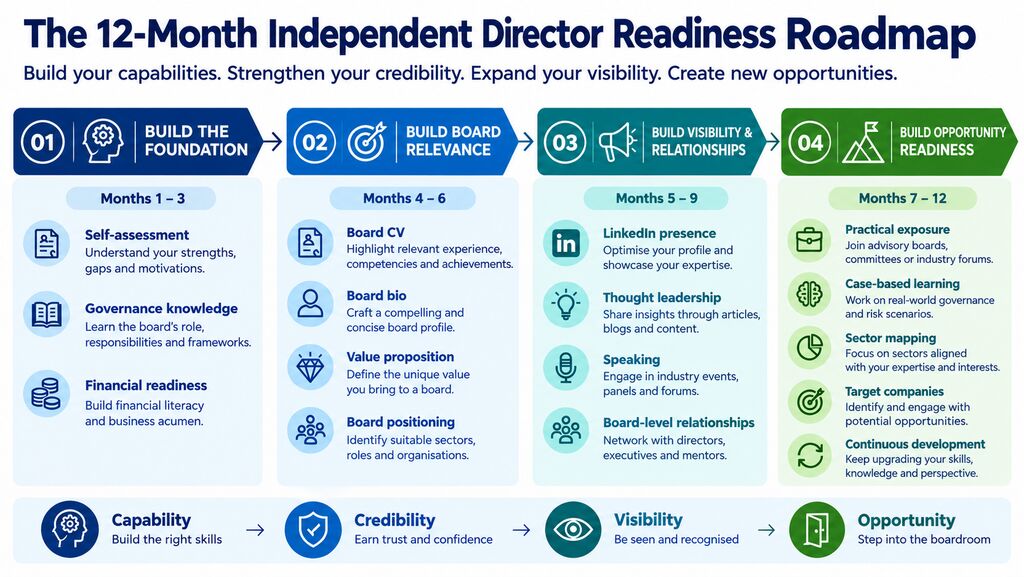
| Period | Priority | Practical action |
| Months 1–2 | Self-assessment | Identify governance-relevant expertise and gaps |
| Months 2–4 | Governance knowledge | Study company law, board duties, committees and risk |
| Months 3–5 | Financial readiness | Strengthen financial statement and capital allocation understanding |
| Months 4–6 | Board positioning | Develop board CV, bio and value proposition |
| Months 5–7 | Visibility | Strengthen LinkedIn, speaking and thought leadership presence |
| Months 6–9 | Relationships | Build meaningful board-level professional connections |
| Months 7–10 | Practical exposure | Participate in governance discussions and case-based learning |
| Months 9–12 | Opportunity mapping | Identify sectors and companies where your expertise is relevant |
| Ongoing | Development | Continue governance education and board-level learning |
The goal is not to manufacture a board persona. It is to make your real experience more relevant and visible to boards.
A useful principle is:
Capability first. Credibility second. Visibility third. Opportunity follows.
That sequence prevents professionals from spending too much time marketing themselves before they have developed the substance required for the role.
How Your Board Profile Can Support Your Board Journey
The journey to becoming an Independent Director in India sits at the intersection of capability and positioning. You may have outstanding experience, but if that experience is buried in a conventional executive résumé, the right people may never understand its relevance.
Your Board Profile focuses on helping senior professionals communicate their experience for board-level audiences through tools such as customised board CVs, LinkedIn profile enhancement, board readiness assessments, coaching and thought leadership content. You can explore the organisation’s portfolio of work to understand the type of professional positioning involved.
The objective is not to promise a board appointment. No credible professional service can guarantee that. The objective is to help a senior professional answer three questions with greater clarity:
What governance value do I bring?
Where is that value most relevant?
Can a board understand that value quickly?
You can also explore the latest boardroom branding insights and articles for additional perspectives on visibility, governance and board careers.
For a broader perspective on how professional positioning evolves before entering the boardroom, see Boardroom Branding Begins.
A practical CTA for aspiring board directors
If you are a CXO, senior executive, entrepreneur or experienced professional preparing for your first board opportunity, don’t wait for a vacancy before preparing your board profile.
Start by assessing your governance readiness, identify the expertise you can bring to a board, and build a clear board-level narrative around it.
A board career is not built overnight. It is built through governance aptitude, independent judgement, relevant expertise, credible relationships and consistent visibility.
Conclusion
Becoming an Independent Director in India is best understood as a professional transition rather than a designation change. The most successful candidates are not necessarily the people with the longest résumés. They are professionals who can demonstrate relevant experience, understand governance responsibilities, exercise independent judgement and contribute thoughtfully to strategic decisions.
The legal framework provides the foundation. The Independent Directors Databank provides an important institutional ecosystem for capacity building. But neither replaces professional judgement.
The real preparation happens when you begin thinking differently.
Instead of asking, “What can I manage?”, ask, “What should the organisation be thinking about?”
Instead of asking, “How do I execute this?”, ask, “What assumptions are behind this decision?”
Instead of asking, “How do I get a board seat?”, ask, “What governance problem can I help a board solve?”
That is the beginning of a genuine corporate governance mindset.
For senior executives and CXOs, the opportunity is to convert decades of operating experience into board-level perspective. For aspiring directors, it is to build governance aptitude before the appointment arrives. And for professionals serious about building a board career in India, the long-term advantage comes from combining capability with a clear, credible and visible board proposition.
The boardroom does not simply need successful executives.
It needs independent thinkers who understand responsibility, recognise risk, challenge constructively and help organisations create sustainable value.
That is what board readiness is really about.
Frequently Asked Questions
1. How do I become an Independent Director in India?
To become an Independent Director in India, you should first assess whether you meet the applicable statutory eligibility and independence requirements under the Companies Act, 2013. You should then build governance knowledge, understand board responsibilities, complete applicable Independent Directors Databank requirements, strengthen your board profile and develop relationships with organisations and professionals involved in board appointments. Legal eligibility is only the foundation; board-level judgement and relevant expertise are equally important.
2. What is the eligibility for an Independent Director in India?
Independent director eligibility India is governed principally by Section 149 of the Companies Act and applicable rules. The framework considers factors including integrity, relevant expertise and experience, independence from promoters and management, relationships and specified financial or professional connections. The exact eligibility should be assessed against the latest law and the circumstances of the proposed appointment.
3. Is registration with the Independent Directors Databank required?
The Companies Act framework provides for a databank of persons eligible and willing to act as independent directors. IICA administers the Independent Directors Databank and states that aspiring and existing independent directors are included within the system. Professionals should verify their current registration and assessment obligations directly with IICA before pursuing an appointment.
4. Do I need to pass the Independent Directors proficiency test?
The applicable framework provides for an online proficiency self-assessment through the Independent Directors Databank, with specified exemptions under the rules. IICA currently provides information and access relating to the proficiency self-assessment process. Eligibility for any exemption should be verified against the current rules applicable to your circumstances.
5. Can a CEO become an Independent Director?
Yes, a former or current senior executive may potentially become an independent director, subject to applicable statutory independence requirements and the circumstances of the proposed appointment. However, being a CEO does not automatically make someone board-ready. The executive must demonstrate the ability to move from an operational mindset to an independent governance perspective.
6. What skills are required to become an Independent Director?
Important board room readiness skills include strategic thinking, financial literacy, risk oversight, governance knowledge, independent judgement, communication, constructive questioning and stakeholder awareness. The right combination depends on the company’s industry and board requirements. Directors are most valuable when their experience fills a genuine capability need on the board.
7. Is a corporate governance course enough to become an Independent Director?
No. A director development program or governance course can strengthen knowledge, but a board appointment generally depends on a much broader combination of experience, independence, reputation, expertise and board relevance. Training should therefore be viewed as one part of a larger board-readiness strategy.
8. How important is a Board CV?
A Board CV is extremely useful because it translates an executive’s career into information relevant to boards. Instead of simply listing responsibilities, it should communicate strategic expertise, governance relevance, industry knowledge, leadership experience and potential committee contribution. A strong Board CV makes your board value easier to understand.
9. How can I build visibility for a board career?
Begin by developing a consistent professional presence around your areas of expertise. This may include LinkedIn content, speaking engagements, industry forums, interviews, publications and thoughtful participation in governance conversations. The objective is not publicity for its own sake; it is to establish credible evidence of expertise.
10. What is the difference between an executive and an Independent Director?
An executive is generally responsible for managing and executing the company’s operations. An independent director participates in governance, oversight, strategic evaluation, risk oversight and constructive challenge while maintaining the required independence. The director should avoid becoming part of day-to-day management.
11. Can an Independent Director be held liable for company decisions?
The Companies Act provides specific provisions concerning the circumstances in which an independent director may be held liable. Section 149(12) links liability to matters including knowledge through board processes, consent or connivance, or failure to act diligently. Directors should therefore understand their responsibilities and maintain appropriate diligence rather than assuming that independence eliminates responsibility.
12. How long can an Independent Director serve?
Under Section 149, an independent director may generally serve for a term of up to five consecutive years and may be eligible for reappointment subject to the statutory conditions. No independent director can hold office for more than two consecutive terms, followed by the prescribed cooling-off period.
13. What is the role of an Independent Director under the Companies Act?
The role of independent directors Companies Act provisions includes participating in board governance, exercising independent judgement, overseeing relevant matters and complying with the code under Schedule IV. The role is designed to strengthen objective governance and protect the interests of the company and its stakeholders.
14. How can I start building a board career while I am still a CXO?
Start before you need the appointment. Identify your board-relevant expertise, develop governance knowledge, participate in industry and governance conversations, strengthen your professional visibility and build relationships with experienced directors and other board stakeholders. Most importantly, start translating your executive achievements into governance and strategic outcomes.
15. What is the biggest mistake aspiring Independent Directors make?
The biggest mistake is treating board appointments as the next promotion after a successful executive career. A board role requires a different mindset. Professionals who combine governance aptitude, boardroom readiness, relevant expertise and a credible board narrative are better positioned to make the transition successfully.
Ready to Build Your Journey as an Independent Director in India?
Your executive experience may already hold significant board-level value. The next step is to translate that experience into governance capability, board relevance, credibility, and visibility.
Build a strong board-ready profile that brings together your leadership experience, governance knowledge, strategic judgement, financial understanding, and unique value proposition into a compelling narrative for board-level opportunities.
Whether you are a CXO, senior executive, entrepreneur, or aspiring Independent Director, preparing early can help you make a more confident transition from executive leadership to boardroom contribution.
Don’t wait for your first board opportunity to start preparing. Start building your board readiness today.
Schedule your complimentary session here:
https://calendly.com/dramitnagpal
Share this post: Facebook | X | LinkedIn