

A professional platform can build visibility in many ways. It can create stronger profiles, sharpen executive positioning, publish insights or help experienced professionals prepare for their next leadership chapter. But there comes a point when a platform begins to move beyond representing leaders and starts contributing to the ideas that shape leadership itself. The Your Board Profile marks 3rd anniversary represents that transition.
Founded by Dr Amit Nagpal, Your Board Profile has been working at the intersection of personal branding, governance and boardroom leadership, helping current and aspiring Independent Directors and senior executives build credible board-level identities through strategic narratives, governance signalling and professional visibility. The third anniversary arrives alongside the launch of the third book, The Safety-Pin Leadership: Why Leaders Need to Hold Before They Move, authored by Anil Yadav.
The development is significant because it expands the conversation from profiles to publications. A profile tells the market what a leader has accomplished. A publication can reveal how that leader thinks. And for senior executives, CXOs and aspiring board directors, that distinction is becoming increasingly important. Boards need people who can interpret complexity, exercise independent judgement, challenge constructively and connect decisions with long-term organisational value. The G20/OECD Principles of Corporate Governance similarly place strategic guidance, oversight, independent judgement and risk supervision at the heart of effective board responsibility.
The bigger story, therefore, is not simply about an anniversary or a new book. It is about the evolution of a boardroom branding platform into a broader governance knowledge platform.
Table of Contents
- From a Three-Year Milestone to a Larger Governance Vision
- From Boardroom Branding to Governance Knowledge
- The Safety-Pin Leadership: A Different Leadership Metaphor
- Dr Amit Nagpal and the Evolution of Your Board Profile
- Three Books, One Expanding Leadership Conversation
- Changing Meaning of Boardroom Branding
- Why Independent Directors and CXOs Need More Than a CV
- Board Readiness and Executive Presence
- Governance Leadership and Strategic Storytelling
- From Personal Brand to Thought Leadership
- Building a Stronger Board-Level Value Proposition
- Five Signals of Boardroom Credibility
- Why Governance Knowledge Needs to Be More Accessible
- The Role of a Boardroom Branding Platform
- Lessons for Senior Executives and Aspiring Directors
- Classroom to Boardroom and the Next Generation of Leaders
- What Comes Next for Your Board Profile
- Conclusion: From Profiles to Publications
- Frequently Asked Questions
From a Three-Year Milestone to a Larger Governance Vision
Three years can be a milestone. For Your Board Profile, however, the third anniversary represents something more substantial: an evolution in how the platform approaches leadership, governance and executive visibility.
What began as a focused effort to help senior professionals strengthen their board profiles has gradually expanded into a broader ecosystem. Today, that ecosystem brings together boardroom branding, governance knowledge, strategic storytelling and thought leadership.
The launch of the third book, The Safety-Pin Leadership by Anil Yadav, adds another dimension to this journey. It takes the conversation beyond individual profiles and into deeper questions about leadership, trust, decision-making and organisational resilience.
This reflects a growing belief that preparing leaders for the boardroom is not only about presenting their experience effectively. It is also about developing the ideas, perspectives and judgement that make that experience valuable at board level.
The expectations of senior leaders are changing as well. For Independent Directors and C-suite leaders, professional credibility extends beyond designations, years of experience or functional expertise.
Boards increasingly need leaders who can understand complexity, ask the right questions and balance competing interests. They also need directors who can contribute meaningfully to conversations around strategy, risk, transformation and long-term value creation.
In this environment, a strong professional profile is only one part of the equation. The ability to articulate a clear point of view is becoming equally important.
The Your Board Profile 3rd anniversary therefore marks a natural progression—from building profiles that communicate leadership experience to creating knowledge and conversations that demonstrate how leaders think.
From Boardroom Branding to Governance Knowledge
The distinction between a branding platform and a knowledge platform is subtle but important. A branding platform primarily helps an individual communicate value. A knowledge platform helps an ecosystem understand an issue, develop a perspective and engage with a larger conversation.
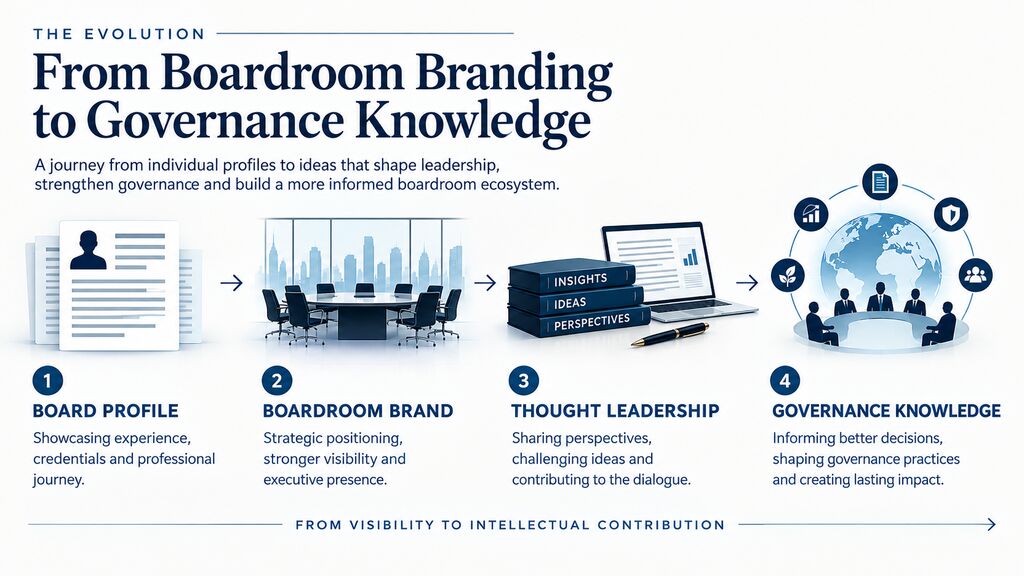
That evolution is visible in Your Board Profile’s journey. Its work spans Board CVs, boardroom branding, executive personal branding, board readiness, LinkedIn positioning, thought leadership and governance-oriented communication. Its portfolio is aimed at leaders who are not simply seeking another job title but are preparing for roles where judgement, credibility and strategic contribution matter. Your Board Profile portfolio
This creates an interesting progression:
The shift is timely. Boards operate in an environment shaped by technological disruption, regulatory change, geopolitical uncertainty, cyber risks, stakeholder expectations and changing business models. In such a landscape, a director cannot rely solely on what worked in the past. The ability to keep learning, interpreting and communicating becomes part of leadership credibility.
The Safety-Pin Leadership: A Different Leadership Metaphor
At the heart of the Your Board Profile 3rd anniversary is The Safety-Pin Leadership: Why Leaders Need to Hold Before They Move, authored by Anil Yadav. The book takes an everyday object and turns it into a leadership metaphor: the safety pin holds things together when there is pressure pulling them apart. The metaphor is simple, but its implications for leadership are surprisingly deep.
Leadership conversations often celebrate movement. We talk about transformation, acceleration, disruption, innovation, scaling and decisive action. Yet organisations also face moments when moving too quickly can create more problems than it solves. A board may need to assess a major acquisition, challenge a transformation proposal, respond to a crisis or examine a succession decision. In such situations, leadership may require the capacity to hold competing perspectives together before deciding where to move.
The book’s central metaphor connects with the realities of modern governance because effective boards must balance competing interests while maintaining objective judgement. The OECD principles emphasise that boards should guide strategy, monitor management, oversee risk and exercise independent judgement while considering the long-term interests of the company and relevant stakeholders.
Holding Before Moving
The idea of holding before moving is particularly relevant to senior leaders.
Holding does not mean avoiding decisions. It means creating enough space for the right decision to emerge.
A leader may need to hold:
- Competing stakeholder expectations
- Short-term performance and long-term value
- Growth and risk
- Innovation and control
- Management confidence and independent challenge
- Organisational stability and transformation
That is where the safety-pin metaphor becomes useful. It represents a form of leadership that does not eliminate pressure but helps prevent pressure from tearing the organisation apart.
Dr Amit Nagpal and the Evolution of Your Board Profile
The evolution of Dr Amit Nagpal Your Board Profile is closely connected with a larger change in how senior professionals approach board-level positioning. The traditional executive profile is generally designed to establish career progression, functional expertise and achievements. Board positioning requires a different lens.
The question changes from “What have you achieved?” to “What can you contribute at board level?”
That requires greater emphasis on governance exposure, strategic judgement, risk awareness, stakeholder management, leadership maturity and the ability to operate without direct operational authority.
Your Board Profile’s service portfolio reflects this broader approach, including customised Board CVs, LinkedIn profile optimisation, personal branding, Board Readiness Assessments, coaching and thought leadership. Your Board Profile Services
This is also where strategic storytelling becomes important. Experience has little boardroom value if it cannot be translated into a clear story about judgement and contribution.
Three Books, One Expanding Leadership Conversation
The third book does not stand alone. It forms part of a broader publishing journey.
The platform’s recent publishing activity has included Mastering Governance, Leadership & Strategic Storytelling: Lessons from PM Modi for Boards & C-Suite Leaders, authored by Dr Amit Nagpal, and Digital Transformation – A Playbook for Boards & C-Suite, co-authored by Uphar Srivastava and Dr Amit Nagpal. The third publication, The Safety-Pin Leadership, expands the conversation toward trust, stability, pressure and leadership behaviour.
The anniversary announcement identifies the three-book journey as part of the platform’s wider evolution.
The subjects differ, but the underlying question remains consistent: What does leadership look like when the stakes are high and the environment is uncertain?
That is an important question for today’s boardrooms.
Changing Meaning of Boardroom Branding
The phrase boardroom branding platform can sound like a sophisticated version of executive resume writing. It is much broader than that.
Boardroom branding is about translating professional experience into a credible governance proposition.
A senior executive may have spent twenty years running businesses, managing teams and delivering growth. But a board does not appoint someone simply because they managed a large P&L. It considers whether that individual can bring a useful perspective to oversight, strategy, risk, succession, transformation and stakeholder relationships.
The boardroom brand therefore needs to communicate three things:
- Experience. What has the leader actually done?
- Judgement. What has the leader learned from those experiences?
- Relevance. Why does that experience matter to a board today?
The third component is often missed. A highly accomplished career can become less compelling if the executive cannot connect past achievements with future boardroom challenges.
Why Independent Directors and CXOs Need More Than a CV
A conventional CV is largely chronological. It tells a story of where someone worked, what positions they held and what they accomplished.
A Board CV needs to be interpretive.
It should help a nomination committee, board chair, search professional or professional network quickly understand the candidate’s governance relevance. That may include sector expertise, transformation experience, risk management, financial understanding, technology knowledge, stakeholder leadership, ESG exposure, committee experience and strategic capabilities.
For independent directors and C-suite leaders, this distinction is particularly important because board service requires a different operating mindset.
An executive can give instructions.
A director must ask questions.
An executive can directly manage implementation.
A director must evaluate whether management is taking the organisation in the right direction.
An executive is often rewarded for execution.
A director is accountable for oversight and judgement.
The OECD’s corporate governance principles emphasise strategic guidance, monitoring management, risk oversight and the board’s ability to exercise objective and independent judgement.
That is why board positioning should not simply reproduce an executive career history. It should reinterpret that history through a governance lens.
Board Readiness and Executive Presence
Board readiness and executive presence are closely connected, but they are not identical.
A leader can possess impressive technical expertise and still struggle to influence a boardroom. Conversely, someone may communicate confidently but lack sufficient governance depth.
Board effectiveness requires both substance and presence.
Executive presence at board level is not about being the loudest voice in the room. It is about being able to listen carefully, challenge respectfully, communicate clearly and remain composed when the discussion becomes difficult.
Consider a board discussing an acquisition. A strong director may ask:
- What assumptions support the valuation?
- What happens if integration takes twice as long?
- Which risks are being underestimated?
- What capabilities are missing internally?
- What would make us walk away from the transaction?
These questions demonstrate something deeper than communication skill. They demonstrate governance thinking.
Leaders preparing for board roles can explore Your Board Profile’s approach to executive and board positioning through its services and board-readiness offerings.
Governance Leadership and Strategic Storytelling
Governance leadership and strategic storytelling may initially appear to belong to different worlds.
One sounds institutional.
The other sounds personal.
In practice, they are deeply connected.
A board candidate needs to explain judgement. The strongest way to demonstrate judgement is often through relevant stories.
Imagine two executives with similar experience.
One says:
“Led a major digital transformation across multiple business units.”
The other explains the problem, the resistance encountered, the risks considered, the decisions made, the stakeholders involved and the lessons learned.
The second narrative gives the audience something much more valuable: evidence of how the leader thinks.
Strategic storytelling is therefore not about exaggerating achievements. It is about creating a structure through which experience becomes understandable.
This is particularly useful for board candidates because board selection is fundamentally about trust. People want evidence that a potential director has dealt with complexity before.
From Personal Brand to Thought Leadership
Personal branding answers the question:
“What should people know about me?”
Thought leadership goes one step further:
“What should people learn from me?”
That distinction matters.
An executive may have a polished LinkedIn profile, strong professional network and impressive career history. But if all communication revolves around personal achievement, the brand can remain self-referential.
Thought leadership creates outward value.
A CFO might publish insights about capital allocation and financial resilience. A technology leader might write about AI governance. An HR leader might discuss succession planning and organisational culture. A manufacturing executive might contribute perspectives on supply-chain resilience.
Over time, these contributions create intellectual associations.
People begin to associate the leader with particular ideas.
That can become powerful boardroom currency.
Your Board Profile’s blog and insights section provides a broader example of how boardroom branding, leadership and governance topics can be developed into ongoing conversations.
Building a Stronger Board-Level Value Proposition
The strongest board profiles answer one central question:
What specific value can this person bring to a board?
That is the essence of a Board Value Proposition.
It should not be a collection of generic words such as “strategic,” “visionary,” “dynamic” or “results-oriented.” Those words are easy to write and difficult to prove.
A stronger proposition connects:
Industry experience + leadership experience + governance capability + strategic perspective + future relevance.
For example, a former technology CEO could position around AI transformation, cybersecurity, digital strategy and technology governance.
A former CFO could focus on capital allocation, financial stewardship, risk and audit.
A former CHRO could bring succession planning, organisational culture, talent strategy and leadership development.
The proposition becomes even stronger when supported by stories, publications, speaking engagements, board exposure and credible professional associations.
Your Board Profile’s Board Value Proposition and Board Bio framework reflects this need to move from a traditional professional biography toward a more strategic governance narrative.
Five Signals of Boardroom Credibility
Boardroom credibility is rarely created by a single achievement. It develops through multiple signals reinforcing one another.
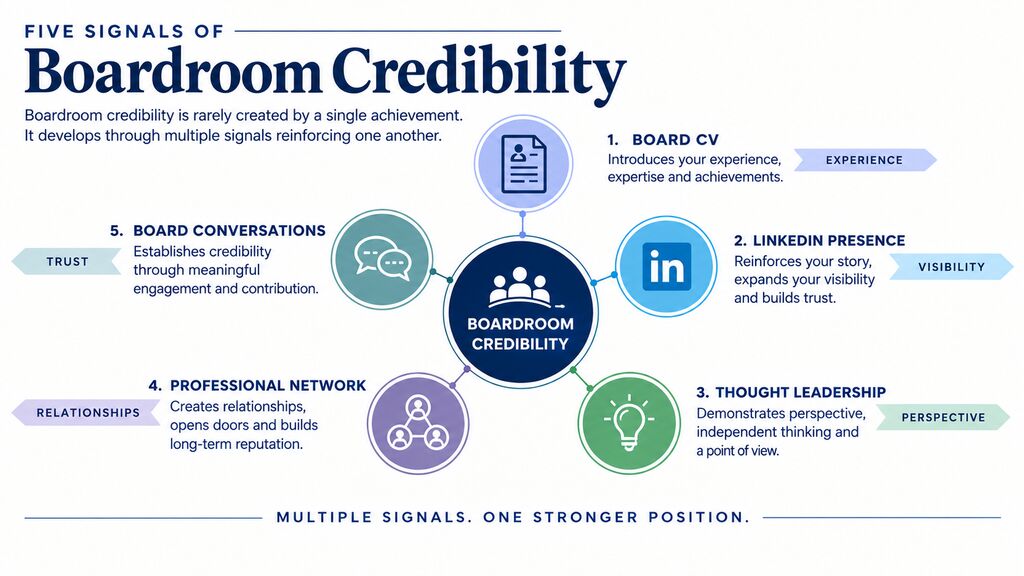
This is why a Board CV should be viewed as one part of a larger positioning system.
The CV introduces the leader.
The LinkedIn profile reinforces the story.
Thought leadership demonstrates perspective.
Networking creates relationships.
Board conversations establish credibility.
Together, these elements create a stronger boardroom brand.
Why Governance Knowledge Needs to Be More Accessible
Governance can sometimes appear distant from everyday leadership.
There are board charters, regulations, committee structures, fiduciary responsibilities, disclosures and compliance requirements. These are essential, but governance is ultimately about decisions.
Should the company acquire another business?
Should the board approve a major investment?
How should a company respond to a regulatory risk?
When should a CEO be challenged?
How should succession be handled?
What risks are not visible in the financial statements?
These are human and strategic questions as much as they are governance questions.
The G20/OECD Principles emphasise that boards should guide strategy, monitor management, oversee risk, ensure appropriate disclosure and exercise independent judgement. Making these ideas accessible through books, articles, case studies and leadership conversations can help future directors develop governance thinking before they enter the boardroom.
This is where the publishing side of the Your Board Profile 3rd anniversary becomes particularly interesting.
The platform is not only helping leaders present themselves.
It is increasingly participating in the conversation about what leadership should look like.
The Role of a Boardroom Branding Platform
A strong boardroom branding platform should help leaders connect the dots between professional experience and boardroom relevance.
That means asking questions such as:
- What governance problems can this leader help solve?
- Which board committees align with the leader’s experience?
- What strategic issues can the leader challenge or strengthen?
- What evidence supports the leader’s judgement?
- What ideas should the leader become known for?
- How visible is that expertise to the right professional audience?
This approach changes the nature of personal branding.
It is no longer about becoming famous.
It is about becoming relevant to the right decision-makers.
For aspiring directors, that may mean becoming visible to nomination committees, search firms, board networks and senior business leaders.
For existing directors, it may mean strengthening a distinct governance identity.
For CXOs, it may mean beginning to build board relevance before leaving the executive role.
Lessons for Senior Executives and Aspiring Directors
The journey behind the Your Board Profile 3rd anniversary offers several practical lessons.
1. Start board positioning before you need it
Board opportunities are rarely created at the moment someone decides they want one. Reputation takes time.
2. Translate achievements into governance language
“Delivered ₹500 crore growth” is an achievement. Explaining how the leader balanced capital allocation, risk and stakeholder expectations provides governance context.
3. Build a point of view
A board candidate should be able to say more than what they have done. They should have informed opinions about the issues shaping their industry.
4. Develop visible thought leadership
Articles, books, conferences, interviews and professional discussions can create evidence of expertise.
5. Build relationships before opportunities appear
Board appointments are trust-driven. Relationships matter because people need confidence in both competence and character.
The Executive Personal Branding Beyond the Job Title perspective is particularly relevant here. A senior executive’s identity should not disappear when the current designation changes.
Classroom to Boardroom and the Next Generation of Leaders
The governance conversation cannot remain limited to experienced directors.
Future boardroom leaders need exposure much earlier.
Your Board Profile’s Classroom to Boardroom initiative reflects this broader approach by connecting high-potential MBA students with senior leaders, mentors and governance professionals. The idea is straightforward: if tomorrow’s leaders are expected to understand governance, leadership and boardroom dynamics, they should encounter these ideas before they reach the boardroom.
This creates a continuum:
Students → emerging leaders → senior executives → aspiring directors → Independent Directors → board leaders.
Knowledge can travel across that continuum.
That is an important part of building a healthier governance ecosystem. Board readiness should not begin when an executive receives a call about a director opportunity. It can begin years earlier through mentoring, exposure, reflection and deliberate leadership development.
What Comes Next for Your Board Profile
The Your Board Profile 3rd anniversary feels less like an endpoint and more like a transition.
The platform has moved from helping professionals communicate their experience toward contributing to a broader conversation about leadership and governance. The publication of a third book reinforces that direction. The anniversary announcement positions the organisation around boardroom branding, governance signalling, strategic narratives and greater visibility and credibility for current and aspiring Independent Directors and senior executives.
The opportunity ahead is significant.
As boards confront AI, cyber risk, geopolitical uncertainty, digital transformation, sustainability expectations and changing stakeholder relationships, leaders will need to demonstrate more than functional expertise.
They will need judgement.
They will need context.
They will need curiosity.
And increasingly, they will need the ability to explain complex ideas clearly.
That makes the movement from profiles to publications more than a branding exercise. It is a natural extension of the work required to prepare leaders for increasingly complex boardrooms.
Conclusion: From Profiles to Publications
The story of the Your Board Profile 3rd anniversary is ultimately a story of evolution.
The journey began with a practical challenge: how can experienced professionals position themselves more effectively for board-level opportunities?
The answer has gradually expanded.
It includes Board CVs, executive visibility, board readiness, governance signalling, strategic storytelling, thought leadership and now publications that contribute to the wider leadership conversation.
The launch of The Safety-Pin Leadership by Anil Yadav adds an especially relevant idea to that conversation: leaders sometimes need to hold before they move. In an environment where speed is frequently celebrated, the ability to create stability, preserve trust and consider competing perspectives can be a powerful form of leadership.
For Independent Directors, CXOs, senior executives and aspiring board members, the larger lesson is clear.
Your career tells people where you have been.
Your Board Value Proposition tells them where you can contribute.
Your thought leadership tells them how you think.
And your reputation tells them whether they can trust you.
That is the real movement from profiles to publications.
It is the movement from visibility to credibility, from personal branding to intellectual contribution, and from individual positioning to a larger ecosystem of governance knowledge.
The third anniversary, therefore, is not simply a celebration of three years. It is a marker of what a boardroom branding platform can become when it starts creating not only profiles, but also ideas, conversations and knowledge for the leaders shaping tomorrow’s boardrooms.
Frequently Asked Questions
1. What is the Your Board Profile 3rd anniversary?
The Your Board Profile 3rd anniversary marks three years of the platform’s work at the intersection of boardroom branding, governance, personal branding and strategic storytelling. The anniversary coincides with the launch of its third book, The Safety-Pin Leadership by Anil Yadav.
2. What is The Safety-Pin Leadership by Anil Yadav about?
The Safety-Pin Leadership: Why Leaders Need to Hold Before They Move uses the safety pin as a metaphor for leadership under pressure. It explores the ability to hold people, trust, perspective and purpose together during uncertainty.
3. Who is Dr Amit Nagpal?
Dr Amit Nagpal is the founder of Your Board Profile and is associated with boardroom branding, strategic storytelling, governance positioning and executive visibility.
4. What is a boardroom branding platform?
A boardroom branding platform helps senior executives and aspiring directors position their professional experience for board-level relevance through Board CVs, board biographies, executive visibility, thought leadership and board-readiness strategies.
5. Why is boardroom branding different from personal branding?
Personal branding broadly communicates a professional’s identity and expertise. Boardroom branding goes further by translating that experience into governance relevance, strategic contribution, judgement and board-level value.
6. Why do Independent Directors need strategic storytelling?
Strategic storytelling helps Independent Directors demonstrate how they approach difficult decisions, competing stakeholder interests, risk and long-term value rather than simply listing career achievements.
7. What is board readiness?
Board readiness is the combination of governance knowledge, strategic judgement, relevant experience, independence, executive presence and credibility required to contribute effectively at board level.
8. What is a Board Value Proposition?
A Board Value Proposition explains the specific expertise, experience, perspective and strategic value an individual can bring to a board.
9. How can thought leadership help an aspiring board director?
Thought leadership can demonstrate expertise, create professional visibility and give boards and other stakeholders evidence of how a leader thinks about issues relevant to the organisation and its industry.
10. Why is executive presence important in the boardroom?
Board members need to communicate clearly, challenge constructively, listen carefully and remain composed during difficult discussions. Executive presence supports this form of influence.
11. What are the three books connected with Your Board Profile’s publishing journey?
The publishing journey includes Mastering Governance, Leadership & Strategic Storytelling, Digital Transformation – A Playbook for Boards & C-Suite, and The Safety-Pin Leadership. The third book was launched in connection with the platform’s third anniversary.
12. How does governance connect with strategic storytelling?
Governance depends heavily on judgement and communication. Strategic storytelling provides a way for leaders to demonstrate how they have handled complexity, risk, stakeholders and difficult decisions.
13. Who can benefit from boardroom branding?
CXOs, senior executives, existing directors, aspiring Independent Directors, founders and experienced professionals preparing for governance roles can benefit from board-focused positioning.
14. When should an executive start preparing for a board role?
Ideally, board preparation should begin well before a specific board opportunity appears. Building governance knowledge, relationships, thought leadership and a clear Board Value Proposition takes time.
15. What is the larger significance of the Your Board Profile 3rd anniversary?
The anniversary represents an evolution from creating professional profiles toward contributing to a broader conversation around governance, leadership, strategic storytelling and boardroom knowledge.
Your Board Journey Starts Before the Opportunity Arrives
A board opportunity doesn’t begin with an invitation—it begins with how you are positioned today. If you are a senior executive, CXO, aspiring Independent Director, or experienced professional preparing for a board-level role, your next step goes beyond updating your CV.
Build a credible boardroom identity that brings together your leadership experience, governance capabilities, strategic perspective, and professional visibility.
Your Board Profile helps you move from executive visibility to boardroom relevance through board positioning, Board CVs, executive branding, board readiness, and strategic thought leadership.
Position your experience. Strengthen your credibility. Prepare for the boardroom.
Schedule your complimentary session here: