

For years, senior executives were often told that if they delivered results, recognition would naturally follow. The logic sounded reasonable: do excellent work, build strong teams, solve difficult problems, and eventually the market will notice. But the executive landscape has changed. Today, Executive Visibility is increasingly connected with how leadership capability is discovered, interpreted and evaluated by boards, investors, search firms, regulators, employees and professional networks. A leader can be highly competent and still remain surprisingly difficult to discover outside the organisation.
This matters because modern governance is increasingly concerned with signals. Boards are looking beyond financial performance to understand leadership capacity, strategic adaptability, stakeholder confidence, reputation, succession depth and the organisation’s ability to respond to uncertainty. NACD’s 2026 work on strategy execution specifically highlights the challenge of distinguishing meaningful signals from noise as boards navigate increasingly interconnected and fast-changing variables.
That creates an interesting paradox for quiet CXOs. The very qualities that may have helped them succeed—listening carefully, avoiding unnecessary publicity, giving credit to others and focusing on execution—can also make their leadership contribution less visible. The problem is not that they lack substance. The problem is that their substance may not generate enough observable evidence.
This is where Executive Visibility becomes more than personal branding. It becomes a strategic leadership capability.
Why Executive Visibility Has Become a Governance Issue
From operational credibility to market credibility
Inside an organisation, credibility is often earned through proximity. Your team knows what you have delivered. Your CEO knows how you handle pressure. Your board may understand the decisions you have influenced. Colleagues have witnessed your judgement over several years. You do not need to explain yourself every week because your work is visible to the people who matter most.
The external market works differently. A board chair considering potential independent directors may not know you personally. A search consultant may see your LinkedIn profile before speaking with you. An investor may encounter your name in an industry discussion. A conference organiser may assess your expertise through articles, interviews or professional commentary. A fellow director may recommend you because they have repeatedly encountered your thinking in credible forums.
That is why Executive Visibility increasingly acts as a bridge between capability and discoverability.
A useful way to think about it is this: performance is the substance, while visibility is the signal that helps others find the substance. Neither replaces the other. A polished profile cannot compensate for weak leadership, just as outstanding leadership can remain commercially and professionally under-recognised when there is little external evidence of it.
McKinsey’s recent research on CEOs and stakeholder relationships reinforces this shift. The firm notes that leaders increasingly need to engage investors, regulators, employees, communities, media and other stakeholders, while also developing a compelling and consistent leadership narrative.
Why quiet leadership can become invisible leadership
There is nothing inherently wrong with being a quiet leader. In fact, many exceptional executives are reflective rather than theatrical. They ask better questions, listen before speaking and allow results to speak for themselves.
The danger begins when quiet leadership becomes invisible leadership.
Imagine two CXOs with comparable experience. Both have led transformation programmes, managed complex stakeholders and delivered measurable business outcomes. One regularly shares thoughtful perspectives on industry developments, participates selectively in professional forums and maintains a clear leadership narrative. The other rarely communicates externally and has a profile that simply lists job titles and responsibilities.
Which one is easier for a board search committee to evaluate?
The answer is obvious.
The second executive may actually be stronger. Yet the first executive has created more signals through which others can understand their judgement, expertise and leadership philosophy. Executive Visibility does not automatically mean being louder. It means making relevant leadership evidence easier to find, understand and remember.
Executive Visibility and Boardroom Perception & Positioning
What boards actually notice
Boards do not simply look for famous executives. In many cases, visibility without substance can create the opposite of the desired effect. What boards need is evidence that an executive understands the difference between management and governance.This distinction is critical.
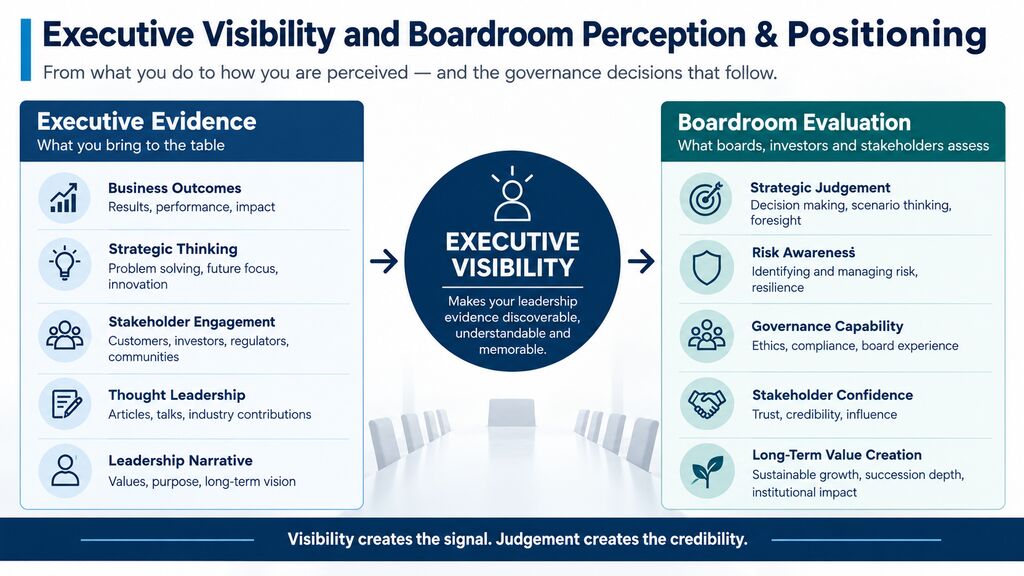
An executive might be highly visible because they frequently discuss operational achievements. But a board may want to know something deeper: Can this person think beyond their functional mandate? Can they understand risk? Can they challenge assumptions? Can they balance stakeholder interests? Can they contribute without becoming operationally intrusive? Can they understand capital allocation, succession, technology disruption, regulation and long-term value creation?
These questions shape Boardroom Perception & Positioning.
NACD’s governance guidance emphasises qualities such as integrity, leadership and sound judgement in director selection, alongside responsibilities involving strategy, risk, succession, compliance and board performance.
This means a future board candidate should not build visibility around a collection of achievements alone. The visible narrative should demonstrate how the executive thinks.
A CFO can discuss capital discipline. A CHRO can discuss workforce governance and leadership succession. A CIO can discuss technology risk and digital resilience. A COO can discuss operational resilience and execution governance. A legal leader can discuss regulatory complexity and ethical decision-making.
The objective is not to become an influencer. The objective is to become recognisable for a specific form of leadership judgement.
Reputation is a governance signal
Reputation is sometimes treated as a communications issue. That view is increasingly outdated.
Reputation influences stakeholder confidence, executive credibility and the degree of trust attached to leadership decisions. NACD’s risk-governance material explicitly recognises reputational risk as a potential source of stakeholder and market-value consequences.
Deloitte has also highlighted the relationship between stakeholder trust and board governance, reporting that 94 percent of surveyed global board members and executives regarded trust as important to organisational performance.
This changes the role of Executive Visibility. What you say publicly, the topics you repeatedly discuss and the way you respond to difficult issues can become part of the broader leadership record surrounding you.
That does not mean every executive needs to comment on every news story. Quite the opposite.
Strategic visibility is selective.
A leader should ideally be associated with a small number of meaningful themes rather than a large number of random opinions. Over time, consistency creates recognition.
Strategic Leadership Signaling in a Noisy Market
Signals that travel beyond the organisation
The modern leadership environment produces an enormous amount of information. Job titles, press releases, conference appearances, podcasts, LinkedIn posts, interviews, articles, awards, board appointments and industry commentary all contribute to how leaders are perceived.
But visibility is not simply volume.
A useful framework is to think of leadership signals across five dimensions:
| Leadership signal | What it communicates | Governance relevance |
| Business outcomes | Ability to deliver | Performance credibility |
| Strategic commentary | Quality of judgement | Strategic thinking |
| Stakeholder engagement | Ability to influence | Relationship management |
| Thought leadership | Depth of expertise | Subject-matter authority |
| Consistent professional narrative | Leadership identity | Boardroom positioning |
The strongest Strategic Leadership Signaling combines these dimensions without turning communication into self-promotion.
For example, instead of repeatedly saying, “I led a successful transformation,” a stronger signal might explain what the transformation taught the executive about technology adoption, organisational resistance, risk management and long-term value creation.
The difference is subtle but powerful.
One statement describes an achievement. The other reveals judgement.
Turning expertise into visible evidence
Senior executives often have an enormous amount of knowledge trapped inside meetings, presentations and internal documents. That knowledge can become valuable external evidence when translated carefully.
A board-ready executive might turn one transformation experience into several forms of intellectual capital: an article on transformation governance, a conference discussion on change leadership, a short LinkedIn perspective on implementation risk and a case-based conversation with another senior executive.
This is Executive Visibility with a purpose.
The objective is not to publish every week simply to satisfy an algorithm. It is to create a coherent trail of evidence that answers three questions:
What do you know?
How do you think?
Where can your judgement create value?
When those answers are consistently visible, discoverability improves.
Silent CXO Leadership: The Visibility Trap
When humility becomes discoverability risk
Humility is a leadership strength. Excessive invisibility is not.
Many senior executives say some version of, “I don’t like talking about myself.” That instinct is understandable. Nobody wants to appear self-important. Yet there is a major difference between self-promotion and professional communication.
Self-promotion says, “Look at me.”
Strategic visibility says, “Here is something useful that I have learned.”
That distinction can make Silent CXO Leadership much more comfortable.
A quiet executive does not need to become a daily content creator. They can begin with one thoughtful article every month, a few carefully selected professional conversations, occasional conference participation and a well-developed executive profile.
The key is consistency rather than intensity.
Building presence without becoming performative
The best Executive Visibility strategies do not force an introverted executive to imitate an extrovert.
Instead, they build around the executive’s natural strengths.
A reflective leader can become known for thoughtful analysis. A technical executive can translate complex technology issues into business implications. A finance leader can explain how financial discipline influences strategic resilience. A people leader can explore leadership systems, succession and organisational culture.
This approach protects authenticity.
It also creates a valuable distinction between visibility and publicity.
Publicity is attention.
Visibility is discoverability plus context.
A leader does not need millions of views. They need the right people to understand their value.
Executive Visibility in Modern Corporate Governance
The stakeholder ecosystem has changed
Governance no longer happens inside a closed boardroom.
Boards increasingly operate within an ecosystem involving investors, employees, regulators, customers, communities, technology platforms, media and professional networks. Deloitte’s India perspective notes that boards are taking a more active role as regulators, investors and employees increasingly press boards to fulfil their responsibilities.
McKinsey similarly describes the CEO as increasingly serving as a primary voice and face of the organisation, with stakeholders expecting leaders to provide context on issues ranging from technology and geopolitics to workplace change.
That environment creates a direct connection between Executive Visibility and governance.
A leader’s external narrative can influence how stakeholders understand organisational priorities. It can also shape whether a future board perceives the executive as commercially relevant, strategically mature and capable of representing stakeholder interests.
Preparing for the boardroom beyond the job title
A common mistake among aspiring directors is to treat their current job title as the foundation of their board profile.
A title is a starting point.
It is not a board value proposition.
“Former CHRO of a large organisation” tells a board where you worked. It does not necessarily explain what governance value you bring.
A stronger board narrative might focus on workforce transformation, leadership succession, culture risk, human capital strategy and organisational resilience.
This is why Boardroom Perception & Positioning should begin well before the first board opportunity appears.
Your public profile should gradually answer the same questions that a nominating committee might ask:
- What governance problems do you understand?
- What strategic issues can you challenge constructively?
- What risks have you handled?
- What stakeholder environments have you navigated?
- What perspective would you add to a board?
Your boardroom branding approach can be built around these questions rather than around a conventional career summary.
How to Build Executive Visibility Without Self-Promotion
A practical visibility architecture
A practical Executive Visibility strategy can be built around four layers.
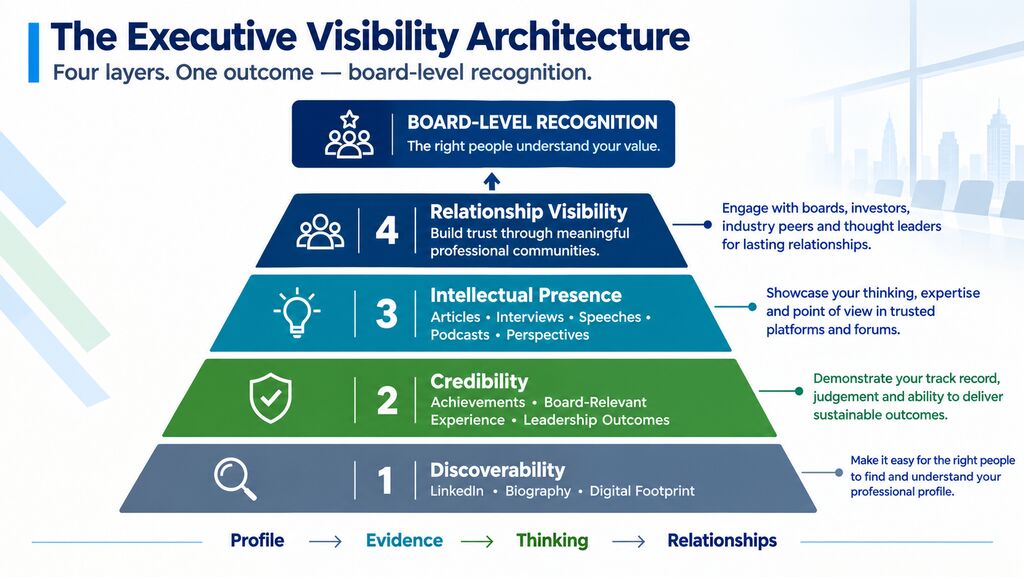
Layer one: discoverability. Your LinkedIn profile, professional biography and digital footprint should make your expertise immediately understandable.
Layer two: credibility. Your achievements, board-relevant experience, expertise and leadership outcomes should provide evidence.
Layer three: intellectual presence. Articles, interviews, speeches, podcasts and professional perspectives can demonstrate how you think.
Layer four: relationship visibility. Meaningful participation in professional communities helps people associate your name with your areas of expertise.
The four layers work together.
Your profile tells people who you are. Your content demonstrates how you think. Your relationships establish trust. Your achievements provide evidence.
For executives preparing for board roles, a well-constructed board value proposition and board bio can bring these elements together.
Measuring visibility as a leadership asset
One of the biggest mistakes is measuring visibility purely through likes and followers.
Those numbers can be useful, but they are not the ultimate objective.
A senior executive should ask better questions:
Are the right people discovering me?
Are people associating me with the issues I want to be known for?
Has my network become more relevant?
Am I receiving invitations to meaningful conversations?
Do people understand my board-level value?
Does my digital footprint reinforce or contradict my professional reputation?
These are more meaningful indicators of Executive Visibility.
A strong visibility programme should eventually create what might be called a recognition loop. You share useful thinking. People begin associating you with a subject. That recognition leads to conversations. Conversations lead to relationships. Relationships create opportunities. New opportunities generate additional evidence of expertise.
That is how visibility becomes an asset rather than a vanity metric.
Executive Visibility, Market Signals and the Future Board Candidate
The future boardroom will not necessarily favour the loudest executive. It will favour leaders whose judgement can be understood and trusted.
That distinction matters.
Current governance discussions increasingly emphasise strategy execution, adaptability, risk, stakeholder expectations and leadership capacity. NACD’s 2026 governance work specifically points to the need for boards to assess leadership capability and distinguish meaningful indicators from noise in a more uncertain environment.
This means aspiring directors should think about their professional reputation as an evidence system.
Every article, interview, conference appearance, board biography, professional conversation and leadership example contributes to that system.
The question is whether those signals tell a coherent story.
A CEO candidate known for transformation but unable to articulate governance implications may have an incomplete leadership narrative. A technology leader known only for technical expertise may be overlooked for broader board opportunities. A finance leader who consistently discusses capital allocation, risk, resilience and long-term value may be easier for a board to position.
The difference is not necessarily competence.
It is signal clarity.
A Board-Ready Executive Visibility Checklist
Before building a public leadership presence, senior executives can assess five areas:
| Area | Question to ask |
| Positioning | What do I want to be known for? |
| Evidence | What proves my expertise? |
| Governance relevance | Why does my experience matter to a board? |
| Communication | Can people understand my thinking without knowing me personally? |
| Consistency | Does my digital presence tell one coherent story? |
For executives who want to explore professional positioning, the Executive Personal Branding Beyond the Job Title perspective provides a useful starting point.
Similarly, leaders can review their professional portfolio and explore relevant board-readiness and executive visibility services to identify gaps between experience and external positioning.
The Strategic Advantage of Being Discoverable
There is a powerful difference between being visible and being discoverable.
Visibility can be temporary. Discoverability compounds.
A conference appearance may last one day. A thoughtful article can remain searchable for years. A strong board bio can be reviewed by multiple decision-makers. A consistent professional profile can introduce an executive to people they have never met.
This is particularly important for quiet CXOs.
They do not have to change their personality. They have to change the availability of evidence.
Think of it as opening the curtains rather than standing on a stage.
The expertise is already inside the room. Executive Visibility simply allows the right people to see it.
That is why the smartest visibility strategy is not built around “How can I get more attention?”
It is built around:
“What should the right stakeholders understand about my leadership when I am not in the room?”
That is a governance question as much as it is a branding question.
Executive Visibility and the New Leadership Equation
The traditional leadership equation was relatively simple:
Performance → Recognition → Opportunity
The modern equation is closer to:
Performance + Evidence + Visibility + Trust → Recognition → Opportunity
The addition of visibility does not diminish performance. It makes performance more discoverable.
For senior executives, that distinction can become particularly important during career transitions. A CXO considering an independent director role, advisory position, board committee opportunity or portfolio career cannot assume that previous achievements will automatically translate into future opportunities.
The market needs context.
It needs to understand not just what you have done, but what you can contribute next.
That is the real purpose of Strategic Leadership Signaling.
Conclusion: From Quiet Expertise to Recognised Governance Value
Quiet CXOs do not need to become louder to become more visible. They need to become more intentional about how their expertise is represented, communicated and discovered.
Executive Visibility is not about chasing attention, manufacturing controversy or turning every professional achievement into a social-media post. It is about creating credible signals that allow boards, stakeholders, search professionals and influential peers to understand your leadership value.
The strongest executive presence is therefore neither invisible nor performative. It is credible, consistent and strategically relevant.
For aspiring board directors, the opportunity is even greater. Start before you need the board seat. Build the narrative before the search begins. Demonstrate governance thinking before someone asks you to demonstrate it in a boardroom.
Your reputation is already sending signals.
The real question is: Are those signals saying what you want them to say?
If you are a senior executive or aspiring board director looking to strengthen your boardroom positioning, begin by reviewing your current digital footprint, leadership narrative and governance relevance. Your next board opportunity may not begin with an application. It may begin when someone searches your name and immediately understands the value you could bring to a board.
Frequently Asked Questions
1. What is Executive Visibility?
Executive Visibility is the extent to which a leader’s expertise, achievements, judgement and leadership perspective are discoverable and understood by relevant stakeholders. It goes beyond social-media activity and includes professional reputation, thought leadership, speaking, networking, digital profiles and board-relevant positioning.
2. Why is Executive Visibility important for CXOs?
CXOs increasingly interact with stakeholders beyond their immediate organisation. Investors, regulators, employees, customers, search professionals and boards may all evaluate leadership capability through external signals. Strong Executive Visibility helps make an executive’s expertise and judgement easier to discover.
3. Does Executive Visibility mean becoming active on social media?
Not necessarily. Social media is only one channel. An executive can build visibility through articles, industry conferences, interviews, professional associations, podcasts, speaking engagements, board biographies and meaningful stakeholder conversations.
4. Can introverted executives build strong Executive Visibility?
Absolutely. Silent CXO Leadership does not have to mean invisible leadership. Introverted executives can build visibility through thoughtful writing, selective speaking, subject-matter expertise and high-quality professional conversations without adopting an overly promotional communication style.
5. What is Strategic Leadership Signaling?
Strategic Leadership Signaling is the intentional communication of evidence that demonstrates how an executive thinks, makes decisions and handles complex business or governance challenges. It helps stakeholders understand leadership capability beyond a job title.
6. How does Boardroom Perception & Positioning affect board opportunities?
Boards need to understand what value a potential director can add. Boardroom Perception & Positioning helps connect an executive’s experience with governance priorities such as risk, strategy, stakeholder management, succession, technology, capital allocation and long-term value creation.
7. Is a strong LinkedIn profile enough for board readiness?
No. A LinkedIn profile is one component of the overall leadership narrative. Board readiness also involves governance knowledge, relevant experience, board value proposition, network, credibility, judgement and the ability to contribute effectively at board level.
8. How frequently should a CXO publish content?
There is no universal requirement. Quality and consistency are more important than volume. One thoughtful, relevant perspective can be more valuable than several generic posts that do not strengthen the executive’s positioning.
9. What should a CXO talk about publicly?
A CXO should focus on subjects connected to their genuine expertise and future positioning. These could include transformation, risk, technology, human capital, strategy, sustainability, regulation, resilience, capital allocation or other issues where the executive has meaningful experience.
10. Can Executive Visibility improve board discoverability?
It can. When an executive consistently communicates relevant expertise and maintains a credible professional profile, search professionals, board members and other stakeholders have more evidence through which to evaluate that individual. Visibility does not guarantee a board appointment, but it can improve discoverability.
11. What is the difference between visibility and personal branding?
Visibility concerns whether relevant people can discover and recognise your expertise. Personal branding is broader: it involves deliberately shaping how that expertise, reputation, positioning and leadership identity are perceived. Strong Executive Visibility can be one component of a broader executive personal brand.
12. Should executives comment on every business trend?
No. Excessive commentary can dilute credibility. Strategic visibility is selective. Executives should focus on issues where they have genuine knowledge, experience or a useful perspective rather than commenting simply to remain visible.
13. How can a CFO build board-level visibility?
A CFO can develop visibility around capital allocation, financial resilience, risk, governance, investor expectations, M&A, performance management and long-term value creation. The focus should move from reporting financial outcomes to demonstrating broader strategic and governance judgement.
14. How can a CHRO build board-level visibility?
A CHRO can develop a governance-oriented narrative around succession, leadership pipelines, human capital strategy, organisational culture, workforce transformation, executive compensation and culture-related risk. This helps demonstrate how people issues connect with enterprise value and board responsibilities.
15. What is the first step toward stronger Executive Visibility?
Start with an audit of your existing professional footprint. Review your LinkedIn profile, biography, board CV, published content, speaking history and digital search results. Then identify the leadership themes you want to own and build a consistent evidence-based narrative around them.
Ready to Make Your Leadership More Visible and Board-Ready?
Your experience may already demonstrate strong board-level potential. The next step is making that value visible, credible, and discoverable to the right stakeholders.
Build a strategic executive presence that brings together your expertise, leadership experience, governance perspective, and professional reputation into a compelling board-level narrative.
Whether you are a CXO, Founder, senior executive, or aspiring Independent Director, stronger Executive Visibility can help ensure that your leadership contribution is recognised beyond the organisation.
Don’t wait for the next board opportunity to start building your visibility. Start positioning yourself today.
Schedule your complimentary session here: