
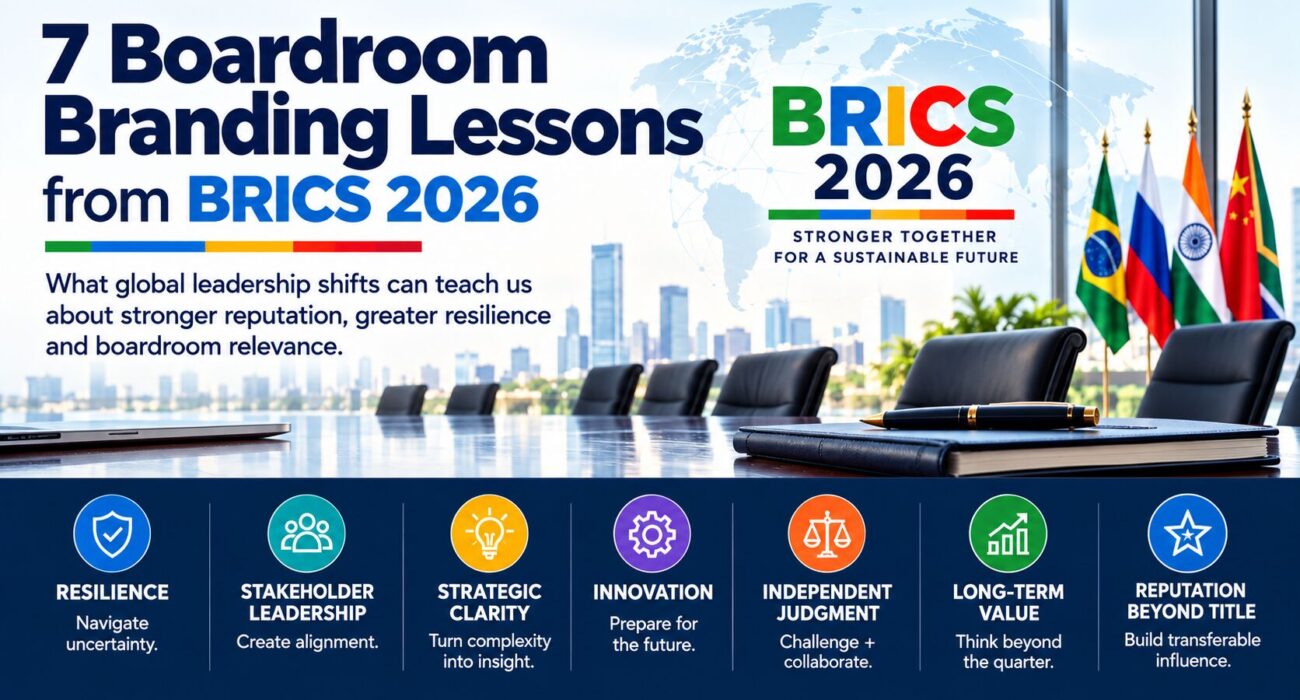
Introduction: What BRICS 2026 Can Teach Leaders About Boardroom Branding Lessons
The 2026 BRICS Summit in New Delhi offered more than a diplomatic discussion about global governance, trade, technology and development. It also presented a useful leadership case study.
Held on 12–13 September 2026 under India’s chairship, the 18th BRICS Summit brought together an expanded group of emerging economies around the theme “Building for Resilience, Innovation, Cooperation and Sustainability.” The New Delhi Declaration emphasised resilience, innovation, practical cooperation, sustainable development and a stronger voice for emerging markets.
For senior executives and aspiring board directors, the interesting question is not simply what BRICS means for geopolitics.
The more strategic question is:
What can the way BRICS navigates complexity teach us about executive reputation, corporate resilience and board-level positioning?
That is where the most valuable Boardroom Branding Lessons emerge.
A boardroom brand is not created by a polished LinkedIn profile or an impressive designation alone. It is built through the way a leader responds to uncertainty, makes decisions, creates alliances, communicates value and demonstrates judgment.
The BRICS story is particularly relevant because today’s executives are operating in an environment where geopolitical tensions, supply-chain disruption, technology shifts, AI, regulatory changes and changing trade relationships increasingly influence corporate strategy.
The World Bank’s 2026 outlook highlights how geopolitical tensions, commodity disruptions and trade-policy uncertainty can affect global growth, while the WTO continues to track the resilience of global trade despite significant geopolitical and policy pressures.
This makes BRICS 2026 a useful strategic lens for understanding modern leadership.
Table of Contents
Why BRICS 2026 Matters to Corporate Leaders
BRICS has evolved considerably from its original economic grouping. In 2026, the expanded grouping is dealing with questions around global governance, economic cooperation, digital transformation, AI, cross-border payments, development finance, supply-chain resilience and sustainable development.
The New Delhi Declaration also highlighted the importance of practical economic cooperation, resilient supply chains, innovation and institutional continuity. It noted India’s work on the BRICS Economic Partnership 2030 and welcomed progress on areas including cross-border payment discussions and the BRICS Growth and Development Task Force.
For executives, this matters because businesses increasingly operate in the same kind of environment:
- Multiple stakeholders with different priorities
- Competing geopolitical interests
- Regulatory uncertainty
- Technology disruption
- Changing customer expectations
- Supply-chain vulnerabilities
- Increasing expectations around sustainability and governance
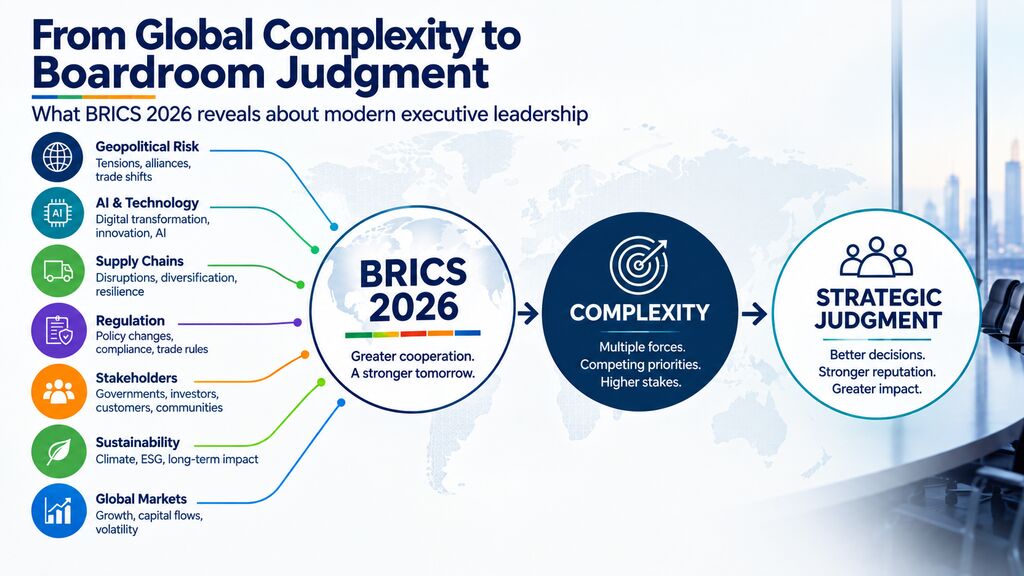
In such an environment, leadership visibility cannot be separated from strategic judgment.
The first of the Boardroom Branding Lessons is therefore simple: your reputation should demonstrate how you handle complexity, not merely what position you hold.
1. Boardroom Branding Lessons: Build Resilience Before You Need It
One of the strongest themes of BRICS 2026 was resilience.
India’s 2026 BRICS priorities were organised around four pillars: resilience, innovation, cooperation and sustainability.
For businesses, resilience is no longer simply about surviving a downturn.
It includes the ability to respond to:
- Geopolitical shocks
- Supply-chain disruptions
- Technology changes
- Regulatory shifts
- Cyber risks
- Talent disruptions
- Changing capital conditions
- Market volatility
Corporate resilience is now a leadership signal
A board does not only want to know whether an executive delivered strong numbers during favourable conditions.
It also wants to understand:
What happens when the environment changes?
This is one of the most important Boardroom Branding Lessons for senior professionals.
An executive who can explain how a business navigated disruption demonstrates a stronger board-level proposition than someone who simply lists annual achievements.
For example, instead of saying:
“Led a business unit generating significant revenue.”
A stronger leadership narrative might explain:
“Led a business transformation that diversified revenue streams, reduced concentration risk and strengthened operating resilience during market uncertainty.”
The second statement communicates judgment.
That is what makes it valuable for a boardroom.
2. Boardroom Branding Lessons: Lead Through Diverse Stakeholders
BRICS is not a group of identical economies with identical interests.
Its members have different economic structures, political priorities, strategic relationships and development needs.
Yet the platform continues to create areas of cooperation.
The lesson for executives is powerful:
Leadership does not require everyone to agree with you. It requires you to create enough alignment to move forward.
Executive leadership lessons from stakeholder diversity
A board director operates in a similar environment.
The stakeholders may include:
- Promoters
- Independent directors
- Institutional investors
- Regulators
- Employees
- Customers
- Government agencies
- Technology partners
- Communities
- Global investors
Each stakeholder may define value differently.
A strong executive does not communicate the same message to every stakeholder.
Instead, the leader maintains a consistent strategic position while adapting the language and evidence to the audience.
This is one of the most practical Boardroom Branding Lessons from BRICS 2026.
Your boardroom brand should communicate:
“I can create alignment without losing strategic clarity.”
That is particularly valuable for aspiring independent directors.
3. Boardroom Branding Lessons: Turn Complexity into Strategic Clarity
Geopolitical environments are complicated.
Corporate environments are no different.
Executives today are expected to understand issues outside their traditional functional expertise.
A CFO may need to understand geopolitical risk.
A CHRO may need to understand AI.
A technology leader may need to understand regulation.
A strategy leader may need to understand supply-chain dependencies.
The IMF’s recent work on geoeconomics highlights how economic interdependence can create both opportunities and vulnerabilities, making diversification and cooperation increasingly important strategic considerations.
The boardroom does not need more information. It needs interpretation.
This is a crucial distinction.
A board member who simply reports information adds limited value.
A board member who says:
“Here is what has changed, here is why it matters, here are the risks, and here is what management should consider next”
is demonstrating strategic leadership.
This is another important Boardroom Branding Lessons principle.
Your reputation should position you as someone who can convert complexity into decision-quality insight.
4. Boardroom Branding Lessons: Make Innovation Part of Your Leadership Identity
Innovation was another central pillar of India’s BRICS 2026 agenda.
The New Delhi Declaration highlighted innovation-driven economic growth and cooperation in areas including AI and digital transformation. It also recognised the need to understand the macroeconomic and financial implications of digital transformation and AI.
For executives, innovation should not be treated as a technology department’s responsibility.
Innovation is also a boardroom capability
Boards increasingly need directors who can ask questions such as:
- Where will AI change our business model?
- Which technologies could make our existing advantage irrelevant?
- What new risks emerge from AI adoption?
- How should we balance innovation with governance?
- Are we investing enough in digital capabilities?
- What happens if competitors adopt new technology faster?
The executive who develops a reputation for asking these questions becomes more strategically relevant.
This is among the most forward-looking Boardroom Branding Lessons from BRICS 2026.
Your leadership brand should not simply say:
“I have experience.”
It should communicate:
“I know how to apply experience to the next business environment.”
5. Boardroom Branding Lessons: Balance Independence with Collaboration
BRICS also demonstrates an important leadership paradox.
A country can protect its national interests while participating in a cooperative multilateral platform.
The same principle applies to executives.
Independence does not mean isolation
An effective board director should be able to challenge management independently while also contributing constructively to collective decision-making.
This is particularly important for independent directors.
Strong boardroom behaviour involves:
- Asking difficult questions
- Respecting different viewpoints
- Challenging assumptions
- Avoiding personal agendas
- Supporting well-reasoned decisions
- Maintaining fiduciary discipline
- Knowing when consensus is appropriate
This balance is central to modern Boardroom Branding Lessons.
A leader who is known only for being agreeable may not appear sufficiently independent.
A leader known only for confrontation may not appear sufficiently collaborative.
The strongest boardroom brand occupies the middle ground:
Independent in judgment. Collaborative in execution.
For more perspective on how the independent director role is changing, readers can explore this analysis of this changing independent director role and governance landscape.
6. Boardroom Branding Lessons: Build a Brand Around Long-Term Value
BRICS 2026 was not designed around one quarter or one year’s financial performance.
Its agenda involved longer-term questions around economic partnership, institutional development, innovation, sustainability and global governance.
Boards operate on a similar time horizon.
Strategic leadership must look beyond the immediate quarter
A senior executive’s board value can therefore be assessed through questions such as:
| Leadership Dimension | Short-Term Approach | Board-Level Approach |
| Growth | Revenue target | Sustainable growth engine |
| Risk | Avoid immediate losses | Build risk resilience |
| Technology | Adopt new tools | Create long-term digital capability |
| Talent | Fill vacancies | Build leadership pipeline |
| Reputation | Manage publicity | Build institutional trust |
| Sustainability | Compliance | Long-term enterprise value |
| Partnerships | Close transactions | Build strategic ecosystems |
This is one of the most valuable Boardroom Branding Lessons because boardrooms need leaders who can connect today’s decisions with tomorrow’s consequences.
A strong board profile therefore needs evidence of long-term thinking.
Your board value proposition and board bio guide should communicate not only what you have achieved, but how you think.
7. Boardroom Branding Lessons: Make Your Reputation Bigger Than Your Job Title
Perhaps the most important lesson is this:
A boardroom brand should survive a change in job title.
A CEO leaving a company does not automatically stop being a strategic leader.
A CFO can become an advisor.
A CHRO can become a board member.
A founder can become an investor or mentor.
A senior technology executive can become a transformation advisor.
The transferable asset is not the designation.
It is the reputation.
Build a leadership narrative that travels with you
This is why executive personal branding matters.
Your professional identity should answer five questions:
- What business problems do you understand deeply?
- What strategic decisions have you influenced?
- What leadership situations have tested you?
- What perspective do you bring to a board?
- What value can you create beyond your current role?
This is one of the foundational Boardroom Branding Lessons for professionals preparing for their next career chapter.
A useful starting point is to understand why executive personal branding beyond the job title.
Corporate Resilience and the Modern Executive
Corporate resilience is becoming a strategic leadership capability rather than simply an operational concern.
The World Bank’s 2026 analysis points to trade-policy uncertainty, geopolitical risks and commodity disruptions as important challenges to the global outlook.
The WTO has similarly highlighted how trade has remained resilient while businesses adapt to geopolitical and policy uncertainty.
For executives, this means resilience needs to become part of their leadership story.
Ask yourself:
If a board reviewed my career today, would it see evidence that I can navigate uncertainty?
If the answer is unclear, your board positioning may need stronger evidence.
Examples could include:
- Leading through a crisis
- Diversifying markets
- Redesigning supply chains
- Managing a major transformation
- Entering new geographies
- Navigating regulatory change
- Protecting stakeholder confidence
- Managing technology disruption
These are not merely career achievements.
They are boardroom signals.
Executive Leadership Lessons for Board Aspirants
The next generation of board directors will need broader strategic awareness.
Functional excellence will remain important, but it will not always be enough.
Five executive leadership lessons stand out
First, develop geopolitical awareness.
Executives should understand how international events affect customers, capital, technology, regulation and supply chains.
Second, think in systems.
Boards rarely deal with isolated problems. One decision can affect people, capital, reputation, compliance and growth simultaneously.
Third, communicate with precision.
A board meeting is not the place for unnecessary complexity. Directors need to communicate the issue, implications, alternatives and recommendation clearly.
Fourth, develop a point of view.
Board-ready executives should have informed perspectives on issues relevant to their industry.
Fifth, demonstrate judgment.
Experience tells the board what you have seen. Judgment tells the board what you may do next.
These are essential Boardroom Branding Lessons for anyone seeking a future board role.
B2B Brand Positioning in a Multipolar Business World
BRICS also provides an interesting lesson for B2B brand positioning.
In a multipolar business environment, companies cannot rely exclusively on one market, one customer group or one strategic relationship.
The same principle applies to professional brands.
Your professional brand needs strategic differentiation
Consider two executives.
Executive A says:
“I am a senior finance professional with 25 years of experience.”
Executive B says:
“I help complex businesses strengthen capital discipline, governance and strategic resilience during periods of transformation.”
Both may have similar experience.
But Executive B has clearer positioning.
This is why B2B brand positioning and executive branding increasingly overlap.
A board does not appoint experience in the abstract.
It appoints relevant experience for a specific strategic context.
Global Market Strategy and Boardroom Reputation
Global market strategy is increasingly influenced by geopolitics.
Companies need to think about market concentration, supply-chain exposure, regulatory regimes, technology dependencies and access to capital.
The WTO’s 2026 World Trade Report describes the global trading system as being at a critical juncture, with geopolitical tensions, digitalisation, AI and changing economic power reshaping the trade environment.
This creates an opportunity for executives.
A leader who understands global market strategy can become more valuable to boards because the role of the board increasingly includes asking:
“What external forces could change our strategic assumptions?”
That question moves leadership beyond operational management.
It moves the conversation towards enterprise stewardship.
A Practical Framework for Building Your Boardroom Brand
The BRICS 2026 example can be converted into a simple executive framework.
| BRICS Principle | Executive Translation | Boardroom Branding Action |
| Resilience | Ability to absorb shocks | Document crisis and transformation experience |
| Innovation | Prepare for future disruption | Develop a point of view on AI and technology |
| Cooperation | Align diverse stakeholders | Highlight cross-functional and cross-border leadership |
| Sustainability | Think long term | Demonstrate durable value creation |
| Strategic autonomy | Reduce excessive dependence | Show independent judgment |
| Multilateral engagement | Build ecosystems | Demonstrate partnership and stakeholder management |
| Institutional continuity | Think beyond individuals | Show governance and succession experience |
This framework can help senior executives convert career experience into a stronger board narrative.
Your Boardroom Branding strategy and services can also be viewed as a structured process of turning experience into board-relevant positioning.
The objective is not to make your profile sound impressive.
The objective is to make your value easy for a board or nomination and remuneration committee to understand.
From Executive Experience to Boardroom Relevance
A common mistake among senior professionals is assuming that a long career automatically creates board readiness.
It does not.
A 25-year career may contain hundreds of achievements, but only a portion may be relevant to board responsibilities.
The process therefore involves filtering.
Convert achievements into board signals
For example:
Career achievement:
Led a ₹1,000 crore business.
Board signal:
Demonstrated enterprise-scale P&L responsibility and capital allocation judgment.
Career achievement:
Expanded into three countries.
Board signal:
Demonstrated international market strategy and cross-cultural stakeholder management.
Career achievement:
Implemented an enterprise AI programme.
Board signal:
Demonstrated technology transformation and future-readiness.
Career achievement:
Managed a regulatory crisis.
Board signal:
Demonstrated governance judgment under pressure.
This transformation is at the heart of effective Boardroom Branding Lessons.
Why Boardroom Branding Lessons Matter More in 2026
The leadership environment is changing quickly.
Geopolitical fragmentation, AI adoption, shifting trade relationships and supply-chain risks are changing what organisations expect from senior leaders.
The IMF’s 2026 research on geoeconomics argues that excessive dependence can create vulnerability, while excessive fragmentation can undermine the benefits of cooperation.
That tension is equally relevant to corporate leadership.
Boards need leaders who can balance:
Growth + resilience
Innovation + governance
Independence + collaboration
Globalisation + strategic autonomy
Short-term performance + long-term value
The executive who can demonstrate these balances will increasingly stand out.
How to Apply These Boardroom Branding Lessons to Your Career
Start with a simple exercise.
Write down your five most significant leadership experiences.
Then ask:
What did each experience teach me about risk, growth, people, governance or strategy?
Next, identify the three themes that appear repeatedly.
Perhaps you are strongest in:
- Transformation
- Governance
- International expansion
Or:
- Risk management
- Digital strategy
- Stakeholder leadership
Those themes can become the foundation of your boardroom narrative.
Your professional portfolio should then reinforce those themes through evidence.
Likewise, your LinkedIn profile, board CV, board bio, speaking profile and thought-leadership content should tell the same strategic story.
Consistency creates credibility.
Conclusion: The Real Boardroom Branding Lessons from BRICS 2026
BRICS 2026 is ultimately a story about navigating complexity.
Its relevance to corporate leadership is not about copying geopolitical strategies.
It is about recognising the leadership capabilities required when there is no simple answer.
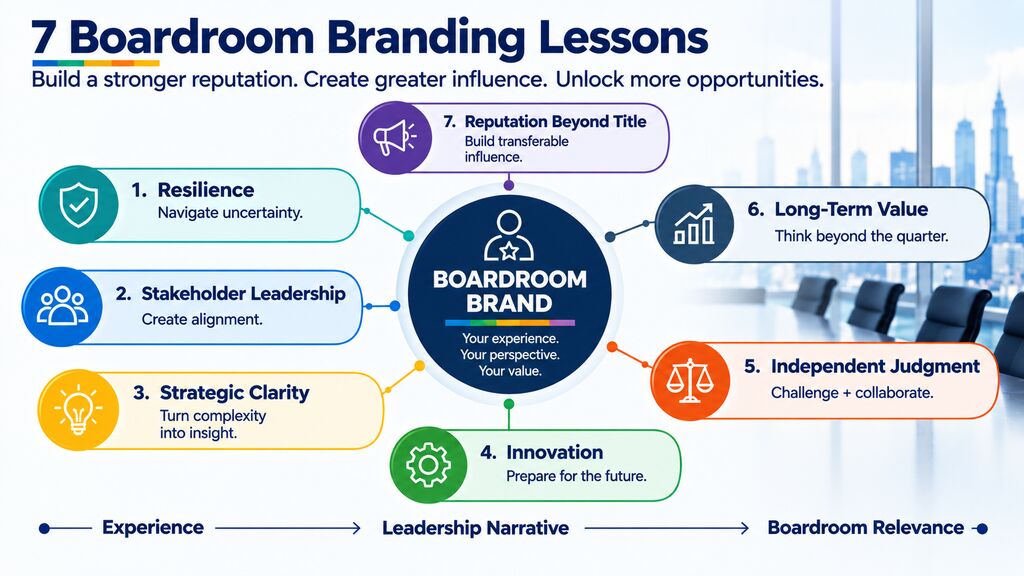
The strongest Boardroom Branding Lessons are clear:
- Build resilience before a crisis forces you to.
- Learn to lead stakeholders with different priorities.
- Turn complex information into strategic clarity.
- Make innovation part of your leadership identity.
- Balance independent judgment with collaboration.
- Think beyond quarterly performance and build long-term value.
- Build a reputation that remains relevant beyond your current job title.
For aspiring board directors, this is an important shift in mindset.
The question is no longer simply:
“What have I achieved?”
It is:
“What does my experience allow a board to understand, challenge, decide and accomplish better?”
That is where executive experience becomes board-level value.
And that is where a strong boardroom brand begins.
A Boardroom Branding CTA for Senior Executives
If you are preparing for a board role, reviewing your executive positioning or wondering whether your current professional story communicates your board value clearly, start by examining the gap between what you have done and what a board can recognise from it.
Explore Your Board Profile’s boardroom branding approach, and use the insights from BRICS 2026 as a prompt to rethink how you communicate resilience, strategic judgment, governance and long-term value.
Your next board opportunity may not begin with a board vacancy.
It may begin with how clearly the board can see the value you already bring.
Frequently Asked Questions
1. What are the key Boardroom Branding Lessons from BRICS 2026?
The key lessons include resilience, stakeholder alignment, strategic clarity, innovation, independent judgment, long-term value creation and building a professional reputation that extends beyond a current job title.
2. Why is BRICS 2026 relevant to executive leadership?
BRICS 2026 provides a useful example of how leaders navigate diverse stakeholders, geopolitical uncertainty, economic interests, technology changes and long-term strategic priorities.
3. How does BRICS relate to corporate resilience?
BRICS 2026 placed resilience among its central priorities. For companies, resilience means preparing for disruptions involving markets, supply chains, technology, regulation, capital and geopolitical developments.
4. What does corporate resilience mean for a board director?
For a board director, corporate resilience means being able to evaluate whether the organisation can withstand disruptions while maintaining financial, operational, technological and stakeholder stability.
5. How can executives use geopolitical events to improve leadership thinking?
Executives can study geopolitical events to understand how external developments influence markets, supply chains, capital flows, technology, regulation and stakeholder expectations.
6. What are the most important executive leadership lessons for aspiring board directors?
Aspiring directors should develop strategic thinking, independent judgment, stakeholder management, governance awareness, communication skills and the ability to interpret complex external developments.
7. Why is innovation important for boardroom branding?
Innovation demonstrates that an executive can think about future business models rather than only past achievements. Increasingly, boards need leaders who understand AI, digital transformation and emerging technologies.
8. How does B2B brand positioning affect an executive’s board prospects?
Strong B2B brand positioning helps clarify the specific business problems an executive understands and the value that executive can bring to an organisation or board.
9. Should an executive’s boardroom brand be different from their corporate profile?
It should be connected but not identical. A corporate profile focuses on the executive’s current organisational role, while a boardroom brand should communicate transferable strategic experience and governance value.
10. How can a CFO build a stronger boardroom brand?
A CFO can position experience around capital allocation, risk management, governance, transformation, investor relations, financial resilience and strategic decision-making rather than focusing only on financial reporting.
11. How can a CHRO position themselves for a board role?
A CHRO can demonstrate board relevance through experience in leadership succession, culture, workforce transformation, executive compensation, organisational risk and human-capital strategy.
12. How can technology executives demonstrate board readiness?
Technology executives can demonstrate board readiness through evidence of digital transformation, cybersecurity, AI strategy, technology governance, innovation, data management and technology-related enterprise risk.
13. What is the difference between executive branding and Boardroom Branding Lessons?
Executive branding communicates professional reputation and expertise. Boardroom branding goes further by connecting that reputation with governance, strategic judgment, enterprise risk and long-term value creation.
14. How often should a senior executive update their board profile?
A board profile should be reviewed whenever there is a major leadership achievement, transformation project, new governance responsibility, strategic expertise or significant change in the executive’s target board roles.
15. What is the first step toward building a board-ready professional brand?
The first step is identifying the strategic themes that consistently appear across your career and translating those experiences into clear board-relevant value propositions.
Ready to Turn Your Executive Experience into Boardroom Relevance?
Your professional experience may already demonstrate valuable board-level capabilities. The next step is to make that value visible, credible, and relevant to the boardroom.
Build a stronger boardroom brand that brings together your leadership experience, strategic judgement, governance perspective, stakeholder management, resilience, and long-term value creation into a clear and compelling professional narrative.
Whether you are a CXO, senior executive, entrepreneur, or aspiring Independent Director, your board journey should begin before the opportunity arrives.
Don’t let your job title define your leadership story. Build a reputation that travels beyond your current role and communicates the value you can bring to the boardroom.
Schedule your complimentary session here:
https://calendly.com/dramitnagpal
Share this post: Facebook | X | LinkedIn