

You have spent years building a company people recognise. Customers know its promise. Investors understand its story. Employees know what it stands for. Your communications team protects its reputation, marketing teams amplify its voice, and every presentation is carefully aligned with the organisation’s identity. But there is a slightly uncomfortable question many senior leaders never ask: what do people know about you when the company logo disappears?
That question sits at the heart of Personal Branding for senior executives. For a CXO, a personal brand is not about becoming an influencer, posting motivational quotes every morning, or turning LinkedIn into a diary. It is about making your leadership philosophy, judgment, expertise, values, and governance perspective visible enough for the right people to understand what you bring to a room. The company title may introduce you today, but it cannot tell the market how you think.
This distinction becomes especially important when you begin moving toward board roles. A nomination committee, chair, investor, executive search consultant, or fellow director is not simply evaluating where you worked. They are trying to understand whether your experience has developed into judgment. Personal Branding can become one of the signals through which that judgment is discovered.
The irony is that some highly accomplished CXOs have spent decades building corporate visibility while remaining professionally invisible themselves. Search their names, and almost everything you find belongs to the organisation: a designation, a press release, an appointment announcement, perhaps an old conference photograph. Their company has a brand. Their career has achievements. But their leadership identity has never really been articulated.
And that creates a gap.
Table of Contents
- Personal Branding Has Changed for Senior Executives
- Why Executives Need a Personal Brand
- Personal Branding Is Becoming a Governance Signal
- Corporate Leadership Branding vs Executive Self-Promotion
- CXO Personal Branding Starts With a Point of View
- Build Personal Branding Across Your Digital Footprint
- The Personal Branding Framework for Board-Aspiring CXOs
- Personal Branding Mistakes Senior Executives Should Avoid
- From Invisible Executive to Recognisable Leadership Brand
- Conclusion
- Frequently Asked Questions
Personal Branding Has Changed for Senior Executives
There was a time when seniority itself created visibility. You spent twenty or thirty years building a career, reached the C-suite, accumulated relationships across the industry, and allowed your title to do most of the talking. That model worked reasonably well when executive reputation circulated primarily through closed professional networks. Today, however, your leadership identity travels through search engines, social platforms, conference pages, corporate announcements, interviews, articles, podcasts, and increasingly AI-generated summaries of publicly available information. The question is no longer simply whether people have heard your name. It is whether the information surrounding your name communicates anything meaningful about your leadership.
This is why modern Personal Branding should be treated as reputation architecture rather than promotion. A strong executive brand connects what you have accomplished with what those experiences taught you, what issues you understand deeply, what principles shape your decisions, and what kind of value you can bring beyond your current position. That matters because board expectations themselves are evolving. PwC’s recent board-effectiveness research has highlighted concerns around director capacity, agility, emerging risks, and digital transformation, while its 2025 Annual Corporate Directors Survey reported that 55% of directors believed at least one fellow director should be replaced. The underlying message is difficult to miss: impressive credentials alone do not guarantee continuing relevance.
Your Corporate Title Is Borrowed Authority
A title can be enormously powerful, but it belongs to the position before it belongs to the person. “Chief Executive Officer,” “Chief Financial Officer,” or “Managing Director” immediately creates authority because people understand the organisational power behind the designation. Yet remove the company name and ask a different question: what leadership idea is associated with you personally? For many executives, the answer becomes surprisingly difficult.
Think of your corporate title as a beautifully furnished office that you occupy for a period of time. It gives you access, status, resources, and visibility, but eventually somebody else receives the keys. Personal Branding, on the other hand, is the intellectual and reputational equity that walks out of the building with you. It includes the way people describe your judgment, the problems they associate with your expertise, the principles they expect you to defend, and the contribution they believe you can make in another context.
That distinction becomes particularly important when exploring board opportunities. Your next organisation cannot inherit your previous authority. It can only evaluate the reputation, evidence, relationships, and perspective you carry forward. This is why executives preparing for board roles should think beyond their job descriptions and begin articulating a clear board value proposition that translates corporate achievements into board-relevant value.
Reputation Exists Whether You Shape It or Not
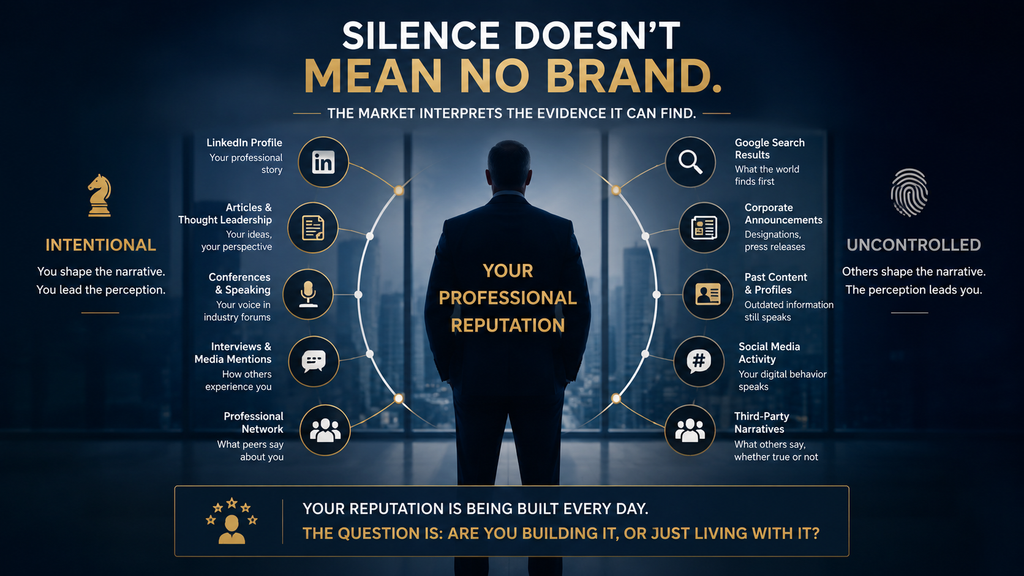
Some executives say, “I don’t believe in personal branding.” Yet the market forms an impression anyway. Silence is not the absence of a brand; it simply means the available evidence is doing the branding without your participation. Search results, old interviews, corporate announcements, social profiles, third-party articles, and comments from colleagues gradually create a public interpretation of who you are.
This makes intentional Personal Branding particularly valuable. You are not manufacturing a fictional persona. You are ensuring that the visible version of your leadership is reasonably consistent with the real one. If you have spent twenty years navigating turnarounds, building ethical cultures, governing technology transformation, or allocating capital through difficult cycles, those experiences should leave an intellectual footprint. Otherwise, someone researching you may see the titles but miss the thinking behind them.
That is also why executive personal branding beyond the job title matters. Your professional identity should survive a company transition, a career pivot, and eventually the move from executive management to governance.
Why Executives Need a Personal Brand
The question of why executives need a personal brand becomes easier to answer when we separate visibility from celebrity. A senior leader does not need millions of followers. In fact, chasing mass attention can dilute executive credibility if it produces constant commentary without substance. The real objective is relevant visibility among the people whose judgment matters: board chairs, nomination committees, investors, industry leaders, executive search professionals, regulators, peers, and governance communities.
Research on thought leadership gives us a useful clue. LinkedIn and Edelman found that 52% of decision-makers and 54% of C-suite executives spent at least an hour per week consuming thought-leadership content. The same research found that 75% had investigated a product or service they had not previously considered after encountering a particular piece of thought leadership. The research addresses B2B decision-making rather than director recruitment specifically, so it should not be treated as proof that publishing content wins board seats. It does demonstrate something relevant, however: sophisticated decision-makers actively use visible thinking to evaluate credibility and expertise.
Visibility Is Not the Same as Vanity
Executive visibility becomes problematic only when visibility itself becomes the objective. There is an enormous difference between saying something because you want attention and saying something because your experience gives you a useful perspective worth sharing. Good CXO personal branding lives on the second side of that line.
Imagine two CFOs with equally strong careers. One profile contains job titles, qualifications, and generic statements about “driving growth.” The other explains how the executive thinks about capital discipline during uncertainty, the questions boards should ask before major acquisitions, and the relationship between financial resilience and strategic optionality. Which person gives you a clearer sense of how they might contribute in a boardroom?
That is the point. Personal Branding should reduce uncertainty about your professional value. Your visibility becomes useful when it helps another person understand your judgment before the first conversation takes place.
Leadership Reputation Travels Beyond the Organisation
Senior executives now operate across several overlapping reputational environments. Employees see one version of the leader. Investors may see another. Customers, regulators, search consultants, and directors encounter different pieces of the same identity. Effective corporate leadership branding connects those pieces without turning them into a scripted persona.
This matters because governance itself increasingly emphasises transparency, informed judgment, and stakeholder considerations. The G20/OECD Principles of Corporate Governance state that directors should act on a fully informed basis, with due diligence and care, and emphasise the board’s ability to exercise objective independent judgment. They also recognise the importance of disclosure and communication within the governance framework. Your personal digital presence is obviously not a substitute for formal governance disclosure, but these principles reinforce the broader reality that credibility at board level depends on evidence of judgment, accountability, and informed leadership—not title alone.
Personal Branding Is Becoming a Governance Signal
For senior executives, Personal Branding becomes genuinely interesting when it moves beyond career marketing and starts revealing governance capability. A board candidate’s public presence can provide clues about how that person interprets risk, handles complexity, engages disagreement, approaches stakeholders, and thinks about long-term value. None of those signals independently establishes board readiness, but together they can create a more complete professional picture.
This is particularly relevant because boards themselves face widening expectations. The Deloitte Global Boardroom Program describes technology governance as a major strategic priority and challenge, while its research notes continuing concerns around talent, resilience, AI, and board-C-suite collaboration. Meanwhile, PwC’s board research shows ongoing pressure around board skills, agility, digital transformation, and emerging risks. A prospective director therefore needs more than historical accomplishments. The candidate needs a credible answer to a forward-looking question: what can you help a board understand next?
What Does Your Public Presence Reveal About Your Judgment?
Open your LinkedIn profile as though you were a nomination committee member who had never met you. Then search your name. Read your biography, posts, articles, interviews, conference appearances, and any public commentary you can find. What emerges?
Do you sound like somebody documenting a career or somebody capable of shaping a conversation?
This is where personal branding and boardroom credibility begin to intersect. A board-facing reputation should demonstrate judgment without pretending to have answers to everything. Good directors ask powerful questions. They recognise trade-offs. They understand that difficult governance decisions rarely arrive with neat labels saying “correct answer.”
Your content should reflect the same maturity. Instead of posting “AI will transform business,” consider discussing the governance tension between rapid AI adoption and accountable oversight. Instead of celebrating an acquisition, explain what leadership teams often underestimate during integration. Perspective reveals far more than proclamation.
From Executive Expertise to Boardroom Relevance
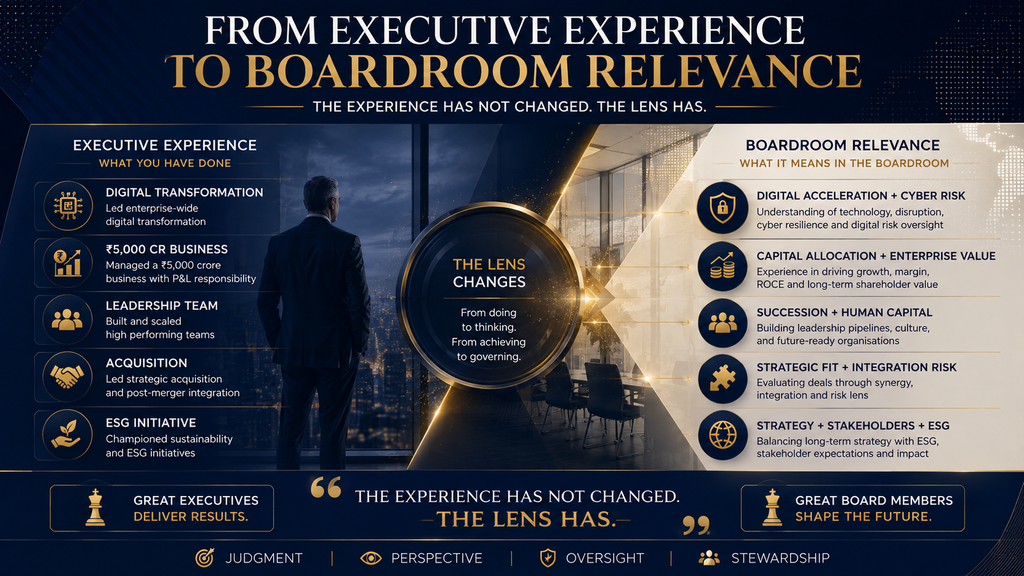
The transition from CXO to director requires a subtle shift in language. Executives are trained to describe what they did. Directors are expected to demonstrate how they think about what organisations should do.
Consider the difference:
| Executive-Level Statement | Board-Relevant Personal Branding Signal |
| Led digital transformation across 12 markets | Explores how boards should balance digital acceleration with operational and cyber risk |
| Managed a ₹5,000 crore business | Demonstrates judgment around capital allocation and sustainable enterprise value |
| Built a high-performing leadership team | Discusses succession, leadership resilience and human-capital oversight |
| Delivered a major acquisition | Shares lessons about strategic fit, integration risk and post-deal governance |
| Led ESG initiatives | Connects sustainability decisions with strategy, risk and stakeholder expectations |
The experience has not changed. The lens has.
That shift is central to strong Personal Branding because boards are not recruiting another operating executive to run a department. They are looking for somebody capable of stepping above functional expertise and contributing to collective governance.
Corporate Leadership Branding vs Executive Self-Promotion
One reason senior leaders resist Personal Branding is that they associate it with self-promotion. That concern is understandable. Nobody wants a respected CEO’s feed to suddenly resemble a motivational-content factory filled with airport photographs and recycled leadership clichés. But credible corporate leadership branding is almost the opposite of that behaviour.
Self-promotion repeatedly asks the audience to notice you. Leadership branding repeatedly gives the audience a reason to remember your thinking.
| Self-Promotion | Strategic Personal Branding |
| “Proud to announce…” dominates communication | Shares lessons and useful perspective |
| Focuses on status | Focuses on substance |
| Talks primarily about achievements | Interprets what experience has taught |
| Chases broad visibility | Builds relevance with the right audience |
| Follows every trending topic | Develops a few credible intellectual territories |
| Presents certainty constantly | Shows judgment, nuance and curiosity |
| Depends on current designation | Builds reputation that travels across roles |
A credible executive brand should feel like an extension of your leadership rather than a marketing costume. If you are measured and analytical in a boardroom, your online voice should not suddenly become theatrical. If your leadership is grounded in evidence, your content should reflect evidence. If you have spent decades building trust quietly, your Personal Branding strategy can remain understated while still making your expertise discoverable.
CXO Personal Branding Starts With a Point of View
A resume tells people what happened to you professionally. Personal Branding tells them what those experiences taught you.
That is why the foundation of CXO personal branding is not a content calendar. It is a point of view.
What have you learned that a less experienced leader may not yet see? Which strategic problem have you encountered repeatedly? What popular assumption do you challenge? What do organisations routinely get wrong in your field? Where does your experience intersect with a board-level priority?
These questions help transform experience into intellectual positioning. An experienced CHRO might build a perspective around succession risk and organisational resilience. A CFO might focus on capital allocation under uncertainty. A technology leader could examine AI governance and cyber resilience. A consumer-business CEO may speak about changing customer trust and portfolio strategy.
Build Intellectual Territory
Trying to speak about everything usually makes an executive memorable for nothing. Select a small number of territories where your experience genuinely gives you authority. The territory should be broad enough to sustain years of discussion but focused enough to create association.
For example, your three territories might be governance and strategic judgment, technology transformation, and leadership succession. Your posts, articles, interviews, panels, and executive biography can approach these themes from different angles. Over time, repetition creates association without requiring repetitive content.
The aim is simple. When a chair or search consultant encounters a challenge in your territory, your name should make intellectual sense in that conversation.
Turn Experience Into Evidence
Statements such as “strategic leader,” “visionary executive,” and “transformational thinker” are weak because almost anybody can claim them. Evidence gives Personal Branding weight.
Rather than calling yourself a transformation expert, discuss a transformation decision that changed how you think about risk. Instead of claiming stakeholder expertise, explain a situation in which competing stakeholder expectations changed the decision. Rather than writing “passionate about governance,” demonstrate governance thinking through the questions you ask publicly.
The same principle applies to executive bios. Your social media bio for board directors should not simply compress your resume into 220 characters. It should help the reader understand the intersection between your experience and the value you now represent.
Build Personal Branding Across Your Digital Footprint
You do not need to be everywhere. You need to be coherent where you are.
Your website biography might describe you as a transformation leader. LinkedIn might present you as a finance specialist. Conference profiles may emphasise sustainability. An old social profile may contain no useful professional context at all. Individually, none of these is disastrous. Collectively, however, they can create a fragmented leadership identity.
Effective Personal Branding creates alignment across touchpoints. Start with the platform most relevant to your professional ecosystem—often LinkedIn for senior executives—then work outward. Review search results, corporate biographies, speaker pages, interviews, professional association profiles, published articles, and board-related references. Ask whether they reinforce the same core value proposition.
This does not mean repeating identical language everywhere. It means making sure different parts of your digital footprint feel like chapters from the same book.
LinkedIn, Search and Executive Bios Must Tell One Story
Think of search as your unofficial due-diligence room. Someone hears your name, becomes curious, and searches. Within minutes, that person may form an initial impression of your professional identity.
Your LinkedIn headline should therefore communicate more than a current designation. Your About section should connect experience with perspective. Your featured content should provide evidence of thought leadership. Your biography should explain board relevance. Your posts should reinforce the subjects you genuinely understand.
The quality of this ecosystem matters more than posting frequency. Tracking the relationship between content, visibility, authority, and influence can also make Personal Branding less subjective. A structured approach such as a personal branding content influence index can help executives think beyond follower counts and examine whether their content is actually strengthening relevant leadership authority.
The Personal Branding Framework for Board-Aspiring CXOs
For executives approaching board careers, Personal Branding can be organised around five connected elements: Position, Proof, Perspective, Presence, and Perception.
Position answers the question: what board-relevant value should people associate with you? Proof establishes why anyone should believe that proposition. Perspective demonstrates how you think. Presence determines whether the right people can discover that thinking. Perception tests whether the market actually sees you the way you intended.
| Element | Core Question | Executive Action |
| Position | What should I be known for? | Define 2–3 board-relevant leadership territories |
| Proof | Why should anyone believe me? | Translate achievements into evidence and outcomes |
| Perspective | How do I think? | Publish informed viewpoints and governance questions |
| Presence | Can the right audience find me? | Align LinkedIn, bios, search presence and speaking |
| Perception | Is my reputation landing correctly? | Audit external signals and refine positioning |
Notice what is missing from the framework: “become famous.”
That is deliberate. Executive Personal Branding is not a popularity contest. Ten thousand irrelevant followers may create less board value than being meaningfully recognised by fifty people in the governance ecosystem that matters to your next chapter.
The broader Your Board Profile approach to board positioning reflects the same principle: the objective is to convert a career history into a credible board proposition. Executives who need a more structured transition can also explore board positioning and profile services designed around board-facing reputation and readiness.
Personal Branding Mistakes Senior Executives Should Avoid
The first mistake is starting with content instead of positioning. Executives are often told, “You should post more on LinkedIn.” So they post. One day it is AI, the next day leadership, then sustainability, then a photograph from an event, followed by a generic quote about teamwork. Activity increases, but positioning remains fuzzy. Before publishing more, decide what you want the publishing to establish.
The second mistake is outsourcing your thinking. Communication support is useful, particularly for executives with demanding schedules, but the intellectual substance still needs to sound like you. A beautifully written article that contains none of your actual judgment may create content without creating a credible leadership brand.
The third mistake is confusing executive presence with performance. Strong boardroom presence is not necessarily the loudest voice, the most polished photograph, or the most dramatic opinion. Boardroom executive presence is perceptual, which means credibility emerges through how others interpret your judgment, composure, communication, and contribution.
The fourth mistake is measuring vanity metrics. Likes can be pleasant. Followers can be useful. Neither automatically indicates governance credibility. Look instead at who engages, which conversations your ideas create, whether search visibility improves around your areas of expertise, whether relevant invitations increase, and whether your professional network begins associating you with the intended territory.
The fifth mistake is waiting until you need a board role. Reputation compounds slowly. You cannot spend twenty years invisible, decide on Monday that you want an independent director position, publish three posts by Friday, and expect the market to reinterpret your professional identity. Build the reputation before you need the opportunity.
From Invisible Executive to Recognisable Leadership Brand
Here is the encouraging part: you probably do not need to invent a brand. If you have spent twenty or thirty years leading businesses, making difficult decisions, navigating uncertainty, developing leaders, allocating resources, handling crises, and negotiating competing priorities, the raw material already exists.
Your job is to uncover the pattern.
Look backward before you look outward. Which decisions defined your leadership? What do colleagues repeatedly seek your advice about? Which experiences changed your mind? Which governance questions fascinate you? Where have you developed a perspective that cannot be acquired from reading five management books?
Then translate those answers into a deliberate Personal Branding architecture. Refine your positioning. Rebuild your executive biography around value rather than chronology. Align your LinkedIn presence. Publish selectively. Participate in relevant conversations. Develop signature viewpoints. Connect your operational achievements with governance implications.
The result should not feel like a louder version of you.
It should feel like a clearer one.
That distinction matters because your organisation’s reputation can open doors while you occupy the executive seat, but your personal reputation determines what follows you after you leave it. Your corporate brand answers, “What does this company represent?” Your leadership brand should answer an equally important question:
“What does this executive represent?”
Conclusion
Personal Branding for a senior executive is not about becoming a social-media personality. It is about ensuring that decades of experience produce a visible and credible leadership identity. As executives move toward advisory and board responsibilities, that identity becomes increasingly valuable because the market needs to understand not only what they have managed, but how they think, what they stand for, and where their judgment can create value.
The strongest corporate leadership branding connects achievement with interpretation. Strong CXO personal branding turns experience into perspective. And the answer to why executives need a personal brand becomes especially clear once the company title is removed: people still need a reason to recognise, understand, trust, and remember the leader behind it.
Your company will continue building its brand.
The more important question for your next chapter is whether you are deliberately building yours.
FAQs
1. What is Personal Branding for senior executives?
Personal Branding for senior executives is the deliberate process of making leadership expertise, values, judgment, experience, and professional perspective visible to relevant audiences. It goes beyond self-promotion by creating a consistent reputation that can travel beyond an executive’s current company or job title.
2. Why do executives need Personal Branding?
Executives need Personal Branding because a corporate designation communicates authority but does not fully communicate individual leadership value. A clear executive brand helps boards, investors, peers, search professionals, and other stakeholders understand what the leader knows, how they think, and where they can contribute.
3. Is Personal Branding important for aspiring board directors?
Yes. Personal Branding can support board positioning by making governance-relevant expertise and judgment easier to discover. It cannot replace genuine board readiness, experience, independence, or relationships, but it can help communicate those qualities more effectively.
4. What is the difference between Personal Branding and self-promotion?
Self-promotion focuses primarily on attracting attention to achievements, while Personal Branding creates a coherent professional reputation through expertise, evidence, perspective, and consistent communication. For CXOs, substance should always come before visibility.
5. What is corporate leadership branding?
Corporate leadership branding is the deliberate positioning of senior leaders around the expertise, values, strategic perspectives, and leadership qualities they represent. It connects individual executive reputation with broader organisational and stakeholder expectations.
6. How should CXOs start building a personal brand?
CXOs should begin by identifying two or three areas where their experience creates genuine authority. They can then align their executive biography, LinkedIn profile, speaking topics, articles, and professional conversations around those themes rather than posting about every trending business subject.
7. Does a CEO need to be active on social media?
A CEO does not need to be constantly active on social media, but a credible and current professional presence can make leadership expertise easier to discover. Quality, consistency, and relevance matter more than publishing every day.
8. Can Personal Branding help with board opportunities?
Personal Branding can improve discoverability and clarify a candidate’s board-relevant proposition, especially when supported by genuine governance experience. Board appointments still depend on factors such as skills fit, reputation, independence, networks, judgment, and the board’s specific needs.
9. What should executives post about on LinkedIn?
Executives should focus on areas where experience gives them something useful to say. Governance lessons, strategic trade-offs, industry changes, leadership decisions, transformation, risk, succession, technology, and stakeholder issues can all provide strong material when approached thoughtfully.
10. How is CXO personal branding different from influencer branding?
CXO personal branding prioritises professional credibility, judgment, relevant relationships, and intellectual authority. Influencer branding often prioritises reach and audience growth. An executive may build a large audience, but audience size should remain secondary to reputation quality.
11. How can executives measure Personal Branding success?
Executives can monitor relevant search visibility, profile views from target audiences, quality of professional engagement, speaking invitations, media opportunities, introductions, governance conversations, and whether others increasingly associate them with their intended areas of expertise.
12. Should executives hire someone to manage Personal Branding?
Professional support can help with strategy, research, writing, digital optimisation, and consistency. However, the executive’s real experience and thinking should remain at the centre. Outsourcing production can work; outsourcing the actual point of view usually cannot.
13. What makes Personal Branding credible for board-level professionals?
Credibility comes from alignment between claims and evidence. A board-facing executive brand becomes stronger when perspectives are supported by genuine experience, informed analysis, governance exposure, measurable achievements, and a consistent professional reputation.
14. How long does executive Personal Branding take to work?
There is no universal timeline because reputation develops through repeated exposure and credible evidence. Executives should approach Personal Branding as a long-term reputational asset rather than a short campaign launched immediately before seeking a new role.
15. What is the biggest Personal Branding mistake CXOs make?
The biggest mistake is mistaking visibility for positioning. Publishing frequently without a clear leadership proposition can create noise without building authority. Effective Personal Branding starts with deciding what you should credibly be known for and then consistently demonstrating it.
Ready to Make Your Leadership Visible Beyond the Logo?
If your career already demonstrates leadership but your public profile still reads like a collection of job titles, this is the moment to close the gap. Build a Personal Branding strategy that translates experience into board-relevant authority, aligns your digital footprint, and makes your leadership perspective visible before the next opportunity appears.
Your company has invested years defining what it stands for.
Your leadership deserves the same clarity.
Whether you’re an aspiring Independent Director, CXO, Founder, or senior executive, a well-positioned board profile can make all the difference in today’s competitive board landscape.
Book a complimentary strategy session with Your Board Profile today. Share this post: Facebook | X | LinkedIn