
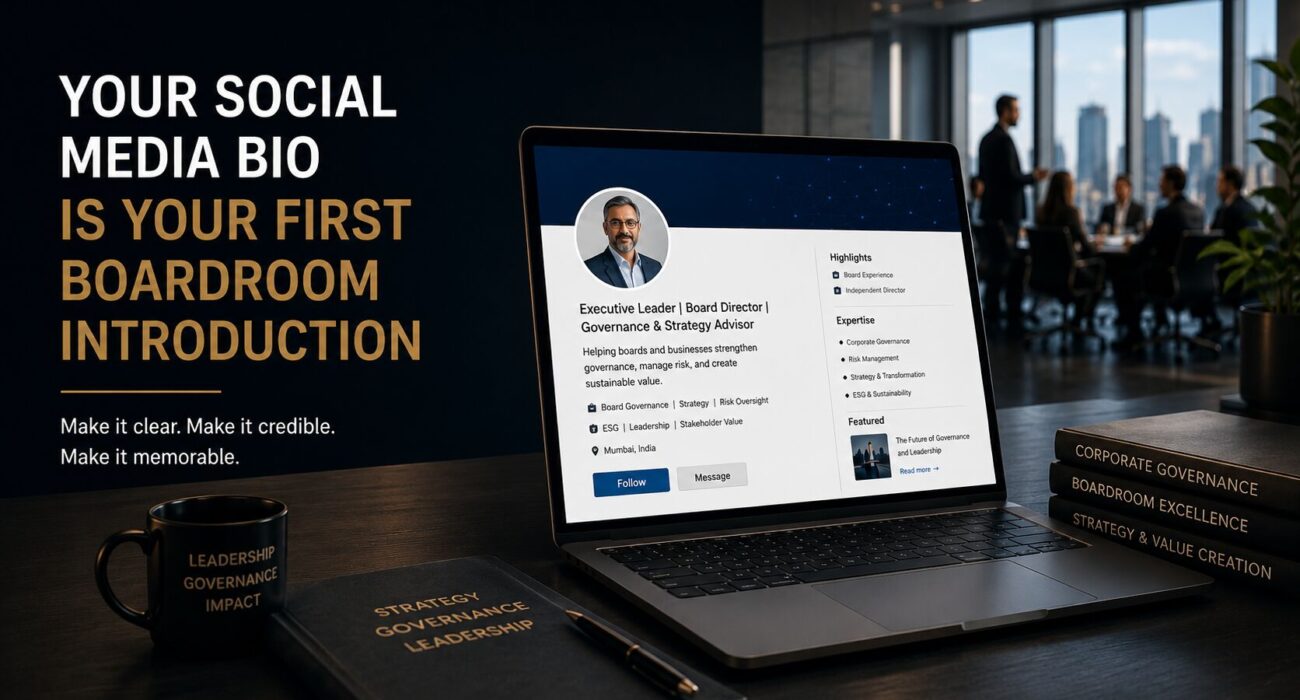
Your social media bio is often the shortest piece of content people will ever read about you. Yet, it can become the most influential. Before someone accepts your LinkedIn request, visits your profile, replies to your comment, or considers you for a board opportunity, they usually spend just a few seconds scanning one thing—your bio. Those few lines quietly answer questions that every executive, recruiter, investor, and board nomination committee member is asking.
“Who is this person?”
“Why should I pay attention?”
“What value do they bring?”
“Do they belong in my professional network?”
That is why a social media bio is much more than a profile description. It is your first professional introduction in a digital-first world. It shapes perception before a conversation begins, influences credibility before your experience is examined, and creates curiosity before anyone reads your achievements.
For senior executives, founders, aspiring board directors, and professionals preparing for board-level opportunities, this matters even more. Your experience may speak volumes during an interview, but your digital profile often determines whether you receive that opportunity in the first place. A weak bio creates hesitation. A thoughtful bio creates confidence.
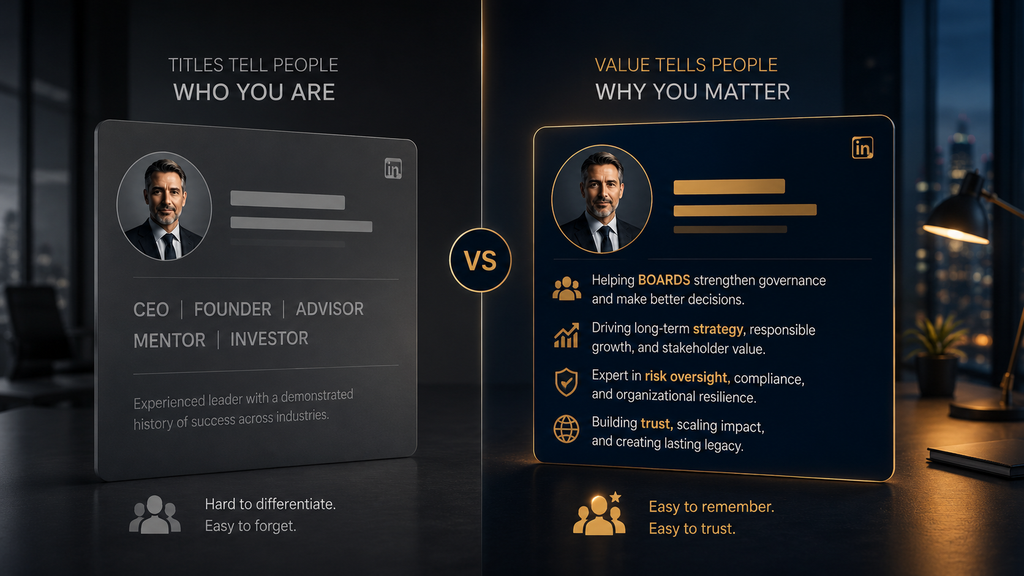
Many accomplished professionals unknowingly reduce decades of leadership experience to a generic list of designations such as CEO | Consultant | Mentor | Investor. While these titles communicate what you do, they rarely explain why someone should remember you. The strongest executive profiles tell a story, communicate a unique value proposition, and leave readers wanting to know more.
This article explores how to write a memorable social media bio that goes beyond job titles. You’ll learn practical frameworks, common mistakes to avoid, and strategic techniques that help your profile reflect not only your experience but also your leadership identity, credibility, and long-term boardroom potential.
Table of Contents
- Why Your Social Media Bio Is More Than a Profile
- Build a Bio That People Remember
- Communicate Your Unique Professional Value
- Add Personality Without Losing Professionalism
- The Executive Social Media Bio Framework
- Examples of Strong Executive Bio Transformations
- Common Mistakes That Make a Social Media Bio Forgettable
- A Simple Checklist Before You Publish Your Bio
- How Board Directors Can Strengthen Their Digital Presence
- Conclusion
- FAQs
Why Your Social Media Bio Is More Than a Profile
Most professionals think of their bio as a place to mention their designation, company, and qualifications. That approach worked when business relationships were built primarily through meetings and introductions. Today, however, professional relationships often begin online. Before someone replies to your message, accepts your invitation, recommends you for a leadership role, or considers you for a board position, they usually visit your profile first.
That quick visit shapes their first impression.
Your social media bio tells people what kind of professional you are before you ever get the opportunity to introduce yourself. It quietly communicates your expertise, your priorities, and even your level of self-awareness. If your bio is generic, people assume your positioning is generic. If it is thoughtful and clear, they naturally expect the same clarity in your work.

Your Bio Is Your First Professional Handshake
Think about meeting someone at an important industry conference. You wouldn’t introduce yourself by reading your entire resume aloud. Instead, you would probably explain who you are, what you do, and why your work matters—all within a minute or two.
Your bio performs exactly the same role online.
The difference is that readers don’t give you a full minute. Most spend only a few seconds deciding whether they want to learn more. During those few moments, your bio has one responsibility: make your value immediately obvious.
This is especially important for executives preparing for board opportunities. Nomination committees, recruiters, investors, and fellow board directors increasingly review digital profiles before scheduling conversations. Your online introduction often becomes part of your professional reputation.
A well-written bio therefore does much more than describe your role. It establishes credibility, communicates relevance, and encourages people to keep reading.
Why Job Titles Alone Don’t Create Recall
Many LinkedIn headlines and professional bios follow a familiar pattern.
CEO, Founder, Investor, Advisor, Mentor ..
There is nothing wrong with these titles. The problem is that they sound exactly like thousands of other profiles.
Titles explain your position.
They rarely explain your contribution.
But the thing is that People remember contribution much longer than they remember designations.
Your Profile Should Reflect Where You’re Going
One of the biggest opportunities many executives overlook is using their profile to position themselves for the future rather than documenting the past.
Suppose you’re preparing for board opportunities. If your bio focuses entirely on operational leadership, readers naturally associate you with execution. If, however, your bio begins highlighting governance, strategic oversight, leadership transformation, stakeholder value, and long-term thinking, you gradually reposition yourself for board-level conversations.
This doesn’t mean inventing a new identity.
It means communicating your evolving one.
Your social media bio should grow as your career grows. It should reflect not only what you’ve achieved but also the direction you’re intentionally moving toward.
At its best, your bio answers three simple questions:
- Who are you?
- What value do you create?
- Why should someone remember you?
When those answers are clear, your profile becomes far more than an online introduction.
It becomes the beginning of your professional reputation.
Build a Bio That People Remember
If your bio only tells people what you do, you’re missing an opportunity to tell them why you matter.
The professionals who leave a lasting impression rarely have the longest bios. Instead, they have the clearest ones. Their profiles don’t feel like a collection of achievements; they feel like a glimpse into the person behind those achievements. That’s what makes them memorable.
Think about the leaders you admire. Chances are you don’t remember every position they’ve held. What you probably remember is what they are known for. Perhaps they’re recognised for transforming struggling businesses, building high-performing teams, simplifying complex ideas, or helping organisations navigate change. That clear association didn’t happen by accident. It happened because they consistently communicated a simple, memorable message.
Your social media bio should do exactly the same thing.
Tell a Story, Not Just Your Designation
Every accomplished executive has a story. The challenge is that many bios never tell it.
Instead, they become a long list of titles, certifications, and industries served. While those details establish credibility, they don’t create connection. Stories do.
For example, compare these two introductions.
Former CFO | Independent Director | Finance Professional
Now compare it with:
Helping businesses strengthen governance, improve capital allocation, and build long-term financial resilience. Former CFO and aspiring board director.
The first version tells us the person’s position.
The second tells us the person’s purpose.
That small difference changes how readers perceive the profile. Instead of simply understanding what the person has done, they begin understanding the value that person creates.
Your story doesn’t have to be dramatic.
Maybe you’ve spent twenty years helping family businesses professionalise their governance.
Perhaps you’ve built technology products that simplified healthcare.
Maybe you’ve led organisational transformation across multiple countries.
Or perhaps your passion lies in mentoring future leaders and preparing organisations for sustainable growth.
Those experiences deserve a place in your bio because they reveal your perspective, not just your profession.
For executives aiming for board opportunities, storytelling is particularly valuable. Boards don’t appoint people solely because of impressive designations. They appoint professionals whose experiences, judgment, and perspectives help organisations make better decisions.
A memorable story signals exactly that.
Highlight the Expertise That Sets You Apart
Many professionals try to include every skill they’ve developed throughout their careers.
- Leadership.
- Strategy.
- Finance.
- Transformation.
- Operations.
- Risk.
- Compliance.
- Digital.
- Governance.
The result is usually a profile that tries to say everything but ends up saying very little.
Here’s the reality.
People don’t remember comprehensive profiles.
They remember distinctive ones.
Imagine two technology leaders.
One describes himself as an expert in software development, cloud computing, cybersecurity, AI, digital transformation, product management, innovation, and operations.
The other says:
Helping boards understand technology risk, cybersecurity, and AI governance.
Who is easier to remember?
The second profile works because it communicates one clear positioning.
That’s exactly how your profile should function.
Rather than asking yourself, “What have I done?”
Ask,
“What do I want people to remember me for?”
Your answer becomes the foundation of your bio.
Professionals preparing for board roles should especially think about the expertise they want nomination committees to associate with them.
- Is it governance?
- Risk oversight?
- Digital transformation?
- ESG?
- Leadership development?
- Global expansion?
- Capital allocation?
Choose one or two themes that genuinely reflect your experience and consistently reinforce them across your online presence.
Clarity creates credibility.
Consistency creates recognition.
Communicate Your Unique Professional Value
An effective social media bio answers a question that most professionals forget to ask.
“Why should someone remember me?”
Notice that the question isn’t about qualifications.
It’s about value.
Executives often write bios that describe who they are without explaining the impact they create.
Move Beyond Titles and Focus on Impact
Whether you’re a founder, a CXO, or an aspiring independent director, people want to know how your expertise helps others.
Think about your career.
- Have you helped companies scale internationally?
- Strengthened governance systems?
- Led digital transformation?
- Improved operational efficiency?
- Built high-performing leadership teams?
- Supported mergers and acquisitions?
Those outcomes are significantly more compelling than simply listing your responsibilities.
Readers remember impact because impact demonstrates relevance.
This becomes especially important for senior executives exploring board opportunities.
Boards don’t recruit experience alone.
They recruit judgment.
They recruit perspective.
They recruit the ability to help organisations navigate uncertainty.
Your bio should begin signalling those strengths immediately.
A Simple Formula That Works
Whenever you’re rewriting your social media bio, use this simple structure.
Who are you?
State your professional identity clearly.
What value do you create?
Explain the problems you solve or the outcomes you help achieve.
Why should people trust you?
Mention experience, industries, leadership journey, or governance expertise.
For example:
Former CEO helping growth-stage businesses strengthen governance, build resilient leadership teams, and prepare for sustainable growth. Passionate about strategy, board effectiveness, and lifelong learning.
Notice what this bio does well.
- It doesn’t overwhelm the reader.
- It doesn’t rely on buzzwords.
- It communicates expertise naturally while still sounding human.
That balance is exactly what makes great executive bios memorable.
Your online profile is often the first thing nomination committees, recruiters, and industry leaders see. If you’re preparing for board opportunities, now is the time to ensure your social media bio reflects the leader you are becoming—not just the role you currently hold.
Create a Social Media Bio That Reflects the Leader Behind the Title
A strong social media bio doesn’t stop at communicating expertise. It also reveals something about the person behind the experience. That’s what separates a profile that earns attention from one that earns trust.
Think about the professionals you remember after browsing LinkedIn or reading an article online. It’s rarely because they listed every qualification or leadership position they’ve held. More often, it’s because their profile felt authentic. You understood not only what they did, but also how they thought, what they cared about, and the kind of impact they wanted to create.
That human element matters, especially for senior executives and aspiring board directors. Governance is built on trust, and trust begins long before someone joins a boardroom. It begins with how consistently and clearly they present themselves.
Add Personality Without Losing Professionalism
For years, professionals believed that a bio had to sound formal to be taken seriously. That thinking has changed.
Today’s most respected executives understand that professionalism and personality can exist together. A touch of authenticity makes your profile easier to remember without reducing your credibility.
You don’t need to share your life story or personal beliefs. Small human details are often enough.
Perhaps you’re passionate about mentoring young entrepreneurs.
Maybe you’re fascinated by behavioural economics.
You could describe yourself as a lifelong learner, an aviation enthusiast, an endurance runner, or someone who enjoys understanding how businesses evolve.
These details make your profile relatable because they reveal curiosity and character.
Several well-known business leaders do this exceptionally well. Instead of presenting themselves only through corporate titles, they include interests, philosophies, or simple personality traits that make their profiles feel genuine. Those small additions help readers remember the person, not just the position.
The key is relevance.
Your personality should complement your professional identity rather than distract from it. A thoughtful line about curiosity, continuous learning, governance, innovation, or leadership philosophy often has a greater impact than a long list of generic adjectives.
Your Bio Should Evolve as Your Career Evolves
One of the biggest mistakes professionals make is treating their bio as something they write once and never revisit.
Careers don’t stand still.
Neither should your profile.
The executive who spent fifteen years building operational excellence may now be advising founders.
A CFO may be preparing for independent board appointments.
A founder might be transitioning into investor and mentor roles.
Each career shift creates a new professional narrative, and your social media bio should reflect that evolution.
This is particularly important for executives pursuing board opportunities. If your profile still focuses entirely on day-to-day execution, it may not communicate the strategic oversight expected from future board directors.
Instead, begin introducing themes that align with where you’re heading.
- Governance
- Risk oversight
- Leadership development
- Stakeholder value
- Board effectiveness
- Long-term strategy
These signals gradually reposition your professional identity and help others see you in the role you’re preparing for—not only the role you’ve already held.
The Executive Social Media Bio Framework
Writing a compelling bio becomes much easier when you stop trying to include everything.
Instead, focus on communicating the right things.
One practical framework is to think of your bio as four connected building blocks.
| Element | Purpose | Example |
| Professional Identity | Who are you? | Former CEO • Independent Director • Founder |
| Value Proposition | What impact do you create? | Helping organisations strengthen governance and long-term growth |
| Credibility | Why should people trust you? | 30+ years across listed companies and global markets |
| Human Element | What makes you memorable? | Lifelong learner • Curious about leadership and human behaviour |
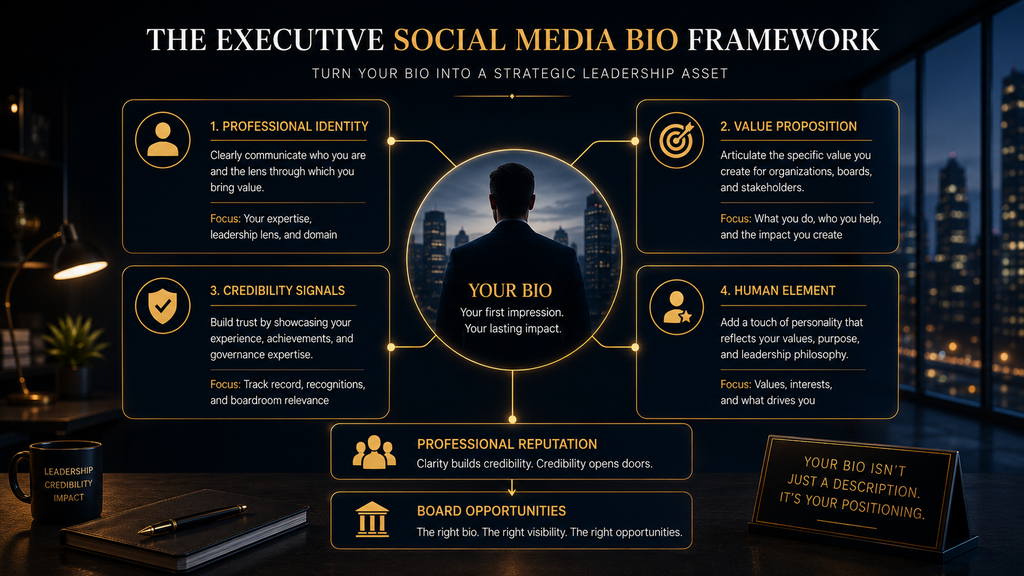
When these four elements work together, your social media bio becomes much more than a description.
It becomes a positioning statement.
Examples of Strong Executive Bio Transformations
Sometimes the easiest way to improve a bio is by seeing the difference between an average version and a stronger one.
| Before | After |
| CEO with 25 years of experience. | Helping businesses scale sustainably through governance, leadership, and long-term strategy. Former CEO with 25+ years building high-performing organisations. |
| Finance professional interested in board roles. | Finance leader preparing for independent board opportunities with expertise in audit, capital allocation, and governance. |
| Founder of a technology company. | Building technology that simplifies business operations for growing enterprises. Founder, builder, and lifelong learner. |
| HR Leader. | Helping organisations build leadership cultures where people and business performance grow together. |
Notice what changes.
The stronger versions don’t simply list positions.
They communicate purpose.
They explain contribution.
Most importantly, they give readers a reason to remember the individual.
Common Mistakes That Make a Social Media Bio Forgettable
Even experienced professionals sometimes weaken their profiles by making a few avoidable mistakes.
Trying to Say Everything
Your bio isn’t your resume.
It isn’t your CV.
And it certainly isn’t a place to list every certification, achievement, or responsibility you’ve accumulated over the years.
The more information you add, the harder it becomes for readers to remember anything.
Focus on clarity rather than completeness.
Relying on Generic Buzzwords
Words like dynamic, passionate, visionary, and results-driven appear in thousands of profiles.
They don’t differentiate you.
Instead of describing yourself with adjectives, demonstrate your value through the impact you’ve created.
Ignoring Your Future Positioning
Many executives describe only what they’ve already done.
Very few communicate where they’re going.
If your long-term goal is becoming one of the respected board directors in your industry, your profile should gradually begin reflecting governance, strategic oversight, and board-level thinking.
Your bio should introduce tomorrow’s identity, not only yesterday’s achievements.
A Simple Checklist Before You Publish Your Bio
Before updating your LinkedIn profile or executive website, ask yourself these questions.
✔ Does my bio clearly explain what I do?
✔ Does it communicate the value I create?
✔ Does it include evidence that builds credibility?
✔ Does it sound like a real person rather than a corporate brochure?
✔ Does it reflect the direction my career is moving?
✔ Would someone remember me after reading it?
If the answer to any of these questions is “no,” your bio probably needs another revision.
Small improvements often create significant differences in how people perceive your professional brand.
How Board Directors Can Strengthen Their Digital Presence
Many people think reputation is built through speeches, awards, media coverage, or years of experience.
Those things certainly help.
But in today’s digital world, reputation often begins much earlier.
It begins with your social media bio.
Every interaction online sends a signal.
Your bio is one of the strongest signals because it introduces you before anyone experiences your work.
For executives, founders, consultants, investors, and aspiring board directors, that signal carries considerable weight. It shapes first impressions, influences opportunities, and reinforces professional credibility long before conversations begin.
Think of your bio as the headline of your professional story.
It doesn’t need to explain everything.
It simply needs to make the right people want to keep reading.
Conclusion
Your social media bio may be only a few lines long, but its influence extends far beyond your profile. It shapes first impressions, communicates credibility, and positions you for the opportunities you want to attract.
For senior executives, founders, CXOs, and aspiring board directors, a thoughtful bio is no longer optional. It is an important part of your professional reputation. Instead of treating it as a collection of job titles, use it to communicate your purpose, your expertise, and the value you consistently create.
The most memorable professionals aren’t always the ones with the longest experience or the biggest titles.
They’re the ones who communicate their story with clarity.
If you’re preparing for board appointments, strengthening your executive presence, or building a leadership brand that inspires confidence, start by reviewing the one section most people read first—your bio.
Your story is your strategy.
Your bio is the first signal people remember.
FAQs
1. What is a social media bio?
A social media bio is a short professional introduction that explains who you are, what you do, and the value you bring. It often creates the first impression before someone explores your profile in detail.
2. Why is a social media bio important for senior executives?
For executives, a well-written bio establishes credibility, communicates leadership positioning, and helps recruiters, investors, and board nomination committees understand your expertise within seconds.
3. How long should a professional social media bio be?
Most professional bios work best when they are concise—typically between 50 and 150 words, depending on the platform. The goal is clarity, not length.
4. What should every executive include in a social media bio?
An executive bio should include your professional identity, the value you create, proof of credibility, and a small personal element that makes you memorable.
5. How can board directors improve their online profile?
Board directors should highlight governance expertise, strategic oversight, leadership experience, and long-term value creation rather than focusing only on operational achievements.
6. Should I mention my hobbies in my bio?
Yes, but selectively. Relevant interests such as mentoring, lifelong learning, reading, or leadership development can make your profile more relatable without reducing professionalism.
7. What’s the biggest mistake people make in a social media bio?
The biggest mistake is writing a generic list of job titles without explaining the value you create or the impact of your work.
8. Can a strong social media bio help with board opportunities?
Absolutely. Many recruiters and nomination committees review digital profiles before initiating conversations. A strategic bio strengthens your professional positioning.
9. How often should I update my social media bio?
Review your bio every six to twelve months or whenever your career direction, achievements, or leadership focus changes.
10. Should my LinkedIn headline match my bio?
Not necessarily. Your headline should attract attention quickly, while your bio can provide additional context and demonstrate your professional story.
11. How do I make my profile memorable?
Focus on your unique contribution, communicate your value clearly, and include one authentic detail that reflects your personality or leadership philosophy.
12. Is storytelling important in executive branding?
Yes. Storytelling helps people remember your journey, your purpose, and your professional identity far better than a list of designations.
13. Can founders use the same bio across all platforms?
The core message should remain consistent, but you can tailor the wording based on the audience and platform.
14. How does a profile influence executive credibility?
Your profile shapes first impressions by communicating your expertise, leadership style, and professional focus before any conversation takes place.
15. What are the three qualities of an effective social media bio?
An effective social media bio should be clear, credible, and memorable. If it achieves these three goals, it is far more likely to leave a lasting impression.
Ready to Build a Board Profile That Boards Trust?
Your board profile begins long before your first board interview. If you’re looking to strengthen your executive positioning, build a compelling personal brand, or prepare for board opportunities, now is the right time to invest in how you present your leadership story.
Explore our executive branding, board profile, and governance advisory services to position yourself for meaningful boardroom opportunities.
Whether you’re an aspiring Independent Director, CXO, Founder, or senior executive, a well-positioned board profile can make all the difference in today’s competitive board landscape.
Schedule your complimentary Session here: