

Senior executives often assume that decades of leadership experience automatically qualify them for a Board Seat. Yet, many highly accomplished CEOs, CFOs, CHROs, and business leaders quietly lose board opportunities before they even enter a conversation.
Why?
Because their LinkedIn profile is telling the wrong story.
Today’s Nomination and Remuneration Committees (NRCs), investors, and professionals involved in Executive Search for Directors increasingly review candidates online long before a formal discussion begins. Your LinkedIn profile has become a digital boardroom lobby. If it fails to communicate governance capability, strategic oversight, committee readiness, and board-level judgement, you may be eliminated without ever knowing it.
Research and global governance frameworks continue to emphasize board effectiveness, transparency, and accountability as essential elements of modern governance. The revised G20/OECD Principles of Corporate Governance identify board responsibilities, disclosure, transparency, and stakeholder accountability as central to effective corporate governance. Boards today are expected to provide strategic guidance, oversee risk, monitor performance, and ensure sustainable value creation. A title-heavy LinkedIn profile rarely demonstrates those capabilities.
Table of Contents
- Why LinkedIn Matters for a Board Seat
- The Biggest LinkedIn Mistakes Costing You a Board Seat
- Understanding the Board Leadership Value Proposition (BLVP)
- Digital Footprint for Board Directors and Board Visibility
- How Executive Search for Directors Evaluates Profiles
- Transforming Your LinkedIn into a Strategic Governance Asset
- Board Seat Readiness Checklist
- Conclusion
- FAQs
Why LinkedIn Matters for a Board Seat
Digital Due Diligence Is the New Normal
Securing a Board Seat no longer depends solely on executive reputation, referrals, or traditional networking. Digital due diligence has fundamentally changed how boards identify and evaluate talent. Search consultants, NRC members, investors, and fellow directors routinely conduct online reviews before making shortlists. A candidate may possess exceptional operational credentials, but if their digital presence fails to demonstrate governance capability, strategic judgement, and boardroom relevance, opportunities disappear silently.
Think of LinkedIn as your permanent board interview. Every section—headline, summary, featured content, recommendations, and experience—either strengthens or weakens your candidacy. A profile that focuses exclusively on revenue growth, P&L ownership, or operational accomplishments often positions the executive as an operator rather than a governor. Boards need oversight, challenge, stewardship, and long-term value creation.
Executives pursuing a Board Seat should regularly audit their digital brand. Resources available through the Digital Footprint for Board Directors section on Your Board Profile can help leaders understand how digital visibility shapes board outcomes.
Executive Search for Directors Starts Online
The world of Executive Search for Directors has become increasingly data-driven and digitally influenced. Search firms no longer rely exclusively on confidential networks. They actively examine online thought leadership, governance commentary, published insights, speaking engagements, and board-related engagement.
According to governance experts, boards are increasingly expected to oversee resilience, sustainability, stakeholder interests, and long-term risk. Search firms therefore look for evidence that candidates understand governance beyond management.
A director candidate’s LinkedIn profile should answer critical questions:
- Can this leader think strategically?
- Has this executive demonstrated governance oversight?
- Does this person understand risk and stakeholder stewardship?
- Is this candidate committee-ready?
- Will this executive contribute constructively in the boardroom?
When these answers are unclear, the candidate often never progresses.
The Biggest LinkedIn Mistakes Costing You a Board Seat

Title-Heavy Profiles
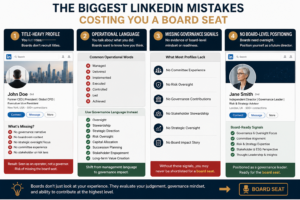
One of the most common mistakes among senior executives is creating profiles that resemble an organisational chart.
Examples include:
- Former CEO, XYZ Limited
- President – Asia Pacific
- Global CFO
- Executive Vice President
Impressive? Certainly.
Sufficient for a Board Seat? Usually not.
Boards do not recruit job titles. They recruit judgement, oversight capability, stakeholder stewardship, and strategic insight. A LinkedIn profile dominated by titles and operational accomplishments communicates management excellence—but not governance readiness.
Instead of simply listing positions, executives should demonstrate:
| Traditional Executive Language | Board-Focused Language |
| Managed operations across 15 countries | Oversaw enterprise risk, capital allocation, and long-term strategic priorities |
| Delivered revenue growth | Guided sustainable value creation and governance oversight |
| Led 5,000 employees | Strengthened stakeholder engagement and succession governance |
The difference is profound. One profile says, “I ran a business.” The other says, “I can govern one.”
Weak Governance Language
Many executives aspiring to a Board Seat unintentionally undermine themselves by using purely operational terminology.
Words such as:
- Executed
- Delivered
- Managed
- Controlled
- Implemented
dominate their profiles.
Board profiles require stronger governance vocabulary, including:
- Oversight
- Stewardship
- Governance
- Strategic direction
- Risk oversight
- Capital allocation
- Succession planning
- Stakeholder engagement
- Long-term value creation
The G20/OECD Principles emphasise that boards are responsible for reviewing strategy, overseeing risk, succession planning, governance effectiveness, and disclosure processes. Candidates who fail to reflect these responsibilities in their digital presence may appear misaligned with modern board expectations.
No Committee Alignment
Every board appointment is usually linked to committee needs.
Audit Committee.
Risk Committee.
Nomination and Remuneration Committee.
ESG Committee.
Technology Committee.
Yet countless executives seeking a Board Seat never indicate where they can contribute.
For example:
- CFOs should demonstrate audit, financial governance, compliance, and risk expertise.
- CHROs should showcase succession planning, talent governance, and compensation oversight.
- CIOs and CTOs should highlight cyber risk, digital transformation, and technology oversight.
Without explicit committee alignment, search consultants struggle to understand your board fit.
Profiles showcased within the portfolio section of Your Board Profile provide strong examples of committee-aligned positioning.
Missing Board Leadership Value Proposition (BLVP)
Perhaps the costliest mistake is lacking a clear Board Leadership Value Proposition (BLVP).
A BLVP answers a simple but powerful question:
Why should a board appoint you?
Without a compelling BLVP, even highly successful executives become interchangeable.
An effective BLVP articulates:
- Strategic expertise
- Governance strengths
- Industry experience
- Committee contribution
- Stakeholder value
- Unique perspective
Executives seeking professional support in developing their BLVP can explore the Board Leadership Value Proposition framework available at Your Board Profile.
Understanding the Board Leadership Value Proposition (BLVP)
What Is a BLVP?
A Board Leadership Value Proposition (BLVP) is not a biography. It is not a résumé summary. It is your strategic governance narrative.
Your BLVP explains how your experience translates into board value.
A strong BLVP might state:
“Global CFO with extensive experience in capital allocation, audit oversight, digital transformation, and enterprise risk governance across listed and private companies.”
Notice the difference.
The focus shifts from career chronology to governance contribution.
For executives serious about securing a Board Seat, a BLVP becomes the foundation of LinkedIn positioning, board bios, networking conversations, and search firm interactions.
For comprehensive board branding support, executives may explore the board advisory services offered by Your Board Profile.
Why Every Board Candidate Needs a BLVP
A compelling Board Leadership Value Proposition (BLVP) is the bridge between executive accomplishment and board relevance. Many senior leaders assume their track record speaks for itself. Unfortunately, board appointments rarely work that way. Boards are not purchasing a career history; they are selecting a strategic partner who can contribute independent judgement, challenge management constructively, and oversee long-term value creation.
Think of your BLVP as the executive summary of your governance story. It should immediately communicate your strategic strengths, industry expertise, committee alignment, and governance contribution. Without it, your LinkedIn profile can appear fragmented and transactional. With it, every section of your profile begins reinforcing a single, powerful narrative.
A well-crafted BLVP should clearly articulate:
- The governance areas where you add value.
- The committees where you can contribute immediately.
- The stakeholder issues you have overseen.
- The strategic challenges you have successfully navigated.
- The unique perspective you bring to a boardroom.
Executives who wish to position themselves effectively for board opportunities can explore governance branding insights available through board branding specialists.
Digital Footprint for Board Directors and Board Visibility
Why Search Visibility Matters
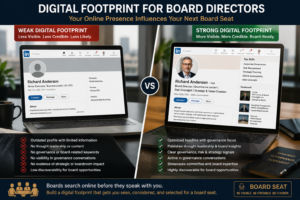
Your Digital Footprint for Board Directors is increasingly becoming a decisive factor in board selection. Search consultants and NRC members often search candidates online before any formal interaction occurs. What appears online shapes first impressions.
Imagine two equally qualified executives.
The first executive has:
- Published governance articles.
- Appeared on podcasts.
- Participated in panel discussions.
- Shared board insights on LinkedIn.
- Maintained a board-focused profile.
The second executive has:
- An outdated LinkedIn profile.
- No governance commentary.
- Minimal digital engagement.
- No visible thought leadership.
Which candidate appears more board-ready?
The answer is obvious.
A study by global consulting firms consistently highlights that boards increasingly seek directors capable of navigating disruption, technology, sustainability, and stakeholder expectations. Candidates who publicly demonstrate these perspectives strengthen their board candidacy. External governance research from Harvard Business Review discusses how board effectiveness increasingly depends on strategic oversight and future-oriented thinking.
Building Governance Credibility Online
Building a strong digital presence does not mean becoming a social media influencer. It means creating visible evidence of governance thinking.
Examples include:
- Publishing articles on governance issues.
- Sharing perspectives on risk oversight.
- Commenting thoughtfully on board trends.
- Participating in governance forums.
- Speaking at industry conferences.
- Joining recognised governance associations.
Your digital presence should consistently reinforce your aspiration for a Board Seat.
A simple framework is shown below:
| Weak Digital Presence | Strong Digital Presence |
| Career history only | Governance-focused narrative |
| No thought leadership | Regular strategic commentary |
| No board keywords | Board-focused terminology |
| Limited visibility | Strong professional footprint |
| No governance engagement | Active participation in governance discussions |
The Digital Footprint for Board Directors resource provides deeper guidance on strengthening online governance credibility.
How Executive Search for Directors Evaluates Profiles
Governance Readiness Indicators
Professionals involved in Executive Search for Directors evaluate much more than leadership experience. They seek evidence that an executive can transition successfully from management to governance.
Key indicators include:
- Strategic oversight experience.
- Risk governance capability.
- Committee readiness.
- Stakeholder stewardship.
- Independence of thought.
- Crisis leadership experience.
- Succession planning exposure.
Deloitte’s board governance research consistently notes that modern directors are expected to oversee risk, technology disruption, ESG priorities, and organisational resilience.
Search firms also pay close attention to how executives describe their achievements. Profiles focused exclusively on operational execution may signal limited governance orientation.
Strong familiarity with governance frameworks demonstrates that a candidate understands board responsibilities beyond executive management.
Strategic Oversight Signals
Board recruiters actively search for language associated with strategic governance.
Examples include:
- Enterprise risk oversight.
- Capital allocation.
- Board reporting.
- Regulatory oversight.
- Governance frameworks.
- Succession governance.
- Stakeholder engagement.
- ESG oversight.
- Cybersecurity oversight.
Executives should ensure these concepts are integrated naturally throughout their LinkedIn profile.
Below is a practical comparison.
| Management Language | Governance Language |
| Managed teams | Oversaw strategic direction |
| Implemented initiatives | Governed enterprise priorities |
| Delivered targets | Guided long-term value creation |
| Executed projects | Oversaw risk and performance |
| Supervised operations | Strengthened governance frameworks |
Transforming Your LinkedIn Into a Strategic Governance Asset
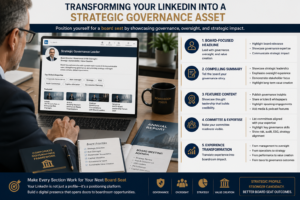
Headline Optimisation
Most LinkedIn headlines waste valuable space.
Poor example:
Former CEO | Business Leader | Advisor
Better example:
Independent Director Candidate | Global CEO | Enterprise Risk, Digital Transformation & Governance Leader
The second headline immediately signals board relevance.
Your headline should ideally include:
- Governance identity.
- Functional expertise.
- Industry expertise.
- Strategic strengths.
- Committee relevance.
This transforms your profile from a résumé into a Strategic Governance Asset.
Experience Section Transformation
Many executives simply copy résumé content into LinkedIn.
This approach is ineffective.
Instead, reshape experience descriptions around governance contribution.
Example:
Before:
“Led business expansion across Asia resulting in 30% revenue growth.”
After:
“Oversaw long-term growth strategy, capital allocation decisions, enterprise risk management, and stakeholder engagement across multi-country operations.”
The second example communicates board-level thinking.
Thought Leadership Strategy
Thought leadership is one of the strongest signals of board readiness.
You do not need to publish every week.
Even monthly insights discussing topics such as:
- Risk governance.
- Board effectiveness.
- ESG oversight.
- Artificial intelligence governance.
- Stakeholder capitalism.
- Succession planning.
can significantly enhance visibility.
The National Association of Corporate Directors and leading governance institutions consistently emphasize continuous learning and governance awareness among directors. External Anchor Text (No Follow): director education and governance trends from NACD.
Board Seat Readiness Checklist
Use the checklist below to assess whether your LinkedIn profile supports your aspiration for a Board Seat.
| Question | Yes/No |
| Does your headline communicate governance capability? | |
| Have you defined your BLVP? | |
| Does your profile mention committee alignment? | |
| Are governance keywords visible throughout your profile? | |
| Have you demonstrated strategic oversight? | |
| Does your profile include thought leadership? | |
| Is your digital footprint board-focused? | |
| Can search firms immediately identify your board value? |
If you answered “No” to several questions, your profile may be limiting opportunities.
Conclusion
Your LinkedIn profile is no longer a passive professional biography. It has become an essential component of board branding, digital due diligence, and executive positioning.
A poorly positioned profile can quietly cost you a valuable Board Seat, even if you possess decades of executive experience.
The good news is that these mistakes are entirely fixable.
Shift the narrative from titles to governance. Clarify your Board Leadership Value Proposition (BLVP). Demonstrate committee readiness. Strengthen your Digital Footprint for Board Directors. Showcase strategic oversight and thought leadership.
Boards are not simply searching for accomplished executives.
They are searching for trusted governors.
FAQs
- Can LinkedIn really influence a Board Seat opportunity?
Yes, many search firms and board committees conduct digital due diligence before contacting candidates.
- What is a Board Leadership Value Proposition (BLVP)?
A BLVP explains the unique governance value and strategic contribution an executive brings to a board.
- How often should directors post on LinkedIn?
Consistent monthly governance-focused content is generally sufficient.
- Why is committee alignment important?
Committee alignment helps search firms understand where you can contribute immediately.
- What governance keywords should appear on my profile?
Terms such as risk oversight, governance, stakeholder stewardship, succession planning, and strategic oversight are valuable.
- What is a Digital Footprint for Board Directors?
It refers to the online presence and governance visibility of an aspiring or existing board director.
- Should board candidates publish thought leadership?
Yes, thoughtful governance commentary strengthens credibility and visibility.
- What is the biggest LinkedIn mistake executives make?
Focusing exclusively on job titles and operational achievements.
- How do executive search firms assess profiles?
They review governance capability, committee readiness, digital visibility, and strategic perspective.
- Should I mention board committees in my profile?
Absolutely. Explicit committee alignment improves board positioning.
- How long should a BLVP be?
Usually, one concise paragraph clearly communicating board value.
- Can a weak digital footprint cost me opportunities?
Yes, limited online visibility may reduce credibility during board searches.
- Is LinkedIn enough for board branding?
No. A comprehensive digital footprint includes articles, speaking engagements, and governance participation.
- What type of content should aspiring-directors share?
Insights on governance, risk, ESG, strategy, and board effectiveness.
- When should executives start board branding?
Ideally several years before actively pursuing a Board Seat.
Ready to Strengthen Your Board Presence and Unlock New Board Opportunities?
Ready to position yourself for your next Board Seat? Stop treating LinkedIn as an online resume. Transform it into a strategic governance platform that communicates your Board Leadership Value Proposition, committee alignment, and governance expertise. Explore professional board branding support and start building a profile that board search firms cannot ignore.
Whether you’re an aspiring Independent Director, CXO, Founder, or senior executive, a well-positioned board profile can make all the difference in today’s competitive board landscape.
Book a complimentary strategy session with Your Board Profile today.