

Many accomplished executives assume that decades of leadership experience automatically translate into board opportunities. Yet, countless CXOs discover that exceptional operational success does not necessarily result in board invitations. Why? Because Boardroom Executive Presence is not determined solely by titles, achievements, or eloquent speeches. It is largely determined by what others infer about you from the signals you consistently send.
Think about the last time you encountered a respected board director. Chances are, you formed an impression long before hearing them speak extensively. Their reputation, the stories others shared, their visibility in governance circles, and the strategic insights associated with their name influenced your perception. Board appointments often work similarly. Boards rarely evaluate candidates based on a single interaction. They assess accumulated evidence, patterns of behaviour, and external perceptions.
Today’s governance environment is evolving rapidly. According to recent research from PwC, only 35% of executives rate their boards as highly effective, while 93% believe at least one director should be replaced to address emerging challenges and skills gaps. Boards increasingly seek directors who demonstrate governance maturity, strategic judgment, and future-oriented thinking.
This means aspiring directors must intentionally shape their professional brand. Boardroom Executive Presence is fundamentally a perception created through signals, stories, repeated evidence, and strategic visibility.
Table of Contents
- What Is Boardroom Executive Presence Really?
- The Psychology Behind Boardroom Executive Presence
- Signals That Build Boardroom Executive Presence
- Stories Shape Executive Reputation
- Why Executive Visibility Strategy Matters
- Boardroom Readiness Requires More Than Experience
- Practical Framework to Strengthen Boardroom Executive Presence
- Conclusion
- FAQs
What Is Boardroom Executive Presence Really?
Presence Is a Perception, not a Performance
Many leaders mistakenly equate executive presence with polished presentations, confident body language, or charismatic communication. While these factors contribute, they represent only a fraction of the equation.
Boardroom Executive Presence is the confidence others place in your ability to govern, guide, and influence during uncertainty. It is less about theatrical performance and more about trust.
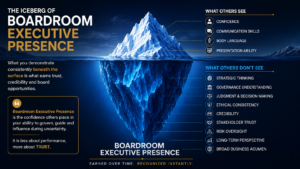
Imagine an iceberg. Communication skills are the visible portion above water. Beneath the surface lie strategic thinking, judgment, credibility, governance understanding, ethical consistency, and stakeholder trust. Board selectors evaluate the entire iceberg.
Academic and leadership research consistently suggests that executive presence significantly enhances leadership effectiveness and influence across organizations.
The strongest executive brands are built when stakeholders repeatedly observe:
- Sound decision-making
- Strategic foresight
- Calmness during crises
- Consistent ethical behaviour
- Broad business perspective
- Ability to challenge constructively
When these signals appear consistently over time, people naturally infer board potential.
Why Boards Evaluate Signals More Than Speeches
Boards operate in environments characterized by ambiguity, disruption, regulatory scrutiny, and stakeholder expectations. Directors are expected to provide oversight rather than operational management.
Consequently, boards ask themselves:
“Can this leader navigate uncertainty?”
“Will this individual ask thoughtful questions?”
“Can they contribute independently?”
“Do they possess governance maturity?”
Recent governance research indicates that boards increasingly prioritize specialized expertise, AI understanding, risk oversight, and strategic adaptability.
Therefore, one compelling keynote speech rarely secures a board seat. Repeated demonstrations of sound judgment do.
The Psychology Behind Boardroom Executive Presence
How Decision-Makers Form Leadership Judgments
Humans are natural pattern-recognition machines.
In board recruitment, decision-makers frequently rely on accumulated impressions rather than formal evaluations alone. This phenomenon becomes particularly significant because board searches often involve referrals and reputation-based assessments.
People unconsciously ask:
- What strategic issues is this executive associated with?
- Do respected leaders endorse them?
- Have they demonstrated governance awareness?
- Are they visible in industry conversations?
- Have they successfully managed complex situations?
These impressions shape perceptions long before formal interviews begin.
An executive consistently publishing governance insights, participating in industry forums, and demonstrating strategic thinking is far more likely to be perceived as board-ready than an equally accomplished but invisible peer.
The Role of Repeated Evidence
One successful transformation project is impressive.
Five years of strategic leadership across multiple initiatives create a pattern.
Patterns matter.
Boardroom Executive Presence strengthens when stakeholders repeatedly encounter evidence supporting a consistent leadership narrative.
Consider the following comparison:
| Single Event | Repeated Evidence |
| Delivered keynote once | Regularly invited as industry speaker |
| Led one transformation | Led multiple enterprise-wide initiatives |
| Wrote one article | Consistently publishes strategic insights |
| Served on internal committee | Participates in governance forums regularly |
Repeated evidence reduces perceived risk.
Boards rarely appoint unknown quantities.
Signals That Build Boardroom Executive Presence
Governance Signals
Governance signals demonstrate that an executive understands oversight responsibilities beyond operational execution.
Examples include:
- Participation in governance education programs
- Advisory board experience
- Audit, risk, or compliance oversight
- ESG governance involvement
- Cybersecurity oversight exposure
- Board simulation participation
Executives seeking board roles should actively cultivate governance credentials.

Recent governance studies show boards increasingly require expertise in emerging risks, succession planning, AI oversight, and cybersecurity governance.
Strategic Thinking Signals
Board directors are expected to think beyond quarterly execution.
Strong strategic signals include:
- Leading enterprise transformation initiatives
- Driving mergers and acquisitions
- Managing cross-border operations
- Steering digital transformation
- Leading crisis response initiatives
- Shaping long-term organizational strategy
These experiences indicate readiness to govern rather than merely operate.
Credibility Signals
Credibility emerges through consistency.
Executives build credibility when they:
- Deliver measurable outcomes
- Demonstrate ethical leadership
- Maintain stakeholder trust
- Build strong external networks
- Earn peer recognition
A reputation for integrity often outweighs charismatic communication.
Stories Shape Executive Reputation
The Narratives Stakeholders Remember
Facts inform.
Stories persuade.
Board selectors frequently remember narratives more vividly than achievements listed on a resume.
For example:
“She led the company through a major cybersecurity crisis while maintaining stakeholder confidence.”
“He transformed a declining business unit into a market leader across three regions.”
These stories become professional shorthand.
They influence perceptions because stories communicate judgment, resilience, and leadership under pressure.
Turning Achievements into Board Stories
Executives should intentionally develop strategic narratives around their careers.
Ask yourself:
- What major business challenges have I solved?
- Which decisions demonstrated governance maturity?
- Where did I influence enterprise strategy?
- How have I created long-term value?
An effective board story generally contains:
| Component | Example |
| Challenge | Significant market disruption |
| Action | Strategic repositioning |
| Governance Lens | Risk oversight and stakeholder alignment |
| Outcome | Sustainable growth and resilience |
Building compelling leadership stories significantly strengthens Boardroom Executive Presence.
Why Executive Visibility Strategy Matters
Visibility vs Self-Promotion
Many senior leaders avoid visibility because they fear appearing self-promotional.
This concern is understandable.
However, invisibility carries greater risk.
An effective executive visibility strategy is not about personal publicity. It is about ensuring relevant stakeholders understand your expertise and governance potential.
Visibility becomes valuable when it focuses on:
- Thought leadership
- Governance insights
- Industry expertise
- Strategic perspectives
- Knowledge sharing
Thoughtful visibility builds familiarity, credibility, and trust.
Building Influence Beyond the Organization
Board opportunities frequently emerge from external networks.
Executives should actively participate in:
- Industry associations
- Governance communities
- Advisory boards
- Leadership forums
- Speaking engagements
- Professional workshops
A structured executive visibility strategy ensures that your expertise reaches board influencers before opportunities arise.
According to governance experts, strategic executive branding is increasingly essential because modern boards seek visible leaders who demonstrate specialized expertise and governance readiness.
Boardroom Readiness Requires More Than Experience
Operating Leader vs Governing Leader
Many accomplished executives struggle to transition because operating and governing require different mindsets.
| Operating Executive | Board Director |
| Executes strategy | Oversees strategy |
| Manages teams | Challenges management |
| Focuses on operations | Focuses on governance |
| Drives execution | Guides and advises |
| Solves problems directly | Asks insightful questions |
Boardroom readiness therefore demands a shift from management to oversight.
Boards increasingly seek directors capable of navigating AI disruption, geopolitical uncertainty, cybersecurity risks, and stakeholder expectations.
Evidence of Board Readiness
Indicators of strong boardroom readiness include:
- Governance education
- Independent advisory experience
- Risk oversight expertise
- Enterprise-wide leadership
- External board exposure
- Strong stakeholder management
- Reputation for strategic thinking
Executives serious about board transitions should assess their readiness systematically.
Practical Framework to Strengthen Boardroom Executive Presence
Audit Your Signals
Begin by conducting a perception audit.
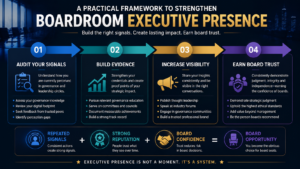
Ask trusted peers:
- What three words describe my leadership?
- What board expertise am I known for?
- What strategic capabilities define my reputation?
The answers often reveal gaps between intention and perception.
Build a Consistent Evidence Portfolio
Create visible evidence supporting your board aspirations.
Examples include:
- Published articles
- Speaking engagements
- Governance certifications
- Advisory assignments
- Industry panel participation
- Board simulations
Consistency matters more than occasional visibility.
Amplify Strategic Visibility
Develop an intentional executive visibility strategy.
Publish insights.
Participate in governance discussions.
Share lessons from strategic transformations.
Engage with industry ecosystems.
The objective is simple: ensure your professional narrative consistently reinforces Boardroom Executive Presence.
Conclusion
Boardroom Executive Presence is not a polished speech, an impressive title, or a charismatic personality. It is the perception stakeholders form after repeatedly observing your signals, stories, judgment, and strategic contributions.
Board appointments are rarely accidental.
They result from accumulated trust.
Executives who intentionally shape their brand through governance signals, strategic visibility, and repeated evidence create powerful professional narratives that inspire confidence.
Ultimately, people do not appoint leaders solely because of what they say.
They appoint leaders because of what they infer.
FAQs
- What is Boardroom Executive Presence?
Boardroom Executive Presence is the perception that an executive possesses the judgment, credibility, and strategic capability required for board-level leadership.
- Why is Boardroom Executive Presence important for aspiring directors?
It influences how boards assess trustworthiness, governance maturity, and long-term leadership potential.
- How can executives improve their boardroom readiness?
Executives can improve boardroom readiness through governance education, advisory experience, thought leadership, and strategic visibility.
- What role does executive visibility strategy play in board appointments?
An executive visibility strategy helps decision-makers recognize an executive’s expertise and board potential.
- Are communication skills enough to demonstrate Boardroom Executive Presence?
No. Communication matters, but credibility, judgment, governance knowledge, and repeated evidence are equally important.
- What role do governance signals play in enhancing Boardroom Executive Presence?
Governance signals demonstrate credibility, oversight capability, and readiness for board-level responsibilities.
- How long does it typically take to develop authentic Boardroom Executive Presence?
Authentic Boardroom Executive Presence develops over time through consistent leadership, visibility, and repeated evidence.
- How do board recruiters evaluate Boardroom Executive Presence during the selection process?
Board recruiters assess Boardroom Executive Presence through reputation, leadership stories, governance experience, and professional visibility.
- Why does executive personal branding matter for board appointments?
A strong personal brand shapes how decision-makers perceive your leadership potential and trustworthiness.
- How can repeated evidence and leadership stories improve Boardroom Executive Presence?
Repeated evidence and compelling leadership stories reinforce trust and strengthen Boardroom Executive Presence.
- Can an effective executive visibility strategy strengthen Boardroom Executive Presence?
Yes, a strategic visibility approach increases credibility and reinforces Boardroom Executive Presence among key stakeholders.
- Why is Boardroom Executive Presence important in today’s evolving governance landscape?
Modern boards seek leaders with strong Boardroom Executive Presence to navigate complexity, risk, and strategic change.
- What common mistakes prevent executives from reaching the boardroom?
Poor visibility, weak governance exposure, and an inconsistent professional reputation often limit board opportunities.
- Why is strategic thinking essential for future directors?
Strategic thinking demonstrates the ability to guide organizations beyond day-to-day operations.
- Is prior board experience required to secure a board position?
No, many executives establish Boardroom Executive Presence through governance education, advisory roles, and thought leadership.
Ready to Strengthen Your Board Presence and Unlock New Board Opportunities?
Start building a board-ready brand today. Evaluate the signals, stories, and evidence your professional reputation communicates—and position yourself as the director boards already trust before the opportunity arrives.
Whether you’re an aspiring Independent Director, CXO, Founder, or senior executive, a well-positioned board profile can make all the difference in today’s competitive board landscape.
Schedule your complimentary Session here: