

A board appointment rarely begins with the formal appointment letter. Long before a NRC, promoter, investor, chairperson, search consultant, or fellow director considers your name for a board position, a quieter assessment is already happening. Someone may have searched your name on LinkedIn, read an article carrying your byline, looked at your professional history, asked a mutual connection about you, or simply formed an impression from the way you communicate online. That is why your boardroom brand is not something you create after receiving a board opportunity. It is the reputation you have been building, intentionally or unintentionally, for years.
This distinction matters because senior executives often assume that a strong career automatically translates into board readiness. It does not. A successful CFO, CEO, CHRO, entrepreneur, technology leader, operations head, or business-unit president may have impressive credentials and still struggle to communicate why they belong in a boardroom. The question at board level is not simply, “What have you achieved?” It is, “What perspective, judgement, governance maturity, network, and strategic value will you bring to the board?” That is the real foundation of an executive boardroom brand.
The shift is becoming even more important as boards face a wider range of strategic questions. Recent governance research shows that investors increasingly expect boards to engage with issues such as AI, cybersecurity, resilience, human capital, geopolitical uncertainty, and long-term value creation. In such an environment, credibility cannot be reduced to a designation on a business card. Your public professional narrative becomes one of the signals through which people judge whether your experience is relevant to the challenges boards are expected to oversee.
Why Your Boardroom Brand Starts Before the Appointment
Think about the last time you were introduced to a senior professional you had never met. You probably formed a preliminary impression within minutes. You noticed their designation, the way they spoke, the subjects they understood, the questions they asked, and perhaps what appeared when you searched their name. Board selection works in a similar way, although the stakes are considerably higher. Before a conversation takes place, decision-makers may already have a mental picture of your capabilities, credibility, and relevance.
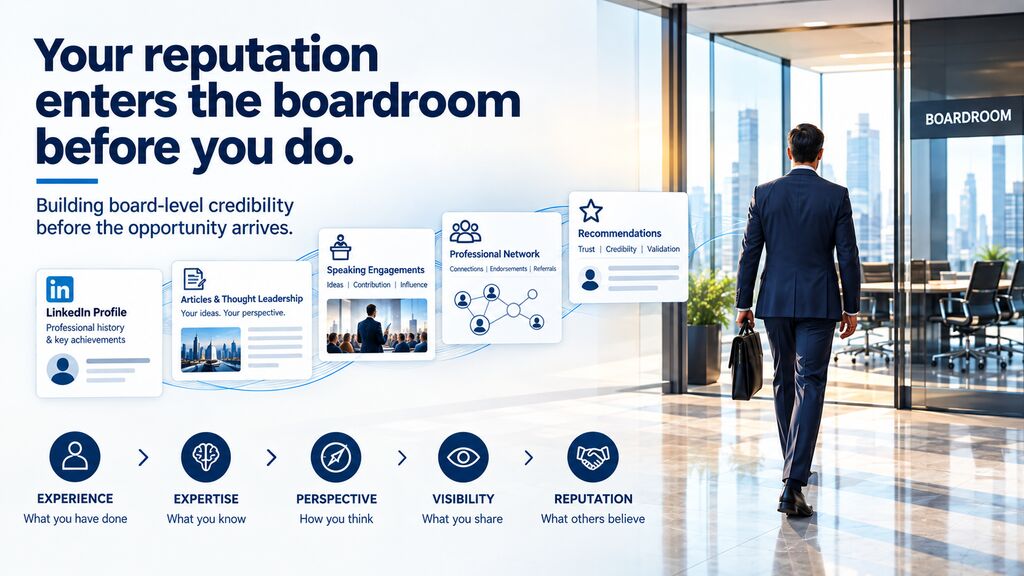
That is the essence of a pre-boardroom presence. It is the professional footprint that exists before you actively pursue a board position. A strong pre-boardroom presence does not mean posting every day or turning LinkedIn into an advertising channel. It means making sure that the professional evidence available about you tells a coherent story. Your career achievements, board interests, thought leadership, interviews, speaking engagements, professional associations, articles, recommendations, and digital profiles should reinforce rather than contradict one another.
This is particularly important for experienced executives because seniority creates an unusual challenge. The more senior you become, the less useful a simple chronology of job titles becomes. “CEO,” “CFO,” “COO,” or “CHRO” tells someone what position you held. It does not necessarily tell them how you think. A board needs to understand your judgement, perspective, independence, commercial understanding, risk awareness, stakeholder maturity, and ability to challenge management constructively. McKinsey research similarly highlights openness, trust, collaboration, and constructive challenge as characteristics associated with effective boards.
The pre-boardroom presence matters
Your digital presence therefore becomes part of your professional due diligence. If someone searches your name and finds an outdated LinkedIn profile, a generic biography, inconsistent job descriptions, or almost no evidence of your current thinking, the absence itself communicates something. On the other hand, a coherent profile can quickly establish context: what you know, what problems you have solved, what industries you understand, and what issues you are prepared to discuss at board level.
Your personal brand before the boardroom should therefore answer one question clearly: Why would an organisation trust this person with a board-level responsibility?
What a Boardroom Brand Really Means
A boardroom brand is not a logo, tagline, photograph, or collection of social-media posts. It is the perception that forms around your professional judgement and potential contribution as a board leader. You can think of it as the intersection of four things: what you have done, what you understand, what you stand for, and what others believe about you.
That distinction separates executive branding from boardroom branding. Executive branding often focuses on leadership visibility, career progression, employer reputation, and functional expertise. Board-level positioning requires a wider lens. A board director is expected to look beyond one department and consider the enterprise as a whole. The relevant narrative therefore moves from “I managed finance” to “I understand capital allocation, risk, transformation, stakeholder expectations, and long-term value creation.”
The same principle applies to every function. A technology leader should not present only as someone who implemented digital systems. A CHRO should not describe only talent programmes. A marketing leader should not stop at brand campaigns. Each needs to translate functional expertise into enterprise-level board relevance.
A useful way to think about it is this: your career is the raw material, but your boardroom brand is the interpretation. Two executives can have almost identical experience and still create very different perceptions because one has articulated a clear point of view while the other has simply listed responsibilities.
From professional reputation to board-level trust
Trust is particularly important because boards operate on judgement. PwC describes trust as a strategic boardroom issue spanning accountability, digital responsibility, resilience, transparency, and stakeholder expectations.
The same principle applies to the individual director. People need confidence that you will handle confidential information, challenge assumptions without creating unnecessary friction, understand your fiduciary responsibilities, and make decisions based on the long-term interests of the organisation.
Your boardroom brand should therefore make your judgement visible. Not by claiming that you are “strategic,” “ethical,” or “visionary,” but by demonstrating those qualities through the subjects you discuss, the examples you share, the questions you ask, and the positions you take.
Why NRCs, Promoters and Investors Look Beyond the CV
A board search is rarely a mechanical exercise in matching keywords. A candidate may meet every formal requirement and still not make the shortlist. Why? Because boards are selecting people, not databases. They are considering how someone will behave in a room when the information is incomplete, the stakes are high, and different stakeholders have competing interests.
Nomination and Remuneration Committees, promoters, investors and search advisers may therefore look for signals beyond formal qualifications. They may want to understand whether a candidate has operated through complexity, managed crises, worked with regulators, handled transformation, challenged conventional thinking, or demonstrated independence of mind. The digital footprint can provide clues about these qualities.
This does not mean social media replaces due diligence. It means digital presence can become one component of it. Recent investor-focused governance research shows that expectations of boards are expanding around AI oversight, governance structures, education, accountability, and transparent communication. EY’s 2026 research, for example, notes that institutional investors representing $55 trillion in assets under management were consulted about expectations around board oversight of AI.
The signals decision-makers actually notice
| Boardroom signal | What it communicates | Weak version | Strong version |
| Career history | Depth of experience | List of positions | Strategic progression |
| LinkedIn profile | Professional positioning | Job-description focused | Board-relevant narrative |
| Articles | Point of view | Generic commentary | Original insight |
| Network | Relationship capital | Large follower count | Relevant relationships |
| Recommendations | Social proof | Generic praise | Specific evidence |
| Media presence | External credibility | Promotional mentions | Meaningful expertise |
| Board bio | Board relevance | Executive biography | Governance-oriented value proposition |
| Speaking | Thought leadership | Self-promotion | Practical perspective |
This is where building your boardroom brand becomes a strategic exercise rather than a cosmetic one. Every visible signal should contribute to the same underlying perception.
Your Digital Presence Is Your First Boardroom Introduction
For many senior professionals, LinkedIn is now the closest thing to a public executive dossier. That does not mean it should become a polished advertisement. It means it should make your professional identity understandable within seconds.
Start with the basics. Does your headline explain your leadership value or merely repeat your current designation? Does your About section explain the business problems you understand? Does your experience demonstrate outcomes? Does your profile communicate industries, geographies, transformation experience, governance exposure, or strategic expertise that might matter to a board?
If someone searches your name after hearing it from a mutual contact, they should not have to reconstruct your career themselves.
This is why a carefully structured boardroom brand should connect your LinkedIn profile with your board CV, speaker profile, board bio, articles, interviews and other professional assets. Consistency creates confidence. If your LinkedIn profile says one thing while your board biography suggests another, the reader has to resolve the contradiction.
Your board-focused portfolio can serve as one part of this ecosystem, while your board and executive branding services can help structure the wider positioning.
LinkedIn and the executive search effect
The objective is not to become a LinkedIn influencer. In fact, excessive visibility can sometimes dilute executive credibility. The objective is to make your expertise discoverable, understandable and credible.
A senior executive who publishes thoughtful commentary on governance, AI risk, capital allocation, succession, transformation, ESG, cybersecurity or industry disruption is creating context around their expertise. Over time, these signals help others understand how that person thinks.
That is particularly valuable when the person is not yet actively looking for a board position. A board opportunity often emerges through conversations, referrals and networks rather than conventional applications. Your digital presence needs to be ready before the opportunity appears.
Build Your Boardroom Brand Around a Clear Narrative
The strongest boardroom brand begins with a narrative, not a résumé. Ask yourself: if a chairperson had thirty seconds to introduce you to another director, what would you want them to say?
Perhaps it would be: “She has spent two decades scaling businesses across emerging markets and brings deep expertise in transformation, risk and stakeholder management.” Or: “He is a technology leader who understands AI not simply as a technology issue but as a strategic and governance challenge.”
That is much more powerful than saying, “He has 25 years of experience and has worked at five companies.”
A board narrative should connect experience to relevance. It should explain what you have seen, what you have learned, where your judgement is strongest, and the kinds of board challenges where your experience could add value.
Your boardroom branding insights can be used as a starting point for thinking about this shift from executive visibility to board-level positioning.
From job titles to a board value proposition
Consider the difference between these two statements:
“Experienced CFO with 25 years of experience in finance, strategy and business transformation.”
And:
“Finance and transformation leader with 25 years of experience helping complex businesses navigate growth, capital allocation, restructuring and strategic change, with a particular focus on long-term value creation and risk.”
The second statement gives the reader something to remember.
That is the heart of an effective executive boardroom brand. It should answer three questions: What do you know? Where have you applied it? Why does it matter at board level?
Reputation Is a Governance Asset
Reputation is often treated as something organisations manage after a crisis. But reputation is built long before the crisis arrives. The same is true for individuals.
A director’s reputation can influence whether stakeholders trust their judgement, whether peers seek their perspective, and whether a promoter considers them suitable for a sensitive board role. A 2026 Private Directors Association article describes reputation as an enterprise asset that can compound growth and argues that boards should treat reputation as part of governance rather than merely as a communications concern.
For individuals, the lesson is straightforward: do not wait until someone needs to verify your reputation before you start managing it.
Your reputation is built through repeated evidence. A thoughtful article today may seem insignificant. A strong recommendation may feel routine. A panel discussion may reach only a small audience. But together, these moments form a pattern. That pattern becomes your professional reputation.
Turning credibility into trust signals
Trust signals are often subtle. They include the quality of people who reference your work, the specificity of your achievements, the seriousness of the subjects you discuss, and the consistency of your professional behaviour.
A credible board candidate does not need to claim expertise in everything. In fact, knowing the boundaries of your expertise can strengthen credibility. Boardrooms need people who can say, “I don’t know enough about this yet, but here is the question I would ask.”
That kind of intellectual honesty is itself a boardroom brand asset.
How to Build Your Boardroom Brand Before You Need It
Building a boardroom brand should be treated like building an investment portfolio. You do not create it in a week because someone suddenly asks for your profile. You make small, deliberate investments over time.
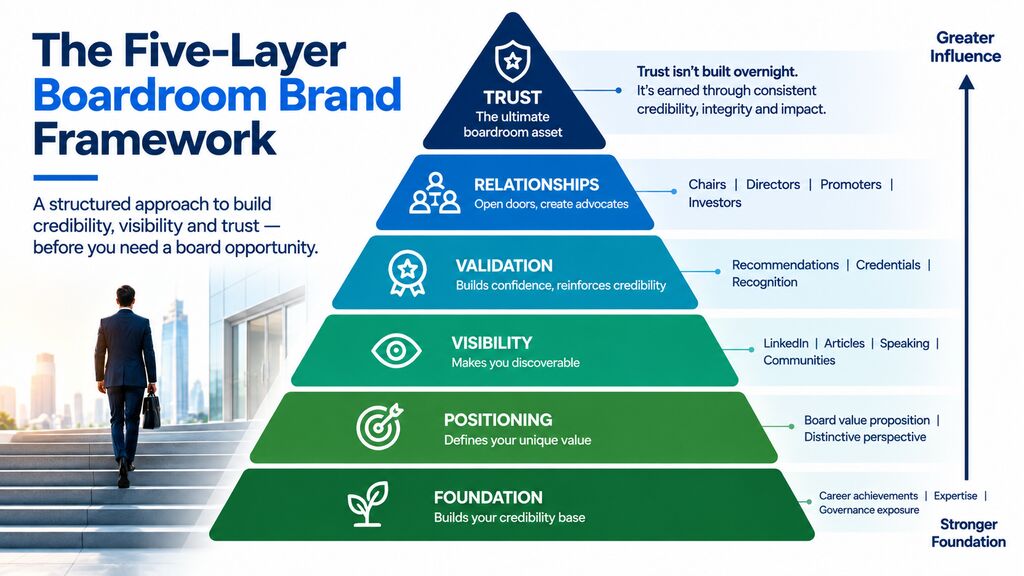
A useful five-layer framework is:
- Foundation: career achievements, expertise and governance exposure.
- Positioning: your board value proposition and distinctive perspective.
- Visibility: LinkedIn, articles, interviews, speaking and professional communities.
- Validation: recommendations, references, credentials and third-party recognition.
- Relationships: meaningful connections with chairs, directors, promoters, investors and governance professionals.
The important word is alignment. If your positioning says you are a strategic transformation leader but your content is entirely about tactical management tips, the signals do not match. If you claim governance expertise but never discuss governance questions, the claim remains unsubstantiated.
The five-layer boardroom brand framework
The process can be thought of as a pyramid. At the bottom is experience. Above it sits expertise. Then comes perspective. Next comes visibility. At the top sits trust.
Many executives try to start at the top. They want visibility before they have clarified their perspective. They want a board appointment before they have articulated their board value. They want networking conversations before they know what they bring to those conversations.
A more sustainable approach is to build from the foundation upward.
The Executive Boardroom Brand Needs Evidence
One of the most common mistakes in executive positioning is confusing adjectives with evidence. Words such as “strategic,” “visionary,” “dynamic,” “results-driven,” and “transformational” have become so common that they rarely differentiate anyone.
A stronger boardroom brand replaces adjectives with evidence. Instead of saying you are experienced in risk management, explain a situation where you identified a significant risk before it became a crisis. Instead of saying you understand transformation, describe the strategic trade-off you managed during a transformation. Instead of saying you are stakeholder-oriented, show how you balanced competing stakeholder interests.
Boards are interested in judgement because judgement is difficult to automate.
Show outcomes, judgement and influence
Your evidence should not read like an annual report. It should reveal how you think.
For example, rather than writing, “Led a major digital transformation,” you might explain that the transformation required balancing speed of adoption with cybersecurity, workforce readiness and customer trust. That single example communicates much more than the original sentence.
It also demonstrates why your experience may be relevant to contemporary boardrooms. PwC’s recent board research shows that directors are dealing with increasingly complex technology and transformation questions, with 62% of surveyed directors saying GenAI could significantly affect their business models, revenue or growth.
Personal Brand Before the Boardroom: What to Publish
You do not need to publish every week. You need to publish with purpose.
A strong personal brand before the boardroom can be built around four categories of content: lessons from experience, perspectives on industry change, governance questions, and practical leadership insights. The best content often begins with a question rather than a declaration.
For example: “What happens when a company’s AI strategy moves faster than its governance framework?” That question immediately creates a board-level conversation. Compare it with: “AI is transforming business and leaders need to adapt.” The second statement is true but forgettable.
Your executive personal branding perspective can also help frame the transition from being known for a job to being known for a point of view.
Thought leadership without self-promotion
Real thought leadership does not repeatedly tell people how accomplished you are. It gives them something useful to think about.
Share a difficult leadership lesson. Explain a strategic trade-off. Discuss a governance question. Challenge a common assumption. Reflect on a market shift. Explain what executives often misunderstand about a topic.
Over time, this creates something far more valuable than reach: recognition.
Someone may eventually say, “Whenever I see her name, she has an interesting perspective on transformation.” That sentence is a small but powerful piece of your boardroom brand.
Board Networks Are Built Through Relevance, Not Requests
Networking is often misunderstood by senior executives. A message saying, “Please let me know if you know of any board opportunities” puts the entire burden on the other person. A better relationship begins with relevance.
Perhaps you have something thoughtful to discuss about an industry development. Perhaps you can share a useful insight from a recent board discussion. Perhaps you want to understand another director’s perspective on AI governance. Relationships become stronger when conversations are based on shared interests rather than immediate transactions.
This is especially important with board networks. Chairs, directors, promoters and investors generally have limited time. They remember people who bring perspective, not simply people who ask for introductions.
Building relationships with intent
Think about networking as building intellectual capital.
Instead of asking, “Who can help me get a board seat?” ask, “Whose thinking would help me become a better board candidate?”
That shift changes the entire quality of your network. You begin following relevant people, participating in meaningful discussions, attending governance forums, contributing to professional communities and sharing useful perspectives.
Your network then becomes an extension of your boardroom brand.
Why Your Board Bio Matters More Than You Think
A board bio is not a shortened résumé. It is a strategic document designed to answer why your experience matters in a governance context.
A good board bio compresses years of experience into a clear value proposition. It identifies the sectors you understand, the strategic challenges you have navigated, your areas of expertise, your leadership perspective and the kinds of board responsibilities where you can contribute.
Your board value proposition and board bio guidance can help structure this transition from career narrative to board narrative.
Converting experience into board relevance
Suppose an executive has led a company through an acquisition, restructuring and international expansion. A conventional CV may list those events under different employers. A board bio can connect them into one larger capability: experience in capital allocation, strategic transformation, integration risk and cross-border growth.
That is the difference between documenting a career and positioning a director.
Your boardroom brand should make this connection visible across every professional asset.
Boardroom Branding and the Changing Governance Landscape
The boardroom itself is changing, which means the definition of board readiness is changing too.
AI is a clear example. Directors are increasingly expected to understand not only technology but its implications for strategy, risk, talent, cybersecurity, regulation and competitive advantage. PwC’s latest corporate director research identifies AI as an increasingly important oversight area, while its 2026 technology-sector findings highlight AI, talent and board refreshment as major governance concerns.
This means your boardroom brand cannot remain frozen around achievements from ten or fifteen years ago. Past experience provides credibility, but current relevance keeps that credibility alive.
AI, risk, resilience and stakeholder expectations
A modern board candidate should be able to demonstrate curiosity about emerging issues. You do not need to become an AI engineer to discuss AI governance. You do need to understand the strategic questions: Who owns the risk? What controls exist? What skills does the board need? How should management report AI-related risks? What happens to the business model if competitors adopt the technology faster?
The same principle applies to cyber risk, sustainability, geopolitical uncertainty, human capital and stakeholder trust.
Your professional reputation should communicate that you are experienced and intellectually current.
Common Boardroom Brand Mistakes Senior Executives Make
The first mistake is assuming that seniority speaks for itself. It does not. A 25-year career can actually make positioning more difficult because the audience must decide which parts of that experience remain relevant.
The second mistake is having an executive profile that is too operational. Boards are not hiring another functional manager. They need enterprise thinkers who can challenge assumptions and see across the organisation.
The third mistake is over-branding. Excessive self-promotion can undermine the very credibility a senior executive is trying to establish. The strongest profiles often feel measured, confident and evidence-led.
When visibility works against credibility
Posting more does not automatically mean building a stronger boardroom brand.
If every post says “I am delighted to announce,” “I am thrilled to share,” or “I am proud to be recognised,” the audience eventually learns very little about how you think.
A better content mix balances achievements with insights. Let other people celebrate your credentials while you demonstrate your perspective.
How to Audit Your Boardroom Brand
Imagine that tomorrow morning a respected board chair hears your name from a trusted colleague and decides to search for you.
What will they find?
Run a simple audit across six areas: LinkedIn, Google search results, board CV, board bio, thought leadership, and network validation.
Ask whether each asset answers the same fundamental questions. What are you known for? What business problems have you solved? What industries do you understand? What governance issues interest you? What evidence supports your claims? Why should someone trust your judgement?
A useful audit can be structured like this:
| Question | Strong signal | Warning signal |
| Can your expertise be understood quickly? | Clear positioning | Generic profile |
| Is your experience board-relevant? | Enterprise outcomes | Task descriptions |
| Is your thinking visible? | Consistent insights | No recent perspective |
| Is your reputation validated? | Specific recommendations | Unsupported claims |
| Is your profile current? | Recent achievements and views | Outdated information |
| Is your network relevant? | Directors and senior leaders | Large but unrelated network |
A practical board-readiness test
Try explaining your board value proposition in one sentence without using your current job title.
If you cannot, your positioning probably needs work.
Then ask three people who know your career well: “What would you say I am uniquely good at?” Their answers may reveal a gap between your intended boardroom brand and your actual reputation.
That gap is where the most valuable branding work often begins.
Turning Your Boardroom Brand Into Board Opportunity
A strong boardroom brand does not guarantee a board appointment. No responsible professional can promise that. What it does is improve the quality of your professional signal when opportunities arise.
It helps a search consultant understand you faster. It gives a promoter a reason to remember you. It gives a fellow director something specific to recommend. It gives an investor confidence that your experience is relevant to a particular strategic challenge.
This is why board branding should be treated as a long-term leadership asset rather than a last-minute job-search exercise.
If you are beginning this journey, start by defining your board value proposition. Then align your LinkedIn profile, board CV, board bio, content strategy and network around that proposition. Your board-focused resources and insights can help you develop the thinking behind that process.
The objective is simple: when the boardroom conversation begins, your reputation should have arrived before you do.
Conclusion: Enter the Boardroom Before You Enter the Room
The most powerful boardroom brand is not the loudest one. It is the one that creates recognition, relevance and trust before a formal conversation ever takes place.
For senior executives and aspiring directors, this requires a change in mindset. Stop thinking of your professional profile as a record of where you have worked. Start treating it as evidence of how you think. Stop waiting for a board opportunity before preparing your board narrative. Start building your pre-boardroom presence while you are still creating value in your current role.
NRCs, promoters, investors, chairs and board networks are ultimately looking for people they can trust with complexity. Your digital presence cannot manufacture that trust, but it can reveal whether the experience, judgement and perspective behind your name are visible.
The boardroom door may open through a recommendation, a search consultant, a professional relationship or an unexpected conversation. You cannot control exactly when that moment arrives.
You can control whether your boardroom brand is ready when it does.
Frequently Asked Questions About Boardroom Brand
1. What is a boardroom brand?
A boardroom brand is the professional reputation and positioning that communicate your relevance, judgement, expertise and potential value as a board director. It goes beyond a CV or job title and connects your experience with the strategic and governance issues boards care about.
2. When should I start building my boardroom brand?
Ideally, several years before you actively seek a board position. A strong reputation takes time to develop because it depends on consistent experience, visibility, relationships, thought leadership and third-party validation.
3. Is LinkedIn important for building a boardroom brand?
Yes. LinkedIn is often one of the first places people look when evaluating a senior professional. It should clearly communicate your expertise, achievements, perspective and board-level relevance rather than simply reproducing your résumé.
4. Do I need to post frequently on LinkedIn?
No. Consistency and relevance matter more than frequency. A thoughtful article or insightful post that demonstrates genuine expertise can contribute more to your reputation than frequent generic updates.
5. What should a board director post about?
Useful subjects include governance, industry disruption, strategy, risk, AI, cybersecurity, leadership, stakeholder management, transformation, succession and lessons from professional experience. The subject should connect naturally with your expertise.
6. How is executive branding different from boardroom branding?
Executive branding often focuses on leadership within an organisation, while boardroom branding focuses on enterprise-level judgement, governance, strategic oversight, independence and long-term value creation.
7. Can a strong boardroom brand guarantee a board appointment?
No. Board appointments depend on many factors, including board composition, business needs, experience, independence, networks, governance requirements and timing. A strong brand improves your readiness and discoverability but cannot guarantee an appointment.
8. What role does reputation play in board appointments?
Reputation is fundamental because directors are entrusted with sensitive information, strategic decisions and oversight responsibilities. A consistent history of sound judgement and professional integrity can become an important trust signal.
9. Should my board bio be different from my executive CV?
Yes. A board bio should translate your executive experience into board relevance. It should focus less on responsibilities and more on strategic contribution, judgement, industry expertise, governance exposure and value creation.
10. How can I demonstrate board readiness without already being a director?
You can demonstrate board readiness through relevant leadership experience, governance education, strategic thought leadership, committee or advisory exposure, industry expertise, stakeholder management and informed perspectives on board-level issues.
11. Should I mention every achievement in my board profile?
No. Select achievements that reinforce your board value proposition. A shorter, sharper narrative is often more powerful than an exhaustive career history.
12. How important are board networks?
Relationships can be highly valuable because many board opportunities emerge through professional networks and referrals. However, effective networking is based on relevance and trust rather than simply asking people for board opportunities.
13. What makes a boardroom brand credible?
Evidence makes it credible. Specific achievements, thoughtful perspectives, credible recommendations, meaningful professional associations, speaking opportunities and consistent communication all help validate your positioning.
14. How often should I review my boardroom brand?
At least once or twice a year, and whenever your career changes significantly. Your positioning should evolve as your experience, expertise, industries and the governance environment change.
15. What is the first step to building my boardroom brand?
Start by defining your board value proposition. Identify the combination of experience, expertise, judgement and perspective that you can bring to a board, then align your LinkedIn profile, board CV, board bio, content and network around that central narrative.