

There was a time when experience alone could earn a leader respect. A strong résumé, decades of industry expertise, and a few successful leadership roles were often enough to open boardroom doors. That world has changed. Today, decision-makers don’t evaluate executives only by what they have achieved—they also evaluate how consistently those achievements communicate leadership, judgment, and trust. This is where personal branding becomes far more than a marketing exercise. It becomes a strategic leadership asset.
The digital era has transformed the way stakeholders assess leaders. Investors, nomination committees, board members, regulators, employees, and even potential collaborators often form opinions long before the first conversation takes place. A LinkedIn profile, a keynote speech, an interview, an article, or even a simple online search contributes to an executive’s reputation. Every touchpoint tells a story. The only question is whether that story has been intentionally designed or left to chance.
For aspiring board directors and senior executives, this shift carries enormous significance. Board appointments rarely happen because someone is simply visible. They happen because people trust what that visibility consistently represents. Trust is created when every professional interaction reinforces the same leadership values, governance mindset, and strategic thinking. That consistency doesn’t happen accidentally—it is built through a carefully designed brand strategy supported by authentic narrative building.
Think about the executives who command attention the moment they enter a room. Their influence isn’t always tied to charisma. Instead, it comes from clarity. People understand what they stand for, what problems they solve, and how they approach leadership. Their personal brand creates confidence before they even begin speaking.
This article explores how executives can intentionally build that kind of influence. You’ll discover why narrative matters more than self-promotion, how strategic storytelling strengthens executive credibility, and the practical framework that transforms scattered achievements into a compelling leadership identity. Whether you’re preparing for your first board role or strengthening your executive reputation, mastering personal branding may become one of the highest-return investments of your professional development.
Table of Contents
- Why Personal Branding Has Become a Boardroom Imperative
- The Difference Between Personal Branding and Self-Promotion
- Narrative Strategy: The Foundation of Meaningful Personal Branding
- The Five Foundations of a Powerful Leadership Narrative
- Creating Your North Star Narrative
- Building Narrative Pillars That Reinforce Trust
- Turning Professional Experiences into Signature Stories
- A Practical Framework for Building an Executive Narrative
- Using Narrative Carriers to Amplify Your Personal Brand
- Conclusion
- FAQs
Why Personal Branding Has Become a Boardroom Imperative
A decade ago, executives could build successful careers while remaining relatively invisible outside their organisations. Their leadership was primarily evaluated by colleagues, direct reports, and shareholders. Today, that reality looks very different. Digital platforms, governance expectations, and increased transparency have fundamentally changed how leadership credibility is established. Every executive now has a public reputation—whether they actively manage it or not.
This transformation has elevated personal branding from an optional career enhancement to a strategic necessity. Board nomination committees, executive search firms, investors, and governance professionals increasingly seek leaders whose expertise is visible, whose values are consistent, and whose communication reflects mature judgment. Technical competence may secure an interview, but reputation often determines who earns a seat at the board table.
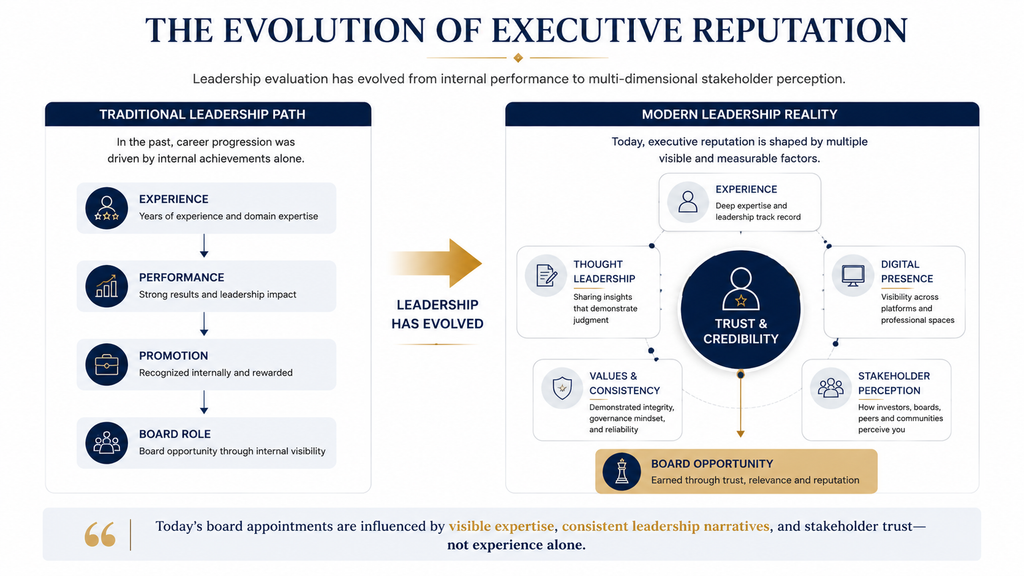
One of the biggest misconceptions surrounding personal branding is that it is about becoming famous. Nothing could be further from the truth. Effective executive branding is not about collecting followers or generating viral content. It is about creating confidence. Every interaction should answer three silent questions stakeholders naturally ask:
- Can I trust this leader?
- Does this executive consistently demonstrate sound judgment?
- Would I confidently associate my organisation with this individual?
When those answers remain consistently positive, opportunities begin to compound naturally.
The acceleration of artificial intelligence has made this even more important. AI can generate articles, presentations, social media posts, and professional biographies within seconds. As content becomes easier to produce, authentic leadership becomes significantly harder to imitate. The executives who stand apart won’t necessarily be those producing the most content. They’ll be the ones whose communication consistently reflects genuine experience, ethical decision-making, and strategic thinking.
The 2025 Edelman Trust Barometer continues to show that trust remains one of the strongest factors influencing leadership credibility and institutional confidence. Executives who demonstrate transparency, expertise, and consistency are significantly more likely to earn stakeholder confidence than those relying solely on credentials or corporate titles. In other words, people increasingly trust evidence over claims.
This evolution has made personal branding a governance issue rather than simply a communication exercise. Directors influence organisational culture, oversee risk, guide long-term strategy, and represent shareholder interests. Every public interaction contributes to perceptions of how they might perform those responsibilities.
Imagine two executives with identical qualifications. Both possess decades of experience, both have led profitable businesses, and both understand governance. Yet one executive consistently publishes thoughtful insights, articulates a clear leadership philosophy, participates in industry discussions, and communicates with remarkable consistency. The other remains professionally accomplished but largely invisible outside formal meetings.
Which leader is more likely to be remembered when a board opportunity emerges?
The answer illustrates why professional development today extends far beyond acquiring new skills. Leaders must also develop the ability to communicate those skills through a coherent narrative that builds trust over time.
The Difference Between Personal Branding and Self-Promotion
Many experienced professionals hesitate when they hear the phrase personal branding because it sounds uncomfortably close to self-promotion. They worry that building visibility may appear boastful or inauthentic. Ironically, this misunderstanding often prevents highly capable leaders from receiving the recognition they deserve.
The distinction is actually quite simple.
Self-promotion focuses on attracting attention.
Personal branding focuses on earning trust.
One seeks applause; the other creates credibility.
Consider two executives sharing career achievements online. The first repeatedly highlights awards, titles, and accomplishments without providing meaningful insight. Readers quickly perceive the communication as self-centred. The second executive shares lessons learned from complex leadership decisions, governance challenges, stakeholder engagement, and organisational transformation. Awards appear occasionally—not as the central message but as supporting evidence.
Both individuals discuss success.
Only one creates influence.
This difference exists because people remember stories far longer than achievements alone. Facts inform, but narratives create emotional connection. When leaders openly discuss challenges, turning points, difficult decisions, and valuable lessons, they become relatable without sacrificing authority.
Authentic narrative building transforms credentials into meaning.
Rather than saying:
“I have twenty-five years of executive experience.”
A compelling narrative explains:
“Over twenty-five years, I’ve consistently helped organisations navigate periods of uncertainty by simplifying complexity, strengthening governance, and aligning leadership teams around long-term value creation.”
Notice the difference.
The first statement lists experience.
The second communicates purpose.
Purpose creates memorability.
This principle becomes especially important in board appointments because directors are selected not merely for what they know but for how they think. Boards seek judgment, independence, ethical reasoning, strategic oversight, and stakeholder awareness. Those qualities are difficult to communicate through bullet points alone. They emerge through carefully crafted stories supported by consistent evidence.
An executive’s narrative should therefore answer questions that a résumé never can:
- Why do you lead the way you do?
- What principles guide difficult decisions?
- How have your experiences shaped your governance philosophy?
- What unique perspective do you consistently bring into board discussions?
When leaders intentionally answer these questions across every communication channel, their brand strategy evolves from personal marketing into professional positioning.
That positioning becomes increasingly valuable throughout an executive’s career. Promotions, advisory opportunities, speaking invitations, media interviews, board appointments, and strategic partnerships often arise because people already understand the value a leader represents before any formal introduction takes place.
That is the true power of personal branding.
It doesn’t create expertise.
It makes genuine expertise impossible to overlook.
Narrative Strategy: The Foundation of Meaningful Personal Branding
Imagine meeting two executives with almost identical career achievements. Both have led large teams, delivered profitable results, and spent decades climbing the corporate ladder. Yet, after speaking with them, only one remains memorable. Why? The difference usually isn’t intelligence, experience, or even communication skills. It’s the presence of a clear narrative—a consistent story that helps others understand not only what the leader has accomplished, but also why those accomplishments matter.
That is exactly what a narrative strategy is. It is a deliberate framework that shapes how people perceive your leadership over time. Rather than allowing others to piece together random impressions from your LinkedIn profile, conference appearances, articles, or conversations, you intentionally create a consistent leadership story. Every interaction reinforces the same themes, values, and strengths, making your reputation stronger with every touchpoint.
Think of your narrative as the operating system behind your personal branding. People see the applications—your achievements, speeches, interviews, and board experience—but they don’t always notice the system quietly connecting everything together. Without that operating system, even an impressive career can appear scattered. One day you present yourself as a transformation leader, the next day as a finance expert, and later as a governance advisor. Individually, each identity may be true. Collectively, they create confusion.
A well-designed narrative strategy removes that confusion by connecting every accomplishment to one larger purpose. Instead of simply listing credentials, it explains the journey behind them. It answers questions that every stakeholder unconsciously asks:
- What kind of leader is this?
- What principles guide their decisions?
- What unique perspective do they consistently bring?
- Why should people trust their judgment?
When those answers become obvious, your leadership brand becomes memorable.
Today’s boardrooms demand exactly this kind of clarity. Directors are expected to guide organisations through uncertainty, technological disruption, regulatory complexity, and increasing stakeholder expectations. Technical expertise remains essential, but leadership influence depends on something deeper—how consistently people interpret your judgment. A strong narrative helps create that interpretation before you even enter the room.
One reason this has become increasingly important is the rise of digital visibility. Executives now communicate across multiple platforms. They write LinkedIn posts, appear on podcasts, contribute thought leadership articles, participate in panel discussions, mentor leaders, and represent organisations publicly. Every one of these interactions contributes another piece to their professional identity. Without an intentional narrative, those pieces often resemble a puzzle with no picture on the box.
By contrast, executives with a clear narrative strategy make every communication reinforce the same leadership philosophy. Their articles, interviews, keynote speeches, and conversations may discuss different topics, but the underlying message remains remarkably consistent. Over time, this consistency becomes trust. Trust becomes credibility. Credibility creates opportunity.
This is why narrative building should never be mistaken for storytelling alone. Storytelling is one of the tools. Narrative is the strategy behind the tool. One communicates an event; the other shapes long-term perception.
For aspiring board directors, this distinction is invaluable. Boards don’t simply recruit experienced executives—they recruit leaders whose judgment, values, and strategic thinking have become easy to recognise. Narrative strategy makes that recognition possible.
The Five Foundations of a Powerful Leadership Narrative
A compelling executive narrative doesn’t emerge from clever writing or polished presentations. It grows from clarity. Before you think about LinkedIn posts, keynote speeches, or board bios, you need to define the strategic building blocks that give your leadership story direction. These foundations ensure that your brand strategy reflects substance rather than style.
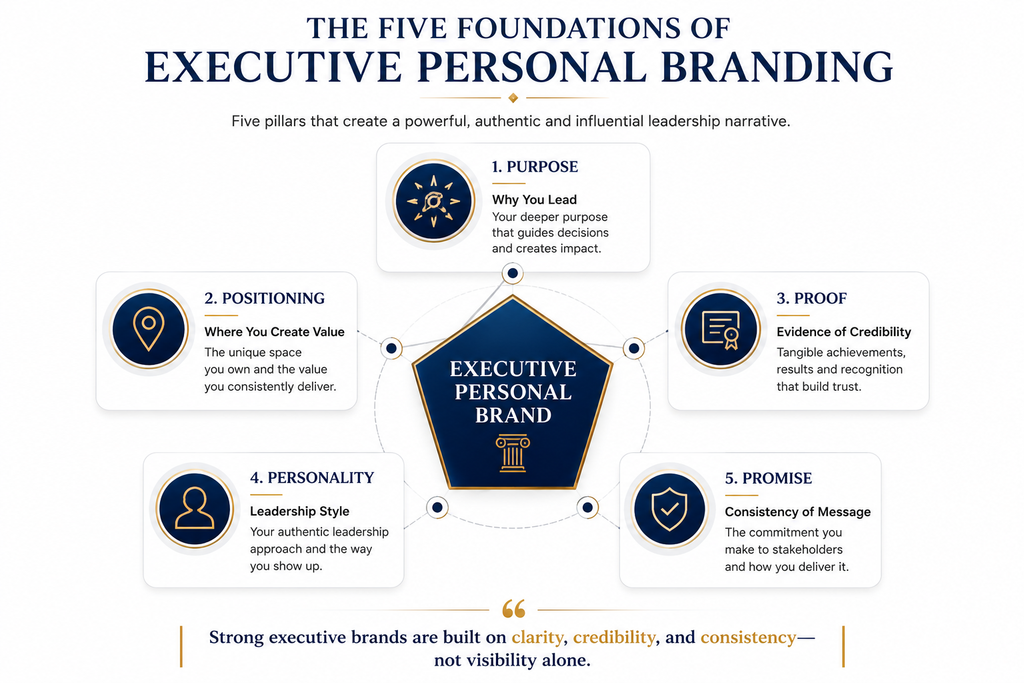
Purpose: The Reason Behind Your Leadership
Every influential leader is driven by something bigger than career progression. Purpose answers a simple but powerful question: Why do you lead?
Many executives initially respond with functional answers such as improving performance, driving growth, or increasing shareholder value. Those outcomes certainly matter, but purpose runs deeper. It explains the impact you hope your leadership creates for organisations, people, and society.
Perhaps you believe sustainable governance creates stronger businesses. Maybe you enjoy transforming uncertainty into strategic clarity. Or perhaps your passion lies in developing future leaders who outperform expectations. Whatever your answer, your purpose becomes the emotional anchor of your personal brand.
When purpose remains consistent, stakeholders begin recognising your leadership philosophy long before they remember your job title.
Positioning: Defining Your Strategic Space
If purpose explains why you lead, positioning explains where you create the greatest value.
Think of positioning as choosing your seat at the boardroom table. Every executive brings expertise, but not every executive becomes known for that expertise. Some become recognised for digital transformation. Others become synonymous with governance excellence, organisational turnaround, innovation, sustainability, or stakeholder engagement.
Strong positioning doesn’t limit your capabilities—it sharpens your identity.
Consider two leaders.
The first introduces themselves as someone with experience across operations, finance, technology, strategy, marketing, and leadership.
The second says:
“I help organisations simplify complex strategic decisions through governance-focused leadership and stakeholder alignment.”
Who leaves a stronger impression?
The second executive hasn’t reduced their expertise. They’ve simply made it easier to remember.
That’s exactly what effective positioning achieves.
Proof: Transforming Claims into Credibility
One of the fastest ways to weaken a personal brand is to make bold claims without supporting evidence.
Experienced board members rarely evaluate leadership based on promises alone. They look for proof.
Proof can take many forms:
- Published thought leadership
- Governance certifications
- Industry recognition
- Board appointments
- Successful transformation initiatives
- Awards and professional achievements
- Speaking engagements
- Research publications
- Executive mentoring
- Measurable business outcomes
Each of these demonstrates competence rather than merely describing it.
Think of proof as the bridge connecting perception with reality. Without it, even compelling narratives remain opinions. With it, your narrative becomes believable.
Personality: The Human Side of Executive Leadership
Professionalism does not require impersonality.
Many senior executives unintentionally communicate in language so formal that their personalities disappear entirely. While authority matters, relatability matters too.
Your personality determines how people experience your leadership.
Are you calm during uncertainty?
Do you simplify complexity?
Are you naturally curious?
Do you challenge assumptions respectfully?
Do you enjoy mentoring emerging leaders?
These characteristics create familiarity. People don’t simply remember facts—they remember how someone made them think and feel.
That doesn’t mean becoming overly casual or sharing unnecessary personal details. Instead, it means allowing your authentic leadership style to become visible.
Ironically, authenticity often strengthens authority rather than weakening it.
Promise: The Consistency That Builds Trust
Every respected executive eventually develops a reputation for delivering something consistently.
Some leaders consistently create clarity.
Others consistently solve difficult problems.
Some consistently unite diverse stakeholders.
Others consistently build ethical organisational cultures.
This consistency becomes your leadership promise.
Think about the brands you trust most. You trust them because you know what to expect. Great executive brands work exactly the same way.
When colleagues, investors, nomination committees, or board members repeatedly experience the same quality of judgment, preparation, integrity, and strategic thinking, they begin associating your name with reliability.
That reliability becomes trust.
Trust becomes influence.
Influence becomes long-term leadership equity.
Together, these five foundations—Purpose, Positioning, Proof, Personality, and Promise—create the architecture that supports every successful narrative. Remove any one of them, and the structure weakens. Strengthen all five, and your personal branding evolves from visibility into lasting credibility.
Creating Your North Star Narrative
Every successful organisation operates with a mission that guides decisions, aligns teams, and shapes long-term strategy. Leaders need something similar. That guiding principle is what we can call the North Star Narrative—the central idea that explains why your leadership matters and how you consistently create value.
Without a North Star Narrative, even experienced executives often introduce themselves differently depending on the audience. During a conference, they emphasise innovation. At a networking event, they highlight operational excellence. During a board interview, they focus on governance. On LinkedIn, they suddenly become thought leaders discussing artificial intelligence.
Individually, none of these identities is incorrect.
Collectively, they dilute clarity.
Your North Star Narrative solves this problem by creating one overarching leadership story capable of supporting every professional conversation.
Imagine standing beneath the night sky. Sailors historically relied on the North Star because it remained fixed while everything else moved around it. Your leadership narrative should function the same way. Markets change. Industries evolve. Job titles shift. Organisations merge. Technologies disrupt entire sectors. Yet your core leadership philosophy remains constant.
A strong North Star Narrative usually combines three essential elements:
- Your purpose
- Your strategic expertise
- The long-term value you create for stakeholders
For example:
“I help organisations strengthen governance by transforming complexity into strategic clarity.”
Or:
“I enable leadership teams to build resilient businesses through ethical decision-making and long-term value creation.”
Notice that neither statement depends on a job title. Whether serving as a CEO, advisor, independent director, mentor, or board committee member, the underlying narrative remains relevant.
One useful way to test your North Star Narrative is by asking a simple question:
Can every achievement in my career support this larger story?
If the answer is yes, you’ve likely identified a narrative capable of lasting decades rather than years.
This becomes especially valuable when building a long-term brand strategy. Every keynote speech, article, interview, podcast, board biography, mentoring conversation, and LinkedIn post should naturally reinforce the same underlying message. Different audiences may hear different examples, but they should all leave with remarkably similar impressions of your leadership.
That’s when narrative begins creating momentum.
People no longer remember isolated accomplishments.
They remember what you consistently stand for.
Building Narrative Pillars That Reinforce Trust
Your North Star Narrative gives people the big picture of who you are as a leader. But a strong vision alone isn’t enough. Think of it as the roof of a house—it can’t stand without solid pillars supporting it. That’s exactly where narrative pillars come in. They transform an inspiring leadership statement into something people can see, experience, and remember.
One of the biggest mistakes executives make in personal branding is trying to talk about everything they’ve ever done. After years or even decades of experience, it’s tempting to showcase every achievement, certification, project, and leadership role. The result? A professional profile that feels impressive but overwhelming. People walk away remembering the volume of experience, not the value behind it.
Narrative pillars solve this problem by narrowing your message without limiting your expertise. They represent three or four recurring themes that consistently appear whenever you communicate—whether you’re writing an article, speaking at a conference, participating in a board interview, or updating your LinkedIn profile. Instead of changing your message every time, you reinforce the same strategic ideas from different angles.
Imagine an executive whose North Star Narrative is about helping organisations create sustainable growth through governance. Their narrative pillars might look something like this:
- Governance and board effectiveness
- Leadership transformation
- Stakeholder trust and reputation
- Strategic decision-making
Now notice what happens. Every article they publish, every keynote they deliver, every mentoring conversation they have, and every board discussion naturally fits under one of these pillars. Their communication feels consistent without becoming repetitive. Over time, people begin associating them with these areas of expertise almost automatically.
This consistency creates familiarity, and familiarity builds trust.
There’s another advantage to narrative pillars that often goes unnoticed. They make content creation dramatically easier. Many executives struggle to stay active on professional platforms because they don’t know what to write about. Without a framework, every post feels like starting from scratch.
Narrative pillars eliminate that uncertainty.
Suppose one of your pillars is leadership transformation. Suddenly, dozens of content ideas emerge naturally. You can write about leading through uncertainty, developing future leaders, managing organisational change, building resilient cultures, or lessons from your own executive journey. The topics may differ, but they all strengthen the same leadership identity.
That’s exactly how thought leadership becomes sustainable rather than exhausting.
As you build your pillars, keep one principle in mind: they should reflect where you want to be known, not simply what you’ve done. Past achievements provide credibility, but future opportunities come from the expertise people consistently associate with your name.
Ask yourself:
- Which topics do people already seek my advice on?
- What type of board discussions energise me the most?
- Which leadership challenges have I repeatedly solved throughout my career?
- If someone introduced me in one sentence, what would I want them to say?
The answers to these questions often reveal your strongest narrative pillars.
Most importantly, resist the temptation to create too many. Three or four well-defined pillars are usually enough. Beyond that, your message starts losing focus.
Remember, memorable leaders aren’t remembered because they talk about everything.
They’re remembered because they stand for something clear.
Turning Professional Experiences into Signature Stories
Facts inform.
Stories influence.
That simple distinction explains why some leaders remain unforgettable long after a conversation ends while others fade from memory despite equally impressive careers.
Think back to the last conference you attended. Chances are you don’t remember every statistic presented on stage. But you probably remember the speaker who shared a compelling experience about navigating a crisis, making a difficult decision, or learning from failure. That’s because our brains naturally organise information through stories rather than isolated facts.
This is where narrative building becomes incredibly powerful.
Every executive already possesses dozens of valuable stories. The challenge isn’t creating them—it’s recognising which experiences best communicate leadership, judgment, resilience, and strategic thinking.
Unfortunately, many professionals reduce extraordinary experiences to a few bullet points on a résumé.
“Led digital transformation.”
“Managed organisational restructuring.”
“Improved operational efficiency.”
These achievements certainly matter, but they leave out the most important part—the human decision-making behind them.
Instead, ask yourself questions like:
- What difficult situation tested my leadership?
- Which decision changed my perspective forever?
- When did I earn trust rather than authority?
- What challenge taught me something I still apply today?
- Which project fundamentally shaped my governance philosophy?
The answers become the raw material for signature stories.
A useful executive narrative typically includes several different types of stories, each serving a distinct purpose.
Origin Stories: Explaining What Shaped You
Every leader has defining experiences that influenced how they think.
Perhaps you began your career during an economic downturn that taught financial discipline.
Maybe you worked under an exceptional mentor whose leadership style still inspires you.
Or perhaps a difficult organisational crisis transformed your understanding of governance.
Origin stories answer one important question:
Why do you lead the way you do?
These stories create authenticity because they reveal the experiences behind your principles.
Turning Point Stories: Demonstrating Growth
Growth rarely happens during comfortable periods.
The moments that shape exceptional leaders usually involve uncertainty, failure, or difficult choices.
A turning point story might describe:
- Managing a major organisational crisis.
- Leading a merger.
- Navigating stakeholder conflict.
- Making an unpopular but necessary decision.
- Recovering from a professional setback.
These stories don’t make leaders appear weak.
They make them believable.
Board members appreciate executives who demonstrate reflection and learning because governance itself depends on thoughtful judgment rather than perfection.
Impact Stories: Showing Results Through People
Executives sometimes focus so heavily on business outcomes that they overlook the broader impact of their leadership.
Yes, financial performance matters.
Operational improvements matter.
Strategic execution matters.
But stakeholders also remember transformation.
How did your leadership improve decision-making?
How did your governance framework reduce organisational risk?
How did your mentoring develop future leaders?
How did your strategy strengthen stakeholder confidence?
Impact stories connect measurable outcomes with meaningful human change.
That’s what makes them memorable.
Governance Stories: Demonstrating Board-Level Thinking
Aspiring board directors should intentionally develop stories demonstrating governance maturity.
These experiences don’t necessarily require previous board appointments.
Perhaps you’ve managed risk during uncertain market conditions.
Perhaps you’ve balanced competing stakeholder interests.
Maybe you’ve strengthened compliance, improved ethical decision-making, or guided long-term strategic planning.
These examples reveal something far more valuable than technical expertise.
They reveal judgment.
And judgment is one of the most valuable currencies inside any boardroom.
A Practical Framework for Building an Executive Narrative
Creating a strong narrative doesn’t have to feel overwhelming. Instead of trying to improve everything at once, focus on building one layer at a time. The framework below provides a practical roadmap that executives can use to strengthen their personal branding while remaining authentic and strategically consistent.
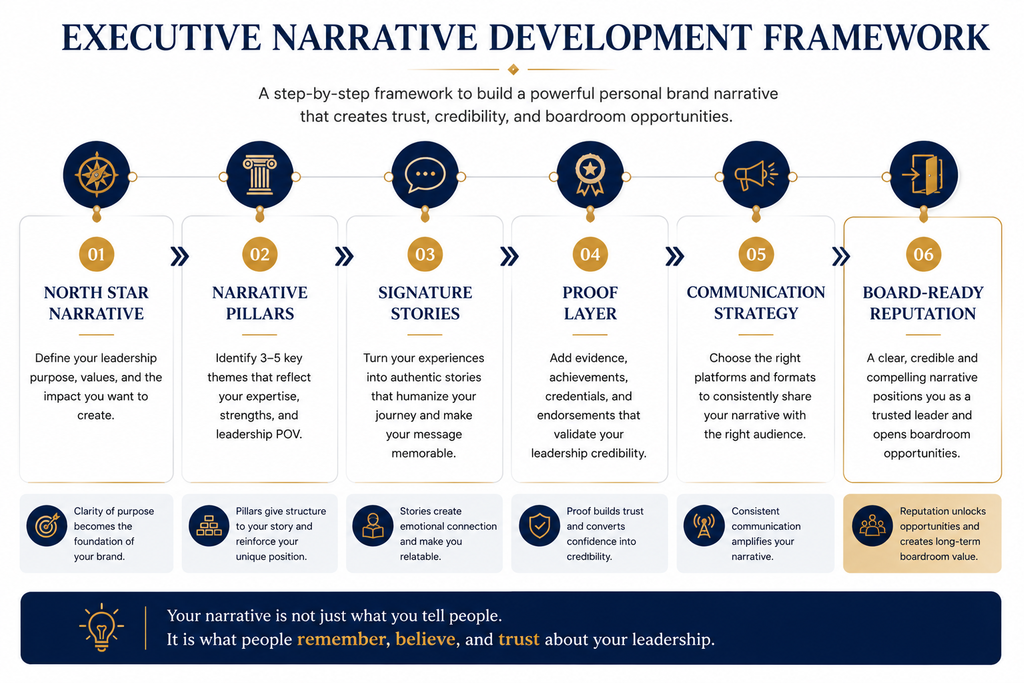
| Narrative Element | Purpose | Questions to Ask Yourself | Expected Outcome |
| North Star Narrative | Defines your overarching leadership purpose | What do I want to be known for over the next decade? | Clear leadership identity |
| Narrative Pillars | Creates consistency across communication | Which three or four themes define my expertise? | Strong positioning |
| Signature Stories | Humanises experience | Which experiences best demonstrate my judgment and values? | Greater trust and memorability |
| Proof Layer | Validates your credibility | What evidence supports my expertise? | Higher executive credibility |
| Communication Strategy | Reinforces your narrative consistently | Where and how will I share my insights? | Stronger professional visibility |
Notice how every layer builds upon the previous one. The framework doesn’t encourage self-promotion—it encourages clarity. Instead of constantly wondering what to say or how to position yourself, you develop a repeatable system that aligns your experience, expertise, and communication.
That’s exactly what exceptional leaders do. They don’t reinvent themselves every few months. They consistently reinforce a leadership identity that grows stronger with every meaningful interaction.
Using Narrative Carriers to Amplify Your Personal Brand
You’ve built your North Star Narrative. You’ve identified your narrative pillars. You’ve collected meaningful stories and supported them with credible proof. Now comes the question many executives ask:
“How do I make sure the right people actually see it?”
The answer lies in what we can call narrative carriers. These are the channels through which your leadership story travels. Think of them as vehicles rather than destinations. Your narrative is the message, while narrative carriers ensure that message reaches stakeholders consistently and effectively.
One mistake executives often make is believing that a polished LinkedIn profile is enough. While LinkedIn is undoubtedly one of the most powerful professional platforms available today, it represents only one touchpoint in a much larger leadership ecosystem. Board opportunities rarely emerge because of a single post or one impressive profile. They develop through repeated exposure to consistent expertise across multiple channels.
Imagine your personal brand as a melody rather than a single note. Hearing one note tells people very little. Hearing the same melody played across different instruments makes it instantly recognizable. Your articles, conference presentations, interviews, podcasts, webinars, mentoring conversations, and board discussions should all play variations of the same melody. The tone may change depending on the audience, but the underlying message should remain remarkably consistent.
For senior executives and aspiring board directors, some of the most effective narrative carriers include:
- LinkedIn thought leadership posts
- Long-form articles and opinion pieces
- Executive interviews and podcasts
- Conference keynotes and panel discussions
- Industry roundtables and webinars
- Professional newsletters
- Board biographies and executive profiles
- Mentoring sessions and guest lectures
- Governance forums and advisory discussions
Notice that none of these channels exists to “promote” you. Instead, they create opportunities to demonstrate how you think. That’s an important distinction. Boards aren’t looking for executives who can talk about themselves endlessly. They’re looking for leaders who can contribute meaningful perspectives on governance, strategy, risk, innovation, ethics, and long-term value creation.
This is where many professionals unintentionally weaken their personal branding. They speak differently on every platform. Their LinkedIn profile emphasizes innovation. Their conference presentation focuses on operational excellence. Their executive biography highlights finance. Their interviews discuss leadership culture. Individually, each message may be valuable. Together, they create a fragmented identity.
Consistency doesn’t mean repetition.
It means alignment.
Your communication should evolve naturally while reinforcing the same leadership philosophy. Whether someone reads one article or follows your work for five years, they should develop a remarkably similar understanding of who you are and what you stand for.
There’s another benefit to using multiple narrative carriers. Different stakeholders discover leaders in different ways. A recruiter may read your LinkedIn article. A board chair may hear you on a podcast. An investor might watch your keynote. A fellow director could meet you during an industry discussion. Every interaction becomes another opportunity to reinforce your leadership identity.
Rather than chasing visibility for its own sake, focus on becoming consistently valuable wherever your audience already spends time. That’s how influence grows organically.
Conclusion
The strongest leaders rarely spend their time convincing others they’re capable. Their reputation does that work long before the conversation begins. That’s the real value of personal branding. It isn’t about becoming the loudest voice in your industry or collecting the highest number of followers. It’s about creating a leadership identity so clear and consistent that people immediately understand what you stand for and why they should trust your judgment.
Throughout this guide, we’ve explored how a carefully designed narrative, supported by meaningful narrative building, transforms experience into influence. We’ve looked at the importance of defining a North Star Narrative, creating focused narrative pillars, telling authentic leadership stories, building a strong proof layer, and maintaining consistency across every professional interaction. Each of these elements strengthens your brand strategy, helping you move beyond visibility toward genuine credibility.
For aspiring board directors, this shift is particularly important. Boards are looking for leaders who bring more than technical expertise. They seek individuals with strategic thinking, ethical judgment, stakeholder awareness, and the ability to inspire confidence during periods of uncertainty. Your narrative becomes the bridge between your experience and those expectations.
Take a moment to reflect on your own professional journey.
If someone searched your name today, would they clearly understand your leadership philosophy?
Would your articles, LinkedIn profile, executive biography, and conversations tell the same story?
Would a nomination committee immediately recognise the value you bring to a boardroom?
If the answer is “not yet,” that’s perfectly fine. The best time to strengthen your narrative isn’t when an opportunity appears—it’s before one does.
Every article you publish, every conversation you have, every presentation you deliver, and every decision you make contributes another chapter to your leadership story. Make those chapters intentional.
Because in today’s boardroom, people don’t simply appoint experience.
They appoint trust.
And trust begins with a personal brand that consistently reflects the leader you truly are.
FAQs
1. What is personal branding for executives?
Personal branding is the intentional process of building a consistent professional reputation that communicates your expertise, leadership values, and credibility.
2. Why is personal branding important for board directors?
It helps board nomination committees understand your leadership philosophy, governance mindset, and strategic value before meeting you.
3. What is a North Star Narrative?
It is your core leadership story that defines your purpose and guides all professional communication.
4. How many narrative pillars should an executive have?
Most executives benefit from three or four focused narrative pillars.
5. Is personal branding the same as self-promotion?
No. Personal branding builds trust through consistent value, while self-promotion focuses mainly on gaining attention.
6. What are narrative pillars?
They are the recurring themes that consistently reinforce your leadership expertise and professional identity.
7. How often should I publish thought leadership content?
Quality matters more than quantity. One meaningful article each month is often more effective than frequent generic posts.
8. Can introverted leaders build a strong personal brand?
Absolutely. Authentic expertise and thoughtful insights often outperform constant visibility.
9. What role does LinkedIn play in executive branding?
LinkedIn serves as one of the primary platforms for demonstrating thought leadership and professional credibility.
10. How do I make my leadership story memorable?
Focus on authentic experiences, clear lessons, measurable outcomes, and consistent messaging.
11. What is the biggest mistake executives make with personal branding?
Trying to be known for everything instead of developing a focused leadership identity.
12. How can I demonstrate credibility beyond my résumé?
Publish insights, speak at industry events, earn governance credentials, mentor leaders, and showcase measurable achievements.
13. Does AI reduce the importance of personal branding?
No. AI increases the value of authentic experience, strategic thinking, and genuine leadership perspectives.
14. How often should I review my personal brand?
At least once every year or whenever your leadership responsibilities significantly evolve.
15. What is the first step toward building a board-ready reputation?
Define your leadership purpose and create a clear North Star Narrative before developing your communication strategy.
Ready to Build a Board Profile That Boards Trust?
One of the smartest career decisions an executive can make is strengthening their board profile before actively pursuing board opportunities.
Waiting until a board position becomes available often means trying to build credibility under pressure. Instead, develop your narrative, refine your digital presence, and strengthen your governance positioning while you’re still focused on your current leadership role. By the time opportunities arise, your reputation will already be working in your favour.
Whether you’re an aspiring Independent Director, CXO, Founder, or senior executive, a well-positioned board profile can make all the difference in today’s competitive board landscape.
Schedule your complimentary Session here: