

The boardroom used to have a relatively predictable relationship with geopolitics. Wars happened somewhere else, tariffs were largely treated as a government or trade-policy issue, and supply-chain disruptions were usually handled by management teams. That separation is becoming harder to maintain. Today, geopolitical volatility can move from a diplomatic headline to an increase in energy prices, freight costs, insurance premiums, working-capital requirements or customer uncertainty in a matter of days. For Indian corporates, that means geopolitical developments are increasingly part of the strategic environment in which boards must make decisions.
For Indian corporates, geopolitical volatility is no longer a distant external risk; it can directly influence operating costs, investment decisions, supply chains, customer demand and long-term growth plans. Persistent geopolitical volatility can influence everything from sourcing and logistics to capital allocation, market expansion and board-level risk discussions.
The evidence is visible in the current global economic landscape. The IMF notes that geopolitical tensions, changing trade relationships and supply-chain disruptions are reshaping global commerce, while the World Bank’s 2026 India Development Update identifies the Middle East conflict, higher energy prices and supply-chain disruptions as important headwinds for India’s economic outlook. At the same time, India’s growth and domestic demand provide meaningful buffers against external shocks.
The real boardroom question, therefore, is not whether geopolitical volatility exists. It is whether the organisation has the governance capability to anticipate its consequences, challenge assumptions and respond without sacrificing long-term strategic discipline.
For senior executives, CXOs and aspiring board directors, this represents an important shift. Geopolitical volatility is no longer simply an external risk to monitor; it is a strategic variable that can influence capital allocation, market entry, procurement, technology decisions, talent planning and corporate resilience.
Table of Contents
Why Geopolitical Volatility Has Become a Boardroom Issue
The growing impact of geopolitical volatility means boards must increasingly connect global developments with their company’s financial and strategic exposure. Geopolitical volatility becomes a boardroom issue when events outside the company’s direct control begin changing the assumptions behind its strategy. Consider a company that has built a five-year growth plan around a particular export market. If that market suddenly introduces higher tariffs, imposes technology restrictions or changes import regulations, the company’s original revenue assumptions may no longer hold.
The growing impact of geopolitical volatility means boards must increasingly connect global developments with their company’s financial exposure and strategic priorities.
Similarly, a manufacturer that depends on a particular shipping route may discover that a conflict thousands of kilometres away can affect delivery schedules, inventory levels and customer commitments. This is why boardroom governance economic uncertainty requires more than reviewing a traditional risk register once every quarter. Boards increasingly need to understand how external shocks can cascade through the business model.
The IMF’s assessment of the global trade environment describes geopolitical tensions and changing trade relationships as forces reshaping trade, investment and supply chains. Its analysis also highlights the tension between efficiency and resilience: companies may need supply chains that are more resilient but potentially less efficient. For Indian businesses, the implication is particularly relevant because companies can simultaneously be exposed to imported energy, global demand, foreign currencies, international logistics and cross-border technology ecosystems. A board does not need to become a foreign-policy expert. It does, however, need enough geopolitical awareness to ask whether the company’s strategy remains valid when external assumptions change.
From Global Conflict to Corporate Cash Flow
The most useful way for a board to understand geopolitical volatility is to translate an international event into business consequences. A conflict may increase oil prices; higher oil prices may increase transportation costs; higher transportation costs may affect margins; margin pressure may reduce cash generation; lower cash generation may delay investment. The original geopolitical event is therefore several steps removed from the eventual boardroom decision.
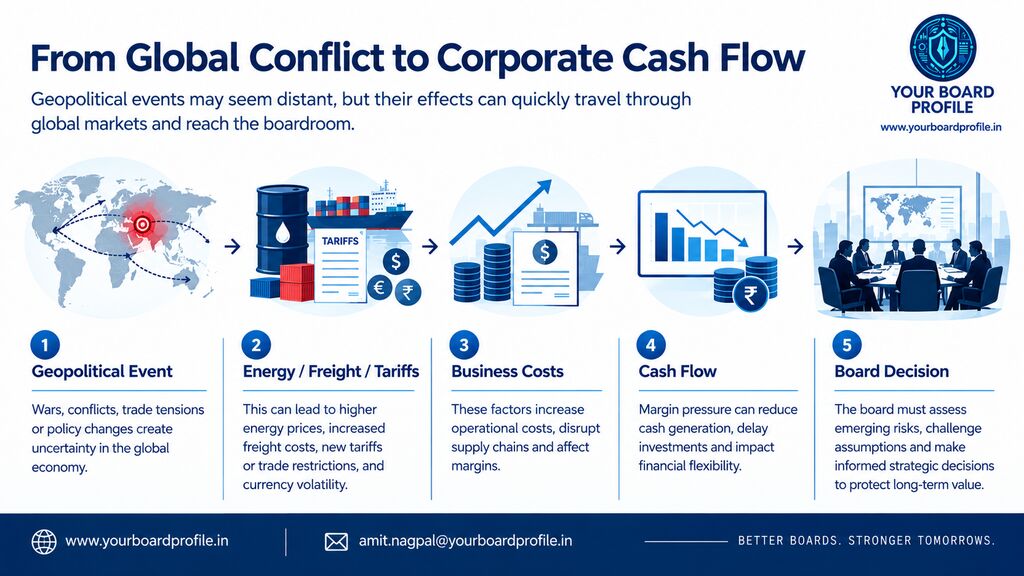
This chain matters because traditional risk discussions can sometimes focus on the event rather than the transmission mechanism. A board may ask, “What happens if the conflict continues?” A more useful question is, “Which part of our operating model becomes vulnerable if the conflict continues for six months?” The answer might involve energy procurement, customer demand, foreign exchange exposure, insurance costs, supplier concentration or access to critical components.
The World Bank’s April 2026 India update illustrates this transmission clearly. It projected India’s FY27 growth at 6.6%, citing higher energy prices and supply-chain disruptions associated with the Middle East conflict as headwinds, while also highlighting India’s macroeconomic buffers and trade diversification efforts.
That is precisely the kind of translation boards should perform: geopolitical event → economic impact → business exposure → strategic response.
The Impact of Wars and Conflicts on Indian Corporates
Geopolitical volatility arising from wars and regional conflicts can quickly move across borders through energy markets, shipping routes, commodity prices and currency movements. Wars and conflicts can affect Indian companies through several channels simultaneously. Energy is one of the most obvious. India remains exposed to international energy markets, so disruptions in major energy-producing or transit regions can influence fuel costs, transportation economics and inflation. The World Bank has specifically highlighted South Asia’s vulnerability to rising energy prices because of its dependence on imported energy.
Geopolitical volatility arising from wars and regional conflicts can quickly affect energy markets, shipping routes, commodity prices, currencies and business confidence.
The second channel is logistics. Maritime disruptions can increase transit times, freight rates and inventory requirements. A company that previously operated with a lean inventory model may suddenly need additional buffer stock. That sounds operational, but it has a direct balance-sheet implication: more inventory means more capital tied up. A board reviewing working capital therefore needs to understand whether an apparently temporary geopolitical shock is changing the economics of the supply chain.
The third channel is demand. Conflict can weaken consumer confidence, investment activity or purchasing power in affected markets. Export-oriented Indian businesses may experience changes in order volumes even when their factories and suppliers remain physically unaffected. The fourth channel is currency and commodity volatility, which can create a mismatch between revenues and costs.
Energy, Logistics and Commodity Shock Transmission
When geopolitical volatility disrupts energy supplies or important trade routes, the resulting cost pressures can reach almost every part of an organization’s operating model. The most effective response is not to attempt to predict every geopolitical event. That is impossible. Instead, boards should understand the company’s exposure to the variables that geopolitical events can move.
| Exposure | Possible Geopolitical Effect | Board-Level Question |
| Energy | Higher oil, gas or electricity costs | How quickly can costs be passed through? |
| Shipping | Longer routes and higher freight costs | What logistics alternatives exist? |
| Raw materials | Commodity price volatility | Which inputs are strategically critical? |
| Currency | Exchange-rate fluctuations | What is our natural hedge? |
| Exports | Tariffs or demand weakness | How diversified are our markets? |
| Technology | Export controls or restrictions | Are critical technologies concentrated geographically? |
| Working capital | Higher inventory requirements | How much liquidity is needed under stress? |
A mature risk management for Indian boards framework therefore connects geopolitical events to financial metrics. The board should know which external variables can materially affect EBITDA, cash flow, debt servicing, capital expenditure and customer commitments.
When geopolitical volatility disrupts energy supplies or important trade routes, the resulting cost pressures can spread across the operating model.
Geopolitical volatility should therefore be integrated into enterprise risk management rather than treated as a separate issue that appears only during a major international crisis.
The Indian government’s own response to geopolitical disruptions reflects this interconnected nature. In July 2026, the Ministry of Ports, Shipping and Waterways said an inter-ministerial group involving commerce, external affairs, shipping, petroleum, RBI, customs and other institutions was reviewing implications for maritime trade and supply chains.
For corporate boards, the lesson is straightforward: geopolitical risk rarely stays inside one department.
Tariff Policies and Their Impact on Indian Industry
Rising geopolitical volatility can also accelerate changes in tariff policies as governments reassess trade relationships, domestic industries and strategic dependencies. Tariffs are often discussed as percentages, but boards should think about them as changes to business economics. A tariff can alter the landed price of a product, reduce export competitiveness, encourage local sourcing, change customer behaviour or make a previously attractive market less attractive. The impact of tariffs on Indian businesses therefore depends on where the tariff is applied, who ultimately absorbs it and how easily the company can adjust its supply chain.
Tariff policies can also create second-order effects. If a major market imposes duties on a product from India, competitors from another country may gain or lose relative competitiveness depending on their own tariff treatment. Companies may reconsider manufacturing locations, sourcing arrangements or distribution networks. Over time, this can influence capital allocation decisions.
Recent Indian trade developments illustrate the complexity. The Department of Commerce has highlighted how free-trade agreements can reduce tariffs and improve market access for Indian exporters, while recent trade arrangements have sought to diversify India’s export opportunities.
Why Tariffs Change More Than Export Prices
A tariff decision can affect at least five strategic questions: where a company manufactures, where it sources, where it sells, how it prices and how it invests. That means a board should not treat tariffs as merely a sales or government-relations issue.
Imagine an Indian manufacturer exporting 40% of its output to one market. A new tariff makes its products more expensive there. Management may propose absorbing part of the tariff to protect market share. Another option may be to raise prices. A third could involve local assembly. A fourth could involve shifting some production to another geography. Each option changes capital requirements, margins, operational complexity and risk.
This is where strategic decision making by the board of directors becomes important. The board’s role is not to choose an operational response without management analysis. Its role is to challenge whether the proposed response is consistent with the company’s risk appetite, capital capacity and long-term strategy.
The WTO’s 2026 World Trade Report describes the global trading system as facing sustained disruption and notes that tariffs, export restrictions and other policy interventions can affect companies beyond their immediate trading relationships because global value chains create deep production interdependence.
Boardroom Governance in Economic Uncertainty
In an environment of persistent geopolitical volatility, boards need to test whether their existing business assumptions remain realistic under different economic and political scenarios. Economic uncertainty tests governance quality because uncertainty makes conventional forecasting less reliable. A management team can produce a detailed five-year forecast, but the board must ask what happens when the assumptions underneath that forecast change. Does the company have sufficient liquidity? Can capital expenditure be staged? Are suppliers sufficiently diversified? Is debt structured appropriately? Can management identify early-warning signals?
This is the essence of corporate governance during economic crisis: maintaining decision quality when visibility is low.
A board should resist two opposite tendencies. The first is complacency, where management assumes that the external shock will disappear quickly. The second is overreaction, where the company abandons strategically important investments because of a temporary disruption. Good governance sits between the two. It creates a disciplined process for distinguishing temporary volatility from structural change.
Moving From Reactive Risk Management to Strategic Resilience
Traditional risk management often asks, “What can go wrong?” Strategic resilience asks, “How quickly can we adapt if something changes?”
That distinction is important. A resilient company does not necessarily have the lowest-cost supply chain. It may have deliberately maintained alternative suppliers, geographic flexibility, liquidity buffers or contractual flexibility. These choices can appear inefficient during stable periods, but their value becomes visible during disruption.
SEBI’s framework for Risk Management Committees has increasingly recognised the importance of structured risk oversight. SEBI’s earlier amendments extended Risk Management Committee requirements to a broader group of listed entities and set out responsibilities around risk management and oversight.
For boards, resilience should therefore be treated as an element of governance rather than simply an operational project.
Supply Chain Diversification in India
For Indian companies, responding to geopolitical volatility increasingly means creating supply-chain alternatives without unnecessarily sacrificing efficiency or competitiveness.
The phrase supply chain diversification India captures one of the most important strategic responses to geopolitical uncertainty. Yet diversification should not mean simply adding more suppliers. The deeper objective is to reduce unacceptable concentration without creating unnecessary cost and complexity.
A company that buys a critical component from five suppliers may still have concentrated risk if all five suppliers depend on the same country for a key raw material. Similarly, a company may have suppliers across several countries but rely on one shipping route. Boards need to examine the supply chain at multiple levels.
The question is not merely, “How many suppliers do we have?” It is “Where are our dependencies?”
Building Optionality Without Destroying Efficiency
Boards should ask management to identify critical dependencies and classify them according to business impact. A useful framework can include:
- Critical components with limited substitutes.
- Suppliers concentrated in one geography.
- Logistics routes vulnerable to disruption.
- Commodities with high price sensitivity.
- Technology or software dependencies subject to export controls.
- Customers concentrated in politically sensitive markets.
The goal is not maximum diversification. Maximum diversification can be expensive and operationally inefficient. The goal is strategic optionality.
The IMF’s analysis of India identifies supply-chain diversification and stronger trade integration as responses to risks arising from trade measures, commodity volatility and geopolitical tensions.
Indian companies can also use expanding trade relationships to build market and sourcing alternatives. The Department of Commerce has highlighted the role of recent FTAs in improving preferential access for Indian exports.
A board that understands this distinction can have a much more sophisticated conversation about resilience: not “Should we diversify?” but “Which dependencies are worth paying to diversify, and which are acceptable risks?”
Risk Management for Indian Boards
Effective enterprise risk management India practices need to connect enterprise-wide risk with strategic decision-making. Geopolitical risk should not sit in a separate presentation that appears once a quarter. It should influence discussions on capital expenditure, M&A, market expansion, financing, technology and procurement.
A useful board dashboard could track a small set of external indicators: commodity prices, freight costs, foreign-exchange exposure, tariff developments, customer concentration, supplier concentration, geopolitical developments affecting critical markets and liquidity headroom.
What Boards Should Ask About External Risks
The quality of a board’s risk oversight often depends on the quality of its questions.
Instead of asking, “Are we protected against geopolitical risk?” the board could ask:
- Which three external developments could most materially affect our strategy?
- Which revenue streams are exposed to tariff changes?
- Which critical inputs depend on one country or one route?
- How many weeks can we operate if a critical supplier is disrupted?
- What happens to cash flow if energy costs rise significantly?
- Which strategic investments become uneconomic under a prolonged shock?
- What assumptions in our current business plan are most vulnerable?
- What are management’s predefined triggers for action?
These questions move the conversation from generic risk language to measurable business exposure.
EY’s 2026 FICCI-EY Risk Survey illustrates why this matters: 64% of surveyed leaders identified geopolitical tensions as a material driver of outcomes, alongside economic slowdown/disruption and prolonged inflation/volatility.
The board’s responsibility is not to eliminate uncertainty. It is to ensure the organisation is capable of making informed decisions despite uncertainty.
Strategic Decision Making by the Board of Directors
When uncertainty is high, boards should avoid pretending that one forecast represents the future. Scenario planning provides a more useful approach. Management can construct several plausible situations and test the company’s financial and strategic resilience against each.
Strategic decision-making becomes more complex when geopolitical volatility can change market access, input costs, customer demand and investment assumptions within a relatively short period.
For example, a board might examine a base case, a prolonged trade-disruption case and a severe geopolitical-shock case. Each scenario could include assumptions for energy costs, tariffs, demand, exchange rates, freight, inventory and capital availability.
Scenario Planning for Multiple Geopolitical Outcomes
The value of scenario planning is not prediction. It is preparedness.
Scenario planning allows boards to examine how different levels of geopolitical volatility could affect revenue, margins, liquidity, capital expenditure and strategic priorities.
A board could ask:
| Scenario | Management Assumption | Board Focus |
| Base case | Trade and logistics remain broadly stable | Execute strategic plan |
| Moderate disruption | Tariffs or freight costs rise | Protect margins and liquidity |
| Prolonged disruption | Supply routes remain constrained | Reconfigure sourcing |
| Severe shock | Energy, trade and demand deteriorate simultaneously | Preserve liquidity and strategic options |
This approach also improves board-management dialogue. Instead of debating whether a particular geopolitical outcome will happen, directors can ask what the organisation should do if it happens.
That is a more productive use of board time because navigating geopolitical uncertainty business conditions requires decisions under imperfect information.
The IMF and World Bank assessments both underline the importance of diversification and resilience as global trade and conflict-related uncertainty evolve.
Corporate Governance During an Economic Crisis
During periods of stress, governance can either become stronger or weaker. Strong governance creates clarity around decision rights, risk appetite, disclosures, liquidity and stakeholder communication. Weak governance can produce rushed decisions, unclear accountability and excessive concentration of authority.
The board should pay particular attention to the quality of information reaching it. If geopolitical developments are changing rapidly, quarterly reporting may not be enough for certain critical exposures. Management may need to establish escalation thresholds for material changes.
For listed companies, this also intersects with disclosure responsibilities. The OECD’s 2025 India corporate governance profile notes SEBI’s framework around material-event disclosures and risk-management requirements for listed entities.
The Role of Independent Directors
Independent directors can play an important role because they bring challenge and external perspective to decisions made under pressure. Their contribution is not simply to disagree with management. It is to test assumptions, ask whether alternatives have been evaluated and ensure that short-term responses do not unintentionally weaken long-term governance.
During periods of heightened geopolitical volatility, independent directors can add value by challenging assumptions and asking whether management has considered credible alternatives.
This makes independent director role governance shift increasingly relevant. In a volatile environment, independence is valuable when directors can distinguish between management confidence and evidence, between temporary pressure and structural change, and between acceptable risk and poorly understood exposure.
For executives preparing for board roles, this is also a reminder that board readiness requires more than functional expertise. Directors need to understand financial consequences, governance responsibilities, risk frameworks and the language of strategic decision-making.
Board Resilience Against Geopolitical Shocks
Board resilience geopolitical shocks is ultimately about the quality of the decision architecture. A resilient board does not need to know exactly what the next geopolitical crisis will look like. It needs the right information, the right questions, the right committee structures and the discipline to revisit assumptions.
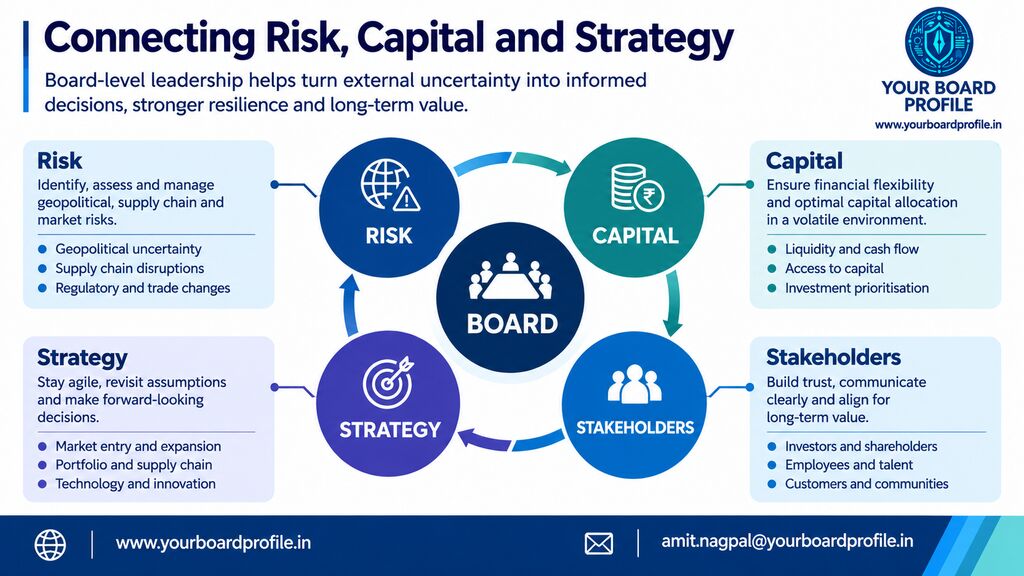
The board should be able to connect four dimensions:
Risk → Capital → Strategy → Stakeholders
If geopolitical volatility raises supply-chain risk, capital allocation may need to change. If capital allocation changes, strategic priorities may change. If strategic priorities change, stakeholders need a clear explanation.
Connecting Risk, Capital and Strategy
This is where board-level leadership becomes particularly important. A company might decide to build a second manufacturing facility in another geography. The investment could reduce supply-chain concentration, but it could also lower short-term returns. The board needs to understand both sides.
Building resilience against geopolitical volatility is ultimately about ensuring that the organisation can adapt without compromising its long-term strategic direction.
Similarly, maintaining higher inventory may reduce disruption risk but increase working capital. Hedging currency exposure may reduce volatility but involve costs. Entering a new export market may reduce dependence on one geography but require significant investment.
There is rarely a perfect answer.
The board’s responsibility is to ensure that these trade-offs are explicit, quantified and aligned with the organisation’s risk appetite.
For professionals aspiring to board positions, this is also where a strong board value proposition matters. Directors are increasingly expected to contribute more than domain knowledge. They need to demonstrate how their experience can help organisations interpret uncertainty, challenge assumptions and create long-term value. A well-developed board value proposition and board bio can help articulate that contribution.
The Future of Board Leadership in a Volatile World
The board of the future will operate in an environment where geopolitical, technological, economic and regulatory risks increasingly overlap. A tariff decision may influence supply chains. A conflict may influence energy prices. An energy shock may influence inflation. Inflation may influence interest rates and consumer demand. Technology restrictions may influence manufacturing strategy.
The boundaries between risk categories are becoming less meaningful.
This is why board directors need a broader strategic lens. They do not need to predict geopolitics. They need to understand how geopolitical volatility can travel through the enterprise.
Technology adds another layer. AI is becoming part of governance, decision-making and risk management, which makes AI accountability in board governance increasingly relevant. Boards need confidence that technology-driven decisions are supported by appropriate accountability, controls and oversight.
At the same time, directors need a credible professional narrative. Functional excellence remains important, but board opportunities increasingly depend on whether a professional can communicate their relevance to governance, strategy and stakeholder value. Senior professionals exploring this transition can review board-focused services and readiness support and explore further boardroom and governance insights.
The boardroom is therefore moving from a model of periodic oversight toward continuous strategic sensing.
The central question is no longer simply, “What is our strategy?”
It is:
“How resilient is our strategy when the assumptions around us change?”
That is a fundamentally different governance question.
Conclusion
Geopolitical volatility has moved closer to the centre of corporate strategy. Wars, conflicts, tariffs, trade restrictions, commodity shocks and supply-chain disruptions can affect Indian businesses through revenue, costs, liquidity, capital expenditure and stakeholder expectations. Current international assessments underline that trade tensions and geopolitical disruptions are creating a more uncertain environment, while India’s domestic demand, macroeconomic buffers and diversification efforts provide important resilience.
As geopolitical volatility becomes a more persistent feature of the global business environment, Indian boards will need to place resilience alongside growth, profitability and governance on the strategic agenda.
For boards, the response should not be fear-driven decision-making. It should be better governance.
That means asking better questions, challenging assumptions, testing scenarios, understanding critical dependencies and ensuring that management has sufficient flexibility to respond. It means connecting risk management with capital allocation rather than treating risk as a separate compliance exercise.
For senior executives and aspiring directors, the lesson is equally important. Board-level value increasingly comes from the ability to interpret complexity and convert uncertainty into informed strategic choices.
The strongest boardroom conversations may not begin with certainty.
They begin with the right questions.
Frequently Asked Questions
1. What is geopolitical volatility in a business context?
Geopolitical volatility refers to uncertainty created by international conflicts, diplomatic tensions, trade restrictions, tariffs, sanctions, political instability and changes in relationships between countries. For businesses, its significance comes from the way these developments can affect markets, supply chains, commodity prices, currencies, regulations and investment decisions.
2. Why is geopolitical volatility important for Indian corporate boards?
Indian companies can be exposed to global energy markets, international customers, imported inputs, foreign currencies, logistics networks and global technology ecosystems. A geopolitical event can therefore influence financial performance even when the company has no direct operations in the affected country.
3. How do wars affect Indian businesses?
Wars can affect Indian businesses through energy prices, shipping disruptions, commodity prices, foreign exchange, insurance costs and changes in customer demand. The impact differs by industry and by the company’s geographic exposure, sourcing model and financial structure.
4. What is the impact of tariffs on Indian businesses?
Tariffs can increase the landed cost of exports, reduce price competitiveness, change customer behaviour and influence where companies manufacture or source products. Their effect depends on the tariff rate, product category, market structure, contractual arrangements and the company’s ability to pass costs to customers.
5. How should boards respond to tariff uncertainty?
Boards should ask management to assess multiple scenarios rather than rely on a single forecast. Key areas include export-market concentration, pricing flexibility, alternative sourcing, manufacturing locations, margin sensitivity, capital requirements and potential changes in customer demand.
6. What does supply chain diversification mean for Indian companies?
Supply-chain diversification means reducing excessive dependence on a single supplier, country, route, commodity or technology ecosystem. It does not necessarily mean using the maximum possible number of suppliers. The objective is to create sufficient strategic alternatives for critical dependencies.
7. What role does the Risk Management Committee play?
For applicable listed entities, the Risk Management Committee provides structured oversight of enterprise risks and risk-management processes. Its role can help ensure that material external risks are identified, monitored and communicated to the board.
8. Should boards predict geopolitical events?
Boards do not need to predict geopolitical events with certainty. A more useful approach is scenario planning: identifying plausible developments, understanding their business consequences and establishing triggers for management action.
9. How can boards manage economic uncertainty?
Boards can improve resilience by monitoring key external indicators, testing business assumptions, maintaining appropriate liquidity, reviewing concentration risks and ensuring that major strategic decisions are evaluated under multiple scenarios.
10. Why are independent directors important during geopolitical uncertainty?
Independent directors can provide challenge and an external perspective when management is making decisions under pressure. Their role includes testing assumptions, examining alternatives and ensuring that short-term responses remain consistent with governance responsibilities and long-term strategy.
11. What is enterprise risk management in India?
Enterprise risk management is a structured approach to identifying, assessing, monitoring and responding to risks across the organisation. For Indian businesses, this can include financial, operational, strategic, cyber, regulatory, supply-chain and geopolitical risks.
12. How can companies prepare for supply-chain disruptions?
Companies can map critical dependencies, identify alternative suppliers and logistics routes, assess inventory requirements and establish contingency plans. Boards should understand which dependencies could materially affect revenue, production or liquidity.
13. How does geopolitical volatility affect board-level decision-making?
It can change assumptions behind capital allocation, market expansion, acquisitions, procurement, financing and technology strategy. Boards therefore need to integrate geopolitical considerations into broader strategic decision-making rather than treating them as a standalone risk topic.
14. What skills should aspiring board directors develop?
Aspiring directors should develop governance knowledge, financial literacy, strategic thinking, risk oversight, stakeholder understanding and the ability to ask effective boardroom questions. The ability to connect external developments with enterprise-level consequences is becoming increasingly valuable.
15. How can senior executives prepare for board-level roles in a volatile environment?
Senior executives can build board readiness by translating their functional experience into governance and strategic value. Developing a clear board narrative, understanding board responsibilities, strengthening financial and risk knowledge and communicating a distinctive board value proposition can help demonstrate readiness for board-level responsibilities.
Ready to Strengthen Your Boardroom Readiness in an Era of Geopolitical Volatility?
Your professional experience can become meaningful boardroom value when it is supported by the ability to understand geopolitical volatility, assess risks, think strategically, challenge assumptions, make informed decisions, and provide effective board-level oversight.
In an environment shaped by geopolitical volatility, economic uncertainty, tariff changes, supply-chain disruptions, and global conflicts, boards need more than conventional business expertise. They need directors who can connect external developments with enterprise risk, capital allocation, business resilience, and long-term strategy.
Whether you are a CXO, senior executive, entrepreneur, or aspiring Independent Director, take the time to strengthen your strategic thinking, risk oversight, governance understanding, decision-making, and boardroom communication.
Don’t wait for a major disruption to test your boardroom capabilities. Build your readiness to navigate geopolitical volatility today and learn how to translate your professional experience into credible, strategic, and governance-focused boardroom value.
Schedule your complimentary session here:
https://calendly.com/dramitnagpal
Share this post: Facebook | X | LinkedIn