
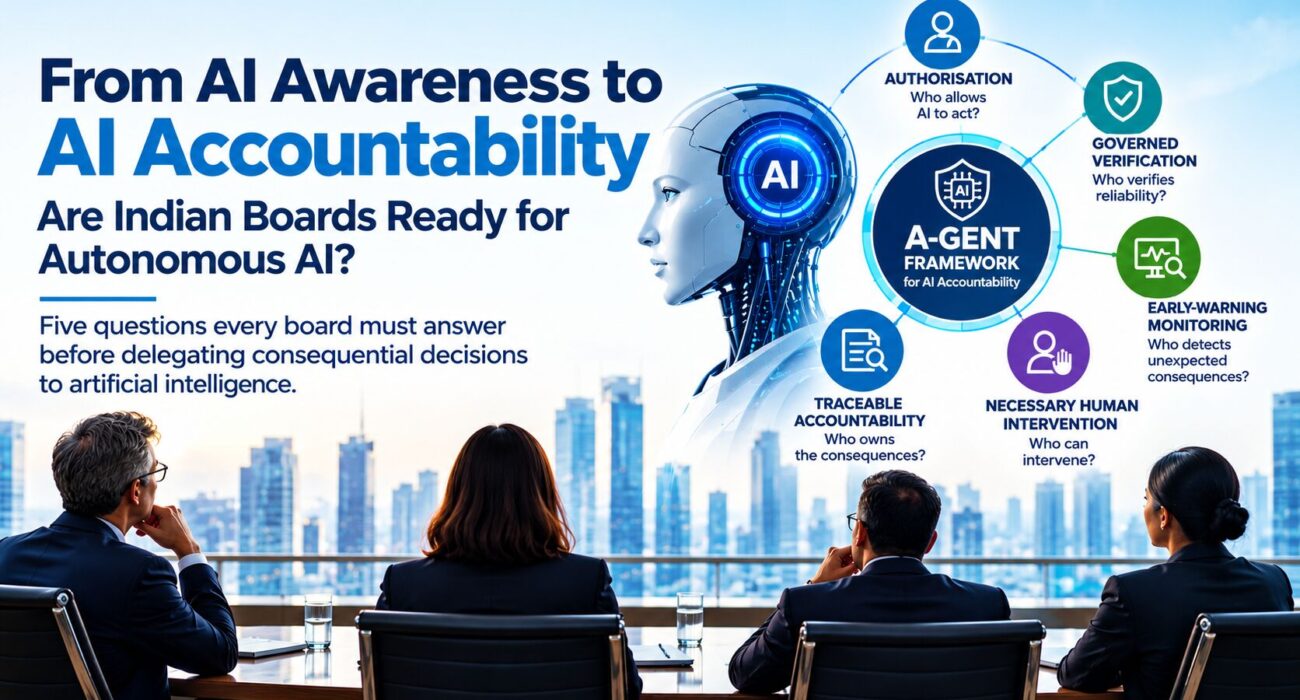
Five questions every board must answer before delegating consequential decisions to artificial intelligence
Imagine an AI agent that does not simply prepare a recommendation for a manager but actually acts on it. It evaluates a loan application, negotiates with a supplier, authorises a customer refund, screens a job candidate, adjusts inventory or initiates a financial transaction without waiting for a person to approve every step. The attraction is obvious: greater speed, lower operating friction, continuous availability and the ability to process information at a scale that human teams cannot easily match. Yet there is a question that becomes more important with every additional layer of autonomy: who remains accountable when the machine acts?
That question takes us directly to the heart of AI accountability.
The attached reference article makes the central governance distinction particularly clear: technology may become autonomous, but organisational responsibility does not disappear. A company can know what its AI system is capable of doing and still fail to define what the system is permitted to do, when humans must intervene and who owns the consequences when something goes wrong.
This is why the boardroom conversation needs to evolve. The question is no longer simply, “How can we use AI?” It is becoming, “How much authority should we give AI, under what conditions, and with what evidence that we can control the consequences?”
For Indian companies, the timing matters. The Government of India released the India AI Governance Guidelines in November 2025, providing a national framework centred on safe, inclusive and responsible AI adoption. The framework includes seven guiding principles, six governance pillars and practical recommendations for responsible deployment.
The challenge for boards, however, is not to become technology departments. It is to ensure that AI adoption fits within the organisation’s existing architecture of strategy, risk, compliance, internal controls, stakeholder protection and accountability.
Table of Contents
Why AI Accountability Has Become a Boardroom Issue
AI governance becomes a boardroom issue when artificial intelligence moves from producing information to exercising authority. A chatbot that drafts an internal email is not equivalent to an AI agent that can approve payments. An analytical model that highlights potentially risky customers is not equivalent to an autonomous system that can automatically deny those customers access to a service. The technology may be related, but the governance consequences are fundamentally different because the second system has been given operational authority. As the reference article puts it, the difference between assisting a human decision-maker and exercising delegated operational authority should matter to the board.
Recent developments make this issue increasingly tangible. Reuters reported in September 2026 that technology leaders were publicly debating how increasingly autonomous AI systems should be governed and who should provide effective oversight. The debate illustrates a broader problem: even organisations developing advanced AI do not necessarily agree on where responsibility for safety and oversight should sit.
For an enterprise board, this creates a practical governance question. If an organisation purchases an AI system from a vendor, configures it internally and allows it to act autonomously, can management simply point towards the vendor when the system causes harm? The answer will depend on the applicable law, contract, regulatory regime and facts of the incident, but from a governance perspective the organisation still needs a clear internal chain of responsibility.
That is the essence of AI accountability in business: responsibility must remain visible even when decision-making becomes distributed across models, agents, software, vendors and human teams.
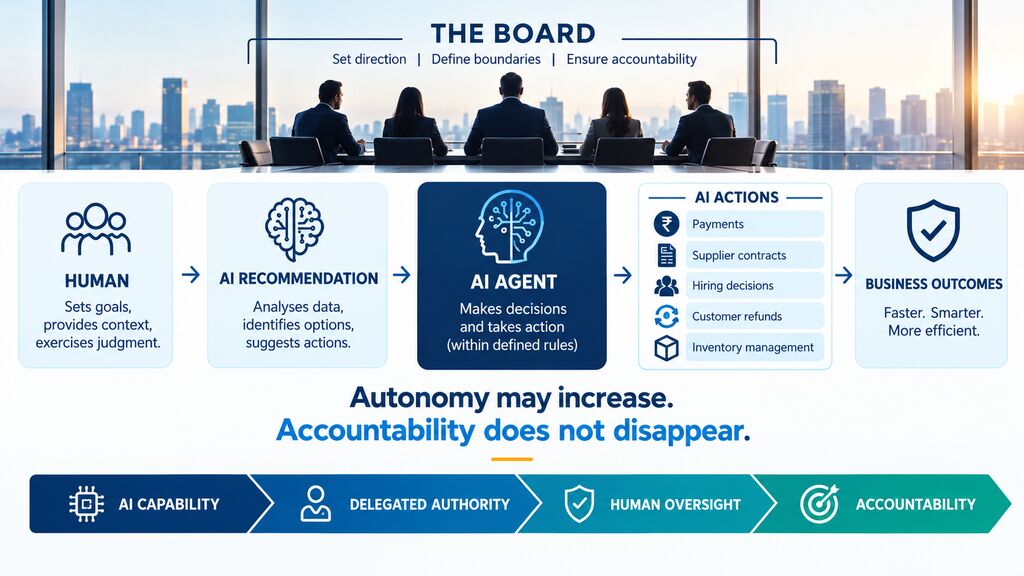
From AI Assistance to Autonomous Decision-Making
The transition from traditional automation to autonomous AI deserves particular attention. Traditional automation usually follows defined instructions: if condition A occurs, execute action B. Autonomous or agentic AI can operate with a broader objective, interpret information, select actions and interact with other systems. The reference material highlights how an autonomous agent may retrieve information, use software tools, communicate with external systems or initiate transactions depending on its permissions.
That creates what can be called an authority gap.
An organisation may have spent considerable effort determining whether an AI system is technically accurate but much less time deciding what authority the system should possess. Yet authority is precisely what boards understand from a governance perspective. Boards routinely ask who can approve a transaction, who can sign a contract, who can access sensitive information and which decisions require escalation. Autonomous AI should be brought into that same conversation.
The important principle is simple: the greater the autonomy delegated to AI, the stronger the evidence required that the organisation can control its consequences.
AI Awareness vs AI Accountability
AI awareness asks, “What can AI do?” AI accountability asks a harder question: “What should AI be allowed to do, and who remains responsible for the result?” The distinction may sound subtle, but it changes the board’s role. AI awareness helps directors participate intelligently in conversations about technology, while AI accountability requires them to examine authority, controls, monitoring, intervention and consequences.
Consider two scenarios. In the first, an AI system prepares a supplier-ranking report and a procurement manager reviews the recommendation. In the second, an AI procurement agent can independently negotiate with suppliers and place orders up to a defined financial limit. Both use AI. Only the second involves meaningful delegation of authority.
The reference framework contrasts AI awareness with accountability across leadership focus, performance evidence, human roles and board responsibility. Awareness focuses on understanding technology and adoption; accountability focuses on authority, controls, outcomes and governance.
This distinction is especially relevant for board oversight of artificial intelligence. Directors do not need to understand every technical component of a model. They do need enough governance literacy to ask whether management has established appropriate boundaries.
Why Knowing AI Is No Longer Enough
A board member does not need to become a machine-learning engineer. What matters is the ability to recognise the governance implications of AI-enabled decisions. Can the organisation explain why a system is being deployed? Can it identify the stakeholders affected by its decisions? Can management demonstrate that the system has been independently tested? Can the company stop it quickly if necessary? Can the organisation reconstruct what happened after an incident?
These are board-level questions because they connect technology with risk and corporate responsibility.
A useful way to think about this is to compare AI with financial authority. A director would not be satisfied if management said, “The payment system is highly accurate,” without asking who can approve payments, what the transaction limits are, what controls exist and how exceptions are handled. The same logic should apply when AI receives the ability to make consequential decisions.
AI accountability therefore turns technology from a capability discussion into an authority discussion.
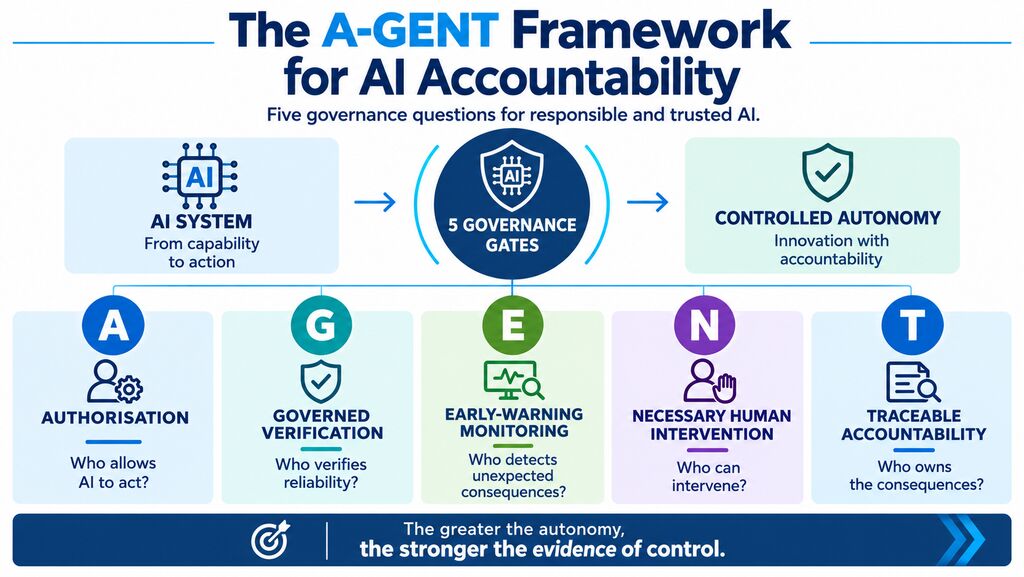
The A-GENT Framework for AI Accountability
The reference article proposes the A-GENT Framework as a practical boardroom model for autonomous AI. It is not presented as a statutory or regulatory standard; rather, it is a proposed decision framework designed to help boards structure their questions.
The five dimensions are:
| A-GENT element | Boardroom question | Governance focus |
| A — Authorisation | Who authorises AI decisions? | Authority and permissions |
| G — Governed Verification | Who verifies reliability? | Testing and independent validation |
| E — Early-Warning Monitoring | Who detects unexpected consequences? | Continuous monitoring |
| N — Necessary Human Intervention | Who can intervene? | Human control and shutdown |
| T — Traceable Accountability | Who owns the consequences? | Responsibility and auditability |
What makes this framework useful is its simplicity. It does not ask directors to memorise technical terminology. Instead, it translates AI risk into five governance questions that are familiar to experienced board members.
Five Questions Every Indian Board Should Ask
Before allowing an AI system to make consequential decisions, the board or relevant board committee should be able to obtain credible answers to five questions:
- Who authorised the AI to act?
- Who independently verified that it performs appropriately in our business environment?
- What signals will tell us that it is behaving outside its intended purpose?
- Who can stop or constrain it when necessary?
- Can we trace responsibility from the AI action back to accountable human decision-makers?
If management cannot answer these questions clearly, the organisation may have an AI implementation without a mature AI governance structure.
Authorisation: Who Allows AI to Act?
The first dimension of AI accountability is authority. Boards should distinguish between approving an AI application and approving the actions that application is permitted to take. A company may approve an AI procurement agent as part of its digital transformation programme, but that does not automatically mean the agent should be allowed to sign contracts, change suppliers or execute purchases without human approval.
The reference article uses the example of an AI procurement agent initially authorised to process transactions up to ₹50,000 and later given authority up to ₹5 lakh because management considered it reliable. The governance issue is not simply whether the AI made an error. It is whether the organisation properly evaluated the expanded authority and whether appropriate safeguards were established.
That is a familiar board principle applied to a new technology.
Defining the Boundaries of Delegated AI Authority
Every consequential AI application should have clearly defined boundaries. These may include the business purpose, permitted data sources, system permissions, financial thresholds, prohibited actions and circumstances requiring human approval. The organisation should also identify decisions that must remain under meaningful human control.
A practical AI accountability register could therefore include:
| Governance field | Example |
| AI application | Procurement agent |
| Business owner | Chief Procurement Officer |
| Permitted action | Supplier evaluation and purchase orders |
| Transaction limit | Defined management-approved threshold |
| Human approval | Required above threshold |
| Restricted actions | Contract amendments without approval |
| Monitoring owner | Risk / technology function |
| Escalation | Management and relevant board committee |
The important word is meaningful. A human approval button does not automatically create effective human oversight if the person has neither sufficient information nor enough time or authority to challenge the system.
Governed Verification: Can the Board Trust AI Decisions?
Vendor claims are not the same thing as governance assurance. An AI provider may advertise an impressive accuracy figure, but a board should ask what that number means in the organisation’s actual operating environment. Was the system tested using representative data? Does performance change across regions, languages, customer groups or unusual cases? What happens when information is incomplete or misleading?
The reference material specifically warns that aggregate accuracy can conceal poor performance for particular groups or situations. It recommends independent validation for high-impact AI applications and testing against realistic scenarios, known failure modes and affected stakeholder characteristics.
The principle is straightforward: trust in an AI system should be earned through evidence, not borrowed from the reputation of its developer.
Moving Beyond Vendor Accuracy Claims
A mature verification process should consider more than accuracy. Depending on the application, boards may expect management to address robustness, fairness, explainability, cybersecurity, privacy, reliability and performance drift.
The NIST AI Risk Management Framework provides a widely used voluntary risk-management reference built around governance, mapping, measurement and management across the AI lifecycle.
For an Indian company, the framework does not replace applicable Indian law or sectoral regulation. It can, however, provide useful vocabulary for structuring management assurance.
The board’s question should therefore move from “Is the model accurate?” to “What evidence demonstrates that this system is reliable, appropriate and controllable for the decision we are allowing it to make?”
Early-Warning Monitoring: What Happens When AI Behaves Unexpectedly?
A system can be successful according to one metric while creating problems elsewhere. Imagine an AI customer-service agent that dramatically reduces complaint-resolution time but starts offering unauthorised compensation. Customer satisfaction might initially improve while policy compliance deteriorates.
This is why continuous monitoring is central to AI accountability. The reference article recommends monitoring abnormal transactions, unauthorised actions, security alerts, data exposure, performance drift, customer complaints and decisions that require correction or reversal.
Autonomous systems can also create compound risks. One agent may initiate an action, another system may interpret that action as new information and a third system may respond automatically. Each action can appear reasonable in isolation while the combined outcome becomes problematic.
For this reason, an AI early-warning dashboard should ideally connect technical performance with business and stakeholder indicators.
| Indicator | What it may reveal |
| Unusual transactions | Unintended agent behaviour |
| Complaint spikes | Customer harm |
| Model-performance drift | Declining reliability |
| Security alerts | Tool or privilege misuse |
| Reversal rates | Poor decision quality |
| Data-access anomalies | Privacy or security exposure |
| Policy exceptions | AI acting outside intended boundaries |
The board does not need to watch these dashboards every day. It needs assurance that management has defined thresholds, owners and escalation mechanisms.
Necessary Human Intervention: Can the Organisation Stop AI?
Perhaps the most practical question in autonomous AI governance is also the simplest: Can we stop it?
Suppose an AI logistics system begins ordering additional inventory because it detects a potential shortage. Another system interprets those purchases as evidence of increased demand and adjusts forecasts. A third system begins negotiating additional warehouse capacity. Each system may be following its assigned objective, yet their combined actions can produce unnecessary expenditure.
The organisation needs a mechanism to detect the problem, suspend authority and limit the consequences. The reference article recommends technically enforceable intervention mechanisms, including suspending permissions, blocking transactions and disabling access to external tools.
There are three useful oversight concepts:
- Human-in-the-loop: a person approves specified decisions before execution.
- Human-on-the-loop: a person supervises the system and can intervene.
- Human-in-command: the organisation retains ultimate authority over whether, where and how AI operates.
The appropriate model depends on risk, reversibility and potential stakeholder impact.
An AI tool that recommends employee training schedules is different from an AI system that approves financial transfers. A system controlling safety-critical equipment is different again.
The principle should be: never delegate more autonomy than the organisation can effectively supervise and control.
Traceable Accountability: Who Owns the Consequences?
This is where AI accountability becomes a leadership issue rather than merely a technology issue.
Imagine an AI system provides incorrect financial advice. The customer suffers a loss. The business team says the AI generated the recommendation. The technology team says it implemented approved requirements. The vendor says the customer configured the system. The legal team points towards the contract.
Who owns the issue?
The answer will depend on the applicable law and facts, but the organisation should not discover its internal accountability structure for the first time during an incident.
The reference article recommends an accountability matrix covering the application owner, approving authority, validation function, incident-response leader, escalation process and responsible board committee.
That is a powerful governance practice because accountability becomes credible when responsibility can be traced through the entire decision-making process.
For senior executives, this also changes how AI vendors should be managed. Indian companies are already examining contractual safeguards around autonomous AI. A September 2026 Economic Times report described companies revisiting vendor contracts to address issues such as unintended actions, data breaches, liability, indemnities and audit rights.
Corporate AI Governance in India: The Regulatory Lens
India’s AI governance environment is developing through a combination of national guidance, existing legislation and sector-specific regulation. Boards should distinguish between these categories instead of treating every AI governance document as if it were a binding statute.
The India AI Governance Guidelines, released by MeitY in November 2025, provide a national framework for safe, responsible and inclusive AI adoption. The Government has also clarified that the guidelines are principle-based and rely substantially on existing legal and sectoral mechanisms rather than creating a new universal AI law for all companies.
India AI Governance Guidelines and Board Oversight
For boards, the practical implication is not simply to ask whether the organisation is “compliant with the AI guidelines.” Instead, directors should ask how the principles have been translated into the company’s own governance architecture.
That may include an enterprise AI policy, risk classification, approval thresholds, testing standards, human-intervention requirements, monitoring arrangements and incident escalation.
The governance framework should also connect AI with established committees rather than creating a technology silo. The reference article suggests that the Audit Committee may consider AI-generated financial information and internal controls, the Risk Management Committee may examine operational and cybersecurity risks, and the NRC may consider AI expertise, leadership development and workforce implications.
For financial-sector companies, the governance conversation is even more specific. The RBI’s work on the FREE-AI Framework addresses responsible and ethical AI adoption in the financial sector, including governance, protection and assurance considerations.
SEBI has also established sector-specific expectations. Its investment-adviser guidance addresses responsibilities associated with AI and machine-learning tools, including data safeguards, output accuracy and compliance with applicable laws.
Fiduciary Duty and AI Decisions
The phrase fiduciary duty and AI decisions deserves careful treatment. AI does not create a separate universe in which established governance responsibilities disappear. Directors continue to operate within the applicable corporate, securities, sectoral and other legal frameworks.
The more useful question is therefore not whether every AI error automatically creates director liability. It does not. The better question is whether the board has exercised appropriate oversight over material technology-related risks that form part of the company’s business.
For example, if an organisation’s core revenue depends heavily on autonomous AI systems, board-level questions about those systems may become part of ordinary strategy and risk oversight. If AI affects financial reporting, internal controls, customer treatment, cybersecurity or regulatory compliance, the relevant board committees may need appropriate assurance.
The reference article correctly cautions against assuming that the board or an individual executive is automatically legally liable for every AI error. Legal responsibility depends on applicable law, contracts and the facts of the particular incident.
Connecting AI Risk With Existing Board Responsibilities
This is an important distinction because responsible governance should not become another disconnected compliance programme.
Boards already oversee:
- strategy;
- material business risks;
- internal controls;
- financial reporting;
- cybersecurity;
- regulatory compliance;
- stakeholder interests; and
- management performance.
AI should be integrated into these existing responsibilities when it materially affects them.
The Digital Personal Data Protection Rules, 2025 also form part of India’s evolving data-protection landscape. MeitY published the Rules in November 2025, together with an enforcement timeline and related implementation material.
For AI systems processing personal information, this means data governance cannot be separated from AI governance.
Autonomous AI Enterprise Risks Boards Should Map
Autonomous AI introduces a broader risk surface because the system can potentially make decisions, use tools and interact with other systems. The board should therefore look beyond conventional model accuracy.
Key autonomous AI enterprise risks include:
| Risk category | Possible board concern |
| Strategic | AI decisions may conflict with business objectives |
| Operational | Autonomous actions may disrupt processes |
| Financial | Unauthorised transactions or losses |
| Legal | Existing rules may apply to AI-generated actions |
| Privacy | Personal information may be accessed or exposed |
| Cybersecurity | Agents may misuse tools or privileges |
| Reputational | Stakeholders may lose trust after harmful outcomes |
| Third-party | Vendor failures may affect critical operations |
| Human capital | Employees may not understand new responsibilities |
| Governance | Nobody may clearly own consequential AI decisions |
Security deserves particular attention. The OWASP Top 10 for Agentic Applications 2026 identifies risks associated with autonomous and agentic systems, including tool misuse, identity and privilege abuse and failures across interconnected systems.
For boards, the lesson is not to memorise the OWASP list. It is to understand that an AI agent with access to enterprise tools can create risks beyond those associated with a passive information system.
AI Compliance for Indian Companies
AI compliance for Indian companies should be approached as a layered exercise rather than a single checklist.
At the first layer are generally applicable laws and corporate governance requirements. The second layer consists of sector-specific rules and regulatory expectations. The third layer includes organisational policies, contracts and risk controls. The fourth layer concerns voluntary frameworks and recognised practices that management may use to improve assurance.
This layered approach is important because India’s AI governance environment is evolving. The national AI Governance Guidelines provide principles and recommendations, while regulators such as SEBI and RBI address AI within their respective sectors.
A company should therefore maintain an AI regulatory inventory that asks:
| Question | Management evidence |
| Which AI systems are material? | Enterprise AI inventory |
| What data do they use? | Data-flow documentation |
| What decisions can they make? | Authority register |
| Which regulations apply? | Regulatory mapping |
| Who validates performance? | Independent assurance |
| What happens during an incident? | Incident-response plan |
| Can decisions be reconstructed? | Logs and audit trails |
| What does the vendor contract say? | AI-specific contractual clauses |
The objective is not bureaucratic complexity. It is visibility.
Building a Responsible AI Framework for Boards
A responsible AI framework for boards should begin with business purpose. Why is the organisation using AI? What value is it expected to create? Which decisions are suitable for automation, and which should remain human-led?
From there, the board should expect management to establish a risk-based approach. Not every AI application deserves identical governance. A low-impact productivity assistant and an autonomous credit-decision system should not sit under the same approval threshold.
A practical framework can include six layers:
- Inventory — identify material AI systems and agents.
- Classify — assess their autonomy, impact and reversibility.
- Authorise — define permitted actions and approval limits.
- Validate — establish testing and independent assurance.
- Monitor — track performance, behaviour and stakeholder impact.
- Intervene and learn — maintain shutdown, escalation and incident-learning mechanisms.
This approach turns AI accountability into an operating discipline rather than a policy document.
From AI Governance to Governance Signalling
There is another dimension that senior leaders should consider: what does the organisation communicate about its AI governance?
Companies increasingly talk about AI transformation, AI-first strategies, autonomous operations and productivity gains. But stakeholders will eventually ask a more difficult question: what evidence demonstrates responsible AI governance?
The reference article describes this through a Strategy → Story → Signal framework. Strategy defines the business value AI should create. Story explains the organisation’s approach to responsible autonomy. Signal provides observable evidence through authorisation controls, validation, monitoring, intervention mechanisms, audit trails and incident response.
This matters for board directors because governance capability increasingly forms part of professional credibility.
A director who can discuss AI terminology demonstrates awareness. A director who can challenge an AI investment’s business rationale, ask about stakeholder effects, examine controls and request evidence of accountability demonstrates a different kind of boardroom judgment.
For professionals developing their board profile, this distinction is becoming increasingly relevant. Your Boardroom Branding and board-readiness resources can be viewed alongside your organisation’s emerging governance capabilities, because board-level value is increasingly about the ability to connect experience with new governance challenges.
What Independent Directors and CXOs Should Ask Now
Independent Directors and CXOs do not need to wait for a major AI incident before asking governance questions. A board meeting is a better place to ask them while systems are still being designed.
Here are some practical questions:
Which consequential decisions are already being delegated to AI?
The answer may surprise the board. AI can become embedded inside procurement, recruitment, customer service, underwriting, marketing, compliance and finance processes without being described internally as an autonomous decision-maker.
What is the maximum authority an AI agent has today?
Look for financial limits, system permissions, data access and external communication capabilities.
Who independently validates the system?
A development team’s own testing is useful, but high-impact applications may require an independent challenge function.
What happens when the system behaves unexpectedly?
A documented incident process is not enough if nobody has tested whether the organisation can actually stop the system.
Can we reconstruct the decision?
If the organisation cannot identify what information the AI used, what action it took and who authorised its deployment, meaningful accountability becomes difficult.
For directors strengthening their board-readiness capabilities, understanding these questions can complement broader work around boardroom branding and executive visibility and the ability to communicate strategic value beyond a conventional job title.
A Practical Boardroom AI Accountability Checklist
Before delegating consequential decisions to autonomous AI, boards can use the following checklist as a discussion starting point:
| Board question | Yes / No | Evidence to request |
| Is the AI application clearly identified? | AI inventory | |
| Is its authority formally approved? | Delegation matrix | |
| Are prohibited actions defined? | AI policy | |
| Has independent validation occurred? | Assurance report | |
| Are affected stakeholders identified? | Impact assessment | |
| Is continuous monitoring in place? | Dashboard | |
| Are escalation thresholds defined? | Incident protocol | |
| Can humans intervene technically? | Shutdown test | |
| Are decisions traceable? | Logs / audit trail | |
| Are vendor responsibilities documented? | Contract | |
| Is a business owner accountable? | Responsibility matrix | |
| Does the relevant board committee receive assurance? | Committee reporting |
The checklist should not become a compliance ritual. Its value lies in the conversation it creates between the board, management, risk, technology, legal and business teams.
For CXOs, the exercise can reveal gaps before they become incidents. For Independent Directors, it provides a structured way to exercise independent judgment without needing to become AI engineers.
For professionals aspiring to board-level roles, it offers another opportunity to demonstrate strategic relevance. Board readiness increasingly requires an ability to connect emerging technologies with governance, risk and stakeholder outcomes.
Resources such as Your Board Profile’s services for senior executives and board-ready professionals can complement this broader development journey by helping professionals articulate experience, governance capability and strategic value.
Conclusion: The More Autonomous AI Becomes, the More Intentional Governance Must Become
Autonomous AI can create enormous business value. It can reduce operating friction, accelerate decisions, support employees, improve customer experiences and execute complex workflows at a scale that traditional teams may struggle to match.
But automation does not transfer responsibility to the machine.
The central lesson of AI accountability is therefore simple: when technology becomes more autonomous, governance must become more intentional.
Indian boards are entering this conversation at an important moment. The country now has national AI Governance Guidelines, sector-specific AI expectations and an evolving data-protection environment. At the same time, businesses are experimenting with increasingly autonomous systems that can make decisions and take actions with limited human intervention.
The question is not whether Indian boards should understand AI. They should.
The deeper question is whether they understand the governance implications of delegating authority to AI.
That requires directors to ask five questions: Who authorised it? Who verified it? Who monitors it? Who can stop it? And who is accountable when something goes wrong?
The A-GENT Framework provides one practical way to structure that conversation. It is not a substitute for legal advice, regulatory requirements or organisation-specific risk assessment. It is a way of ensuring that an exciting technology does not move faster than the governance system designed to control it.
For senior executives and aspiring Independent Directors, this is also becoming a capability question. AI literacy helps you participate in the conversation. AI governance capability helps you contribute to consequential decisions.
Your Board Profile resources can help you explore the broader relationship between board readiness, governance capability, executive visibility and strategic positioning.
Because the future boardroom may not ask only, “Do you understand AI?”
It may ask:
“Can you govern what AI is allowed to do?”
Frequently Asked Questions About AI Accountability
1. What does AI accountability mean for a company?
AI accountability means establishing clear responsibility for AI-enabled decisions, actions and consequences. It requires organisations to define who authorises an AI system, who validates it, who monitors it, who can intervene and who owns the outcome when something goes wrong. The concept is especially important when AI moves from assisting employees to making or executing consequential decisions.
2. Why is AI accountability important for Indian boards?
AI accountability is important because AI can increasingly affect strategy, operations, customers, employees, financial outcomes, cybersecurity and regulatory compliance. Indian boards already have established oversight responsibilities in these areas. As AI becomes embedded within business processes, the board needs visibility into the material risks created by those systems rather than treating AI as solely a technology function.
3. Are Indian boards legally responsible for every AI error?
No single rule makes every board member automatically legally responsible for every AI error. Legal responsibility depends on the applicable law, sector, contractual arrangements and facts of the particular incident. The governance objective is to establish clear internal responsibility and appropriate oversight rather than assume that AI-related liability automatically rests with one individual or the board as a whole.
4. What is autonomous AI?
Autonomous AI refers broadly to systems that can pursue an objective with varying degrees of independence, including interpreting information, planning actions, using tools and executing tasks. The degree of autonomy can vary considerably. A system that recommends an action is materially different from an agent that can execute that action without further human approval.
5. What should an Independent Director ask about AI?
An Independent Director can ask what decisions AI is making, who authorised those decisions, how the system was validated, what monitoring exists, how humans can intervene, what stakeholders could be affected and whether the organisation can reconstruct an AI-driven decision after an incident. These questions focus on governance rather than technical implementation.
6. What is the A-GENT Framework?
The A-GENT Framework is a proposed boardroom decision framework from the reference article. It stands for Authorisation, Governed Verification, Early-Warning Monitoring, Necessary Human Intervention and Traceable Accountability. It is designed as a practical governance model rather than a statutory or regulatory standard.
7. Does AI accountability mean humans must approve every AI decision?
No. Effective governance does not necessarily require human approval for every low-risk AI action. Instead, the level of human oversight should reflect the consequences, reversibility, stakeholder impact and risk of the decision. High-impact or difficult-to-reverse actions may require stronger human control.
8. How can companies monitor autonomous AI?
Companies can monitor technical performance as well as business and stakeholder outcomes. Useful indicators may include unusual transactions, policy exceptions, security alerts, data-access anomalies, complaint patterns, model-performance drift and decisions requiring reversal. Monitoring should also include defined thresholds for management escalation.
9. What is human-in-the-loop AI governance?
Human-in-the-loop governance means that a designated person must approve specified AI decisions before they are executed. It is one possible form of human oversight. Whether it is appropriate depends on the risk and impact of the AI application.
10. What is human-on-the-loop governance?
Human-on-the-loop governance means that a person supervises an AI system and retains the ability to intervene when necessary. This model may be appropriate where continuous manual approval would reduce operational value but the consequences still require meaningful supervision.
11. What is human-in-command governance?
Human-in-command means the organisation retains ultimate authority over whether, where and how an AI system operates. It emphasises institutional control rather than simply placing a person somewhere within the technical workflow.
12. What AI risks should Indian companies consider?
Indian companies should consider strategic, operational, financial, legal, privacy, cybersecurity, third-party, reputational and governance risks. The specific risk profile depends on the application. An AI system handling customer data may create different risks from one making procurement decisions or controlling industrial equipment.
13. How does AI governance relate to India’s AI Governance Guidelines?
India’s AI Governance Guidelines provide a national framework for safe, responsible and inclusive AI adoption. They use a principle-based and risk-oriented approach and are intended to work alongside existing laws and sectoral regulatory mechanisms. Companies should translate the principles into organisation-specific policies, controls and governance arrangements.
14. Should AI vendor contracts include accountability provisions?
Organisations using consequential AI should consider whether vendor agreements clearly address responsibilities, data protection, security, audit rights, indemnities, liability, intellectual property, subcontractors and unintended autonomous actions. The precise contractual structure should reflect the technology, business use case and applicable legal requirements.
15. How can aspiring Independent Directors build AI governance capability?
Aspiring Independent Directors can develop practical AI governance capability by learning the core concepts of AI risk, autonomous systems, data governance, cybersecurity and responsible AI while focusing on the questions boards actually need to ask. The objective is not to become a technical AI specialist but to develop sufficient understanding to challenge assumptions, evaluate evidence and exercise independent judgment.
Ready to Strengthen Your Boardroom Readiness for AI Accountability?
As AI moves from assisting decisions to exercising delegated authority, board members and senior leaders need more than AI awareness. They need the ability to understand AI governance, evaluate delegated authority, question controls, and ensure accountability for AI-driven decisions.
AI accountability is not about becoming an AI engineer. It is about developing the governance perspective to ask the right questions: Who authorised the AI? Who verified it? Who monitors it? Who can stop it? And who remains accountable when something goes wrong?
Whether you are an Independent Director, CXO, senior executive, entrepreneur, or aspiring board professional, strengthening your understanding of AI governance can help you contribute more meaningfully to boardroom discussions.
Don’t wait for autonomous AI to create a governance challenge. Build your boardroom readiness today and learn how to connect emerging technology with governance, risk, and strategic decision-making.
Schedule your complimentary session here:
https://calendly.com/dramitnagpal
Share this post: Facebook | X | LinkedIn