
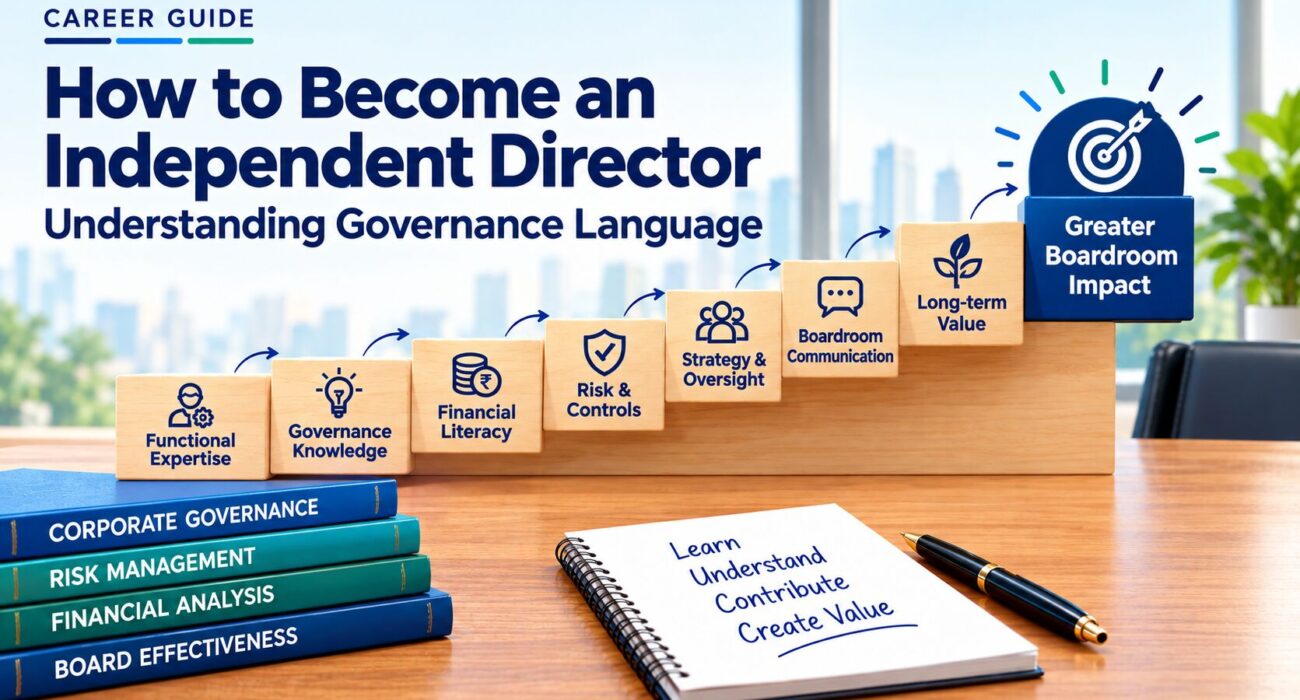
Becoming an Independent Director is not simply about reaching a senior position, collecting impressive credentials or having decades of corporate experience. At the board level, the conversation changes. The questions become sharper, the information becomes more complex, and the responsibility moves beyond managing a function to exercising independent judgment in the interests of the company and its stakeholders. That is why understanding governance language is such an important part of becoming genuinely board-ready.
An experienced CFO may understand cash flows exceptionally well. A CEO may have an outstanding record of building businesses. A technology leader may understand digital transformation better than most people in the room. Yet, when these professionals enter a boardroom, their expertise needs to be translated into boardroom vocabulary and communication. They must understand concepts such as fiduciary responsibility, related-party transactions, materiality, internal controls, risk appetite, audit findings, succession planning and stakeholder accountability.
This is particularly relevant in India, where the legal and regulatory framework around independent directors continues to place emphasis on independence, knowledge, familiarisation and responsible participation. The Indian Institute of Corporate Affairs (IICA), for example, operates the Independent Directors Databank as a capacity-building and selection platform under the framework created through the Companies Act and related rules.
So, how do you make the transition from being a successful executive to becoming a credible Independent Director? One answer lies in learning to speak the language of governance—and, more importantly, learning to think through that language.
Table of Contents
Why Governance Language Matters for an Independent Director
Imagine joining a board meeting where the CFO presents a dashboard containing EBITDA movement, working-capital cycles, cash conversion, contingent liabilities and related-party exposures. The Chief Risk Officer then discusses risk appetite, emerging risks and control deficiencies. The Company Secretary moves into regulatory compliance, committee responsibilities and disclosure requirements. If you understand only your own professional vocabulary, you may have an impressive career but still struggle to contribute effectively to the discussion.
That is the difference between executive expertise and boardroom readiness. An Independent Director is expected to bring experience while also understanding the broader governance context in which that experience is applied. The Companies Act framework requires independent directors to undertake appropriate induction and regularly update and refresh their skills, knowledge and familiarity with the company. This makes continuous learning more than a professional-development preference; it is closely connected to effective board participation.
The shift can be thought of as moving from “How do I run this?” to “How should the board oversee this?”. An executive typically owns execution. A director participates in oversight, challenge, strategy and accountability. The distinction sounds subtle, but it changes the nature of the conversation.
From Executive Expertise to Boardroom Judgment
A senior executive often approaches a problem by looking for an answer. A director needs to understand whether the right questions have been asked before an answer is accepted.
For example, suppose management proposes a major acquisition. An executive might immediately evaluate integration costs, revenue synergies and operational feasibility. A board member should widen the frame: What assumptions support the valuation? What risks could invalidate the business case? Has management considered alternative scenarios? What happens if expected synergies do not materialise? Are there conflicts of interest? How will the transaction affect capital allocation and long-term stakeholder value?
This is where governance language becomes a practical tool rather than a collection of technical expressions.
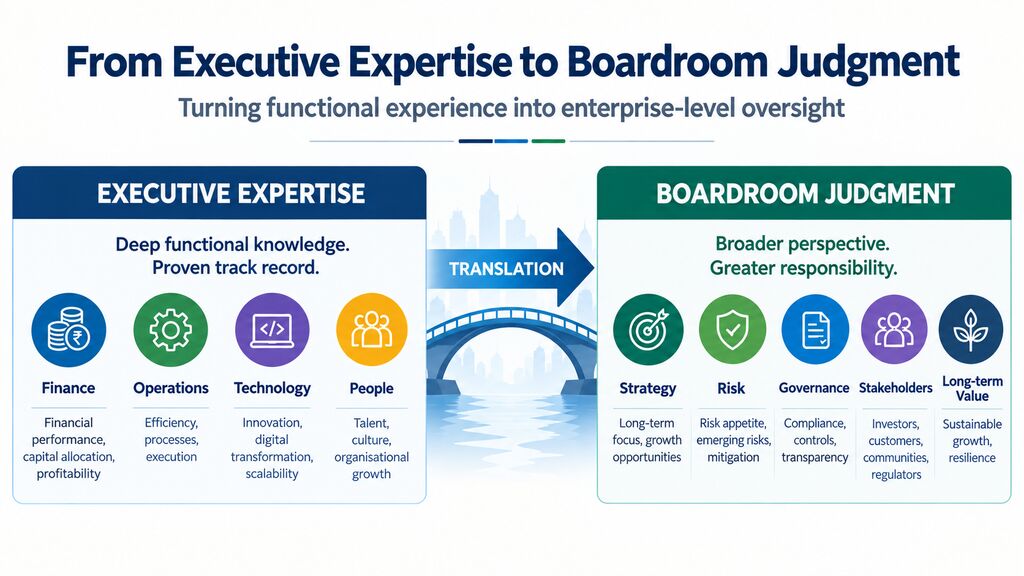
A board-ready professional learns to move comfortably between strategy, finance, risk, compliance, people and stakeholder considerations. The ability to ask a precise question at the right moment can be more valuable than delivering a long presentation.
Building Boardroom Vocabulary and Communication
Boardroom vocabulary and communication are not about sounding complicated. In fact, effective directors often communicate with remarkable simplicity. The objective is to understand complex issues well enough to reduce them to their essential questions.
Consider terms such as materiality, fiduciary duty, related-party transaction, internal financial controls, risk appetite, business continuity, succession planning, impairment, contingent liability and regulatory exposure. These terms appear regularly in corporate discussions, but understanding their dictionary definitions is only the starting point. A director needs to understand their implications.
For example, when management says a matter is “not material,” a board member should understand what materiality means in that particular context. Materiality can have financial, regulatory, operational and reputational dimensions. Similarly, when a company reports that its internal controls are “adequate,” a director should understand the basis for that conclusion and whether significant deficiencies or control weaknesses have been identified.
The boardroom rewards clarity over vocabulary. A director who asks, “What assumption would most change this outcome?” may contribute more than someone who uses ten technical terms without challenging the underlying logic.
The Language of Risk, Controls and Accountability
Risk language deserves special attention because directors are often required to oversee risks without managing them directly.
A useful mental model is to separate risk identification, risk assessment, risk response and risk monitoring. Once that structure becomes familiar, board papers become easier to interpret.
| Governance term | What a board member should understand |
| Risk appetite | How much risk the organisation is prepared to accept |
| Materiality | Whether an issue could reasonably influence decisions or outcomes |
| Internal controls | Processes designed to manage risks and support reliable operations/reporting |
| Related-party transaction | A transaction involving parties with specified relationships to the company |
| Contingent liability | A potential obligation dependent on future events |
| Fiduciary responsibility | The responsibility to act within the duties imposed by law and governance principles |
| Succession planning | Preparation for continuity of leadership and critical capabilities |
The point is not to memorise terminology. The point is to understand what each term should trigger in your thinking.
If management reports that a particular risk is within appetite, ask what changed to make that assessment. If an audit committee reports a control weakness, ask about root cause, remediation and recurrence. If a major customer represents a significant percentage of revenue, ask whether concentration risk has been assessed.
That is governance thinking in practice.
Corporate Governance Terminology Every Director Should Know
For anyone preparing to become an Independent Director, corporate governance terminology should become part of everyday professional learning. The Companies Act, SEBI regulations for applicable listed entities, stock-exchange disclosures and board committee frameworks create a substantial vocabulary around corporate oversight. SEBI’s corporate governance materials have historically emphasised independence, accountability, financial literacy, strategic thinking and the ability to ask difficult questions as important characteristics of effective directors.
The vocabulary becomes easier when organised around five broad areas: governance, finance, risk, compliance and strategy.
Governance includes concepts such as board composition, committees, independence, stakeholder interests, board evaluation and director responsibilities. Finance includes revenue recognition, margins, cash flows, working capital, debt, capital expenditure, provisions and impairments. Risk includes operational, financial, cyber, regulatory, geopolitical and reputational risk. Compliance involves applicable laws, disclosures, policies and regulatory expectations. Strategy connects all of these areas to long-term value creation.
A useful exercise is to take one annual report every month and identify unfamiliar governance terms. Instead of merely searching for definitions, examine how the term is used in context.
That habit gradually develops governance fluency.
Financial Literacy for Independent Directors
You do not necessarily need to be a finance professional to become an effective Independent Director, but financial literacy is essential for meaningful board oversight. A director should be able to read the major financial statements and understand how they connect.
The balance sheet tells you about the company’s financial position at a point in time. The profit-and-loss statement shows financial performance over a period. The cash-flow statement explains how cash is generated and used. The notes to accounts often provide the context that makes the headline numbers meaningful.
The real skill is connecting the three.
A company can report profit while experiencing weak operating cash flow. Revenue can grow while receivables rise faster. EBITDA can improve while debt increases materially. A strong balance sheet can still contain significant contingent liabilities. None of these observations automatically indicates a problem, but each can lead to a useful board question.
Reading Corporate Balance Sheets and Financials
When reading financial statements, an aspiring director should resist the temptation to focus only on headline growth.
Instead, look for relationships.
| Financial indicator | Board-level question |
| Revenue growth | What is driving growth, and how sustainable is it? |
| EBITDA margin | Is margin expansion operationally sustainable? |
| Receivables | Is working capital growing proportionately with revenue? |
| Debt | Is leverage consistent with the company’s risk appetite? |
| Operating cash flow | Does cash generation support reported profitability? |
| Capital expenditure | What returns are expected from major investments? |
| Contingent liabilities | What potential future obligations require monitoring? |
| Related-party transactions | Are they appropriately governed and disclosed? |
The objective is not to become the company’s second CFO. The objective is to become sufficiently financially literate to challenge assumptions intelligently.
The IICA’s current Centre for Independent Directors describes its capacity-building work as covering corporate governance, regulatory frameworks, financial prudence and related areas.
That is a useful indication of the breadth expected from professionals preparing for board responsibilities.
Understanding Board Meeting Discourse in India
Board meeting discourse in India can feel very different from a management meeting. Management meetings often focus on execution, targets, resources and timelines. Board meetings tend to focus more heavily on oversight, strategic direction, risk, compliance, performance and accountability.
An Independent Director should therefore learn how to listen for what is being said—and what may not yet be being said.
Suppose management reports that revenue increased by 25 percent. The board discussion should not stop at congratulations. Directors may want to understand customer concentration, pricing assumptions, margins, working capital, sustainability of demand and competitive dynamics.
Similarly, if a company reports that a strategic initiative is “on track,” a director can ask what specific milestones define success, what assumptions have changed and what early-warning indicators management is monitoring.
Asking the Right Questions in Boardrooms
Strong board questions are usually specific, evidence-based and connected to the company’s long-term interests.
Instead of asking:
“Are there any risks?”
A stronger question could be:
“Which two assumptions, if they deteriorate over the next twelve months, could materially change the economics of this plan?”
Instead of:
“Is the cybersecurity framework adequate?”
A more useful question could be:
“When was the last independent assessment of our critical systems, and what unresolved high-priority findings remain?”
The difference is important. The second question creates a path toward evidence.
A director should also avoid turning questioning into interrogation. The purpose of board challenge is not to demonstrate superior intelligence. It is to improve decision quality.
Strategic Communication for Directors
Strategic communication for directors involves knowing when to speak, what to ask and how to express disagreement constructively.
An Independent Director may disagree with management, another director or even the board chair. The manner of disagreement matters because governance is not simply about having an independent view; it is about ensuring that the view contributes to better deliberation.
A useful structure is:
Observation → Question → Implication → Alternative
For example:
“Customer concentration has increased over the last three years. What assumptions are embedded in the current forecast regarding our largest customers? If one of those contracts were delayed, how would that affect cash flow? Should we consider a downside scenario before approving the plan?”
This is strategic communication because the director is not merely opposing a proposal. The director is helping the board examine its assumptions.
SEBI’s corporate governance framework has also emphasised the importance of independent directors’ active participation and the broader objective of effective corporate governance.
Turning Governance Knowledge into Boardroom Value
Governance knowledge becomes valuable when it connects with your existing professional expertise.
A former technology executive can contribute to discussions on cybersecurity, technology architecture, digital transformation and technology risk. A former HR leader may bring depth to succession, culture, remuneration and leadership development. A finance professional may contribute to audit, capital allocation, controls and financial strategy.
But the board does not need another functional manager.
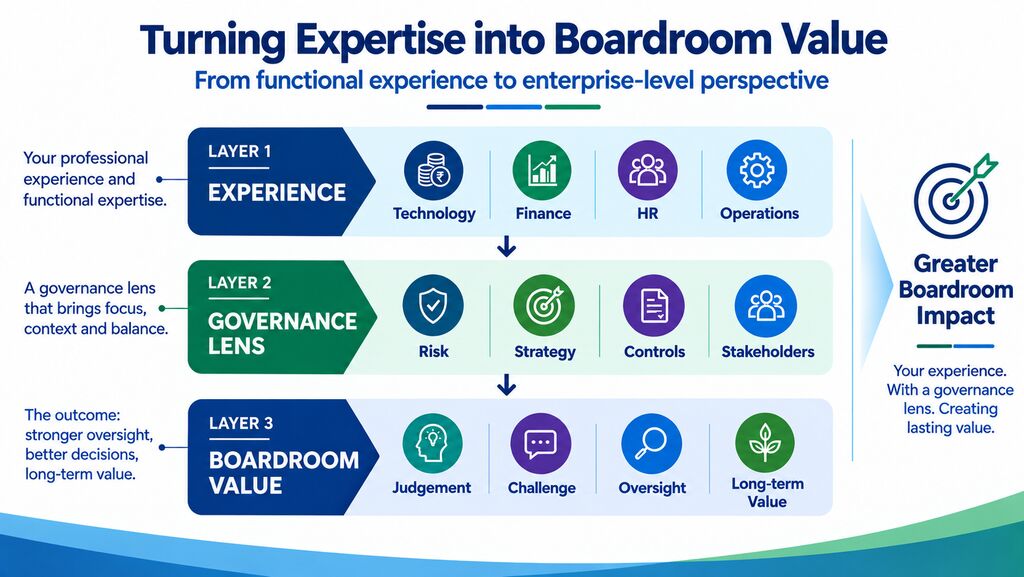
It needs someone who can take that expertise and connect it to enterprise-level oversight.
That is why your board proposition should answer three questions:
- What experience do you bring?
- Which board-level issues can you understand deeply?
- What perspective can you contribute that strengthens board deliberation?
Your professional experience becomes more compelling when translated into governance outcomes rather than simply listing job responsibilities.
How to Prepare for an Independent Director Role
Preparing to become an Independent Director should be treated as a structured transition rather than a last-minute application exercise.
Start by understanding the legal framework and eligibility requirements applicable to your intended board roles. The IICA Independent Directors Databank is an important part of India’s formal ecosystem for independent directors, and IICA currently describes the databank as a platform for both serving directors and professionals aspiring to board appointments.
The IICA also conducts the online proficiency self-assessment associated with the Independent Directors Databank framework.
But regulatory registration alone does not create a board career.
You also need to develop board visibility, governance knowledge, financial literacy, strategic communication and a credible professional narrative.
A practical preparation framework can look like this:
| Preparation area | What to develop |
| Governance | Companies Act, applicable SEBI requirements and board responsibilities |
| Finance | Financial statements, cash flows, ratios and capital allocation |
| Risk | Enterprise, cyber, regulatory and reputational risk awareness |
| Strategy | Long-term value creation and competitive positioning |
| Communication | Questioning, challenge and constructive disagreement |
| Profile | Board CV, board bio, LinkedIn presence and value proposition |
| Network | Relationships with governance professionals, board members and relevant institutions |
| Continuous learning | Regulatory updates, annual reports and governance developments |
Building a Credible Board Profile
Your board profile should tell a coherent story.
A conventional executive CV often answers: Where have you worked? What was your designation? What did you achieve?
A board profile should go further: What board-level perspective do you bring?
This is where a carefully developed boardroom branding approach can help translate executive experience into a governance-oriented narrative.
Similarly, your Board Value Proposition and Board Bio should make your expertise understandable to someone evaluating you for a board opportunity.
For professionals who are developing their board journey, resources on how to become an Independent Director in India and the next stage of the Independent Director journey can provide additional context.
Common Governance Language Mistakes to Avoid
One common mistake is confusing confidence with independence. A person can speak forcefully and still fail to challenge the right assumption. Independence is reflected in judgment, objectivity and the willingness to examine an issue on its merits.
Another mistake is using governance terminology without understanding its consequences. Saying “risk appetite” repeatedly does not demonstrate risk oversight. A director needs to understand how risk appetite connects with strategy, controls, capital and decision-making.
A third mistake is becoming too operational. An executive joining a board may naturally want to solve problems. But the board’s role is different from management’s role. Asking management to explain a decision, challenging assumptions and seeking assurance are different from taking over execution.
The fourth mistake is neglecting financial statements. Even directors without finance backgrounds should become comfortable reading annual reports and asking financially informed questions.
Finally, some professionals underestimate communication. A boardroom is not a presentation competition. Listening carefully, synthesising information and asking the question that moves the discussion forward are core boardroom skills.
Conclusion
Becoming an Independent Director in India is a journey from professional expertise toward broader governance judgment. Experience remains important, but experience becomes more useful when it can be translated into questions about strategy, risk, financial performance, accountability and long-term value creation.
Understanding governance language is therefore not about memorising corporate terminology. It is about developing a new way of seeing the organisation. A balance sheet becomes a window into capital allocation. A risk register becomes a starting point for strategic discussion. An audit observation becomes a question about control effectiveness. A board paper becomes an invitation to test assumptions.
For senior executives and CXOs considering board-level roles, this shift can be transformative. Your next step could be to assess your existing board readiness across governance knowledge, financial literacy, strategic communication and professional positioning. You can also explore Your Board Profile’s board-focused services or review its portfolio of board-profile work to understand how executive experience can be presented for board-level opportunities.
The goal is not simply to become an Independent Director. The goal is to become the kind of board professional whose experience, questions and judgment add meaningful value when the room is making consequential decisions.
Frequently Asked Questions
1. What qualifications are required to become an Independent Director in India?
The applicable eligibility requirements arise primarily from the Companies Act, 2013 and relevant rules, along with requirements applicable to listed entities. Candidates also need to satisfy independence-related conditions and other statutory requirements applicable to the appointment.
2. Is financial knowledge necessary for an Independent Director?
Yes. An Independent Director should have sufficient financial literacy to understand financial statements, cash flows, significant accounting matters, risks and major financial decisions. You do not necessarily need to be a finance professional.
3. What is the Independent Directors Databank?
The Independent Directors Databank is an initiative administered through the Indian Institute of Corporate Affairs under the statutory framework relating to independent directors. It provides a platform for eligible professionals and companies and also supports capacity building.
4. Does every Independent Director need to pass the IICA proficiency test?
The applicable rules provide for the online proficiency self-assessment, while specified exemptions exist for eligible individuals meeting prescribed experience criteria. Candidates should verify the current requirements applicable to their circumstances.
5. What is boardroom vocabulary?
Boardroom vocabulary refers to the terminology and concepts used in corporate governance, finance, risk, compliance, strategy and board oversight. Understanding this language helps directors participate meaningfully in board discussions.
6. How can I improve my boardroom communication?
Read annual reports, observe governance discussions, study board-level case studies and practise asking concise questions based on evidence. Focus on understanding assumptions rather than trying to demonstrate technical knowledge.
7. What financial statements should an aspiring director learn to read?
Start with the balance sheet, statement of profit and loss, cash-flow statement and notes to accounts. Then learn how these statements connect with working capital, debt, capital expenditure and business strategy.
8. What should an Independent Director ask during a board meeting?
Questions can address assumptions, risks, financial implications, controls, stakeholder impact, regulatory exposure, execution capability and alternative scenarios. The strongest questions are usually specific and evidence-based.
9. Can a CEO become an Independent Director?
A former or current CEO may be eligible depending on the statutory requirements, relationships, tenure, financial interests and other circumstances. Eligibility should always be assessed against the applicable legal framework.
10. Is corporate governance knowledge enough to become board-ready?
No. Governance knowledge is one component. Board readiness can also involve financial literacy, strategic thinking, risk understanding, communication, independence of judgment, relevant experience and professional positioning.
11. How important is a Board CV?
A Board CV can be important because it presents executive experience through a board-relevant lens. It should highlight governance exposure, strategic contribution, industry expertise and areas where the candidate can add board-level value.
12. What is the difference between an executive director and an Independent Director?
An executive director is involved in the company’s management and executive responsibilities, while an Independent Director performs a non-executive oversight role subject to applicable legal requirements and duties.
13. How can I build credibility before seeking a board position?
Develop governance knowledge, improve financial literacy, participate in relevant professional forums, build meaningful relationships within the governance ecosystem and create a consistent professional profile that clearly communicates your board value proposition.
14. Why is asking questions important for an Independent Director?
Questions enable directors to test assumptions, understand risks, seek clarity and contribute to informed decision-making. SEBI’s corporate governance materials have specifically recognised the importance of directors’ ability to ask tough questions.
15. How can I assess whether I am ready for an Independent Director role?
Consider your knowledge of governance, financial statements, risk, strategy and board responsibilities. Then examine whether your professional experience can be translated into a clear board value proposition and whether your communication style supports constructive challenge and independent judgment.
Ready to Build Your Journey as an Independent Director in India?
Your professional experience can become a powerful board-level asset when it is translated into governance knowledge, financial understanding, strategic thinking, and effective boardroom communication.
Becoming board-ready is not just about meeting eligibility requirements. It is about developing the ability to understand governance language, ask the right questions, challenge assumptions, and contribute meaningfully to board discussions.
Whether you are a CXO, senior executive, entrepreneur, or aspiring Independent Director, now is the time to assess your governance knowledge, financial literacy, strategic judgement, communication skills, and board value proposition.
Don’t wait for a board opportunity to start preparing. Build your board readiness today and learn how to translate your professional experience into meaningful boardroom value.
Schedule your complimentary session here:
https://calendly.com/dramitnagpal
Share this post: Facebook | X | LinkedIn