

Becoming an Independent Director in India is rarely about simply reaching a certain seniority level, collecting impressive designations, or making your LinkedIn profile more visible. A board is not hiring another functional executive. It is looking for someone who can bring independent judgement, challenge constructively, understand governance responsibilities, ask the right questions, and contribute perspective without becoming operationally involved. That is why the transition from CXO or senior executive to board candidate requires a different kind of professional positioning.
The important question, therefore, is not only, “How visible am I?” It is also, “What signals does my professional profile send about my ability to contribute in a boardroom?” This is where governance signalling for directors becomes useful. Your career history, board exposure, thought leadership, professional relationships, financial understanding, regulatory awareness, public profile and even the way you describe your achievements can collectively signal whether you are ready for a board-level conversation.
India’s regulatory environment also makes the role more structured than many professionals realise. The Independent Directors Databank, operated by the Indian Institute of Corporate Affairs (IICA) under the Ministry of Corporate Affairs framework, was created to support capacity building and create an ecosystem connecting eligible professionals and companies. IICA currently describes its Centre for Independent Directors as supporting thousands of directors and companies through learning, knowledge resources, assessments and corporate search facilities.
So, if your objective is to become an Independent Director in India, think of the journey as a repositioning exercise. You are moving from being known for what you managed to being recognised for what you can govern, question, guide and oversee.
Table of Contents
Why Visibility Alone Does Not Create Board Readiness
The Shift From Executive Reputation to Governance Signalling
A successful executive career creates visibility naturally. Your company announces promotions, business media may cover your achievements, conferences invite you to speak, and professional networks associate you with particular functions or industries. Yet a board appointment operates through a different lens. The question changes from “Can this person run the function?” to “What judgement, independence, experience and perspective can this person bring to the board?”
That distinction is fundamental to how to become an Independent Director in India. A CFO may have excellent financial credentials, but the board may need evidence that the person can think beyond financial reporting and understand risk, capital allocation, audit oversight and stakeholder accountability. A CHRO may have decades of people leadership, but board relevance may depend on whether that experience translates into succession planning, culture, leadership risk and remuneration oversight. Similarly, a technology leader needs to demonstrate more than digital expertise; the board may want to understand how that expertise informs cyber risk, technology governance, AI oversight and strategic resilience.
In other words, board readiness is not simply the sum of your career achievements. It is the interpretation of those achievements through a governance lens. That is why a professional can have an impressive executive profile and still struggle to communicate why they are suitable for an Independent Director in India role.
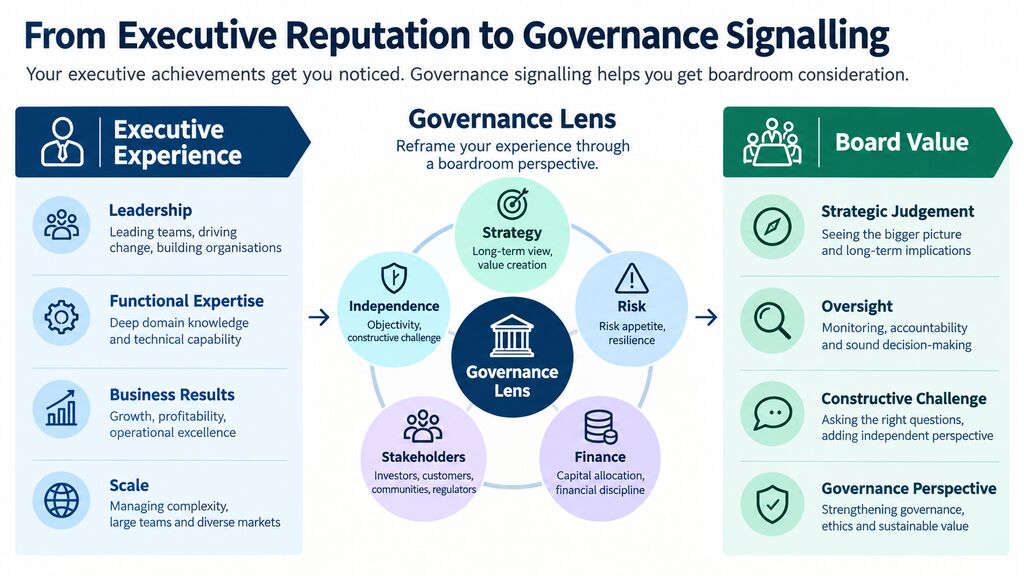
What Boards Need to See Before They Consider a Candidate
The boardroom is fundamentally an environment of judgement. Directors may receive large volumes of information, but their value comes from identifying what matters, understanding implications and asking questions that improve decision-making.
A board-ready professional therefore needs to communicate several dimensions of value. These include strategic perspective, governance awareness, financial literacy, risk understanding, stakeholder sensitivity, ethical judgement, independence of thought and the ability to operate collaboratively without becoming part of management.
This does not mean every candidate needs identical experience. A technology company may value a different combination of capabilities from a manufacturing company, financial institution or consumer business. Board composition itself can also influence what expertise is relevant at a particular point in time.
The practical lesson is simple: profile building for independent directors should start with the needs of the board, not merely the achievements of the individual.
Independent Director in India: Understanding the Governance Role
Legal Eligibility and Regulatory Expectations
The Companies Act, 2013 provides the statutory framework governing independent directors in India, while listed entities are also subject to SEBI’s regulatory framework. The Independent Directors Databank exists within this broader ecosystem. IICA states that Section 150 of the Companies Act provides for selection from a databank maintained by a notified institution, with companies required to exercise due diligence when selecting an individual.
IICA also states that professionals who intend to be appointed as independent directors are required to apply for inclusion in the databank, subject to the applicable rules and exemptions. The platform provides an online proficiency self-assessment mechanism and learning resources covering subjects ranging from directors’ duties and financial statements to board committees, related-party transactions, SEBI regulations and professional ethics.
These formal requirements matter, but compliance should not be confused with board positioning. Registration, eligibility and assessment address whether a professional can enter the relevant ecosystem. They do not automatically communicate why a particular company should consider that professional for its board.
That second part is where governance signalling for directors becomes particularly important.
The Difference Between Executive Experience and Board Value
Consider two senior professionals. One says, “I led a ₹5,000-crore business and delivered double-digit growth.” Another says, “I led a complex business through expansion, strengthened risk oversight, managed stakeholder interests and worked closely with the board on strategic decisions.”
Both statements may describe the same career. But the second statement begins to translate executive experience into board language.
This is not about exaggerating achievements. It is about making the governance implications of those achievements visible. A board does not necessarily need another person who can replicate the CEO’s operational responsibilities. It needs directors who can oversee management, challenge assumptions, understand consequences and contribute independent judgement.
That is why professionals exploring an Independent Director in India career should review their entire career narrative. Which decisions required judgement under uncertainty? Which situations involved competing stakeholder interests? Where did you oversee risk? When did you work with boards, regulators, investors, auditors or institutional stakeholders? Which experiences demonstrate that you can ask difficult questions without losing perspective?
Those stories can become powerful evidence of board readiness.
Governance Signalling for Directors: What Does It Really Mean?
Demonstrating Governance Aptitude Through Experience
Governance aptitude is not a single qualification written on a certificate. It develops through exposure to situations involving accountability, controls, risk, ethics, stakeholders and long-term consequences.
IICA’s own learning architecture illustrates the breadth of knowledge associated with independent directorship. Its board-practice resources include subjects such as due diligence before joining a board, board effectiveness and culture, governance of committees, strategy, stakeholder engagement and evaluation of independent directors.
For an executive, this creates an important positioning opportunity. Instead of presenting your career as a list of functional responsibilities, identify the governance dimensions within your experience.
For example, a former CEO could highlight experience in succession planning, enterprise risk and stakeholder management. A former CFO could demonstrate expertise in audit oversight, financial reporting, capital allocation and controls. A technology executive could connect digital transformation experience with cybersecurity, data governance, technology risk and AI oversight.
This is demonstrating governance aptitude in practical terms: showing that your experience equips you to think about the organisation as a whole rather than only through your previous functional lens.
Turning Career Achievements Into Board-Relevant Evidence
A useful exercise is to take ten major achievements from your executive career and ask four questions about each one.
What was the strategic issue? What risks were involved? Which stakeholders were affected? What governance judgement was required?
The answers can transform an ordinary executive achievement into a board-relevant story.
For instance, “implemented a new ERP system across seven business units” is operational. “Led enterprise-wide technology transformation while strengthening data controls, risk visibility and decision-making across seven business units” begins to communicate governance relevance.
This distinction matters for how to signal board readiness because boards often have limited time to understand a candidate. Your profile needs to help the reader connect your experience with the issues a board is expected to oversee.
How to Signal Board Readiness Before Your First Board Seat
Building Professional Credibility for Board Seats
The first board seat presents a classic credibility challenge: companies want evidence of board relevance, while aspiring directors often need their first appointment to create that evidence.
One way to address this is by building visible proof points before the appointment. Thought leadership, committee exposure, advisory roles, governance education, industry forums, board-level conversations and informed commentary on governance issues can gradually change how the market perceives you.
This does not mean posting generic content about leadership every week. Building professional credibility for board seats requires substance. Write about the governance implications of AI. Discuss lessons from risk failures. Explain what boards should consider when evaluating succession. Share perspectives on cybersecurity oversight, stakeholder trust or regulatory developments.
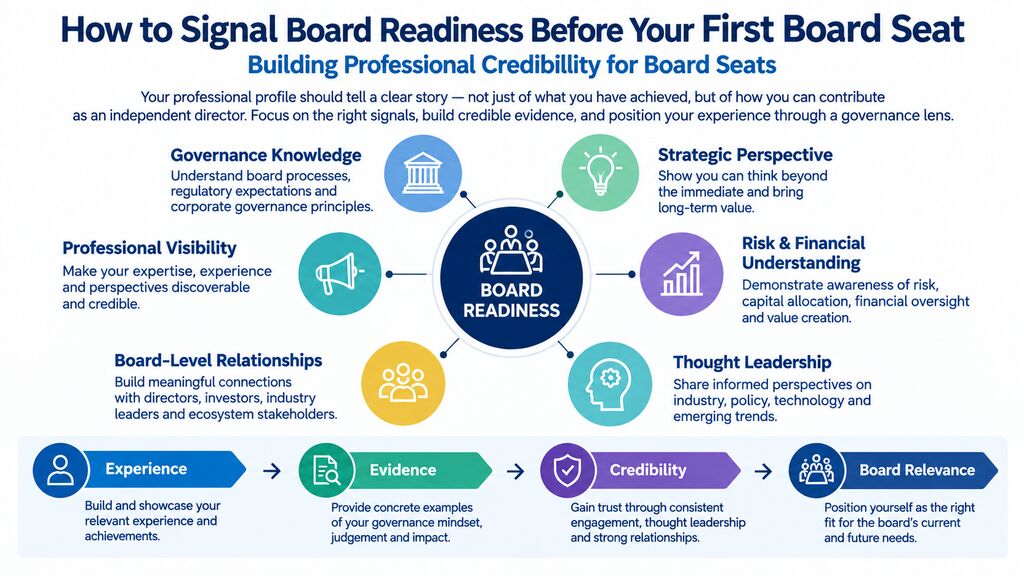
The objective is not to announce repeatedly that you want a board seat. The objective is to demonstrate that you already think about business issues from a board perspective.
Profile Building for Independent Directors
Your LinkedIn profile, professional biography, speaker profile and board CV should tell the same story.
A common mistake is to retain an executive resume almost unchanged and simply add “Aspiring Independent Director” to the headline. That rarely solves the positioning problem. The narrative needs to evolve from job progression to governance contribution.
A board-oriented profile can bring forward:
- Strategic oversight experience
- Board and committee exposure
- Governance and risk expertise
- Industry knowledge
- Transformation experience
- Financial and regulatory understanding
- Stakeholder management
- Crisis or turnaround experience
- ESG or sustainability exposure
- Technology, cyber or AI oversight
- Mentoring and succession experience
For professionals developing this narrative, resources such as boardroom branding can help frame the transition from executive visibility toward board-level positioning.
Independent Director Selection Criteria: What Companies Look For
Skills, Independence, Diversity and Industry Perspective
There is no universal formula for selecting an Independent Director in India because the appropriate board composition depends on the company, industry, strategy, risks and regulatory requirements.
Yet several recurring considerations shape board discussions. Companies need directors who satisfy the applicable independence requirements while also bringing relevant expertise and perspective. Board composition can involve questions of finance, law, technology, industry knowledge, risk, sustainability, international markets, human capital or stakeholder management.
For listed companies, SEBI’s LODR framework also contains requirements concerning board composition and directorship limits. For example, Regulation 17A provides limits on the number of listed-entity directorships and specifically addresses the number of listed entities in which a person may serve as an independent director.
This is one reason candidates should avoid positioning themselves as “available for any board.” A stronger approach is to define the situations where your expertise is genuinely relevant.
Why Financial and Regulatory Literacy Matters
You do not need to be an accountant to become an independent director. But you do need to be comfortable engaging with financial information and understanding the governance consequences of major decisions.
A board may discuss cash flow, debt, acquisitions, related-party transactions, internal controls, regulatory exposure, cyber incidents, remuneration, succession or capital expenditure in the same meeting. Directors need enough literacy to understand the underlying issues and challenge management constructively.
IICA’s current learning resources explicitly include topics such as balance sheets, financial statements, directors’ duties, related-party transactions, audit, board committees, SEBI regulations and professional ethics.
For aspiring directors, this suggests a useful principle: board readiness is multidisciplinary. Your expertise may be deep in one field, but your governance perspective needs to extend across the enterprise.
Corporate Board Networking India: Moving Beyond Conventional Networking
Building Relationships With the Right Board Ecosystem
Corporate board networking India is not simply about attending more conferences and collecting more contacts. The quality and relevance of relationships matter.
Consider the ecosystem around board appointments: current directors, former directors, CEOs, promoters, institutional investors, governance professionals, executive search firms, company secretaries, lawyers, CFOs, board advisors and industry associations. Each group can provide a different perspective on what companies are looking for.
The strongest relationships usually develop around intellectual credibility rather than direct requests for appointments. Instead of opening every conversation with “I am looking for an independent director position,” engage around governance issues where you have genuine expertise.
Discuss a regulatory development. Share an insight from an industry transformation. Ask an experienced director how a particular board challenge is handled. Over time, such conversations can build professional familiarity.
The aim of corporate board networking India should be to become part of relevant conversations, not simply to become more visible.
Creating a Board-Ready Digital Presence
Your digital presence is often the first point at which someone evaluates your professional positioning.
A board-ready digital presence should answer three questions quickly:
What do you know? What governance problems can you help boards think through? Why should a board trust your judgement?
Your LinkedIn headline, About section, featured content, professional website, articles, speaker profile and board CV should reinforce those answers.
This is where your executive personal branding should evolve beyond the traditional executive narrative. The objective is not personal promotion for its own sake. It is to make your expertise legible to people evaluating board composition.
Board of Directors Resume and Positioning
What a Board-Ready CV Should Communicate
A conventional executive resume often focuses on responsibilities, reporting lines, revenue and team size. A board of directors resume and positioning strategy requires a different emphasis.
A board CV should make it easy to understand your strategic contribution, governance exposure, industry expertise and areas of board relevance. It should not read like a chronological employment record alone.
A useful structure can include:
| Board CV Element | What It Should Demonstrate |
| Board profile | Your governance proposition |
| Executive experience | Strategic depth and leadership scale |
| Board exposure | Existing governance experience |
| Committee experience | Audit, risk, CSR, nomination, remuneration or other relevant exposure |
| Industry expertise | Sector-specific perspective |
| Governance capabilities | Risk, compliance, ethics and stakeholder oversight |
| Thought leadership | Evidence of independent perspective |
| Education and certifications | Relevant governance and professional knowledge |
Your board value proposition and board bio should complement this document rather than simply repeat it.
From Job Description to Board Value Proposition
One of the biggest positioning changes occurs when you stop describing yourself by what your previous employer hired you to do.
Imagine a former COO whose profile says: “Responsible for operations, supply chain, procurement and manufacturing.”
That describes a job.
Now consider: “Brings extensive experience in operational resilience, supply-chain risk, capital efficiency and transformation across complex manufacturing environments.”
That describes board relevance.
The second version does not invent anything. It reframes existing experience in terms of strategic and governance questions.
This is the heart of building professional credibility for board seats. Your professional story should make it possible for a board member or nomination and remuneration committee stakeholder to understand what conversation you would bring into the room.
A Practical Roadmap to Becoming an Independent Director in India
The journey toward becoming an Independent Director in India is easier to manage when treated as a structured professional-development project rather than an open-ended networking exercise.
Start by understanding the applicable statutory requirements and your eligibility. The IICA Independent Directors Databank is an important part of the formal ecosystem, and its resources include registration, learning and proficiency-assessment mechanisms.
Next, conduct a board-readiness audit. Map your experience against governance themes such as strategy, finance, risk, technology, compliance, stakeholder management, succession and sustainability. Identify the areas where you already have credible evidence and the areas where further learning or exposure would strengthen your profile.
Then build your positioning architecture. Your board CV, LinkedIn profile, board bio, speaker profile and thought-leadership content should reinforce one another. Your services and board-profile resources can serve as a reference point for the different components that contribute to a professional board positioning strategy.
After that, develop your governance visibility. Publish useful insights, participate in relevant discussions, attend governance forums and develop relationships with people who operate within the board ecosystem. Your goal is not to manufacture visibility; it is to create a consistent trail of evidence that demonstrates your interest and aptitude for governance.
Finally, maintain your profile continuously. A board career is not a one-time branding exercise. Regulations evolve, industries change, technologies create new risks and board priorities shift. Your positioning should evolve with them.
IICA’s current materials describe the Independent Directors Databank as a platform intended not only for aspiring professionals but also for companies searching for suitable profiles. That reinforces an important point: being discoverable matters, but being relevant to a specific governance need matters just as much.
For professionals ready to make that transition, Your Board Profile’s portfolio provides examples of how executive experience can be translated into professional positioning.
Conclusion: From Visibility to Governance Credibility
The path to becoming an Independent Director in India is not simply a race for visibility. It is a journey from professional recognition toward governance credibility.
Your executive career gives you raw material: decisions, challenges, successes, failures, transformations, stakeholder relationships and hard-earned judgement. Your responsibility is to translate that experience into a language that a board can understand.
That means demonstrating governance aptitude, creating a board-ready profile, developing relevant relationships, understanding regulatory expectations and communicating a clear board value proposition. It also means recognising that the strongest board profiles are rarely the loudest ones. They are the ones where experience, judgement, independence and relevance become visible without being overstated.
If your next professional chapter is the boardroom, start by asking a different question: What governance signal does my profile send today, and what evidence would make that signal stronger?
That question can become the foundation for a more deliberate and credible journey toward board service.
Ready to move from executive visibility to boardroom positioning? Explore Your Board Profile to understand how a structured board-profile strategy can bring your experience, governance strengths and board value proposition together.
Frequently Asked Questions
1. What is an Independent Director in India?
An Independent Director in India is a non-executive director expected to bring independent judgement and oversight to the board, subject to the applicable requirements under the Companies Act and, for listed entities, SEBI regulations. The role is distinct from management and involves responsibilities relating to governance, oversight, challenge and stakeholder interests.
2. How can I become an Independent Director in India?
Start by reviewing your eligibility under the applicable legal framework, registering with the relevant Independent Directors Databank where required, developing governance knowledge and building a board-relevant professional profile. You should also develop relationships within the board ecosystem and clearly communicate your areas of expertise.
3. Is registration with the Independent Directors Databank important?
The Independent Directors Databank was established under the Ministry of Corporate Affairs framework and is administered by IICA. IICA states that eligible professionals intending to become independent directors are required to apply for inclusion subject to the applicable rules and exemptions.
4. What is governance signalling for directors?
Governance signalling for directors refers to the evidence your professional profile provides about your ability to understand governance, risk, strategy, accountability and board-level decision-making. It can come from experience, education, thought leadership, board exposure and the way you communicate your career achievements.
5. How do I signal board readiness without having board experience?
Focus on demonstrating board-relevant evidence from your existing career. Examples include strategic oversight, enterprise risk, stakeholder management, regulatory exposure, financial decision-making, succession planning, transformation and situations requiring independent judgement.
6. What are the independent director selection criteria?
Selection depends on the company’s requirements and the applicable legal and regulatory framework. Companies may consider independence, relevant expertise, industry experience, diversity, governance knowledge, financial literacy, strategic perspective and the specific skills required to strengthen board composition.
7. Does a CXO automatically qualify for an independent director role?
No. Senior executive experience can provide valuable evidence of leadership and strategic capability, but eligibility and suitability for an independent director appointment depend on applicable legal requirements and the company’s board needs.
8. What should an independent director resume contain?
A board of directors resume and positioning document should emphasise governance relevance, strategic experience, board exposure, industry expertise, committee experience, risk perspective, stakeholder management and other capabilities relevant to board oversight.
9. How important is LinkedIn for an aspiring independent director?
LinkedIn can support professional discoverability and credibility, but it should complement rather than replace substantive governance experience and qualifications. A strong profile should clearly communicate your expertise and the board-level issues on which you can contribute.
10. How can I improve my profile building for independent directors?
Start by reviewing your career through a governance lens. Identify your strongest board-relevant capabilities, create a focused board bio and CV, strengthen your LinkedIn positioning and publish thoughtful content around governance topics relevant to your expertise.
11. What role does networking play in becoming an independent director?
Networking can help professionals develop relationships within the board ecosystem and understand how companies approach board composition. The most useful relationships are generally built around expertise and meaningful conversations rather than repeated requests for appointments.
12. Does an independent director need financial knowledge?
Financial literacy is highly relevant to board work because directors may need to understand financial statements, controls, capital allocation, audit matters and financial risks. IICA’s board-learning resources include financial statements, balance sheets, audit and related financial topics.
13. Can technology leaders become independent directors?
Yes, where their experience and qualifications meet applicable requirements and align with a company’s board needs. Technology leaders may bring perspectives on digital strategy, cybersecurity, AI, data governance, technology risk and transformation.
14. How can I demonstrate governance aptitude?
Use specific career evidence rather than generic claims. Explain situations where you managed risk, dealt with stakeholders, strengthened controls, participated in strategic decisions, handled ethical dilemmas or worked with boards and governance bodies.
15. How long does it take to become an Independent Director in India?
There is no universal timeline. It depends on eligibility, experience, governance preparation, professional positioning, relationships, company requirements and the availability of suitable board opportunities. Building credibility should therefore be viewed as an ongoing professional process rather than a fixed-duration certification exercise.
Ready to Build Your Journey as an Independent Director in India?
Your executive experience may already hold significant board-level value. The next step is to translate that experience into governance capability, board relevance, credibility, and visibility.
Build a strong board-ready profile that brings together your leadership experience, governance knowledge, strategic judgement, financial understanding, stakeholder perspective, and unique value proposition into a clear and compelling boardroom narrative.
Whether you are a CXO, senior executive, entrepreneur, or aspiring Independent Director, your journey to the boardroom should begin before the opportunity arrives.
Don’t wait for a board seat to start building board readiness. Make your experience, judgement, and governance perspective visible to the right stakeholders.
Schedule your complimentary session here:
https://calendly.com/dramitnagpal
Share this post: Facebook | X | LinkedIn