

You have spent years building your career. You have led teams, managed difficult business situations, delivered growth, handled pressure, and made decisions that shaped the organisations you worked for. On paper, you may already look like someone who belongs in a boardroom. But here is the question many senior executives overlook: does the market see you that way?
That question sits at the heart of board readiness for executives. Being a successful CEO, CFO, CHRO, CTO or business leader does not automatically make someone ready for a board role. A board is not hiring you to run the business. It is trusting you to help oversee it, challenge assumptions, understand risks and contribute to decisions that influence long-term value. That requires a different kind of credibility.
And today, that credibility often begins before the first conversation.
Someone may hear your name through a professional connection and then search for you. What appears? Is your professional story clear? Does your digital presence reflect the executive you have become? Can someone quickly understand your expertise, judgement and leadership perspective?
This is where Beyond Visibility becomes important. Visibility alone is not the objective. No serious board appoints a director simply because that person is active online. What matters is whether your visibility creates a pattern of executive credibility markers that makes your reputation easier to understand and trust.
Talent may get you noticed. Experience may get you shortlisted. But trust is what makes someone comfortable putting you in the room when the stakes are high.
Table of Contents
- Why Board Readiness for Executives Is Different From Executive Success
- What Trust Looks Like at Board Level
- Beyond Visibility: Why Your Digital Footprint Matters
- How Board Readiness for Executives Is Built
- From Executive Branding to Non-Executive Director Positioning
- A Practical Board Readiness Framework
- Conclusion
- Frequently Asked Questions
Why Board Readiness for Executives Is Different From Executive Success
There is an important difference between being successful as an executive and being ready to serve as a director.
As an executive, you are usually judged by what you deliver. Did you increase revenue? Improve profitability? Launch the product? Turn around the business? Build the team?
A board looks at your career through a different lens.
A director needs to step back from daily execution and look at the bigger picture. The questions become: Is the strategy still right? What could go wrong? Are management assumptions sound? What risks are being accepted? Is the leadership pipeline strong enough?
That is why board readiness for executives is not simply a reward for seniority.
You could have thirty years of experience and still need to develop your board proposition if your career story focuses entirely on execution. Equally, an executive with a less conventional career can be highly valuable if they demonstrate strategic judgement, governance exposure, stakeholder understanding and a distinctive perspective.
The shift is almost like moving from steering the ship to helping decide where the ship should go.
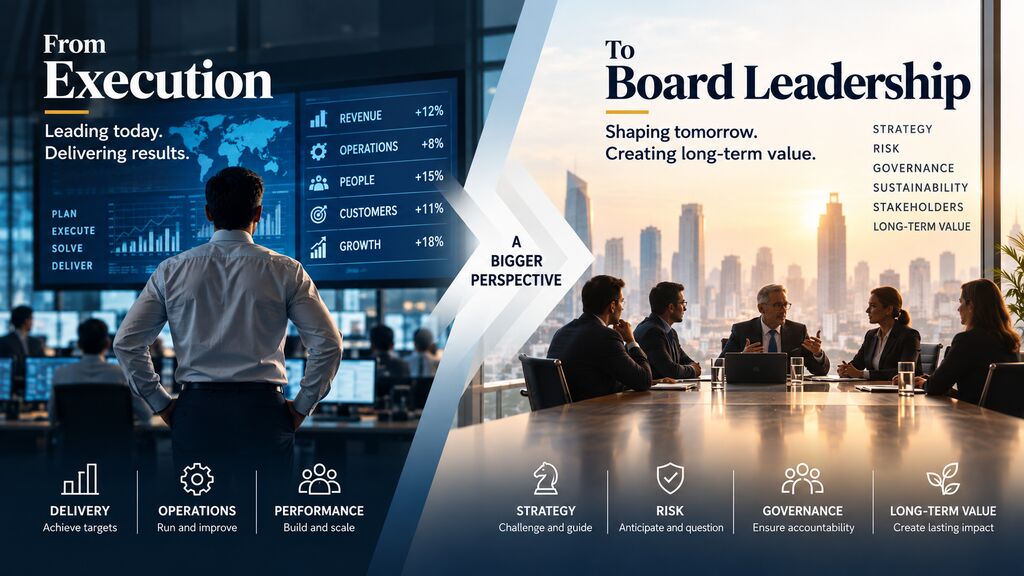
A great executive is not automatically a great director
This is one of the biggest misconceptions among senior professionals.
Someone can be an outstanding operator and still need to develop a different mindset for a board role. An executive asks, “How do we execute this?” A director asks, “Why are we doing this, what assumptions are behind it, and what could make it fail?”
Your executive experience is still the foundation. The challenge is translating it into governance relevance.
A transformation leader, for example, can demonstrate an understanding of strategic change. A CFO can bring capital allocation and risk expertise. A CHRO can contribute to succession and organisational resilience. The experience already exists; it needs to be presented in a way that shows why it matters in the boardroom.
The boardroom asks a different question
Your resume answers:
“What have you achieved?”
Your board profile should answer:
“What perspective will you bring to the boardroom?”
Suppose you have spent fifteen years leading international expansion. Saying that you opened operations in six countries is impressive. But what did you learn about geopolitical risk, market-entry decisions, regulation, stakeholder management and capital allocation?
Those experiences reveal judgement.
And judgement is one of the most valuable currencies in a boardroom.
What Trust Looks Like at Board Level
Trust may sound intangible, but boards experience it through very tangible signals.
A chairperson assessing a candidate may look at previous leadership roles, professional references, governance exposure, industry reputation, published thinking, interviews and online profiles. None of these necessarily tells the entire story. Together, however, they create a picture.
That picture answers an underlying question:
“Can we trust this person with the responsibility that comes with being a director?”
This is where executive credibility markers become important.
Executive credibility markers that matter
Not every credential carries equal weight.
A long list of conferences attended does not automatically demonstrate judgement. Calling yourself a “thought leader” does not prove expertise. Even a senior title tells only part of the story.
Strong credibility markers usually have evidence behind them. They can include significant leadership achievements, governance or advisory exposure, experience in regulated environments, crisis management, stakeholder leadership, succession involvement, capital allocation decisions, industry contributions and credible third-party recognition.
The important word is evidence.
Anyone can say they are strategic. Your career should show it.
Anyone can claim to understand risk. Your decisions should demonstrate it.
Anyone can describe themselves as a governance-minded leader. Your experience should give people a reason to believe it.
The strongest board positioning therefore does not manufacture credibility. It organises genuine evidence so that credibility becomes easier to recognise.
Why consistency matters more than constant visibility
There is a trap in executive personal branding: believing that more content automatically means more credibility.
It does not.
An executive posting every day about generic leadership lessons may be highly visible but not necessarily memorable for anything meaningful. Another executive may publish less frequently but consistently discuss transformation, governance, risk, technology or industry challenges.
The second approach often creates a stronger professional signal.
For a future non-executive director, the goal is not popularity. It is recognition.
You want people to associate your name with a specific area of expertise and a thoughtful point of view.
Beyond Visibility: Why Your Digital Footprint Matters
Try a simple exercise. Open a private browser window and search your full name.
Now imagine you are a board recruiter seeing those results for the first time.
What appears?
Perhaps your LinkedIn profile is followed by an old company biography, a conference page, an interview, an article and an outdated profile photograph.
Do all those results tell the same story?
If they do, your digital footprint is working for you. If they do not, there may be a credibility gap.
This is the real meaning of Beyond Visibility. Your digital presence should not merely prove that you exist. It should help people understand why your experience matters.
What happens when someone searches your name?
Senior professionals are increasingly researched before important conversations take place. A board recruiter or chairperson may search an executive after receiving an introduction.
They may look at your professional profile, company biography, interviews, articles and industry contributions.
No single result determines whether you receive a board opportunity. But together, those results influence the first impression.
That is why professional consistency matters.
Your executive personal branding strategy should make your expertise recognisable across different platforms rather than presenting disconnected versions of your professional identity.
Turning online presence into professional evidence
Start by identifying what you want to be known for at board level.
Perhaps it is digital transformation and consumer strategy. Perhaps it is finance, risk and capital allocation. Perhaps it is people strategy and succession. Perhaps it is technology, cybersecurity and AI governance.
Once that territory is clear, your professional presence can reinforce it naturally.
Your articles can explore relevant questions. Your LinkedIn profile can communicate the relevant experience. Your biography can connect achievements to strategic themes.
You are not trying to become famous.
You are trying to become credible and recognisable for something valuable.
How Board Readiness for Executives Is Built
There is no switch that suddenly makes an executive board-ready.
Board readiness for executives develops over time through experience, governance exposure, strategic thinking, professional credibility and consistency.
The important point is to start before you need the board seat.
If you wait until a board opportunity appears, suddenly creating a board biography, rewriting your profile and publishing governance content can feel artificial. Start earlier, and the reputation develops naturally.
Start with your board value proposition
Ask yourself:
Why would a board need someone like me?
Not why would a company hire you.
Why would a board benefit from your presence?
Your board value proposition and board bio should focus on the strategic value you can contribute rather than simply reproducing your career history.
A useful starting point is:
“I bring board-level perspective on…”
Complete that sentence honestly.
Then look for evidence in your career.
Translate achievements into board-level evidence
Consider the difference between these two statements:
“Led a digital transformation programme.”
Now consider:
“Led a multi-year digital transformation involving technology investment, operating-model redesign, cybersecurity considerations and organisational change.”
The second version reveals complexity.
It shows investment, risk, change and strategic decision-making.
That is what makes an executive achievement more relevant to a board.
Look through your career for similar experiences: acquisitions, restructurings, regulatory challenges, market expansion, crises, succession decisions or major investments.
These are not merely career stories.
They are evidence of how you make decisions under pressure.
Demonstrate judgement, not just expertise
Boards have access to information. They can commission research, hire consultants and receive management reports.
What they need from directors is perspective.
Take AI as an example. Saying, “AI will transform every industry” demonstrates awareness but little judgement.
Asking what business problem AI is solving, what assumptions support the investment, what risks exist, how returns will be measured and what management capabilities are required demonstrates a much more board-level perspective.
Expertise tells people what you know. Judgement shows them how you think.
From Executive Branding to Non-Executive Director Positioning
At some point, executives pursuing board roles need to change the question they are asking.
Instead of:
“How do I make my executive profile more impressive?”
Ask: “How do I make my board contribution easier to understand?”
That small change can completely transform your positioning.
Stop leading with the job title
Your title tells people where you sit.
It does not necessarily tell them what you see.
A CFO saying, “I am a CFO with 20 years of experience,” establishes seniority.
A CFO saying, “I bring two decades of experience across capital allocation, transformation, risk and international growth,” starts establishing a board proposition.
Your executive title is evidence of experience.
Your board positioning is the interpretation of that experience.
Your boardroom branding strategy should therefore focus on the perspective developed through your career.
Build a reputation around contribution
Strong board candidates are not necessarily those constantly announcing that they want board seats.
They are often the executives already contributing to wider business conversations.
They share useful perspectives. They understand governance questions. They contribute to industry discussions. They mentor others. They demonstrate curiosity beyond their immediate job description.
That creates something powerful: a reputation for contribution.
Someone may not know you personally, but they may know your work.
Someone may not have worked with you, but they may recognise your perspective.
That is Beyond Visibility in practice.
You are not simply trying to be seen.
You are trying to be remembered for the right reasons.
A Practical Board Readiness Framework
A simple way to assess board readiness for executives is to examine five areas together:
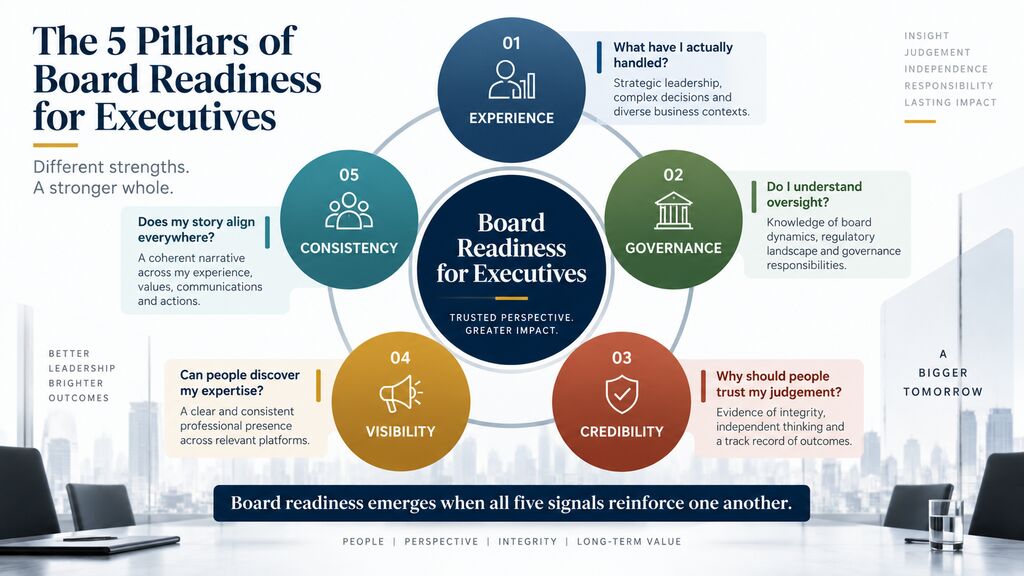
| Experience | What have I actually handled? | Strategic leadership and complex decisions |
| Governance | Do I understand oversight? | Board, committee, advisory or governance exposure |
| Credibility | Why should people trust my judgement? | Third-party evidence and demonstrated outcomes |
| Visibility | Can people discover my expertise? | Relevant and professional digital presence |
| Consistency | Does my story align everywhere? | Profiles and content reinforcing one narrative |
These areas work together.
Strong experience with weak visibility means your capability may be difficult to discover. Strong visibility without evidence creates noise rather than credibility. Strong experience and credibility with inconsistent positioning can still leave people unclear about where you fit.
The objective is alignment.
Your portfolio should support your positioning. Your professional profile should support your expertise. Your content should support your point of view. Your governance experience should support your claims.
When these elements reinforce each other, your professional reputation becomes much easier to understand.
Conclusion
The journey from executive leadership to the boardroom is not simply about collecting more achievements.
Most senior executives already have enough achievements.
The harder task is making those achievements legible as board-level value.
That is why board readiness for executives is ultimately a trust exercise.
Experience establishes competence. Governance exposure demonstrates familiarity with oversight. Executive credibility markers provide evidence. Your digital footprint makes that evidence discoverable. Consistency connects everything into one professional story.
And that changes how you should think about visibility.
You do not need to be everywhere.
You need to be credible where it matters.
You do not need to publish every day.
You need to demonstrate that you have something meaningful to say.
You do not need to look like a director before becoming one.
You need to make your existing experience understandable as board-level value.
Because when a chairperson, recruiter or fellow director searches your name, the real question is rarely, “Is this person visible?”
The better question is:
“Do I trust what I am seeing?”
That is the difference between visibility and reputation.
And ultimately, that is the difference between looking accomplished and looking board-ready.
FAQs
1. What is board readiness for executives?
Board readiness for executives is the combination of experience, governance understanding, strategic judgement, credibility, independence and professional maturity required to contribute effectively at board level.
2. Can a successful CEO become a board director immediately?
CEO experience provides a strong foundation, but it does not automatically establish board readiness. Prospective directors also need to demonstrate an understanding of governance, oversight, risk and constructive challenge.
3. Why does trust matter so much in board appointments?
Directors are trusted with confidential information and decisions involving significant strategic, financial and reputational consequences. Boards therefore need confidence in an individual’s judgement, independence and integrity.
4. What are executive credibility markers?
They are observable pieces of evidence supporting an executive’s professional reputation, including leadership achievements, governance exposure, advisory experience, industry recognition, published insights and credible recommendations.
5. Does an executive need a strong online presence to become board-ready?
Not necessarily. However, a credible digital footprint can help recruiters, chairs and directors understand an executive’s expertise and professional positioning.
6. How important is LinkedIn for aspiring board directors?
LinkedIn can be an important part of professional visibility. A strong profile can make an executive’s leadership experience, expertise and board interests easier to understand.
7. What should an executive include in a board biography?
A board biography should highlight strategic experience, relevant expertise, governance exposure, leadership responsibilities and the perspective the executive can bring to a board.
8. How can an executive demonstrate board-level thinking?
By discussing strategic trade-offs, risks, stakeholder considerations and long-term consequences rather than focusing only on operational execution.
9. What is the difference between executive branding and board branding?
Executive branding generally focuses on leadership achievements and professional expertise. Board branding focuses more strongly on governance perspective, strategic judgement, independence, risk awareness and board-level contribution.
10. Should aspiring directors post regularly about governance?
Not necessarily. Quality and relevance matter more than frequency. Thoughtful perspectives on meaningful business and governance questions can strengthen credibility.
11. How can I turn executive achievements into board evidence?
Look beyond the result and examine the decisions, risks, stakeholders and trade-offs involved. This reveals the judgement developed through the achievement.
12. What makes someone attractive to a board?
Relevant expertise, sound judgement, independence, diverse perspectives and the ability to contribute constructively to strategic discussions are all important elements.
13. Is visibility more important than experience?
No. Visibility cannot replace experience. It can, however, make genuine experience easier for the right people to discover and understand.
14. When should an executive start preparing for a board career?
Ideally, preparation should begin well before the desired appointment. Governance exposure, professional credibility and a strong board proposition take time to develop.
15. What is the biggest mistake executives make when preparing for board roles?
One common mistake is assuming that an impressive executive résumé automatically communicates board value. Executives need to translate their achievements into strategic insight, governance relevance and a clear board contribution.
Ready to Strengthen Your Board Presence and Unlock New Board Opportunities?
Your experience may already be board-ready. Your positioning should be too. Build a credible board profile that turns your expertise, achievements, and leadership story into a compelling board-level proposition.
Whether you’re an aspiring Independent Director, CXO, Founder, or senior executive, a well-positioned board profile can make all the difference in today’s competitive board landscape.
Schedule your complimentary Session here: