
Why Strategic Networking Matters for Board Careers
For many senior executives, becoming an Independent Director is a natural next step in their professional journey. After years of managing teams, leading business transformations, overseeing financial performance, or building organisations, they want to contribute their experience at the board level. Yet there is an important difference between being an accomplished executive and being recognised as a credible board candidate. Professional achievements establish your expertise, but strategic networking helps the right people understand how that expertise can contribute to board effectiveness.
Think about it this way: you may have an excellent professional track record, but if board chairs, fellow directors, governance professionals, and executive recruiters do not understand your potential contribution, your experience may never enter the appointment conversation. This is where strategic networking for an Independent Director career becomes valuable. It is not about collecting business cards, requesting favours, or approaching influential people only when a vacancy appears. It is about building meaningful relationships, demonstrating sound judgement, sharing relevant insights, and developing a reputation for responsible leadership.
In India, aspiring directors can combine relationship-building with formal preparation. The Independent Directors Databank maintained by the Indian Institute of Corporate Affairs (IICA) provides a formal platform for eligible and willing candidates and enables companies to search profiles against relevant criteria.
However, registration alone does not guarantee an appointment. Candidates must also establish their suitability, independence, governance knowledge, and ability to contribute to the board’s responsibilities.
This article explores practical boardroom networking strategies, explains how to approach independent director search firms, and outlines ways to turn professional relationships into credible board opportunities without compromising independence or professional ethics.
Table of Contents
Understanding the Independent Director Appointment Landscape
What boards look for beyond professional experience
An Independent Director is expected to contribute more than technical expertise or an impressive career history. Boards need individuals who can challenge assumptions constructively, examine risks, assess management decisions, protect the interests of the company and its stakeholders, and contribute to long-term strategy. Depending on the organisation’s needs, relevant experience may include finance, technology, cybersecurity, human resources, risk management, sustainability, international expansion, mergers and acquisitions, or regulatory compliance.
This changes the way aspiring directors should approach networking. Instead of introducing yourself only as a former CEO, CFO, CHRO, entrepreneur, or functional leader, explain the board-level problems you are equipped to help address. A former CFO, for example, could demonstrate how experience in capital allocation, financial controls, and acquisition due diligence supports stronger audit committee discussions. A technology executive might explain how experience in digital transformation and cyber-risk oversight can help a board ask better questions about technology investments.
The objective is to connect your professional experience with a company’s strategic priorities. When people in your network can clearly articulate the value you bring, they are better equipped to recognise relevant opportunities and make informed introductions.
How the Nomination and Remuneration Committee evaluates candidates
The Nomination and Remuneration Committee (NRC) plays an important role in director selection and board composition. For listed entities, the applicable regulatory framework includes requirements relating to the NRC’s role in recommending appointments and considering the skills required on the board. SEBI’s framework also addresses disclosures around the expertise sought and the candidate’s suitability for that skill set.
Consequently, networking should help you communicate three things clearly: what you know, how you exercise judgement, and where you can contribute. A warm introduction might bring your profile to someone’s attention, but the appointment process still requires proper assessment of qualifications, independence, experience, conflicts of interest, and the company’s requirements.
Before reaching out to potential board contacts, research the organisations you are interested in. Study their industry, business model, risk exposure, governance priorities, and board composition. Consider whether your experience fills a genuine capability gap. This allows you to have a focused conversation about board contribution rather than making a general request for a directorship.
Strategic Networking for Independent Director Opportunities
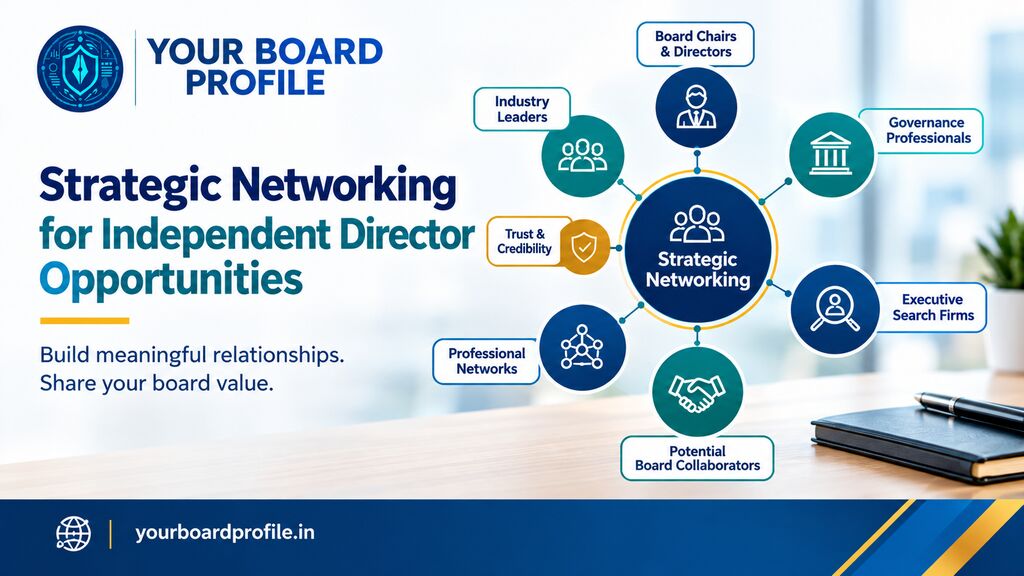
Build relationships before you need an appointment
One of the most common mistakes aspiring directors make is beginning their networking efforts only after deciding to pursue a board position. They contact former colleagues, senior industry leaders, and recruiters with an immediate request for an appointment. Although such outreach can sometimes produce a lead, it rarely substitutes for a well-established professional reputation.
Strategic networking works best when relationships develop over time. Stay connected with people who have observed your judgement, integrity, and leadership under pressure. Reconnect with former colleagues, industry peers, professional advisers, investors, and senior executives who have moved into board positions. Participate in meaningful conversations about business risks, governance developments, industry changes, and leadership challenges.
For example, a senior executive with extensive manufacturing experience might regularly exchange views with a former colleague who now serves on the board of a listed industrial company. Rather than immediately asking about vacancies, the executive could share a thoughtful perspective on supply-chain resilience or capital expenditure oversight. Over time, these exchanges help the other person understand the executive’s thinking and may reveal whether their expertise is relevant to a future board requirement.
The principle is simple: build professional trust before you ask for professional consideration. Your aim is not to turn every relationship into an appointment opportunity. It is to develop a credible network in which people understand your strengths and can make appropriate connections when circumstances align.
Develop a distinctive board value proposition
Networking becomes considerably more effective when you can explain your board value proposition in a few clear sentences. A long career summary is rarely the best opening for a conversation with a board chair or search consultant. What matters is your ability to connect experience with the organisation’s needs.
A useful board value proposition identifies your sector experience, specialist capabilities, governance perspective, and potential contribution to board or committee discussions. It should also demonstrate that you understand the distinction between executive management and board oversight.
Consider the following examples.
| Executive background | Potential board-level contribution | Networking conversation starter |
| Chief Financial Officer | Financial oversight, capital allocation, audit, and risk | “I have worked extensively on financial controls and acquisition due diligence, particularly where downside risks required closer examination.” |
| Technology executive | Digital strategy, cybersecurity, technology risk, and AI oversight | “My experience centres on connecting digital investments with measurable business outcomes and stronger risk governance.” |
| Human Resources leader | Succession planning, leadership assessment, culture, and remuneration | “I have led succession and leadership transformation initiatives that could inform board discussions on talent continuity.” |
| Manufacturing executive | Operational resilience, supply chains, safety, and expansion | “I bring experience in operational risk and large-scale transformation, with a focus on resilience and disciplined execution.” |
| Entrepreneur | Business scaling, innovation, market development, and strategy | “I have navigated growth decisions where governance structures needed to evolve alongside the business.” |
These are starting points, not claims to copy without evidence. Your own proposition should be supported by specific responsibilities, decisions, results, and examples of professional judgement.
For further guidance, explore Your Board Profile’s portfolio and consider how your career achievements can be presented in a way that communicates board-level relevance.
Turn executive relationships into a board advisory network
A board advisory network is a group of professional relationships that helps you understand governance expectations, improve your readiness, exchange knowledge, and identify relevant opportunities. It may include current directors, company secretaries, governance specialists, corporate lawyers, auditors, industry experts, investors, executive recruiters, and experienced former executives.
The value of this network comes from the diversity and quality of its perspectives. A serving director may help you understand how board discussions differ from executive meetings. A company secretary may explain governance processes and documentation. A search consultant may offer insights into the capabilities organisations are currently seeking. A former CEO may help you recognise where your leadership experience translates into effective oversight.
Build these relationships through genuine professional engagement. Attend governance seminars, contribute to industry discussions, participate in relevant professional associations, and ask thoughtful questions. When you seek advice, be specific. Instead of asking, “Can you help me become a director?”, consider asking, “Which aspects of my experience would be most relevant to an audit committee, and what evidence would help demonstrate that capability?”
This approach makes the conversation easier for the other person and gives you more actionable feedback. It also ensures that your network grows around shared learning and professional credibility rather than transactional expectations.
How to Get Board Appointments Through Networking
Engage with current directors and governance professionals
Current directors can offer useful perspectives on boardroom expectations, but the quality of your engagement matters more than the seniority of the person you contact. Approach potential contacts with a clear reason for the conversation, an understanding of their professional background, and a genuine interest in their insights.
Start with people who already know your work. Former board members, advisers, investors, mentors, and colleagues may be able to provide informed feedback on your readiness. If you reach out to someone you do not know, refer to a specific professional interest or published insight rather than sending a generic message asking for a board appointment.
A useful networking message might read:
I have been exploring how my experience in financial transformation and risk oversight could translate into board-level contribution. Given your experience in corporate governance, I would value your perspective on the capabilities boards increasingly seek in directors with a finance background.
The message opens a professional conversation without putting the recipient under pressure to offer an opportunity.
Be equally careful about follow-ups. Thank people for their time, act on relevant advice, and share a brief update when you have made progress. A relationship becomes stronger when the other person sees that their guidance was useful and that you approach your development seriously.
Connect with independent director search firms
Independent director search firms and executive recruiters for board positions can help organisations identify candidates whose expertise matches their board requirements. Their work may involve understanding a company’s strategy, assessing board composition, defining the desired capabilities, identifying potential candidates, and supporting the selection process.
For aspiring directors, the first step is to identify search consultants who handle board, non-executive director, chairperson, or governance appointments in relevant sectors. Review their areas of specialisation and the types of assignments they publicly describe. For example, a consultant focused on financial services boards may be more relevant to a banking risk executive than a recruiter whose practice concentrates on consumer technology.
Approach recruiters with a concise, board-focused profile. Explain your sector expertise, relevant governance exposure, committee capabilities, and the types of organisations where your experience may be useful. Be transparent about your current executive responsibilities, potential conflicts, and any limitations on your availability.
A recruiter should understand not only what you have accomplished but also the kinds of board problems you can help solve. Avoid repeatedly sending the same CV without context or asking for immediate placement. Instead, establish a professional relationship, request feedback where appropriate, and provide meaningful updates when your experience or governance preparation changes.
You can also review specialist guidance, such as this overview of board and non-executive director search firms in India, to better understand the board recruitment landscape. Treat any directory or editorial guide as a starting point for your own due diligence rather than an endorsement.
Use LinkedIn and thought leadership strategically
LinkedIn can support board-career networking when it demonstrates your thinking rather than merely announcing your ambitions. A profile built exclusively around job titles, operational achievements, and performance metrics may communicate executive competence, but it may not reveal your approach to governance, accountability, independent judgement, or board oversight.
Strengthen your profile by explaining how you approach strategic decisions, assess risks, manage stakeholder expectations, and balance commercial objectives with responsible oversight. Where appropriate, publish thoughtful commentary on governance developments, industry risks, succession planning, technology oversight, or long-term value creation.
For example, a technology leader could write about the questions boards should ask before approving a major AI investment. A finance leader could discuss the importance of independent assumptions in acquisition valuations. A sustainability executive could explore how boards can distinguish measurable progress from unsupported claims.
The aim is not to publish frequently for its own sake. It is to create a consistent, evidence-based professional identity that gives board contacts a reason to remember you. Participate constructively in discussions led by directors and governance professionals, and share useful perspectives without overstating your expertise.
Your online presence should reinforce your real-world reputation. It cannot replace sound judgement, relevant experience, due diligence, or the trust built through professional relationships.
For additional ideas, read Executive Personal Branding Beyond Job Title and Boardroom Branding Begins.
Build Board Readiness Before Approaching Decision-Makers
Strengthen governance knowledge and boardroom communication
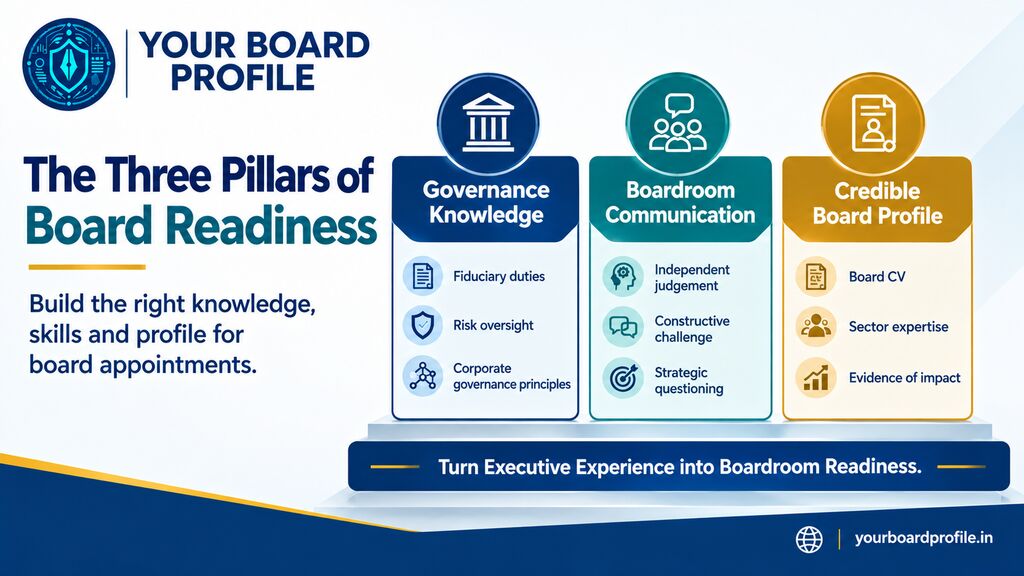
Networking can introduce you to the right people, but board readiness helps determine whether you are a credible candidate. Before pursuing appointments, understand the responsibilities associated with independent directorships, including fiduciary duties, financial oversight, risk management, conflicts of interest, board evaluation, and the distinction between governance and day-to-day management.
In India, the IICA Independent Directors Databank offers relevant learning resources and information about the applicable proficiency self-assessment requirements. Its official self-assessment guidance outlines the assessment process and the relevant subject areas, including company law, securities law, basic accountancy, and corporate governance.
Candidates should check the current rules and their individual circumstances to establish the requirements that apply to them.
Equally important is the ability to communicate effectively in a boardroom. Directors must be able to ask difficult questions respectfully, challenge assumptions without becoming adversarial, and distinguish between information that is interesting and information that is material to a decision.
Practise explaining complex business issues in a concise, balanced manner. Prepare examples of situations in which you questioned an assumption, escalated a risk, challenged an overly optimistic forecast, or supported a difficult decision after considering competing perspectives. These examples help demonstrate how you exercise judgement, rather than simply describing yourself as a strategic thinker.
For a broader perspective, review the OECD Principles of Corporate Governance and consider how recognised governance principles apply to your industry and experience.
Create a credible board profile and evidence of impact
Your board profile should make it easy for someone unfamiliar with your career to understand your potential contribution. It is not simply a shortened executive CV. It should connect your experience to board responsibilities and provide credible evidence of your judgement, oversight capabilities, and sector knowledge.
A useful profile typically highlights your leadership experience, relevant governance exposure, financial and strategic capabilities, risk oversight, committee-relevant expertise, and significant professional achievements. It should also distinguish between responsibilities you personally held and outcomes delivered by the wider organisation.
For example, stating that you led a major acquisition is less informative than explaining how you evaluated strategic fit, assessed valuation assumptions, identified integration risks, and helped decision-makers understand the potential downside. The second description offers greater insight into your decision-making approach.
Prepare a board CV and a concise board biography that can be shared when appropriate. Ensure that all claims are accurate, verifiable, and consistent with your public profile. Review the Your Board Profile services to explore professional support for board CV development, LinkedIn positioning, and board-readiness preparation.
Your networking conversations become more productive when your profile provides a clear, credible account of what you can contribute. A strong introduction may open a door; a well-supported profile gives the recipient a reason to consider you seriously.
Networking Channels Compared: Where Should You Focus?
Not every networking channel serves the same purpose. Some help you build governance knowledge, others help you improve visibility, and still others may introduce you to an actual appointment process. A balanced approach is usually more effective than depending on one channel.
| Networking channel | Primary benefit | Recommended approach | Important limitation |
| Current and former directors | Practical insights and professional credibility | Seek informed conversations and feedback | Advice does not guarantee an appointment |
| Independent director search firms | Visibility in relevant search processes | Share a focused, accurate board profile | Recruiters work against specific client requirements |
| IICA Independent Directors Databank | Formal profile visibility and learning resources | Maintain accurate details and check applicable requirements | Registration does not guarantee selection |
| LinkedIn and thought leadership | Demonstrates expertise and professional perspective | Share useful, evidence-based governance insights | Online visibility cannot replace experience |
| Industry and governance forums | Peer learning and relationship development | Participate consistently and contribute thoughtfully | Attendance alone rarely builds meaningful trust |
| Professional advisers and mentors | Feedback, introductions, and broader perspectives | Ask focused questions and follow through on advice | Recommendations must not replace formal due diligence |
The IICA Databank is particularly relevant because companies can search profiles using criteria such as expertise, qualifications, sector exposure, and professional experience. This makes accurate profile information important. Think of the databank as one component of your board-career strategy, not a substitute for building relationships and demonstrating readiness.
You can also follow developments in board governance and director recruitment through credible professional resources. For listed companies, consult the SEBI website for applicable regulatory materials and updates. When discussing a specific appointment, always verify the current requirements and the company’s selection process rather than relying on informal advice alone.
A Practical 90-Day Strategic Networking Plan
A structured plan makes networking easier to sustain alongside a demanding executive role. The objective of the first 90 days is not to secure a directorship on a fixed deadline. It is to improve your readiness, clarify your positioning, and develop a network that understands your potential contribution.
Days 1–30
Foundation
Clarify your board value proposition
Review your professional experience, identify two or three areas of board-level contribution, and assess any gaps in governance knowledge. Prepare a board-focused CV, update your LinkedIn profile, and identify 15–20 relevant professional contacts across directors, advisers, recruiters, and governance experts.
Days 31–60
Engagement
Start meaningful conversations
Reach out to a manageable number of contacts each week. Request insights rather than appointments, attend relevant governance events, and engage with thoughtful industry discussions. Identify suitable search consultants and investigate the IICA Databank requirements applicable to your situation.
Days 61–90
Credibility
Build on relationships and demonstrate expertise
Follow up on useful conversations, publish one or two well-researched governance insights, and seek feedback on your board profile. Map organisations where your expertise may be relevant and assess potential conflicts or independence concerns before pursuing specific opportunities.
Track progress through meaningful indicators rather than vanity metrics. For example, monitor the number of substantive conversations, introductions made with permission, feedback received, governance learning activities completed, and relevant opportunities identified.
A spreadsheet can be sufficient. Record the contact’s professional area, the date of your last interaction, the main insight exchanged, and the next appropriate follow-up. Avoid treating relationships as a sales pipeline; the purpose is to remain organised while respecting other people’s time.
At the end of 90 days, assess what you have learned. Are people beginning to understand your board value proposition? Have you identified gaps in your readiness? Are you building relationships in the sectors and governance communities most relevant to your expertise? These are meaningful signs of progress even if no appointment has materialised.
Common Networking Mistakes to Avoid
Strategic networking requires patience, discretion, and a clear understanding of professional boundaries. Several avoidable mistakes can weaken an otherwise strong board candidacy.
Asking for appointments too early: A first conversation should not automatically become a request for a directorship. Establish relevance and trust before discussing specific opportunities.
Relying exclusively on senior contacts: Board opportunities may emerge through company secretaries, specialist advisers, professional associations, investors, and peers. A diverse network offers broader perspectives than a list of influential names.
Using the same message for everyone: A generic message does little to show why a conversation is relevant. Tailor your approach to the recipient’s experience and your genuine reason for connecting.
Confusing executive success with board readiness: Running a large business demonstrates leadership, but an effective director must also understand oversight, accountability, collective decision-making, and independent judgement.
Treating social media visibility as proof of competence: Frequent posting is not the same as governance expertise. Prioritise accurate analysis and meaningful professional engagement.
Ignoring independence and conflicts of interest: Before pursuing an appointment, carefully assess professional relationships, financial interests, competing responsibilities, and other circumstances that may affect eligibility or perceived independence. Networking should never encourage you to bypass required disclosures or formal selection procedures.
Expecting guaranteed results: Neither a recruiter, a mentor, a professional network, nor a databank can guarantee a board appointment. Selection depends on the organisation’s needs, eligibility, suitability, board composition, and the formal appointment process.
Ultimately, the strongest networking strategy combines visibility with substance. You want people to know your expertise, understand your judgement, and trust your professional conduct. That reputation takes time to establish, but it can support your board-career ambitions well beyond a single appointment.
Conclusion: Turn Professional Visibility into Boardroom Credibility
Becoming an Independent Director requires more than a distinguished executive career. It requires the ability to translate your experience into board-level value, demonstrate governance readiness, and build relationships with people who understand the responsibilities of effective corporate oversight.
Strategic networking brings these elements together. Start by defining the contribution you can make, then develop relationships with current directors, governance professionals, search consultants, and relevant industry peers. Use LinkedIn and thought leadership to communicate your perspective, strengthen your board profile, and participate in governance conversations with substance. Combine these efforts with formal learning, appropriate registration, and a clear understanding of independence requirements.
Remember that networking is not about finding someone who can simply recommend you. It is about building a professional reputation that makes your suitability understandable and credible when a relevant opportunity arises.
For senior executives and aspiring directors, the next step is to review how your current professional identity aligns with board expectations. Explore Your Board Profile’s resources and articles to develop your understanding of boardroom positioning, governance, and director readiness.
Ready to strengthen your boardroom readiness? Review your experience, identify your strongest board-level contributions, and build a networking plan around the relationships and governance capabilities that matter most. A deliberate approach can help turn years of executive experience into a clearer, more credible board-career proposition.
Frequently Asked Questions (FAQs)
1. How can I become an Independent Director in India?
Start by assessing your professional experience, governance knowledge, and suitability for board-level responsibilities. Develop a board-focused CV, understand applicable eligibility requirements, explore the IICA Independent Directors Databank, and build relationships with directors, governance professionals, and relevant search consultants. Networking should complement, not replace, formal appointment procedures.
2. Why is strategic networking important for aspiring Independent Directors?
Strategic networking helps aspiring directors develop professional credibility, understand board expectations, receive feedback on their readiness, and become visible to people involved in director selection. It also helps them understand which industries and board responsibilities align with their experience.
3. How do I get board appointments through networking?
Build genuine relationships with current directors, company secretaries, governance advisers, executive recruiters, and industry peers. Clearly communicate your board value proposition, share relevant professional insights, and maintain contact without repeatedly requesting appointments. Selection ultimately depends on suitability, eligibility, and the organisation’s requirements.
4. What is a board advisory network?
A board advisory network is a group of professional contacts who can help you understand governance practices, assess your readiness, exchange industry knowledge, and identify relevant opportunities. It may include serving directors, experienced executives, governance specialists, investors, and search consultants.
5. How can I approach independent director search firms?
Research firms that handle board and non-executive director appointments in your sector. Contact relevant consultants with a concise board profile highlighting your expertise, governance exposure, and potential contribution. Seek professional feedback and maintain accurate information about your experience and availability.
6. Does registering with the IICA Independent Directors Databank guarantee an appointment?
No. The databank provides a formal platform for profile visibility, learning resources, and company searches. Registration does not guarantee selection. Candidates must still satisfy applicable requirements and demonstrate suitability for the particular appointment.
7. What is the role of the Nomination and Remuneration Committee (NRC)?
The NRC has responsibilities relating to director and senior-management nominations, remuneration policies, and other matters prescribed by applicable law and regulations. In director selection, the committee considers the board’s requirements and the candidate’s suitability against relevant criteria.
8. What should an aspiring Independent Director include in a board CV?
A board CV should highlight relevant leadership experience, strategic judgement, financial understanding, risk oversight, governance exposure, sector expertise, and significant achievements. It should demonstrate how the candidate can contribute to board discussions rather than simply reproduce an executive job history.
9. Can LinkedIn help me find Independent Director opportunities?
Yes. LinkedIn can help you build professional visibility, connect with governance professionals, engage with directors, and communicate your expertise through thoughtful content. However, an effective profile and online network cannot guarantee an appointment or substitute for board readiness.
10. How can senior executives demonstrate board readiness?
Senior executives can strengthen board readiness through governance education, financial and regulatory knowledge, boardroom communication practice, and a clear understanding of director responsibilities. They should also prepare evidence of independent judgement, constructive challenge, risk awareness, and responsible decision-making.
11. What are the best boardroom networking strategies for CXOs?
CXOs should focus on relationships with current directors, sector specialists, professional advisers, and relevant search consultants. Participating in governance forums, sharing informed perspectives, and communicating a clear board value proposition can make networking more purposeful.
12. How long does it take to secure an Independent Director appointment through networking?
There is no fixed timeline. It depends on the candidate’s experience, readiness, network, industry relevance, and the availability of suitable opportunities. Building credible relationships and strengthening governance capabilities should be treated as an ongoing professional-development process rather than a guaranteed short-term route to appointment.
13. What is the difference between executive networking and board-level networking?
Executive networking often focuses on career progression, business opportunities, operational collaboration, and leadership roles. Board-level networking places greater emphasis on governance, oversight, strategic judgement, risk management, accountability, and the candidate’s ability to contribute independently to collective decision-making.
14. How can I communicate my board value proposition effectively?
Identify the two or three areas where your experience can make a meaningful board-level contribution. Support these strengths with specific examples, explain their relevance to governance or strategy, and communicate them clearly in your board CV, LinkedIn profile, and professional conversations.
15. How can Your Board Profile help aspiring Independent Directors?
Your Board Profile offers services and resources related to board CVs, LinkedIn profile enhancement, personal branding, board-readiness assessments, and coaching. These can help professionals present their experience more effectively and develop a clearer board-career proposition. Explore the Your Board Profile services page for further information.
Ready to Build Meaningful Connections for Your Independent Director Journey?
Becoming an Independent Director requires more than professional experience—it takes strategic networking, governance knowledge, boardroom readiness, and a clear board value proposition. Build meaningful relationships with directors, governance professionals, and industry leaders while positioning your expertise for relevant board opportunities.
Whether you are a CXO, senior executive, entrepreneur, or aspiring Independent Director, take a proactive step toward strengthening your board profile, expanding your professional network, and communicating your potential board-level contribution.
Schedule your complimentary session here:
https://calendly.com/dramitnagpal
Share this post: Facebook | X | LinkedIn