
An experienced executive may have decades of leadership experience, a strong professional reputation, and an impressive track record. Yet, when it comes to securing an Independent Director position, one important question remains: can a board clearly see the value this professional will bring to its decision-making?
That is where boardroom branding becomes important. Becoming an Independent Director is not simply about reaching a senior position or adding another credential to your CV. It is about demonstrating sound judgement, governance knowledge, strategic thinking, independence, and the ability to contribute meaningfully to board discussions.
For senior executives, CXOs, entrepreneurs, and professionals aspiring to join corporate boards, a deliberate boardroom branding strategy can help connect professional experience with the expectations of boards, Nomination and Remuneration Committees (NRCs), and board search firms.
This article explores the 8 pillars of boardroom branding, explaining how you can strengthen your board readiness, communicate your board value proposition, establish governance credibility, and prepare for suitable board opportunities in the Indian corporate environment.
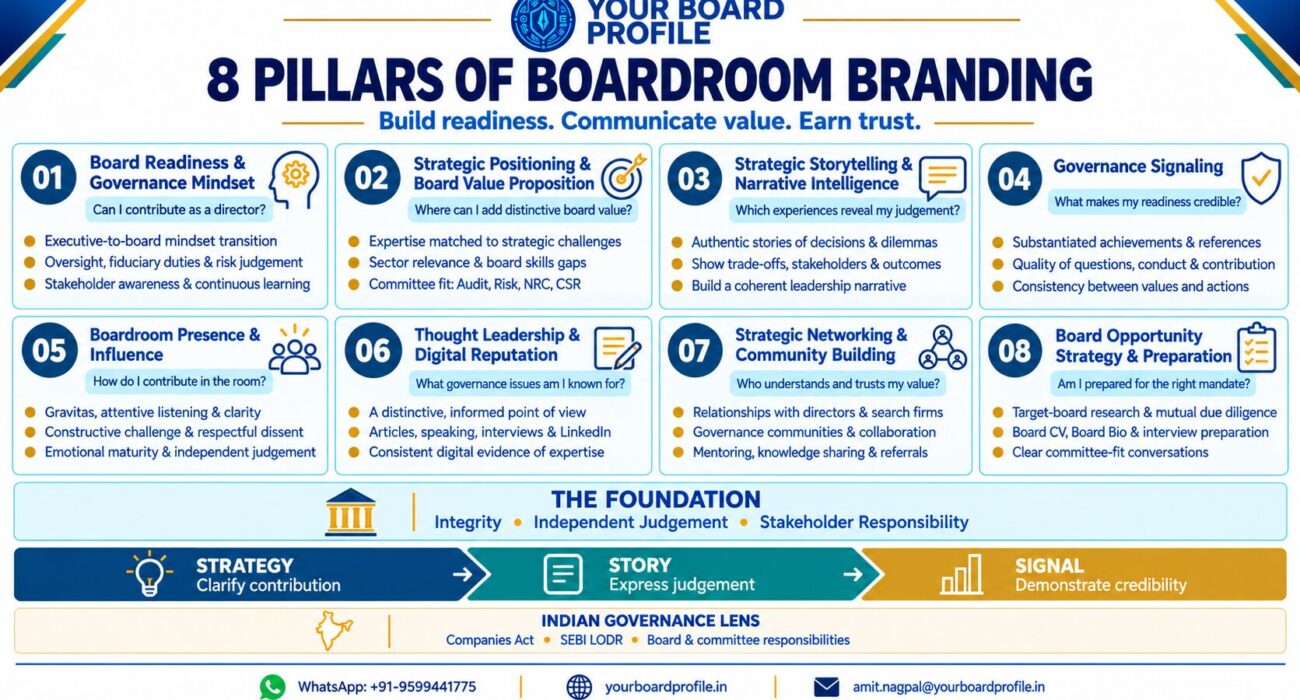
The framework follows the eight pillars presented in the accompanying infographic: Board Readiness and Governance Mindset; Strategic Positioning and Board Value Proposition; Strategic Storytelling and Narrative Intelligence; Governance Signalling; Boardroom Presence and Influence; Thought Leadership and Digital Reputation; Strategic Networking and Community Building; and Board Opportunity Strategy and Preparation.
The central idea is simple: build readiness, communicate value, and earn trust.
Table of Contents
Why Boardroom Branding Matters
Think about two senior professionals with comparable experience. Both have led large teams, managed budgets, and contributed to business growth. One presents a lengthy executive CV filled with job responsibilities, while the other clearly explains how their experience in financial oversight, enterprise risk, business transformation, or stakeholder management can help a board make better decisions. Which professional makes their potential contribution easier to understand?
The second professional has translated executive experience into a compelling board value proposition. That is the foundation of boardroom branding.
A strong boardroom brand is not about self-promotion or creating an impressive online personality. It is about making your governance capabilities, independent judgement, professional integrity, and strategic contribution visible through credible evidence. It helps a board understand not only what you have achieved but also how your experience may support its future priorities.
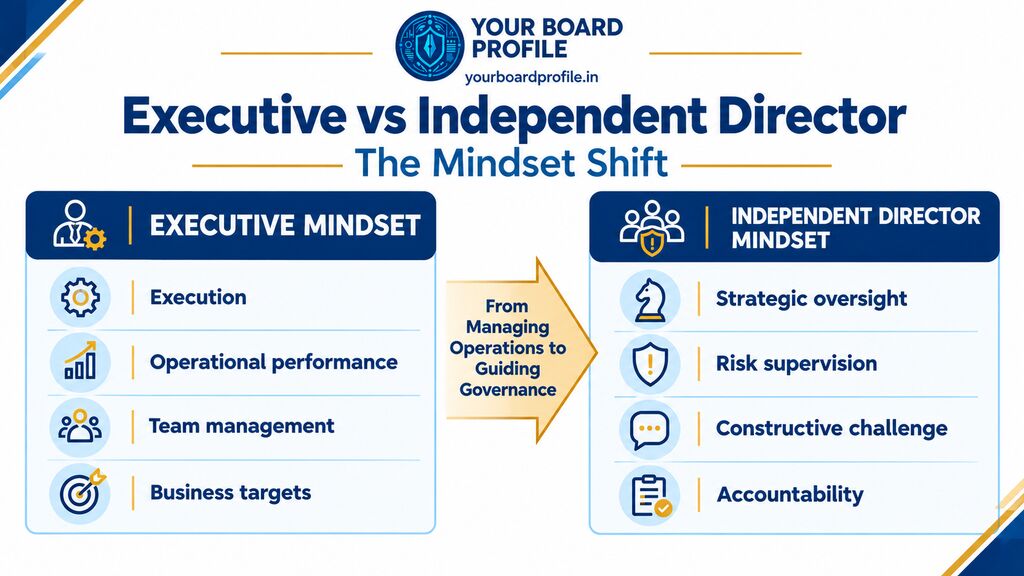
For aspiring directors, the challenge is to move from an executive mindset to a board-level perspective. Executives typically focus on implementation and operational performance. Directors, by contrast, contribute through oversight, constructive challenge, strategic guidance, risk supervision, and accountability. Your professional brand must reflect this distinction.
The eight pillars provide a practical framework for making that transition. They connect competence with communication and communication with credibility, helping you prepare for board opportunities without treating visibility as a substitute for capability.
Understanding the Independent Director Role in India
An Independent Director contributes objective judgement, oversight, and a wider stakeholder perspective to the board. The role involves more than attending meetings or lending professional prestige to a company. Directors must engage with strategy, financial performance, risk, leadership accountability, governance practices, and the long-term interests of the company.
India’s corporate governance framework provides an important foundation for this responsibility. Section 149 of the Companies Act, 2013 addresses independent directors, while Schedule IV sets out a code for their professional conduct. For listed entities, the Securities and Exchange Board of India (SEBI) Listing Obligations and Disclosure Requirements Regulations, 2015, commonly known as SEBI LODR, establish additional governance and disclosure requirements.
You can consult the Companies Act, 2013 and the latest SEBI LODR Regulations for the relevant legal framework.
Eligibility, Governance and Regulatory Expectations
Before pursuing an Independent Director position, understand the applicable eligibility conditions, independence criteria, disclosure requirements, responsibilities, and potential conflicts of interest. Depending on your circumstances and the type of appointment, you may also need to understand the Independent Directors Databank and the applicable proficiency-test requirements or exemptions.
The Indian Institute of Corporate Affairs (IICA) provides resources relevant to independent directors and corporate governance. You can also explore this practical guide to the Independent Director IICA Proficiency Test.
Remember that legal eligibility is only one part of the journey. A professional may satisfy the formal requirements and still need to demonstrate sector knowledge, committee suitability, sound judgement, and the ability to contribute to a particular board. Boardroom branding helps communicate these qualities; it does not replace statutory compliance, independence, or actual competence.
The 8 Pillars of Boardroom Branding
The eight pillars work together as a connected system rather than eight independent personal-branding activities. Governance knowledge gives you the foundation, strategic positioning clarifies your contribution, storytelling explains your judgement, and governance signalling provides evidence of credibility. Boardroom presence, thought leadership, networking, and opportunity preparation then help you communicate that value to the right people.
1. Board Readiness and Governance Mindset
Develop the knowledge, judgement, and oversight capabilities required to contribute effectively as a director.
2. Strategic Positioning and Board Value Proposition
Identify the distinctive value your experience can bring to a board and its strategic priorities.
3. Strategic Storytelling and Narrative Intelligence
Explain the decisions, trade-offs, and lessons behind your achievements.
4. Governance Signalling
Make your integrity, independent judgement, and governance competence visible through credible evidence.
5. Boardroom Presence and Influence
Demonstrate clarity, attentive listening, respectful dissent, and the ability to ask meaningful questions.
6. Thought Leadership and Digital Reputation
Build a professional digital presence that reflects your understanding of governance and strategic issues.
7. Strategic Networking and Community Building
Develop genuine relationships with directors, governance professionals, and relevant search networks.
8. Board Opportunity Strategy and Preparation
Research target companies and prepare your Board CV, professional biography, and committee-fit narrative.
Pillar 1 — Board Readiness and Governance Mindset
The first pillar is about becoming ready for the responsibilities of an Independent Director, not merely expressing interest in a board position. Your executive career may have taught you how to run a business, manage people, deliver financial results, and execute a strategy. A board, however, needs someone who can examine the assumptions behind management decisions, identify material risks, and evaluate whether the organisation is creating sustainable value.
Develop your understanding of financial statements, internal controls, risk management, corporate governance, regulatory compliance, stakeholder interests, and board responsibilities. Familiarise yourself with emerging issues such as cybersecurity, artificial intelligence, geopolitical uncertainty, succession planning, and reputational risk. You do not need to become an expert in every subject, but you should be able to recognise important questions, understand the implications, and know when specialist advice is required.
The mindset shift is equally important. Instead of asking, “How would I solve this operational problem?”, learn to ask, “What assumptions support management’s proposed solution? What could go wrong? What information does the board need before making a decision?” These questions reflect the transition from executive implementation to board oversight.
For a structured starting point, read about the Independent Director role and the shift towards governance. Use the insights to assess your existing strengths and identify areas where you need additional learning.
Pillar 2 — Strategic Positioning and Board Value Proposition
Your board value proposition answers a fundamental question: Why would a board benefit from your appointment?
A long career history does not automatically provide a clear answer. Boards have specific business challenges, skill requirements, sector priorities, and committee responsibilities. Your task is to connect your experience with the challenges a company may face rather than present yourself as a general-purpose candidate.
For example, a CFO who has managed complex acquisitions, strengthened internal controls, and improved capital allocation may offer relevant experience to an organisation seeking stronger financial oversight. A technology leader who has supervised digital transformation and cybersecurity programmes may bring a useful perspective to a company navigating digital disruption. A human resources leader with experience in executive succession, remuneration frameworks, and organisational culture may have relevant strengths for a Nomination and Remuneration Committee.
| Executive background | Potential board value proposition | Possible area of relevance |
| Finance and audit | Financial reporting, capital allocation, internal controls | Audit Committee |
| Risk and compliance | Enterprise risk, regulatory oversight, control frameworks | Risk Committee |
| Human resources | Leadership succession, remuneration, board effectiveness | NRC |
| Technology | Cybersecurity, digital transformation, AI oversight | Technology and risk oversight |
| Sustainability and social impact | ESG oversight, sustainability strategy, social responsibility | CSR and relevant sustainability oversight |
| Business strategy | Growth, acquisitions, transformation, competitive positioning | Board strategy discussions |
Committee responsibilities and eligibility depend on the applicable legal framework, company circumstances, and the individual’s qualifications and experience.
Your positioning should be specific enough to be memorable but broad enough to reflect the value you can genuinely offer. Identify two or three areas in which your experience is strongest, then support each with credible examples. This is more persuasive than claiming expertise in every aspect of governance.
You can strengthen this process by reviewing Your Board Profile’s services and exploring how executive personal branding goes beyond a job title.
Pillar 3 — Strategic Storytelling and Narrative Intelligence
Boards rarely benefit from a list of achievements without context. They need to understand how you think, how you handle uncertainty, and whether you can distinguish short-term performance from long-term organisational value. This is where strategic storytelling and narrative intelligence become valuable.
Consider an executive who writes, “Led a major acquisition and delivered business growth.” The statement communicates an outcome but reveals little about the quality of the person’s judgement. A stronger account explains how the executive evaluated the acquisition, questioned optimistic assumptions, assessed integration risks, considered stakeholder implications, and communicated the downside scenarios to decision-makers.
The difference is not dramatic language. It is the explanation of reasoning.
When preparing your board stories, focus on three elements: the strategic challenge, the judgement exercised, and the outcome or lesson. Include the trade-offs involved and acknowledge what you learned. A credible account of a difficult decision can reveal more about your readiness than several generic claims about leadership excellence.
Narrative intelligence also means adapting the same experience for different audiences. An NRC may be interested in leadership development and succession experience, while an Audit Committee may focus on financial controls, risk, and reporting. Your underlying experience remains the same, but the relevance of the story changes with the board’s needs.
Build a small collection of evidence-based stories from your career. Each should demonstrate a different capability, such as challenging a proposal, managing a crisis, protecting stakeholder interests, or navigating a conflict of priorities. These stories can strengthen your Board CV, interview preparation, professional biography, and board-level conversations.
Pillar 4 — Governance Signalling
Governance signalling is the way an aspiring director makes governance competence, independent judgement, and trustworthiness visible through credible actions, evidence, and communication.
A professional may possess strong capabilities, but a prospective board cannot assess them from an unsupported statement such as “I have excellent governance skills.” It needs meaningful indicators. Examples include evidence of risk oversight, transparent decision-making, responsible handling of conflicts, constructive challenge, ethical leadership, and a record of accountability.
Imagine a CFO involved in a proposed acquisition. The financial projections appear attractive, but the assumptions depend on optimistic revenue growth. Instead of simply endorsing the proposal, the CFO requests an independent valuation, examines downside scenarios, and ensures that material risks are presented to the decision-makers. The value of this example lies not merely in financial expertise; it shows how judgement, challenge, and accountability work together.
Your governance signals should be consistent across your professional conduct, public statements, career examples, and references. Integrity cannot be established through a polished LinkedIn profile alone. It is reinforced by actions, reliable evidence, transparency, and the willingness to raise uncomfortable questions when necessary.
Explore governance signalling for Independent Directors to understand how aspiring directors can communicate their credibility more effectively. Remember, signalling is not about manufacturing an image. It is about making genuine competence easier to evaluate.
Pillar 5 — Boardroom Presence and Influence
Boardroom presence is often misunderstood as confidence, authority, or the ability to speak frequently. In practice, effective boardroom presence is about contributing thoughtfully, listening carefully, and asking questions that improve the quality of discussion.
An Independent Director must be capable of constructive challenge without turning every disagreement into a confrontation. When management presents a growth plan, for instance, an effective director might ask how the projections account for changing market conditions, whether the organisation has sufficient execution capacity, and what indicators would trigger a reassessment of the plan.
Notice the difference between questioning a decision and attacking the people who made it. The first strengthens governance; the second can damage trust and discourage open discussion.
Develop your communication by practising concise explanations, evidence-based questions, and respectful disagreement. Learn to distinguish between information that belongs in a board paper and issues that genuinely require discussion. Equally important, recognise when to listen, when to seek clarification, and when to challenge an assumption that could materially affect the organisation.
Emotional maturity is a crucial part of this pillar. Board discussions may involve competing interests, incomplete information, and difficult trade-offs. The ability to remain composed, exercise independent judgement, and consider different perspectives can make your contribution more effective than an impressive speaking style alone.
Pillar 6 — Thought Leadership and Digital Reputation
Your professional reputation increasingly extends beyond the organisations where you have worked. Board members, recruiters, and search professionals may review your public profile, articles, interviews, or professional contributions when assessing your expertise and interests.
This makes digital reputation for directors an important part of boardroom branding. A useful digital presence should communicate a clear point of view about issues relevant to your experience. Rather than posting general leadership quotations, consider writing about a governance question you understand well: the board’s role in AI oversight, the relationship between cybersecurity and enterprise risk, capital allocation under uncertainty, or the challenges of leadership succession.
Quality matters more than volume. A carefully reasoned article, a relevant industry discussion, or a well-prepared interview can provide stronger evidence of your thinking than frequent posts with little substance. Be accurate, protect confidential information, distinguish facts from opinions, and avoid presenting yourself as an expert in areas where your experience is limited.
Your digital profile should also tell a consistent story. Your headline, summary, career history, and public contributions should support the board value proposition you have defined. If you are positioning yourself around finance and risk oversight, for example, your content should demonstrate an informed understanding of those areas.
Explore the Your Board Profile blog for ideas on governance and boardroom branding topics. The objective is not to become an online celebrity. It is to establish a credible, relevant, and verifiable professional reputation.
Pillar 7 — Strategic Networking and Community Building
Many board opportunities emerge through professional relationships, referrals, and discussions about a company’s future needs. This makes strategic networking valuable, but it should not be confused with collecting contacts or repeatedly asking influential people for appointments.
Build relationships with existing directors, governance professionals, company secretaries, industry associations, executive search consultants, and peers with complementary experience. Participate in relevant discussions, share useful insights, and demonstrate that you understand the responsibilities of a director. The strongest professional relationships develop through mutual respect and a genuine exchange of knowledge.
Community participation can also improve your understanding of board expectations. Conversations with experienced directors may expose you to issues that are not immediately visible from an executive role, such as committee dynamics, board evaluation, director independence, and the balance between oversight and management autonomy.
A practical approach is to identify a focused group of professionals whose experience aligns with your intended board contribution. Maintain relationships consistently rather than reaching out only when a vacancy appears. When appropriate, seek advice on your positioning and ask informed questions about the skills boards need.
For more guidance, explore strategic networking for Independent Directors. Remember that networking can create awareness and access, but it cannot replace capability, independence, or the formal selection process.
Pillar 8 — Board Opportunity Strategy and Preparation
The final pillar connects your readiness and reputation with actual board opportunities. Instead of applying indiscriminately, develop a focused strategy based on the sectors, company stages, governance challenges, and committee responsibilities that fit your experience.
Research potential organisations before approaching them. Understand their business model, ownership structure, growth plans, material risks, regulatory environment, and board composition. Review the expertise already represented on the board and consider where your capabilities could add a genuinely different perspective.
Prepare a board-specific CV that highlights governance-relevant achievements rather than reproducing your entire executive employment history. Your document should make your strategic experience, risk oversight, stakeholder responsibilities, committee relevance, and professional credentials easy to identify. Where relevant, develop a concise Board Bio and an introduction that explains your value proposition without sounding like a sales pitch.
Interview preparation matters too. Be ready to explain how you would handle conflicts of interest, challenge management constructively, evaluate incomplete information, and balance competing stakeholder interests. Do not assume that your executive seniority will automatically answer these questions.
A thoughtful board opportunity strategy also includes mutual due diligence. Assess whether the company’s expectations, governance culture, time commitments, potential conflicts, and risk profile are appropriate for you. A board appointment is a significant responsibility, not simply a career milestone.
How to Build Your Boardroom Branding Strategy
Understanding the eight pillars is a useful starting point. The next step is to turn them into a practical plan that fits your experience, ambitions, and available time.
Start with an honest assessment of your readiness. Identify your strongest governance-related capabilities, the areas where you need further development, and the evidence that supports your claims. You may have significant operational experience but limited exposure to board committee responsibilities. Alternatively, you may understand governance requirements but need to communicate your strategic contribution more clearly.
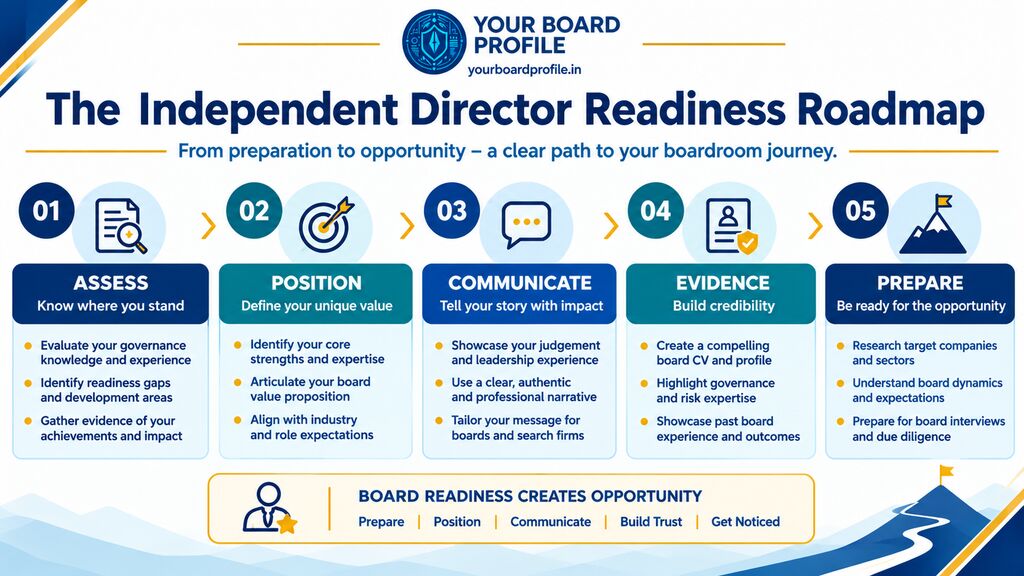
Use the following roadmap to connect the pillars with concrete actions.
| Stage | Priority | Practical action | Evidence of progress |
| 1. Assess | Board readiness | Review governance knowledge and identify learning gaps | Personal readiness assessment |
| 2. Position | Board value proposition | Select two or three areas of distinctive contribution | Clear board positioning statement |
| 3. Communicate | Strategic storytelling | Develop examples of judgement and oversight | Board-ready professional narrative |
| 4. Validate | Governance signalling | Document achievements, responsibilities, and references | Verifiable evidence of credibility |
| 5. Prepare | Presence and digital reputation | Refine communication and professional profiles | Consistent board-focused presence |
| 6. Connect | Strategic networking | Build relevant professional relationships | Meaningful governance conversations |
| 7. Pursue | Opportunity strategy | Research suitable companies and committee requirements | Target-company shortlist |
| 8. Review | Continuous improvement | Seek feedback and update your approach | Updated CV and development plan |
Strengthen Your Board CV and Professional Narrative
Your Board CV should communicate board relevance, not simply seniority. Begin with a concise professional summary that explains your experience, strategic perspective, and potential contribution. Follow it with evidence of achievements related to financial oversight, enterprise risk, transformation, leadership, stakeholder management, or other relevant areas.
Avoid unsupported phrases such as “visionary leader” or “governance expert” unless you can demonstrate what they mean in practice. Specific achievements, relevant qualifications, and clearly described responsibilities make your professional narrative more credible.
For additional guidance, review the Your Board Profile portfolio to understand how a professional profile can be presented in a board-focused context.
Align Your Positioning with India’s Governance Environment
An effective boardroom branding strategy must reflect the responsibilities that come with the role. Familiarise yourself with applicable provisions of the Companies Act, 2013, including Section 149 and Schedule IV, and the relevant requirements of SEBI LODR for listed entities.
The OECD Principles of Corporate Governance provide an additional international reference for understanding board responsibilities, transparency, and accountability. The International Finance Corporation’s corporate governance resources can also help broaden your understanding of governance practices.
These resources should inform your professional development rather than serve as a substitute for advice on the legal requirements applicable to a particular appointment. A strong Independent Director candidate understands both the principles of effective governance and the responsibilities that arise in the specific company context.
Measure Progress Beyond Visibility
It is tempting to measure boardroom branding through LinkedIn impressions, the number of professional contacts, or the number of times your profile is viewed. These indicators can be useful, but they do not establish board readiness.
A better approach is to assess whether your positioning is clear, your examples demonstrate sound judgement, your professional claims are verifiable, and your target opportunities genuinely match your capabilities. Ask trusted governance professionals to review your Board CV and explain what they understand your distinctive contribution to be.
If they struggle to articulate your value, your positioning may need refinement. If they can identify your strengths but cannot see evidence of governance judgement, you may need stronger examples or further development. If your capabilities are clear but your target opportunities are poorly matched, revisit your opportunity strategy.
The aim is to make your professional value easier to understand and assess, not to manufacture the appearance of readiness.
Common Boardroom Branding Mistakes to Avoid
Even experienced professionals can undermine their board positioning by approaching the process as a conventional job search. Several mistakes deserve particular attention.
Confusing seniority with board readiness. A senior title can establish professional experience, but it does not automatically demonstrate independent judgement, oversight capability, or an understanding of director responsibilities. Explain how your experience translates into effective board contribution.
Using a generic Board CV. Sending the same lengthy executive CV to every organisation makes it difficult for a selection committee to identify your relevance. Adapt the emphasis to the company’s needs without exaggerating your experience or changing the facts.
Treating digital visibility as credibility. Regular posting can increase awareness, but it cannot compensate for weak governance knowledge, unsupported claims, or inconsistent conduct. Thought leadership should demonstrate informed thinking rather than simply create activity.
Networking only when you need an appointment. Relationships built around immediate requests can feel transactional. Build trust by contributing to discussions, sharing relevant insights, and learning from experienced directors over time.
Claiming expertise across every committee. No professional needs to present themselves as an expert in everything. A credible Independent Director recognises the limits of their knowledge and understands when additional expertise is required.
Ignoring independence and conflicts of interest. Personal branding must never overshadow the actual requirements of independence. Be transparent about relevant relationships and potential conflicts, and assess each opportunity carefully.
The strongest boardroom brand is built on alignment: what you say, what you have done, what others can verify, and how you behave when difficult decisions arise.
Conclusion: Turn Executive Experience into Boardroom Value
Becoming an Independent Director requires more than a distinguished career. It calls for a shift in perspective—from managing business operations to contributing to strategy, oversight, accountability, and long-term value creation.
The 8 pillars of boardroom branding provide a practical framework for making that shift visible. Board readiness establishes the foundation. Strategic positioning clarifies your contribution. Storytelling reveals your judgement, governance signalling reinforces credibility, and boardroom presence helps you contribute constructively. Thought leadership, strategic networking, and opportunity preparation connect your capabilities with relevant board requirements.
These pillars should reinforce one another. A strong professional narrative without evidence may lack credibility. Governance knowledge without clear communication may remain difficult to recognise. Visibility without integrity cannot establish trust. The goal is to bring all three elements—capability, communication, and credibility—together.
For senior executives, CXOs, entrepreneurs, and aspiring directors, the next step is to evaluate your current position and identify the improvements that will make the greatest difference. Start with your board value proposition, review your Board CV, strengthen your governance knowledge, and focus on opportunities where your experience can add genuine value.
Frequently Asked Questions
1. What is an Independent Director?
An Independent Director is a non-executive director who meets the applicable legal criteria for independence and contributes objective judgement to the board. The role includes oversight, constructive challenge, strategic guidance, and attention to governance and stakeholder interests.
2. How can I become an Independent Director in India?
Begin by understanding the eligibility and independence requirements under the Companies Act, 2013, and any applicable SEBI LODR provisions. Develop governance knowledge, assess your board readiness, prepare a board-focused CV, identify suitable companies, and build credible professional relationships.
3. What are the 8 pillars of boardroom branding?
The eight pillars are Board Readiness and Governance Mindset; Strategic Positioning and Board Value Proposition; Strategic Storytelling and Narrative Intelligence; Governance Signalling; Boardroom Presence and Influence; Thought Leadership and Digital Reputation; Strategic Networking and Community Building; and Board Opportunity Strategy and Preparation.
4. Why is boardroom branding important for an aspiring Independent Director?
Boardroom branding helps communicate how your experience, judgement, and expertise relate to a company’s needs. It makes your potential contribution easier to assess while reinforcing the importance of evidence, professional integrity, and governance competence.
5. What is a board value proposition?
A board value proposition explains the distinctive contribution a director can bring to a company’s strategic discussions and oversight responsibilities. It connects professional experience with relevant business challenges, governance priorities, and committee requirements.
6. How is a Board CV different from an executive CV?
An executive CV generally emphasises operational responsibilities, leadership achievements, and business performance. A Board CV places greater emphasis on strategic oversight, risk management, governance, stakeholder accountability, committee relevance, and evidence of independent judgement.
7. What is governance signalling?
Governance signalling is the process of making governance competence and trustworthiness visible through credible actions, evidence, professional conduct, and communication. It helps prospective boards assess how a candidate approaches accountability, risk, ethical decisions, and constructive challenge.
8. What qualifications are needed to become an Independent Director?
The applicable requirements depend on the law, the nature of the appointment, and the individual’s circumstances. Relevant professional qualifications and experience can support a candidacy, but applicants should verify statutory eligibility, independence criteria, and any applicable databank or proficiency-test requirements.
9. What is the Independent Directors Databank?
The Independent Directors Databank is associated with the Indian Institute of Corporate Affairs and supports the framework for independent-director learning and professional development. Aspiring candidates should consult the official IICA resources to verify current registration, assessment, exemption, and compliance requirements applicable to them.
10. How can I demonstrate committee fit for an Independent Director role?
Connect your experience to the responsibilities and skill requirements of the relevant committee. For example, financial reporting and internal-control experience may support Audit Committee relevance, while succession planning and remuneration experience may support NRC relevance. Actual suitability depends on applicable requirements and the company’s needs.
11. Does LinkedIn help aspiring Independent Directors?
Yes. A well-developed LinkedIn profile can communicate professional expertise, governance interests, thought leadership, and relevant achievements. However, digital visibility is only one part of boardroom branding and does not replace experience, independence, or a credible record of professional conduct.
12. How does strategic networking help secure board opportunities?
Strategic networking helps aspiring directors build relationships with experienced directors, governance professionals, industry peers, and search consultants. These relationships can improve awareness of relevant opportunities and provide useful feedback, although they do not guarantee an appointment.
13. How can I improve my boardroom presence?
Practise concise communication, attentive listening, evidence-based questioning, and respectful disagreement. Learn to challenge assumptions without making discussions personal, and demonstrate emotional maturity when addressing uncertainty or competing stakeholder interests.
14. How long does it take to become board-ready?
There is no fixed timeline. It depends on your existing experience, governance knowledge, professional development needs, independence eligibility, and suitability for particular boards. A structured assessment can help identify priorities and create a realistic development plan.
15. Can Your Board Profile help me build my boardroom brand?
Your Board Profile offers services including customised Board CVs, LinkedIn profile enhancement, board readiness assessments, and one-to-one coaching and mentorship. These services can help professionals clarify their board value proposition, communicate relevant experience, and prepare for appropriate board opportunities.
Ready to Strengthen Your Boardroom Brand as an Independent Director?
Becoming an Independent Director requires more than professional achievements—it takes board readiness, strategic positioning, governance credibility, and a compelling board value proposition. By developing your boardroom brand, you can communicate your expertise, demonstrate independent judgement, and position yourself for relevant board opportunities.
Whether you are a CXO, senior executive, entrepreneur, or aspiring Independent Director, take a proactive step towards building a credible board profile. Strengthen your governance perspective, showcase your strategic contribution, and prepare to engage with the right board opportunities.
Schedule your complimentary session here:
https://calendly.com/dramitnagpal
Share this post: Facebook | X | LinkedIn