

Why Cyber Security Is a Boardroom Priority
Imagine a company that has spent decades building customer trust, developing valuable intellectual property and expanding into new markets. One morning, its systems become inaccessible, customer information is potentially compromised, and employees cannot process orders. Customers want answers, regulators expect timely action, and investors are watching closely. In that moment, the organisation discovers that a digital incident can quickly become a business crisis. This is why Cyber Security deserves a permanent place on the board agenda rather than an occasional discussion during technology reviews. Effective Cyber Security oversight helps boards protect business continuity, stakeholder trust, and long-term organisational value.
The business environment of 2026 makes this responsibility increasingly important. The World Economic Forum’s Global Cybersecurity Outlook 2026 highlights how artificial intelligence, geopolitical fragmentation and increasingly complex technology ecosystems are reshaping cyber risk. These developments affect not only technology companies but also manufacturers, banks, healthcare providers, professional services firms and businesses that rely on third-party platforms. Cyber threats can interrupt operations, undermine stakeholder confidence and expose weaknesses in decision-making.
For boards, the central question is not simply whether the organisation has installed security software. It is whether the business understands its most important digital risks, protects sensitive information, responds effectively to incidents and can continue operating when disruption occurs. Effective oversight requires directors to connect technology risk with strategy, financial performance, regulatory responsibilities and long-term organisational resilience.
This article explores how senior executives, CXOs and aspiring independent directors can approach cyber security governance as a strategic leadership responsibility. It examines enterprise resilience, data governance, regulatory compliance, board-level metrics and practical steps that help organisations become more prepared, accountable and trustworthy.
Table of Contents
Understanding Cyber Security as an Enterprise Risk
Cyber security is often associated with firewalls, passwords, antivirus software and technical teams monitoring suspicious activity. These controls matter, but they represent only one part of the picture. At the board level, cyber risk includes the possibility that digital disruption will affect revenue, operations, customer relationships, intellectual property, contractual obligations or strategic objectives. A compromised supplier, a fraudulent payment instruction or an exposed customer database can create consequences far beyond the IT department. Cyber Security should therefore be treated as an enterprise risk that requires active board-level attention.
Directors therefore need to understand cyber security in the same way they understand financial, operational and legal risks. The organisation should know which business activities depend on critical systems, which information assets would cause the greatest harm if exposed, and which services must remain available during a crisis. It should also identify who has authority to make urgent decisions when normal reporting channels fail. These are governance questions, not merely technical questions.
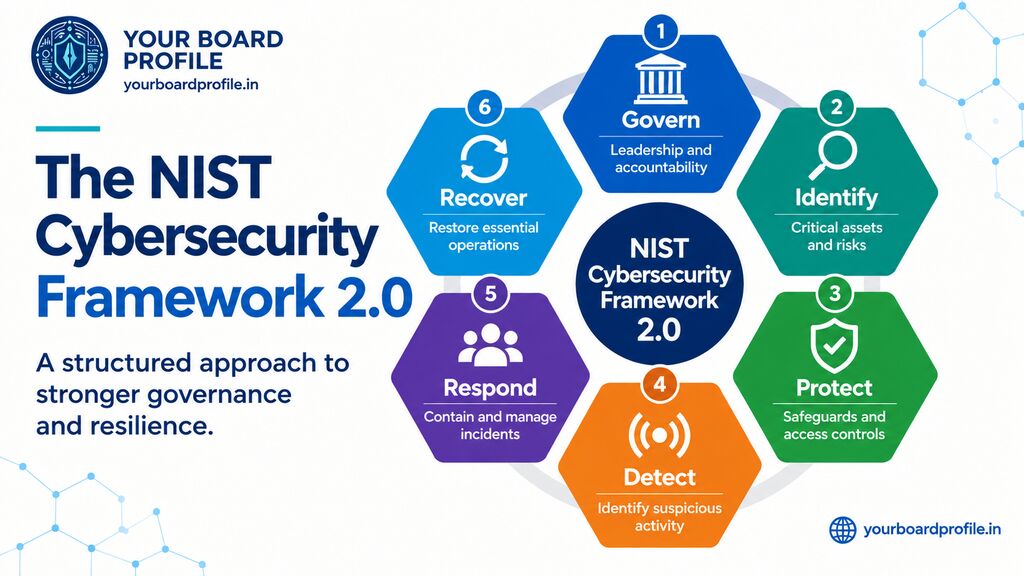
The NIST Cybersecurity Framework 2.0 provides a useful reference point. It organises cyber security outcomes around six functions: Govern, Identify, Protect, Detect, Respond and Recover. The inclusion of Govern reinforces the importance of leadership, organisational context, accountability and risk oversight.
Boards can use this structure to ask whether the organisation has an integrated approach rather than a collection of disconnected security projects.
From Technical Vulnerability to Business Disruption
Consider a manufacturing company whose production process depends on connected equipment, cloud-based applications and an external logistics provider. An incident affecting one supplier could interrupt production scheduling, delay deliveries and trigger contractual penalties. Even if the company’s own network remains secure, its operations may still suffer because a critical dependency has failed.
This example illustrates why enterprise resilience cyber security must extend beyond the organisation’s immediate IT environment. Boards should understand dependencies on cloud providers, software vendors, outsourced service providers, payment systems and other business partners. They should also consider how artificial intelligence tools, employee access privileges and rapidly changing digital workflows introduce new exposures. A Cyber Security review should examine these dependencies alongside the potential impact on critical business operations.
Directors do not need to inspect technical logs or choose individual security products. They need credible answers to questions such as: Which business services are most vulnerable? How quickly would the company detect a serious incident? What is the expected operational impact of an outage lasting several hours or days? Who can approve emergency spending, suspend affected services or communicate with customers? These questions transform cyber security from a specialist concern into a practical discussion about continuity, accountability and business judgement.
The Financial and Reputational Cost of Cyber Incidents
The impact of a cyber incident rarely ends when access to systems is restored. An organisation may face forensic investigations, legal expenses, customer support costs, business interruption, contractual disputes and the expense of rebuilding affected systems. Depending on the facts, it may also need to notify regulators or affected individuals. If confidential information has been exposed, customers and business partners may reconsider whether the organisation can be trusted with sensitive data.
Reputational damage can be especially difficult to measure. A company might recover its systems within days but spend months reassuring customers, employees, investors and suppliers. For a business competing on reliability or professional credibility, the loss of confidence can affect future opportunities even when the immediate technical problem has been resolved.
| Cyber risk | Potential business consequence | Board-level consideration |
| Ransomware or system disruption | Lost productivity and interrupted services | Recovery capability and continuity planning |
| Data breach | Legal exposure and loss of customer trust | Data protection and incident notification |
| Supplier compromise | Disruption across connected operations | Third-party risk oversight |
| Executive impersonation or payment fraud | Financial loss and control failures | Payment authorisation and verification |
| Intellectual property theft | Competitive disadvantage | Protection of strategic information |
| AI-enabled attacks | More convincing fraud or faster attacks | AI governance and workforce preparedness |
These consequences should influence investment decisions. The right approach is not to spend without limits or assume that every risk can be eliminated. Instead, boards should evaluate whether the organisation’s controls are proportionate to its exposure, whether residual risks are understood and whether management has a credible plan for reducing the most significant vulnerabilities.
Enterprise Resilience and Cyber Security: Preparing for Disruption
Enterprise resilience is the ability to anticipate disruption, absorb its effects, maintain essential functions and recover within an acceptable period. Cyber resilience applies this principle to digital threats. It recognises that prevention is essential, but prevention alone cannot guarantee that an incident will never occur. An organisation must also be able to detect problems, contain their spread, make informed decisions and restore business services safely. Cyber Security planning must include both preventive controls and the ability to respond to and recover from incidents.
This distinction matters because many business leaders still evaluate cyber security primarily through the number of tools purchased or vulnerabilities fixed. Those measures offer useful information, but they do not establish whether the organisation can withstand a major incident. A company may have modern security technology and still lack tested backups, clear decision rights, alternative operating arrangements or a reliable crisis communication process.
A strong resilience approach begins with business priorities. Management should identify the services that must continue, determine how long each service can remain unavailable, assess dependencies and define acceptable recovery objectives. These decisions should involve business leaders rather than being left entirely to technical teams. The resulting plan should be tested against realistic scenarios, including ransomware, cloud outages, compromised credentials and the loss of a critical supplier.
Building a Practical Cyber Resilience Strategy
A cyber resilience strategy should connect prevention, response and recovery into a single operating model. It should clarify which risks are most important, who owns each risk, how controls are evaluated and how management will demonstrate progress to the board. It should also reflect the organisation’s size, sector, data sensitivity, operating geography and reliance on external technology providers.
The following table illustrates how boards can connect strategic priorities with practical action.
| Strategic priority | Management action | Evidence for the board |
| Understand exposure | Map critical systems, data and dependencies | Current risk register and business impact analysis |
| Reduce likelihood | Strengthen identity controls, patching and monitoring | Control effectiveness and unresolved critical issues |
| Limit disruption | Separate critical systems and test recovery arrangements | Recovery test results and restoration times |
| Improve response | Assign crisis roles and establish escalation procedures | Incident simulations and lessons learned |
| Manage supplier risk | Assess critical vendors and contractual protections | Vendor risk assessments and remediation status |
| Build adaptability | Review emerging threats and changing technology | Updated scenarios and investment priorities |
Boards should request evidence that these arrangements work under pressure. A recovery plan that exists only as a document may offer limited reassurance if nobody has tested it. Similarly, a supplier assessment completed several years ago may not reflect changes in the supplier’s technology, ownership or security practices.
A useful exercise is to simulate a serious incident during a board or executive meeting. Management could present a scenario in which a critical system becomes unavailable while suspicious data transfers are detected. Directors would then consider who makes decisions, how operational priorities are set, what information the board needs and when stakeholders should be informed. The objective is not to turn directors into incident responders. It is to test whether the governance structure enables timely, well-informed action.
Data Governance and Cyber Security: Protecting Business Value
Data has become a strategic asset, but its value depends on the organisation’s ability to manage it responsibly. Companies collect information about customers, employees, suppliers, transactions, products and internal operations. They may also hold commercially sensitive forecasts, acquisition plans, source code and intellectual property. When ownership, access and retention rules are unclear, sensitive information becomes harder to protect.
Data governance and cyber security must therefore operate together. Data governance establishes how information is classified, owned, accessed, retained, shared and disposed of. Cyber security provides the safeguards that protect information against unauthorised access, alteration, disclosure or disruption. When these functions work separately, organisations may secure their systems without understanding which information matters most, or maintain data inventories without applying adequate protection. Strong Cyber Security practices help ensure that sensitive business and customer information remains protected throughout its lifecycle.
For example, a business might encrypt its central customer database while employees regularly download customer records into spreadsheets and share them through unapproved applications. The main system may be secure, but the information has spread into less controlled environments. Strong data governance reduces this exposure by defining approved access, setting rules for data movement and assigning clear accountability for information assets.
Boards should also understand that collecting more data does not automatically create more value. Information that is no longer needed may introduce unnecessary storage costs, privacy exposure and security obligations. A disciplined data strategy identifies which information supports business objectives, who is responsible for it and how long it should be retained.
Secure Data Governance Strategies for Modern Enterprises
Secure data governance strategies begin with visibility. Organisations need to know what information they hold, where it is stored, which systems process it and which internal or external parties can access it. This becomes more complex when data is spread across cloud platforms, remote devices, outsourced services and AI applications. A reliable inventory helps management prioritise protection according to business importance and potential harm.
The next step is to establish appropriate controls. Sensitive information may require stronger authentication, restricted access, encryption, monitoring and additional approval before it can be shared. Access should reflect job responsibilities, and permissions should be reviewed when employees change roles or leave the organisation. Retention and deletion policies should also be practical enough to follow consistently.
The board should pay particular attention to information used in artificial intelligence systems. Employees may inadvertently enter confidential material into external tools, while AI applications may connect to business databases or process personal information. Management should define approved uses, assess the security of providers, establish appropriate access limits and review how information is processed.
A mature approach to data governance should answer five questions:
- What information is most valuable or sensitive?
- Who is accountable for its protection and appropriate use?
- Where is the information stored, processed and shared?
- What controls prevent inappropriate access or disclosure?
- How does the organisation verify that its policies are followed?
These questions connect information management to enterprise accountability. They also help directors assess whether the company is protecting not just its technology infrastructure but the information and relationships that support its long-term value.
Building a Cyber Security Governance Framework
A cyber security governance framework translates the board’s risk appetite and business priorities into clear responsibilities, policies, controls and reporting arrangements. It helps an organisation move away from reactive decision-making towards a repeatable process for identifying risks, allocating resources and evaluating outcomes. Without such a framework, departments may develop separate approaches to security, leaving gaps between technology, operations, legal, compliance and business leadership. A Cyber Security governance framework also helps directors evaluate accountability, control effectiveness, and management preparedness.
The framework should be proportionate to the organisation. A regulated financial institution may require extensive control testing, formal reporting and specialised oversight, while a smaller business may need a simpler structure that concentrates on its most critical systems and data. The objective is not to create paperwork for its own sake. It is to ensure that significant risks are visible, decisions have accountable owners and management can demonstrate that agreed controls are operating effectively.
The NIST Cyber security Framework 2.0 is a useful starting point for structuring this work. Its six functions provide a common language for discussing cyber security outcomes across technical and business teams. Organisations can adapt the framework to their operating model and combine it with applicable legal obligations, industry standards and internal risk management processes.
Defining Board and Executive Accountability
Effective oversight starts with a clear distinction between the board’s responsibilities and management’s responsibilities. The board provides direction, challenges assumptions, oversees significant risks and evaluates whether management has adequate resources and capabilities. Executives implement the strategy, operate controls, manage incidents and report material developments.
The chief information security officer, where the role exists, should have sufficient access to senior leadership and an appropriate route for escalating significant concerns. The chief information officer, chief risk officer, legal team, compliance leaders and business heads may also have essential responsibilities. Their roles should be documented so that an incident does not create confusion about who can make decisions.
A practical accountability model might look like this:
| Stakeholder | Principal responsibility |
| Board of directors | Oversight of cyber risk, resilience and management accountability |
| Risk or audit committee | Detailed scrutiny of controls, assurance and material exposures, according to its mandate |
| CEO and executive leadership | Business ownership, prioritisation and cross-functional coordination |
| CISO or security leader | Security strategy, technical safeguards, monitoring and response coordination |
| CIO and technology teams | Secure technology operations, infrastructure and recovery |
| Legal and compliance teams | Regulatory interpretation, reporting obligations and legal coordination |
| Business and data owners | Appropriate access, operational controls and protection of business-critical information |
| Internal audit | Independent assurance within its approved scope |
This model should be adapted to the organisation’s constitution, committee charters and applicable requirements. Not every board needs a separate cyber security committee, but every board needs clarity about where cyber security oversight sits and how significant concerns reach directors.
Connecting Cyber Security with GRC and Enterprise Risk
Governance, risk and compliance (GRC) brings together the policies, assessments, controls and reporting processes that help an organisation manage obligations and exposure. A GRC cyber security strategy integrates cyber risk into the broader enterprise risk management system rather than treating it as a separate technical register.
This integration matters because the same cyber incident can affect several risk categories simultaneously. A ransomware attack may interrupt production, create financial losses, trigger privacy concerns and expose contractual weaknesses. If these consequences appear in separate departmental reports without a shared assessment, the board may struggle to understand the full scale of the exposure.
A joined-up approach uses consistent risk definitions, clear ownership, agreed escalation thresholds and coordinated reporting. It links cyber security investments to business objectives and helps directors understand trade-offs. For instance, management may recommend accelerating the replacement of an unsupported system because the potential disruption outweighs the cost of upgrading it.
Boards should also ask how independent assurance is obtained. Management reporting is essential, but periodic control testing, internal audit and appropriately scoped external assessments can provide additional perspectives. The goal is to understand whether the controls are effective in practice, not simply whether policies have been approved.
Regulatory Compliance in Cyber Security: The Indian Perspective
Regulatory compliance is a core element of cyber security governance because an incident can trigger legal, contractual and reporting responsibilities alongside operational consequences. For Indian organisations, the relevant obligations depend on the sector, the type of information processed, the organisation’s role and the circumstances of the incident. Directors should therefore avoid assuming that one security policy or certification automatically satisfies every applicable requirement.
The Indian Computer Emergency Response Team (CERT-In) issued directions on 28 April 2022 covering information security practices and the prevention, response and reporting of cyber incidents. These directions include a six-hour reporting requirement for covered incidents from the time the incident is noticed or brought to the entity’s notice, subject to the applicable requirements. CERT-In also specifies log-retention and related obligations for covered entities. Organisations should consult the official CERT-In directions and guidance to determine how the rules apply to their circumstances. Cyber Security compliance requires organisations to understand the specific reporting and security obligations applicable to their operations.
For organisations regulated by the Securities and Exchange Board of India, SEBI introduced its Cyber Security and Cyber Resilience Framework (CSCRF) in August 2024, followed by clarifications and implementation-related circulars. The framework is relevant to regulated entities within its scope and addresses cyber security governance, protection, resilience and related controls. Boards and compliance teams should review the latest applicable SEBI cybersecurity and cyber resilience framework, including subsequent amendments and clarifications.
India’s Digital Personal Data Protection framework is another important consideration for organisations processing digital personal data within its scope. The applicable commencement notifications, rules and transitional arrangements matter; boards should not assume that every provision becomes enforceable on the same date. Legal and privacy teams should confirm the requirements applicable to the organisation, including relevant security safeguards, breach-related obligations and timelines.
A practical compliance approach should include:
- A current register of applicable laws, regulations and contractual obligations.
- Defined responsibilities for assessing and reporting incidents.
- An escalation process that can operate outside normal working hours.
- Evidence that relevant employees understand their reporting responsibilities.
- Regular reviews of regulatory changes and the organisation’s compliance position.
Regulatory compliance should be treated as a minimum baseline rather than the complete definition of security. A company may satisfy a particular reporting requirement and still have weaknesses in recovery planning, supplier oversight or internal access controls. Strong governance combines legal compliance with an ongoing assessment of operational resilience.
This section provides general information, not legal advice. Organisations should confirm current requirements with qualified legal and compliance professionals.
Boardroom Cyber Security Best Practices
Good board oversight depends on asking useful questions and receiving evidence that supports meaningful decisions. Directors do not need to understand every technical control, but they should be able to recognise when reporting is incomplete, when a risk is being understated or when management’s assurances are not supported by testing.
One useful practice is to review cyber security as part of the enterprise risk agenda at a frequency proportionate to the organisation’s exposure. The board should also receive an immediate escalation when a significant incident or material change warrants attention. Waiting for the next scheduled meeting may be inappropriate when a crisis requires urgent decisions. Regular Cyber Security reviews help directors identify emerging threats, challenge management assumptions, and prioritise corrective action.
The following practices can help make board discussions more focused.
| Boardroom practice | Questions directors should ask | Intended outcome |
| Review critical risks | Which systems, data and services would cause the greatest harm if compromised? | Clear prioritisation |
| Challenge investment plans | Which material risks will this investment reduce? | Better resource allocation |
| Test resilience | When were backups and recovery plans last tested? | Evidence of recoverability |
| Examine third-party exposure | Which suppliers could interrupt critical services? | Stronger supply-chain oversight |
| Review incident readiness | Who leads response, reporting and stakeholder communication? | Clear accountability |
| Assess assurance | Which controls have been independently tested? | Greater confidence in reporting |
| Monitor workforce behaviour | Are employees prepared to recognise fraud and report suspicious activity? | Reduced human-related exposure |
Board reporting should be concise without concealing uncertainty. A dashboard filled with technical statistics may appear impressive but leave directors unsure whether the organisation is becoming safer. Reporting should connect the most important risks to business consequences, control effectiveness, remediation progress and decisions requiring board attention.
Cyber Security should also appear in discussions about major business changes. Acquisitions, cloud migrations, new digital products, AI deployments and expansion into new markets can introduce additional dependencies and vulnerabilities. Early board visibility enables the organisation to evaluate risk before a decision becomes difficult or expensive to reverse.
For directors strengthening their broader understanding of oversight, understanding the evolving independent director role in governance provides a related perspective on the responsibilities and expectations associated with board service.
Executive Leadership in Cyber Defense
Technology controls are important, but cyber security outcomes also depend on leadership behaviour. Employees observe what executives prioritise, what they measure and what they are willing to challenge. If leaders treat security as an obstacle to speed, teams may bypass controls to meet deadlines. If leaders make security part of responsible business execution, employees are more likely to raise concerns and follow agreed procedures.
Executive leadership in cyber defense begins with ownership. Senior leaders should communicate that protecting customer information, intellectual property and essential business services is a shared responsibility. They should also ensure that security teams can escalate serious concerns without being discouraged by commercial pressure or organisational hierarchy.
A mature security culture does not rely on blaming individuals whenever mistakes occur. It examines why a control failed, whether procedures were realistic, whether employees had adequate training and whether management incentives encouraged unsafe behaviour. For example, repeated incidents involving fraudulent payment instructions may indicate not only a need for awareness training but also weaknesses in payment approval and independent verification processes.
Executives should model practical behaviours: verifying unusual requests, using approved collaboration tools, respecting access restrictions and reporting suspected incidents promptly. Leadership teams should also understand how AI-generated impersonation, synthetic voices and convincing phishing messages can undermine traditional assumptions about identity and trust.
Cyber Security culture becomes more credible when employees can report suspicious activity without fear of disproportionate punishment. Lessons from incidents should be shared appropriately, controls should be improved and leaders should demonstrate that feedback leads to action.
For senior professionals preparing for board-level responsibilities, these behaviours also illustrate how personal credibility is built. Executive personal branding beyond a job title explores the broader value of demonstrating judgement, accountability and professional trust. In cyber security governance, these qualities are especially relevant when leaders must make difficult decisions with incomplete information.
Measuring Cyber Security Performance Through Board-Level Metrics
Boards cannot oversee what they cannot meaningfully assess. However, measuring cyber security performance is not as simple as counting blocked attacks or comparing the security budget with that of competitors. Organisations differ in size, threat exposure, technology architecture and business criticality. A useful dashboard therefore measures whether the organisation is reducing material risks and improving its ability to withstand disruption. Cyber Security metrics should provide clear evidence of risk reduction, control effectiveness, and recovery readiness.
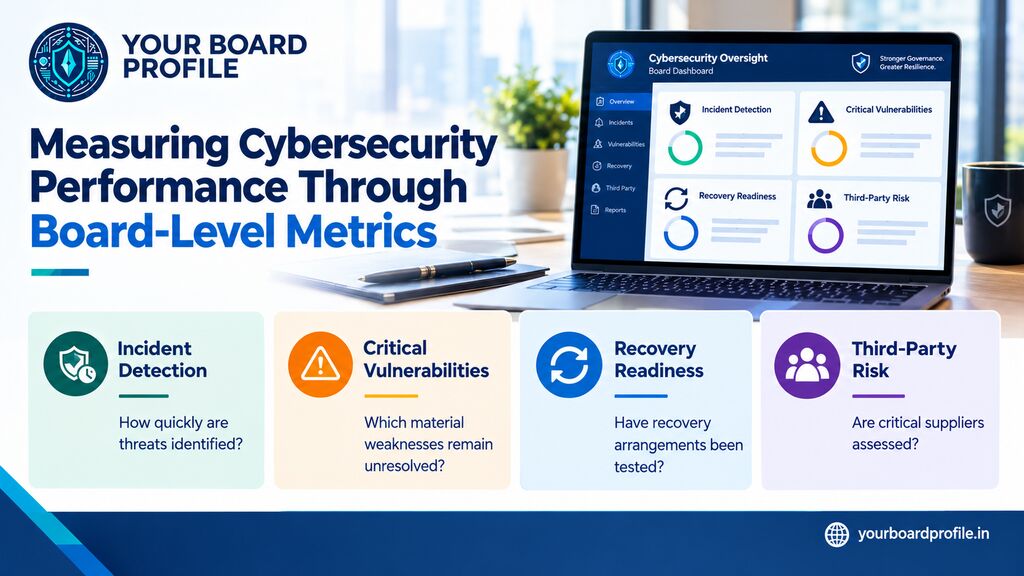
Directors should ask management to distinguish between activity metrics and outcome metrics. Activity metrics show what the organisation has done, such as completing training or conducting vulnerability assessments. Outcome metrics provide evidence of whether controls are working, whether weaknesses are being resolved and whether essential services can recover within agreed objectives.
| Metric | What it tells the board | Important qualification |
| Time to detect significant incidents | How quickly suspicious activity is identified | Consider the severity and nature of incidents |
| Time to contain incidents | How effectively damage is limited | Compare like-for-like incident categories |
| Critical vulnerabilities overdue for remediation | Whether material weaknesses remain unresolved | Consider exposure and compensating controls |
| Recovery test success rate | Whether recovery arrangements work as intended | Test realistic scenarios and dependencies |
| Critical supplier assessment coverage | Whether important external dependencies are assessed | Assessment alone does not prove effective controls |
| Privileged access review completion | Whether powerful access rights are being reviewed | Check that unnecessary permissions are removed |
| Incident simulation findings closed | Whether lessons translate into improvements | Track overdue and repeat findings |
| Compliance obligations met on time | Whether required processes are being followed | Validate the scope and evidence of compliance |
Metrics should include trends, thresholds, accountable owners and explanations for significant changes. A sudden improvement in reported incidents, for example, may reflect stronger controls, but it could also reflect reduced reporting. Boards should understand the context before concluding that risk has declined.
Directors should also request a clear view of residual risk: the exposure that remains after controls have been applied. Some risks cannot be eliminated economically or immediately. Management should explain what remains, what action is planned, who has accepted the exposure and whether that acceptance falls within the organisation’s approved risk appetite.
The ultimate test is whether reporting supports better decisions. If the dashboard reveals that a critical recovery process repeatedly fails, the board should understand the business implications and the proposed corrective action. If a supplier presents an unacceptable risk, directors should know whether management plans to strengthen controls, renegotiate arrangements or consider alternatives.
Conclusion: Making Cyber Security a Strategic Board Priority
Cyber Security has become a fundamental part of responsible business leadership. It influences operational continuity, customer confidence, regulatory exposure, financial performance and the organisation’s ability to pursue its strategic objectives. Boards that treat it exclusively as a technology issue risk overlooking the business decisions that determine how effectively an organisation prepares for disruption. Cyber Security has become a fundamental part of responsible business leadership, influencing operational continuity, customer confidence, regulatory exposure, and financial performance.
A stronger approach connects Cyber Security, enterprise resilience and data governance through clear accountability, informed investment, measurable outcomes and tested recovery arrangements. Directors should understand the organisation’s critical information assets, challenge management’s assumptions, evaluate third-party exposure and ensure that significant risks receive appropriate attention. They should also recognise that compliance is essential but does not, by itself, establish resilience.
For aspiring independent directors and senior executives, cyber security oversight offers an opportunity to demonstrate strategic thinking, sound judgement and constructive challenge. A board-ready professional does not need to be a technical specialist. They need to understand how digital risk affects enterprise value, ask relevant questions and help management make accountable decisions.
At Your Board Profile, board readiness involves more than presenting professional achievements. It also means demonstrating the judgement, governance awareness and strategic perspective expected in the boardroom. Explore our services and portfolio to learn more about developing a credible board-level professional profile.
The question for every board is simple: if a serious cyber incident occurred tomorrow, would the organisation merely react, or would it be prepared to protect its people, preserve critical operations and recover with confidence? The answer depends on the decisions leaders make today.
Frequently Asked Questions (FAQs)
1. Why is Cyber Security important for the board of directors?
Cyber security can affect business continuity, financial performance, customer trust, regulatory compliance and strategic objectives. Directors need to oversee material cyber risks, assess management’s preparedness and ensure that the organisation has appropriate resources, accountability and recovery arrangements.
2. Is cyber security the responsibility of the IT department alone?
No. IT and security teams implement technical safeguards, but cyber security risk also involves business operations, legal obligations, finance, human resources, procurement and executive decision-making. The board oversees the risk, while management and designated control owners implement and maintain the necessary safeguards.
3. What is enterprise resilience cyber security?
Enterprise resilience cyber security is the integration of cyber risk management with the organisation’s ability to maintain essential business functions during digital disruption. It combines prevention, detection, incident response, business continuity and recovery planning.
4. What is a cyber resilience strategy?
A cyber resilience strategy defines how an organisation prepares for cyber incidents, limits their impact and restores critical services. It typically includes risk prioritisation, incident response plans, tested backups, recovery objectives, supplier risk management and regular simulations.
5. How does data governance support cyber security?
Data governance establishes ownership, classification, access permissions, retention rules and appropriate information-sharing practices. These measures help cyber security teams identify sensitive information, apply proportionate safeguards and reduce the risk of unauthorised disclosure or misuse.
6. What should a cyber security governance framework include?
It should include a risk management approach, defined roles, approved policies, incident escalation procedures, control monitoring, supplier oversight, regulatory compliance processes and board-level reporting. It should also include mechanisms for testing controls and tracking corrective actions.
7. What cyber security questions should directors ask management?
Directors should ask which risks could materially disrupt the business, how quickly serious incidents can be detected, whether recovery arrangements have been tested, which critical suppliers present exposure and whether unresolved vulnerabilities are being addressed. They should also ask what decisions or resources are needed from the board.
8. What is GRC cyber security strategy?
A GRC cyber security strategy integrates governance, risk management and compliance into a coordinated approach. It connects security policies and controls with enterprise risk priorities, regulatory obligations, accountable owners and management reporting.
9. What are the main cyber security compliance considerations for Indian companies?
Depending on the organisation and its activities, relevant considerations may include CERT-In directions, applicable data protection requirements, sector-specific regulations and contractual obligations. SEBI-regulated entities should also assess the cyber security and cyber resilience requirements that apply to them. Legal and compliance teams should verify current rules, scope and timelines.
10. How can a board measure cyber security effectiveness?
Boards can review detection and containment times, unresolved critical vulnerabilities, recovery test results, supplier risk coverage, access reviews and the closure of incident-related findings. Metrics should be linked to business impact and risk reduction rather than treated as isolated numbers.
11. What is the difference between cyber security and cyber resilience?
Cyber Security focuses on protecting systems, networks and information against digital threats. Cyber resilience extends the approach by emphasising the ability to withstand disruption, continue essential operations, respond effectively and recover when security controls do not prevent an incident.
12. Why is third-party cyber security risk important?
Organisations depend on cloud providers, software vendors, outsourced service providers and business partners. A weakness in one of these relationships can expose data or interrupt critical operations. Boards should ensure that important suppliers are assessed, contractual responsibilities are understood and continuity arrangements are credible.
13. How does artificial intelligence change board-level cyber risk?
AI can support threat detection and security operations, but it can also help attackers create convincing impersonations, phishing messages and automated attacks. AI systems may introduce additional data exposure and access-control risks. Boards should oversee approved use, vendor risk, information protection and appropriate human accountability.
14. What role does executive leadership play in cyber defense?
Executives set priorities, allocate resources, establish accountability and influence organisational behaviour. They help ensure that cyber security is incorporated into business decisions, employees can report concerns, and serious incidents receive timely attention from the appropriate decision-makers.
15. How can aspiring independent directors demonstrate cyber security governance awareness?
Aspiring directors can demonstrate awareness by understanding enterprise risk, data governance, regulatory responsibilities, business continuity and executive accountability. They should be prepared to challenge assumptions constructively, interpret risk reporting and connect cyber security decisions with long-term organisational value.
Ready to Strengthen Your Boardroom Readiness in Cyber Security?
Build the ability to understand cyber risks, challenge assumptions, strengthen oversight, and support business resilience. Whether you are a CXO, senior executive, entrepreneur, or aspiring Independent Director, strengthen your governance capabilities to navigate cyber threats with confidence.
Schedule your complimentary session today:
https://calendly.com/dramitnagpal
Share this post: Facebook | X | LinkedIn