
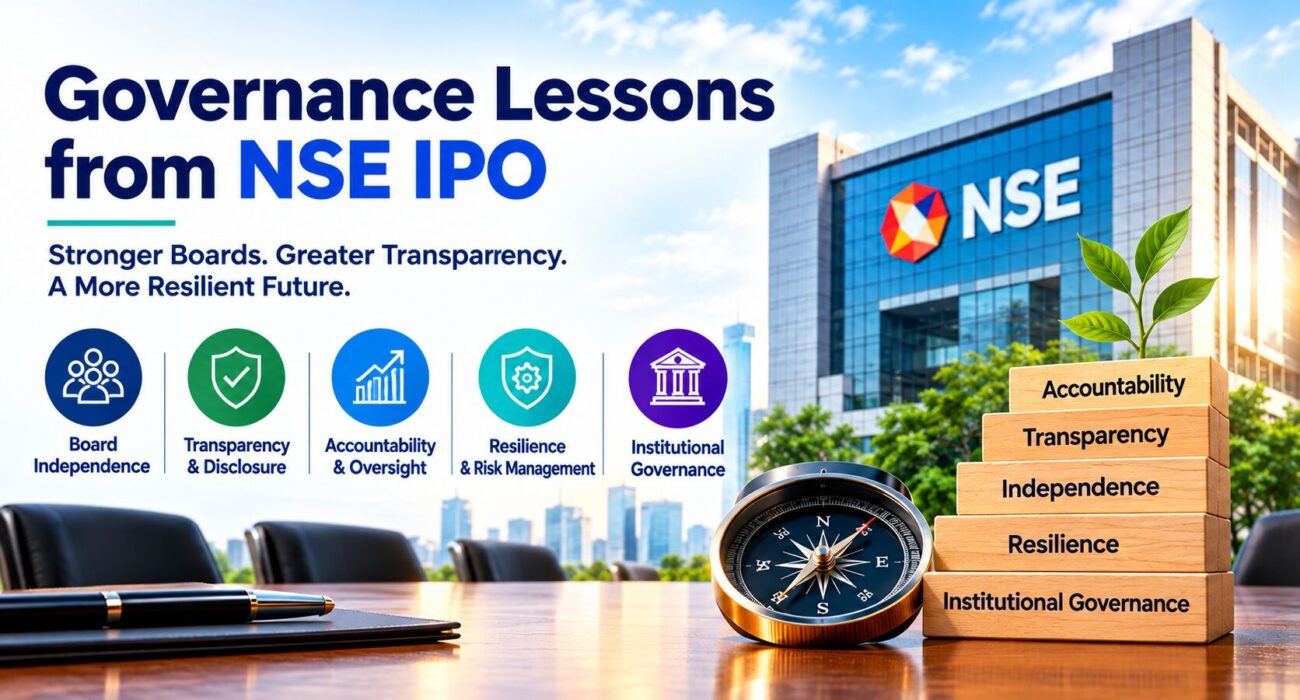
National Stock Exchange of India Ltd (NSE) share price is trading around ₹1,807.20 on September 25,2026, following its market debur at ₹1,800 against an issue price of ₹1,785.
Why NSE IPO governance matters beyond the listing
An IPO is often described as a financial milestone, but the more important change happens inside the organisation. Once a company enters the public market, its accountability expands beyond promoters, founders, lenders and a relatively concentrated shareholder group. Investors, regulators, employees, customers, analysts and minority shareholders all begin looking at the organisation through a wider governance lens. The Governance Lessons from NSE IPO therefore go well beyond preparing financial statements, appointing investment bankers or completing regulatory documentation. They concern the ability of an organisation to demonstrate that its decision-making, controls, leadership and disclosure systems can withstand sustained public scrutiny.
NSE’s journey is particularly relevant because it is itself a critical market institution, where commercial objectives coexist with responsibilities connected to market infrastructure and investor confidence. The NSE’s official offer-document repository now contains its prospectus, audited financial statements, governing-board resolutions, IPO committee resolutions, due-diligence documentation and other transaction material, illustrating the breadth of institutional preparation involved. The exchange began trading publicly on September 24, 2026, following its IPO, completing a listing journey that had stretched over many years. Reuters reported that NSE shares closed at ₹1,818 on debut, valuing the exchange at approximately ₹4.5 trillion.
The important boardroom question is therefore not simply, “Can we get listed?” It is, “Can our institution behave like a public company after we are listed?” That distinction changes how senior executives should think about IPO preparation. A company can prepare an impressive prospectus while still relying heavily on founder intervention, informal approvals, personality-driven decision-making or controls that have not been properly tested. Those weaknesses may remain hidden during a private-company phase, but public ownership makes them considerably more consequential. The Governance Lessons from NSE IPO suggest that IPO readiness should be treated as a transformation in institutional accountability rather than as a project with a fixed completion date.
IPO readiness versus governance readiness
Think of IPO readiness as preparing for an examination. Governance readiness is building the capability to perform consistently after the examination is over. The first involves documentation, due diligence, regulatory processes and transaction execution. The second involves board behaviour, information quality, independence, accountability, resilience and the ability to make difficult decisions without relying excessively on a few individuals. The distinction is especially important for founders and CXOs who have successfully built businesses through personal relationships and fast decision-making. What worked when five people were in a room may not work when thousands of shareholders expect transparency and institutional processes.
This is why IPO governance readiness should begin well before the filing stage. The board needs enough time to identify weaknesses, challenge assumptions and establish evidence that governance systems actually work. NSE’s own public disclosures illustrate how a listing process can involve governance, regulatory, leadership, technology and operational matters alongside conventional financial information. Its investor-relations announcements include disclosures relating to regulatory settlements, auditor changes, leadership changes, technical matters and IPO developments. For boards, the message is straightforward: governance is not a section of the IPO checklist. It is the operating system underneath the checklist.
Table of Contents
The LISTING framework for board governance
A practical way to translate the Governance Lessons from NSE IPO into boardroom action is through a seven-part LISTING framework: Legal credibility, Independence, Stakeholder responsibility, Transparency, Infrastructure resilience, Numbers and Governance institutionalisation. The value of a framework like this is that it converts an abstract idea such as “good governance” into questions directors can actually ask. Is the organisation learning from regulatory scrutiny? Are independent directors genuinely able to challenge management? Can investors understand material developments? Are operational risks being tested? Do the numbers tell the complete story? And finally, can the organisation function effectively without depending on the founder’s personal intervention?
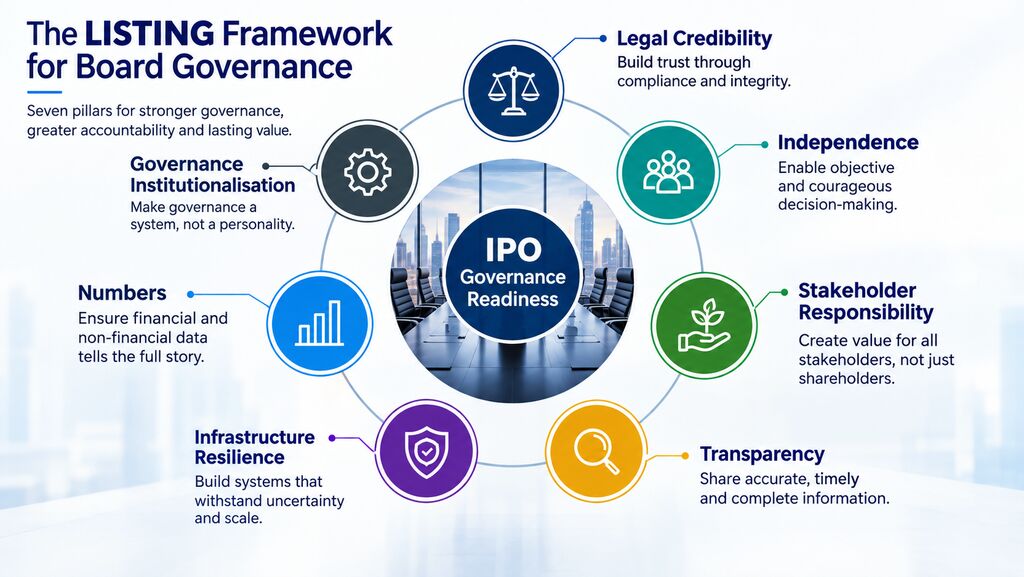
For senior executives, this framework is also useful because it connects governance with strategy. A board does not exist simply to approve management proposals. It exists to provide oversight, challenge assumptions, understand risk and protect long-term organisational interests. The NSE case makes that relationship especially visible because the exchange operates within a specialised regulatory environment. For ordinary companies preparing for listing, the regulatory context may differ, but the underlying board challenge remains relevant: commercial ambition must operate within an institutional framework capable of protecting stakeholders and sustaining confidence.
Legal and regulatory credibility
The first of the Governance Lessons from NSE IPO is that regulatory credibility cannot be created overnight. NSE’s listing journey has included regulatory scrutiny and legacy matters associated with co-location and dark-fibre issues. Its official announcements show disclosures relating to settlement of the co-location case and the dark-fibre case around the IPO period. The lesson for a board is not that the existence of a regulatory matter automatically determines an organisation’s governance quality. Rather, directors should examine what happened, what controls were affected, what corrective actions were taken and whether the organisation has learned from the episode.
This distinction matters for every company. Paying a penalty or reaching a settlement may address a particular legal or regulatory matter, but it does not automatically demonstrate that the underlying control environment has improved. A board should therefore maintain a regulatory-risk register that identifies open matters, potential financial exposure, accountable executives, corrective actions and independent validation where appropriate. The useful question is not simply, “Has the matter been closed?” It is, “What has changed inside the organisation because this matter occurred?” That is a much more demanding governance question.
For aspiring directors, this is also an important capability. A strong board discussion should move beyond compliance status and into institutional learning. If a company received a regulatory notice, what caused the issue? Did management identify it internally before the regulator did? Were warning signals ignored? Were incentives encouraging risky behaviour? Did internal audit have sufficient authority? Such questions transform compliance from a defensive exercise into a governance mechanism.
Independence of board judgment
The second major lesson concerns Independent directors in IPO preparation. Independence is not meaningful simply because a director satisfies a formal definition or has an impressive professional background. The real test appears when a director has to disagree with a powerful promoter, question an attractive growth assumption or ask management to revisit a decision that appears commercially convenient. The board needs people who can contribute independent judgment without allowing personal relationships or executive influence to weaken their oversight role.
For companies preparing for public listing, the Nomination and Remuneration Committee should therefore assess more than credentials. Board composition should be examined in terms of relevant expertise, time commitment, potential conflicts, diversity of experience and the ability to challenge management constructively. A board dominated by similar professional backgrounds may look prestigious on paper but still leave important capability gaps. For example, a technology-heavy business may require directors who understand cybersecurity and operational resilience, while a regulated financial business may need deep regulatory and risk expertise.
This is one reason Board governance for public listing should be evaluated before the prospectus is finalised. Directors need time to understand the business, management information and key risks. If they receive important information only shortly before meetings, their formal independence may exist while their practical ability to challenge remains limited. Good governance requires both independence of status and independence of information.
Stakeholder accountability
Public ownership changes the stakeholder equation. Before an IPO, a promoter-led organisation may have a concentrated ownership structure and relatively informal communication patterns. After listing, the company must operate within a framework involving public shareholders, institutional investors, regulators, employees and other stakeholders. The third of the Governance Lessons from NSE IPO is therefore about moving from concentrated accountability to broader institutional accountability.
NSE’s 2026 transaction also demonstrates why boards should understand exactly what an IPO is doing economically. The offering was structured as an offer for sale by existing shareholders rather than a fresh issue of shares by NSE. Reuters reported that the IPO raised $2.3 billion, while the proceeds were associated with selling shareholders rather than fresh capital for the exchange itself. This distinction matters because an IPO can change ownership and liquidity without necessarily providing the company with new growth capital.
For a board, stakeholder accountability means being precise about what the transaction changes and what it does not change. Incoming investors need to understand ownership structures, risks, related-party relationships and business economics. Existing shareholders need clarity about the consequences of the transaction. Employees need confidence that leadership and governance structures are capable of supporting the next stage of growth.
Transparency beyond financial reporting
The fourth lesson is that pre-IPO disclosure readiness must extend beyond financial statements. A public company communicates through a much wider information ecosystem: financial results, material events, leadership changes, related-party transactions, regulatory developments, risk disclosures and other information required under the applicable framework. SEBI’s Listing Obligations and Disclosure Requirements framework was amended in July 2026, reinforcing the continuing importance of the regulatory architecture surrounding listed companies.
The board should therefore ask whether internal records can support the public story being presented to investors. If the investor presentation describes strong controls while internal audit identifies significant unresolved weaknesses, the board has a problem. If management describes customer concentration as low while another internal report shows dependence on a few customers, that discrepancy needs attention. Transparency is not merely the absence of false statements; it also depends on whether material information is identified, escalated, verified and communicated appropriately.
NSE’s own investor-relations announcements provide a useful illustration of the range of information that can become relevant to public-market stakeholders. Its current announcements include IPO-related disclosures, regulatory matters, auditor changes, leadership developments and operational issues. This demonstrates why disclosure readiness should be designed as a cross-functional process involving finance, legal, compliance, internal audit, technology and senior management rather than being left entirely to the finance department.
Transparency as a boardroom discipline
A practical NSE listing regulatory compliance exercise should therefore include a pre-IPO disclosure-readiness assessment. Directors can review how material information moves from operating teams to management, from management to committees and ultimately to the board and public disclosures. They should also examine related-party transaction controls, whistle-blower mechanisms, unpublished price-sensitive information controls, internal audit independence and the process for approving public statements.
| Governance area | Board-level question | Evidence to examine |
| Financial reporting | Are results supported by robust controls? | Audit reports, reconciliations, control testing |
| Related parties | Are relationships identified and governed consistently? | RPT registers, approvals, contracts |
| Regulatory matters | Are significant issues escalated promptly? | Regulatory-risk register |
| Leadership | Are changes communicated appropriately? | Board records and disclosures |
| Operational risk | Can material disruptions be reported accurately? | Incident reports and continuity tests |
| Investor communication | Does the external narrative match internal evidence? | Presentations, board papers and disclosures |
The objective is not to make every disclosure sound reassuring. The objective is to make it accurate, understandable, timely and supported by evidence.
Infrastructure resilience belongs in the boardroom
The fifth lesson is particularly relevant for technology-intensive businesses: operational resilience is a board responsibility, not simply an IT responsibility. NSE is a market infrastructure institution, so the reliability of its technology systems has direct relevance to market functioning. The exchange’s public announcements include disclosures relating to technical glitches and associated financial disincentives during 2026.
For boards outside financial services, the principle remains highly relevant. An airline depends on technology for operations and safety. A hospital depends on clinical information systems. An e-commerce company depends on payments, logistics and data infrastructure. A manufacturing business may depend on automated production systems. If a critical system fails, the consequences can involve customers, employees, revenues, regulatory obligations and reputation simultaneously.
Technology risk and operational resilience
The governance question is not whether management can promise that systems will never fail. They will. The question is whether the organisation knows what happens when they do. Does management know which systems are critical? Are recovery-time objectives defined? Have continuity plans actually been tested? Are key vendors assessed? Are cybersecurity incidents escalated to the appropriate governance level? Does the board receive meaningful metrics rather than technical jargon?
A useful operational-resilience dashboard can include system availability, major incidents, unresolved high-risk audit findings, cybersecurity events, critical vendor dependencies, recovery testing and business-continuity performance. This transforms technology risk from an abstract technical issue into a governance issue.
For a company approaching an IPO, this is increasingly part of IPO governance readiness. Public investors are not simply buying last year’s financial performance. They are buying exposure to the company’s future ability to operate. A board that understands this connection is better positioned to ask useful questions about resilience before the market asks them.
Numbers must tell the complete business story
The sixth lesson from the NSE journey concerns financial interpretation. An IPO prospectus contains extensive financial information, but the board should not stop at revenue, EBITDA, profit or valuation. NSE’s FY2026 performance illustrates why context matters. Reuters reported that NSE’s revenue declined 3.1% and profit declined 15.5% in FY2026, while regulatory changes affecting derivatives trading influenced market activity and the exchange continued efforts to diversify revenue.
The broader lesson is not about whether those figures are positive or negative. It is about understanding the factors behind them. A company can report impressive growth while remaining heavily dependent on a small number of customers. Another may show strong profitability while experiencing weak cash conversion. A third may have excellent historical performance but significant exposure to regulatory changes. Directors should therefore ask what assumptions sit behind the numbers.
Consider the difference between saying, “Revenue grew 30%,” and saying, “Revenue grew 30%, but two customers account for 60% of sales, receivables are increasing and additional working capital will be required.” Both statements could be factually correct, but the second gives the board a much richer picture of business-model resilience.
Looking beyond revenue and valuation
This is where Governance Lessons from NSE IPO become particularly relevant to CXOs. Financial governance is not about challenging every forecast simply for the sake of challenge. It is about understanding whether management’s assumptions are credible and whether the board has considered downside scenarios. Directors should examine revenue concentration, regulatory sensitivity, cash conversion, capital requirements, customer dependency, related-party exposure and the sustainability of margins.
A useful board dashboard might look like this:
| Business question | What the board should examine |
| Revenue quality | Concentration, recurring versus one-time revenue |
| Cash generation | Operating cash flow and working-capital requirements |
| Growth assumptions | Capacity, customer demand and market conditions |
| Regulatory exposure | Rules that could materially affect revenue |
| Capital allocation | Expansion, acquisitions and other uses of capital |
| Downside resilience | Stress scenarios and management responses |
The purpose is not to make forecasts unnecessarily conservative. It is to ensure that the board understands the difference between an attractive narrative and an evidence-backed business case.
Institutionalise governance before the listing bell
The seventh and perhaps most important lesson is that governance must become institutionalised before listing. A company can complete the formal requirements for an IPO while continuing to operate through informal founder-led decision-making. That is where the distinction between IPO governance readiness and genuine institutional readiness becomes critical.
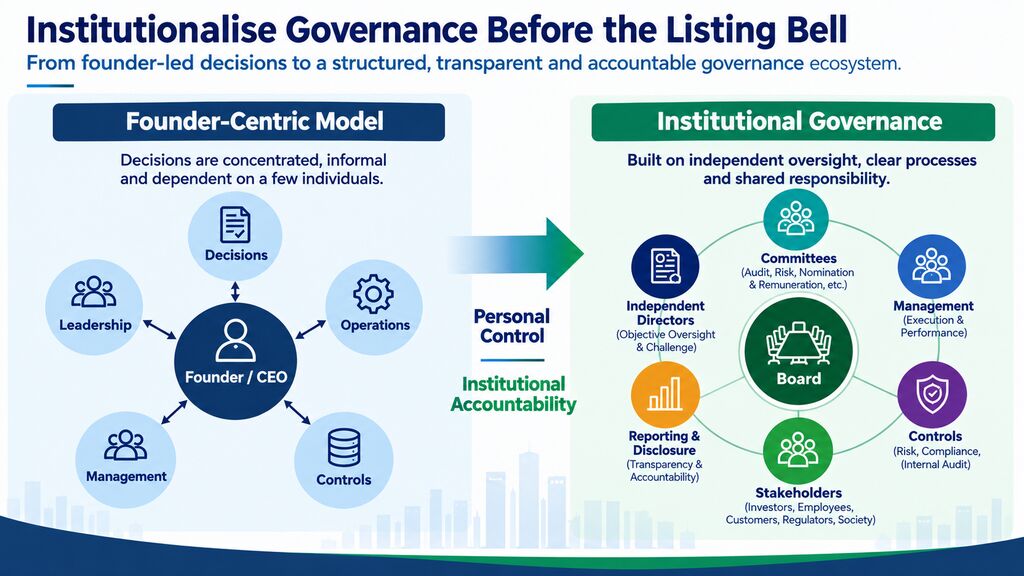
Imagine a founder-led company where the CEO approves almost everything personally. The CFO waits for the founder before making routine decisions. The Audit Committee meets according to schedule but rarely challenges management. Independent directors receive information after major decisions have effectively been made. The organisation may have excellent legal documents and committee charters, yet the actual governance system remains dependent on individual personalities.
Public listing changes the expectations around accountability. The objective is not to eliminate founder influence. Founders often possess valuable strategic knowledge and long-term commitment. The objective is to ensure that influence operates within a governance architecture where decisions can be questioned, documented and reviewed.
From promoter accountability to institutional accountability
This transition can be uncomfortable because it requires successful entrepreneurs to move from personal control to institutional accountability. The founder’s role evolves. Instead of being the person who knows every detail, the founder becomes one of the leaders responsible for building systems through which the organisation can make sound decisions at scale.
The board should ask:
- Can management present bad news without unnecessary delay?
- Can an Independent Director disagree constructively with the promoter?
- Does the CFO have sufficient authority and independence?
- Does internal audit have direct access to the Audit Committee?
- Are succession plans documented?
- Does the board track whether difficult decisions are actually implemented?
These questions reveal governance culture more effectively than a committee charter sitting in a corporate folder.
This is also where board effectiveness intersects with boardroom reputation. A board should not attempt to manufacture an impressive external image that its internal governance cannot support. The strongest institutional story is built from observable signals: credible directors, transparent disclosures, functioning committees, strong controls, resilient operations and accountable leadership.
For senior professionals preparing for board-level roles, this is an important distinction. Board governance for public listing requires more than knowing regulations. It requires the ability to interpret business information, challenge management, understand stakeholder consequences and communicate with clarity.
A 90-day IPO governance readiness playbook
A practical Governance Lessons from NSE IPO framework can be translated into a 90-day diagnostic programme. This should complement—not replace—the formal IPO process, legal advice and regulatory requirements applicable to a particular company. The first 30 days can focus on diagnosis: board and committee effectiveness, director independence, regulatory exposure, related-party transactions, financial controls and operational risks. The next 30 days can focus on strengthening systems, including escalation protocols, audit oversight, resilience testing and succession arrangements.
The final 30 days can focus on demonstrating that the changes actually work. A company could simulate a listed-company board meeting, test a material-disclosure scenario, conduct an operational crisis exercise and independently review whether corrective actions have been implemented. The value of this approach is that it moves governance from documentation to evidence.
| Period | Primary objective | Key actions |
| Days 1–30 | Diagnose | Board review, regulatory-risk mapping, RPT review, control assessment |
| Days 31–60 | Strengthen | Decision rights, audit oversight, disclosure escalation, resilience |
| Days 61–90 | Demonstrate | Board simulation, crisis test, disclosure test, independent review |
Boards can also use a simple Strategy → Story → Signal approach. Strategy asks what institution the company is trying to build. Story explains how its performance, choices and challenges fit together. Signal asks what stakeholders can actually observe and verify. This framework is particularly useful because governance should not be treated as a branding exercise; the external story should emerge from substantive institutional practices.
For executives and directors seeking to strengthen their board positioning, resources such as board-readiness and professional services can help translate experience into a clearer board-level proposition. Similarly, reviewing boardroom branding principles can help senior professionals think about how credibility is communicated alongside capability. The central point remains the same: visibility works best when it is supported by evidence.
Conclusion: The listing bell rings once, governance is tested every day
The most useful Governance Lessons from NSE IPO are not about the excitement of a market debut. They are about what happens after the celebration. NSE’s listing on September 24, 2026 marked the completion of a long public-market journey; Reuters reported that the shares closed at ₹1,818 on their first trading day. Yet a listing is only one event in the life of a public company. Governance continues through every board meeting, disclosure, regulatory interaction, investor communication, leadership decision and operational challenge that follows.
For founders, IPO preparation means moving from personal control toward institutional accountability. For CFOs and CXOs, it means building systems that can withstand scrutiny without relying excessively on individual intervention. For Independent Directors, it means bringing informed, independent judgment to decisions that may involve competing commercial and stakeholder interests. For the board collectively, it means making sure that governance architecture works in practice—not merely that the organisation has the right committees and policies on paper.
That is why IPO governance readiness should begin long before the prospectus. Financial compliance is necessary, but it is only one part of public-market readiness. Institutional trust develops when stakeholders can see consistency between what a company says, how it behaves and the evidence supporting both.
The listing bell rings once. Governance is tested every day.
If you are a CXO preparing for board responsibilities, an aspiring Independent Director, or a company moving toward public-market readiness, a structured Board Readiness and Board Branding approach can help identify capability gaps and communicate board-level value more clearly. You can also explore board value proposition and board bio resources to understand how professional credibility can be converted into a more evidence-based board narrative.
Frequently Asked Questions
1. What are the key Governance Lessons from NSE IPO?
The seven core lessons can be organised around legal and regulatory credibility, independent board judgment, stakeholder accountability, transparency, infrastructure resilience, financial understanding and institutionalised governance. Together, they show why IPO preparation should extend beyond financial and legal compliance.
2. Why is IPO governance readiness important?
IPO governance readiness helps an organisation prepare for the broader accountability that accompanies public ownership. It focuses on whether decision-making, controls, disclosure processes and board oversight can function effectively under sustained scrutiny.
3. What does NSE’s IPO teach Independent Directors?
The NSE case highlights the importance of independent judgment, regulatory awareness, stakeholder responsibility and oversight of operational and financial risks. Independent directors need to assess not only whether processes exist but whether they work in practice.
4. What is board governance for public listing?
Board governance for public listing refers to the structures, processes and behaviours that enable a board to oversee a company preparing to enter public markets. It includes board composition, committees, disclosures, risk oversight, internal controls and accountability.
5. Why does transparency matter before an IPO?
Investors need reliable information to understand a company’s performance, risks and prospects. Pre-IPO disclosure readiness helps ensure that public information is accurate, timely, authorised and consistent with the organisation’s underlying records.
6. What is pre-IPO disclosure readiness?
It is the process of assessing whether the organisation can identify, verify, approve and communicate material information appropriately. It can cover financial reporting, regulatory matters, related-party transactions, leadership changes, operational incidents and other relevant disclosures.
7. How should companies assess Independent Directors before an IPO?
Companies should consider relevant expertise, independence, potential conflicts, time availability, diversity of experience and the individual’s ability to challenge management constructively. A strong CV alone does not demonstrate effective board independence.
8. What is NSE listing regulatory compliance?
It refers to compliance with the applicable legal and regulatory requirements governing NSE’s listing and subsequent operation as a listed entity. SEBI’s LODR framework forms part of the regulatory architecture applicable to listed entities, while NSE also publishes compliance information and relevant documentation.
9. Does an IPO automatically create institutional trust?
No single IPO event can establish long-term institutional trust. Subscription levels, listing performance and investor demand are market indicators, while enduring trust depends on continuing transparency, governance, performance, accountability and stakeholder engagement.
10. Why is operational resilience relevant to IPO governance?
A serious technology or operational failure can affect customers, revenue, regulatory obligations and investor confidence. Boards therefore need visibility into critical systems, business continuity, cybersecurity and recovery arrangements.
11. What does promoter to institutional accountability mean?
It describes the transition from a business where decision-making may be heavily concentrated around promoters to one where authority, oversight and accountability operate through defined institutional processes.
12. What should an Audit Committee examine before an IPO?
Depending on the company’s circumstances and applicable requirements, the Audit Committee can focus on financial reporting, internal controls, audit independence, related-party transactions, regulatory matters, whistle-blower mechanisms and the reliability of information provided to the board.
13. How can a board test IPO governance readiness?
A board can conduct an independent board-effectiveness review, examine regulatory and control gaps, simulate listed-company decision-making, test disclosure processes and assess operational-resilience arrangements. The aim should be to generate evidence rather than simply complete paperwork.
14. What is the difference between IPO readiness and governance readiness?
IPO readiness focuses heavily on completing the requirements necessary for the transaction. Governance readiness focuses on whether the organisation has the institutional capabilities needed to operate responsibly after becoming publicly listed.
15. What should senior executives learn from the NSE IPO?
Senior executives can view the NSE journey as a reminder that public-market readiness involves more than financial performance. Governance Lessons from NSE IPO include the importance of independent oversight, regulatory learning, stakeholder accountability, transparent communication, resilience and institutional decision-making.
Ready to Strengthen Your Boardroom Readiness?
Preparing for the public markets is about more than financial compliance or completing an IPO checklist. It requires strong governance, independent judgement, transparent decision-making, institutional accountability, and systems that can withstand sustained scrutiny.
Whether you are a CXO, senior executive, entrepreneur, experienced professional, or aspiring Independent Director, understanding what makes governance work in practice can strengthen your ability to contribute effectively at the board level.
The Governance Lessons from NSE IPO highlight an important principle: the listing bell rings once, but governance is tested every day. Building board-level credibility therefore means developing the ability to understand risk, challenge assumptions, evaluate information, consider stakeholder interests, and contribute to sound institutional decision-making.
Don’t wait until an IPO or board opportunity arrives to prepare. Strengthen your governance perspective, sharpen your board-level value proposition, and build the credibility needed for meaningful boardroom contribution.
Schedule your complimentary session here:
https://calendly.com/dramitnagpal
Share this post: Facebook | X | LinkedIn