

Many senior executives assume that securing a board role is a straightforward transition. They believe that after decades in the C-suite, board appointments will naturally follow. Unfortunately, reality tells a different story. A distinguished designation, an impressive resume, or years of leadership experience do not automatically translate into a successful board portfolio career.
The modern board ecosystem operates differently. Boards increasingly seek individuals whose reputations extend beyond their organizations. Nomination committees, investors, and executive search firms want directors known for sound judgement, governance maturity, strategic insight, and ecosystem influence. In other words, the strongest board brands are rarely built through self-promotion alone. They are built indirectly—through sustained contribution, trusted associations, thought leadership, and visible engagement within governance communities.
Research from leading governance institutions indicates that board appointments increasingly arise from professional networks, industry credibility, and demonstrated governance expertise rather than traditional career progression alone. This shift means executives aspiring to build a board portfolio career must think differently. They must intentionally cultivate reputation, influence, and trust long before board opportunities emerge.
If you aspire to serve on multiple boards, advisory councils, or governance committees, your journey starts today—not after retirement.
Table of Contents
- Understanding the Modern Board Portfolio Career
- Why the Best Board Brands Are Built Indirectly
- The Four Drivers of a Successful Board Portfolio Career
- Non-executive Director Branding in Action
- Boardroom Thought Leadership as a Career Accelerator
- How to Get on a Corporate Board Through Strategic Positioning
- Common Mistakes Executives Make
- A Practical Framework for Building a Board Portfolio Career
- Conclusion
- FAQs
Understanding the Modern Board Portfolio Career
What Is a Board Portfolio Career?
A board portfolio career refers to a professional pathway in which executives serve across multiple boards, advisory councils, committees, or governance roles rather than relying on a single executive position. It often includes independent directorships, advisory assignments, non-profit governance, mentoring, and strategic consulting engagements.
Unlike traditional executive careers, portfolio careers are built on influence rather than authority. The shift can be challenging because executives move from operational leadership to strategic oversight. Board members are expected to challenge assumptions, oversee risk, guide long-term strategy, and protect stakeholder interests.
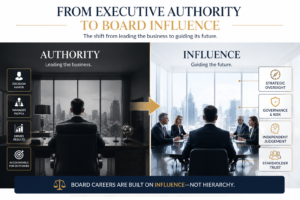
The transition requires a different professional identity. Instead of being recognized solely as “the CEO of Company X,” aspiring directors must establish themselves as governance leaders capable of adding value across multiple contexts.
Executives interested in exploring structured pathways to board careers often benefit from specialized resources such as the Board Portfolio Career solutions offered through the Your Board Profile platform.
Why More Executives Are Pursuing Portfolio Careers
The growing popularity of the board portfolio career reflects broader shifts in leadership aspirations and corporate governance.
Senior executives increasingly seek opportunities to:
- Extend their professional influence
- Contribute beyond a single organization
- Share accumulated expertise
- Diversify intellectual engagement
- Create post-executive career pathways
Boards also benefit. Diverse experiences and cross-industry insights enable directors to challenge management constructively and anticipate emerging risks more effectively.
Many executives no longer view retirement as an endpoint. Instead, they see it as a transition toward governance, mentorship, and strategic contribution.
Why the Best Board Brands Are Built Indirectly
Reputation Precedes Appointment
One of the least understood realities about board appointments is that reputation often precedes opportunity.
Nomination committees rarely begin by reviewing thousands of résumés. Instead, they ask a simple question:
“Who do we know and trust?”
This trust develops gradually through years of interaction, observation, collaboration, and reputation-building.
Executives who consistently contribute to industry conversations, mentor future leaders, participate in governance forums, and engage with professional communities become visible long before formal board searches begin.
A strong reputation acts like compound interest. Small contributions accumulate over time, eventually creating substantial credibility.
The best board directors rarely announce that they want board roles. Instead, their reputation naturally positions them for consideration.
Trust Compounds Through Contribution
Trust cannot be manufactured overnight.
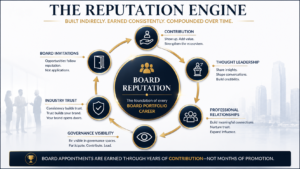
Executives build trust when they:
- Share expertise generously
- Support industry initiatives
- Mentor emerging leaders
- Participate in governance discussions
- Contribute thought leadership
This is why boardroom thought leadership plays such a significant role in building a successful board portfolio career.
Governance ecosystems remember contributors. They remember individuals who elevate conversations, offer strategic perspectives, and strengthen professional communities.
Board appointments often emerge from these ecosystems rather than from traditional job applications.
The Four Drivers of a Successful Board Portfolio Career
Contribution
Contribution is the foundation of every successful board portfolio career.
Executives who actively contribute to professional communities establish themselves as trusted advisors rather than passive observers.
Examples include:
- Serving on industry committees
- Mentoring founders and emerging leaders
- Participating in policy discussions
- Supporting educational institutions
- Advising start-ups
Contribution demonstrates commitment to broader stakeholder interests—a quality highly valued in governance environments.
Association
People are often judged by the professional ecosystems they participate in.
Associations with respected institutions, governance bodies, educational organizations, and industry forums enhance credibility.
Meaningful association differs from superficial membership. Merely joining an organization is not enough. Active engagement creates stronger reputation signals.
Executives who regularly engage with governance institutions frequently gain access to influential networks and valuable learning opportunities.
Thought Leadership
Boardroom thought leadership enables executives to communicate how they think, not merely what they have achieved.
Publishing articles, participating in podcasts, speaking at conferences, and contributing insights on governance trends help establish intellectual credibility.
Topics may include:
- Corporate governance
- Risk oversight
- ESG strategy
- Digital transformation
- Succession planning
- Cybersecurity governance
Thought leadership transforms experience into influence.
Ecosystem Trust
Trust within governance ecosystems represents one of the most valuable forms of professional capital.
Ecosystem trust develops when stakeholders repeatedly observe integrity, sound judgement, professionalism, and strategic thinking.
Unlike visibility, trust cannot be accelerated through marketing alone. It emerges through consistent behaviour over time.
Executives who prioritize trust-building often enjoy stronger referral networks and broader board opportunities.
Non-executive Director Branding in Action
Moving Beyond Titles
Effective non-executive director branding requires executives to move beyond corporate titles.
Board recruiters are less interested in organizational hierarchy and more interested in transferable governance capabilities.
Questions frequently considered include:
- Can this executive oversee risk?
- Can they challenge management constructively?
- Can they contribute independently?
- Can they navigate stakeholder complexity?
Strong branding answers these questions proactively.
Positioning Yourself as a Governance Asset
A powerful board brand communicates strategic value.
Executives should articulate:
| Leadership Dimension | Governance Signal |
| Strategy | Long-term value creation |
| Finance | Capital allocation expertise |
| Operations | Scalability and execution oversight |
| Technology | Digital transformation leadership |
| People | Succession and talent governance |
| Risk | Enterprise risk management |
Professionals seeking stronger governance positioning frequently invest in specialized Board Value Proposition and Board Bio development to communicate board readiness effectively.
Boardroom Thought Leadership as a Career Accelerator
Creating Governance Content
Publishing governance-focused content is one of the most effective ways to build visibility.
Articles, white papers, interviews, and commentary enable executives to demonstrate judgement, insight, and strategic perspective.
Content should address real governance challenges rather than simply celebrate personal achievements.
Examples include:
- Board oversight during disruption
- AI governance implications
- Succession planning best practices
- Risk governance frameworks
- Stakeholder stewardship
High-quality content builds credibility among decision makers.
Building Visibility Among Decision Makers
Visibility matters because opportunities frequently emerge from awareness.
Executive search consultants, board chairs, investors, and fellow directors cannot recommend individuals they have never encountered.
Thoughtful visibility strategies include:
- Conference speaking
- Industry panel participation
- Governance associations
- Published articles
- Professional networking
Board opportunities often emerge from cumulative visibility rather than isolated activities.
How to Get on a Corporate Board Through Strategic Positioning
Building Relationships Before Opportunities Arise
Understanding how to get on a corporate board requires abandoning transactional networking.
Effective board networking focuses on long-term relationship development.
Executives should cultivate relationships with:
- Existing directors
- Governance professionals
- Executive search consultants
- Industry association leaders
- Investors and advisors
Strong relationships create trust, credibility, and referral pathways.
Strengthening Your Board Value Proposition
Every aspiring director should clearly answer:
“Why should a board appoint me?”
A compelling value proposition combines:
- Governance expertise
- Industry experience
- Strategic capabilities
- Independent judgement
- Stakeholder perspective
Without clarity, even accomplished executives may struggle to secure board opportunities.
Common Mistakes Executives Make
Waiting Until Retirement
Many executives delay board preparation until retirement approaches.
This is often too late.
Successful board portfolio careers are usually built years in advance through contribution, relationships, and reputation.
Over-Relying on Corporate Titles
Corporate designations provide credibility but rarely guarantee appointments.
Boards seek governance capability, not hierarchy alone.
Executives must demonstrate independent thinking, oversight capability, and ecosystem trust.
A Practical Framework for Building a Board Portfolio Career
The C.O.R.E. Framework provides a practical roadmap:
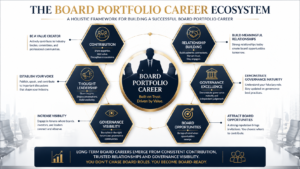
| Element | Meaning |
| C | Contribution to professional ecosystems |
| O | Ongoing visibility and thought leadership |
| R | Relationship building and reputation |
| E | Ecosystem trust and engagement |
Consistent investment across these dimensions significantly strengthens long-term board readiness.
Conclusion
A successful board portfolio career is rarely built directly. It emerges from years of meaningful contribution, trusted relationships, ecosystem participation, and visible thought leadership.
Executives who understand this principle position themselves differently. They invest in reputation rather than recognition, trust rather than visibility alone, and contribution rather than self-promotion.
The strongest board brands are not created overnight. They are earned—one conversation, one contribution, and one trusted relationship at a time.
FAQs
- What is a board portfolio career?
A board portfolio career is a professional pathway where executives serve on multiple boards, advisory councils, and governance roles.
- Why is a board portfolio career becoming popular among senior executives?
A board portfolio career allows executives to extend their influence, share expertise, and remain strategically engaged beyond full-time roles.
- How do I start building a board portfolio career?
You can start building a board portfolio career by strengthening governance expertise, expanding networks, and developing thought leadership.
- Why are the best board brands built indirectly in a board portfolio career?
In a board portfolio career, reputation grows through contribution, trusted relationships, and ecosystem engagement rather than direct self-promotion.
- How important is thought leadership for a board portfolio career?
Boardroom thought leadership is essential because it showcases strategic thinking and governance capability to decision-makers.
- How does non-executive director branding support a board portfolio career?
Strong non-executive director branding helps executives position themselves as valuable governance assets across multiple boards.
- Can a board portfolio career begin before retirement?
Yes, building a board portfolio career should ideally begin several years before retirement through networking and governance participation.
- How can executives improve their visibility for a board portfolio career?
Executives can improve visibility for a board portfolio career by speaking at industry events, publishing insights, and participating in governance forums.
- What role does ecosystem trust play in a board portfolio career?
Ecosystem trust is critical in a board portfolio career because board appointments often arise through referrals and professional credibility.
- How do executive search firms evaluate candidates for a board portfolio career?
Executive search firms assess governance expertise, reputation, visibility, and strategic fit when evaluating candidates for a board portfolio career.
- What are the common mistakes executives make while pursuing a board portfolio career?
Common mistakes include waiting until retirement, relying only on corporate titles, and neglecting professional visibility.
- How does contribution influence success in a board portfolio career?
Consistent contribution to industry and governance ecosystems significantly strengthens a board portfolio career.
- How can thought leadership help executives get on a corporate board?
Thought leadership demonstrates expertise, builds trust, and increases visibility among board decision-makers.
- Why is networking important for a board portfolio career?
Networking helps executives build trusted relationships that often lead to opportunities in a board portfolio career.
- How long does it take to establish a successful board portfolio career?
A successful board portfolio career is typically built over several years through sustained contribution, credibility, and relationship-building.
Ready to Strengthen Your Board Presence and Unlock New Board Opportunities?
Your next board opportunity may not come from a job application—it may come from the reputation you build today. Start strengthening your governance profile, clarify your board value proposition, and position yourself as a trusted strategic advisor before opportunities arise.
Whether you’re an aspiring Independent Director, CXO, Founder, or senior executive, a well-positioned board profile can make all the difference in today’s competitive board landscape.
Book a complimentary strategy session with Your Board Profile today.