
A strong Board Community is not built simply by increasing the number of people who hold board positions. It develops when experienced professionals share knowledge, understand governance responsibilities, prepare thoughtfully for board roles and help others make the transition from executive leadership to boardroom contribution.
That distinction is important. A senior executive may have spent 20 or 30 years leading businesses, managing people, navigating crises and making difficult decisions, yet still find it difficult to explain what those experiences mean in a boardroom. The challenge is not always a lack of experience. Often, it is a lack of translation.
This is where Your Board Profile, under the leadership of Dr Amit Nagpal, positions its work differently. Its focus extends beyond professional visibility toward boardroom branding, strategic storytelling, governance positioning, board readiness and knowledge sharing. The platform describes its work around helping Independent Directors, aspiring directors, CXOs and senior professionals build credible board-level identities. Current public information also describes Dr Nagpal’s work through Board Talks, board branding frameworks and governance-focused storytelling.
The larger idea is simple: your experience becomes more valuable to the Board Community when other people can understand it, learn from it and apply it responsibly.
Table of Contents
Why the Board Community Needs More Than Board Appointments
The modern boardroom requires more than impressive résumés. Directors are expected to bring judgement, independence, oversight, questioning ability, stakeholder awareness and the capacity to contribute to complex decisions.
That makes the development of a healthy Board Community a shared responsibility. Experienced directors can contribute lessons from the boardroom. CXOs can share what they have learned from leading transformation, people, technology or capital allocation. Aspiring directors can bring fresh perspectives while developing an understanding of governance. Mentors can shorten the learning curve for professionals who have never previously worked at board level.
The result is a much broader ecosystem than a simple network of people searching for appointments.
From Personal Visibility to Shared Value
Personal branding naturally begins with an individual question: What do I want people to know about me?
Board-level positioning requires a second question: What value can I create for a board, its stakeholders and the wider governance ecosystem?
That shift changes the conversation.
Instead of presenting a career as a list of achievements, a board-ready professional needs to connect those achievements with governance relevance. A former CHRO, for example, may have experience in succession planning, executive compensation, culture and leadership development. The stronger board narrative is not simply that the executive has handled these areas. It is how that experience could help a board think about leadership continuity, organisational culture, talent risk and remuneration oversight.
The supplied source material describes this principle through the idea of helping leaders articulate a Board Value Proposition: identifying the perspectives they bring, risks they understand and committees they could credibly serve.
That is where self-promotion can become shared value.
Your Board Profile and the Changing Governance Landscape
The relevance of this approach becomes clearer when viewed against the expectations surrounding Indian boards.
The SEBI Listing Obligations and Disclosure Requirements framework gives the Nomination and Remuneration Committee an important role in evaluating the balance of skills, knowledge and experience on the board and identifying the capabilities required for an Independent Director appointment.
The Companies Act, 2013 also establishes important provisions around independent directors, including their responsibilities and the conditions associated with their appointment and independence.
This creates an important practical implication for aspiring directors.
A board profile cannot simply say, “I am an experienced leader.”
It needs to answer a more useful question:
Experienced in what, relevant to which board need, and capable of contributing in what governance context?
Why Board-Level Relevance Matters
Consider two executives.
Both have 25 years of leadership experience. Both have managed large teams. Both have handled business transformation. Both have worked with senior stakeholders.
One profile says:
“Experienced business leader with extensive experience in strategy and transformation.”
The other explains:
“Three decades of leading transformation across complex businesses, with experience in technology adoption, stakeholder management, risk oversight and organisational change.”
The second profile creates more material for a board conversation because it begins to identify areas of board relevance.
That does not guarantee a board appointment. It simply makes the person’s experience easier to evaluate against a board’s needs.
This distinction is central to a credible Board Community: visibility should make expertise easier to discover, but credibility must still come from evidence, judgement and conduct.
Building a Strong Board Value Proposition for Independent Directors
A Board value proposition for independent directors should answer one fundamental question:
Why would this board benefit from having this particular person around the table?
The answer should go deeper than functional expertise.
A CFO may bring financial expertise, but the board may also value experience in capital allocation, investor communication, risk management and transformation. A CHRO may bring people expertise, but the board may need someone who understands succession planning, leadership pipelines and organisational culture. A technology executive may offer digital expertise, but increasingly the relevant board conversation may also involve cybersecurity, AI governance, data risk and technology-led business models.
The point is not to create a longer profile.
It is to create a more relevant one.
Connecting Experience With Board Requirements
The source material describes this work as connecting professional experience with the needs of a particular board, including sector relevance, governance judgement and committee fit.
That is a useful framework for senior professionals.
| Executive Experience | Potential Board Relevance |
| Succession planning | NRC, leadership continuity and talent risk |
| Cybersecurity leadership | Technology, cyber and enterprise risk oversight |
| M&A experience | Strategy, capital allocation and transaction oversight |
| ESG transformation | Sustainability, stakeholder and regulatory considerations |
| Financial leadership | Audit, risk, controls and capital allocation |
| Digital transformation | Technology strategy, AI and transformation oversight |
| Crisis management | Risk, resilience and stakeholder communication |
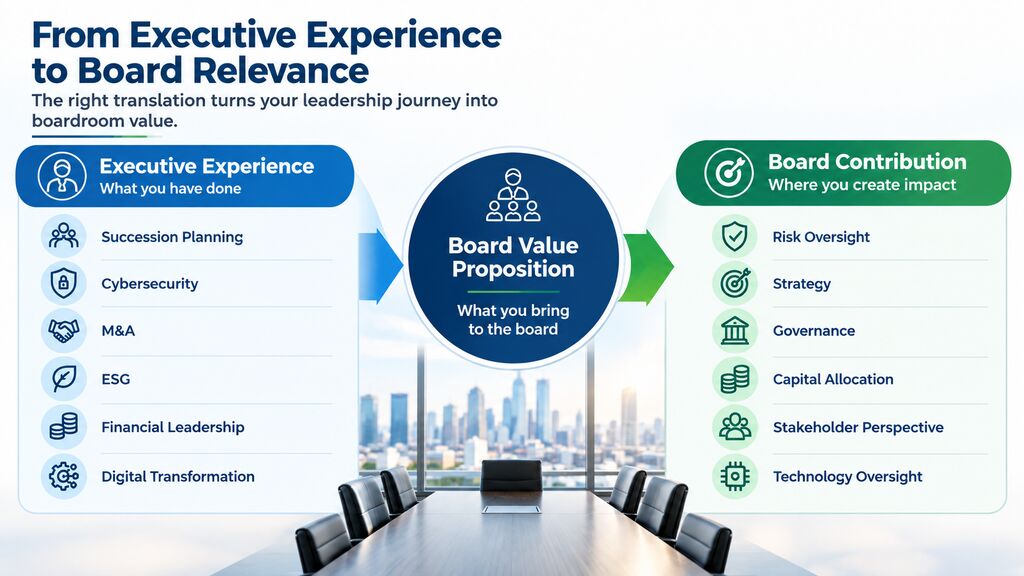
The table is not a formula for board appointments. Board requirements differ from company to company.
Instead, it demonstrates a useful discipline: translate experience into board-relevant evidence.
That is an important contribution to the Board Community because it helps professionals understand that board readiness is not merely about seniority.
Board Readiness and Preparation for CXOs
Many CXOs reach a point in their careers where the next chapter may include board roles. Yet executive success and board effectiveness are not identical.
A CEO is often expected to make decisions and drive execution. A director must oversee, question, challenge and exercise judgement without becoming part of management.
This difference deserves deliberate preparation.
The supplied YBP material identifies customised Board CVs, Board Readiness Reviews, Board Branding Scorecards, Boardroom Branding Coaching, digital presence optimisation and networking strategy among its services.
The value of such preparation lies in structure.
Turning Executive Experience Into Boardroom Evidence
Imagine an executive who has successfully led a major turnaround.
At an operational level, that may be an impressive achievement. At board level, the more useful story asks:
- What risks did the executive identify?
- Which assumptions were challenged?
- What alternatives were considered?
- How were stakeholder interests balanced?
- What ethical tensions emerged?
- What was the long-term consequence of the decision?
That is the difference between an achievement story and a governance story.
A boardroom is rarely interested only in what happened. Directors need to understand how decisions were reached.
The source material captures this discipline by emphasising consistency between what a profile promises and the individual’s actual knowledge, conduct and contribution.
In other words, board readiness is not about creating a better-looking professional identity. It is about making the underlying capability easier to see and evaluate.
Boardroom Branding and Governance Positioning
Boardroom branding and governance positioning can sound like marketing terminology. In practice, its strongest application is much more disciplined.
A boardroom brand should communicate three things:
What do I understand?
What have I experienced?
How do I think when the stakes are high?
This is particularly relevant because directors operate in environments where trust matters as much as visibility.
Strategy, Story and Signal
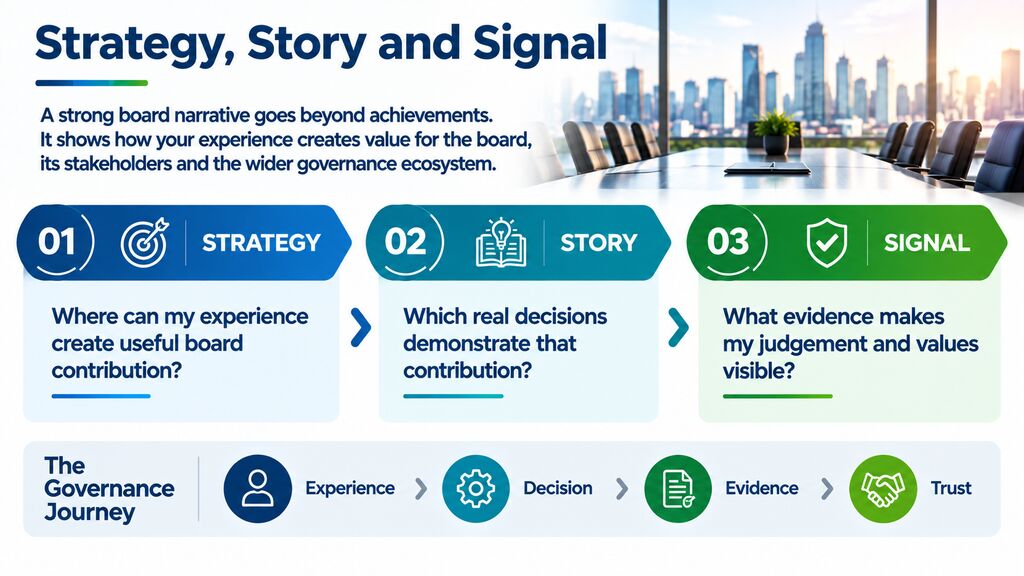
Dr Amit Nagpal’s work describes a Strategy → Story → Signal framework.
The logic is straightforward:
| Element | Core Question |
| Strategy | Where can my experience create useful board contribution? |
| Story | Which real decisions demonstrate that contribution? |
| Signal | What evidence makes my judgement and values visible? |
The source material explains the framework through the idea that a transformation story becomes more meaningful when it demonstrates how a leader assessed risk, challenged assumptions and protected stakeholder interests.
This is a valuable distinction.
A board does not need another person who can simply describe achievements. It needs people who can contribute thoughtful judgement.
Dr Nagpal’s public professional material also describes the TQCJDG framework — Think, Question, Challenge, Judge, Decide and Govern — as a way of focusing attention on how leaders approach boardroom situations.
That moves boardroom branding away from surface-level visibility and toward governance signalling.
Making Governance Knowledge More Accessible
A healthy Board Community cannot depend entirely on private conversations.
Knowledge grows when ideas are written, discussed, challenged and shared.
This is one of the areas where Your Board Profile’s broader ecosystem becomes relevant. The supplied material refers to Dr Nagpal’s monthly “Your Brand for the Boardroom” column in Board Stewardship, Board Talks videos, the “Your Story is Your Brand” newsletter, blogs, FAQs and free training.
These channels serve a different purpose from a one-to-one coaching engagement.
Someone who is still exploring a board career may not yet know which questions to ask. Accessible educational material can provide the first vocabulary for that exploration.
What does board readiness mean?
What makes an executive experience relevant to a board?
How should a professional explain committee fit?
What does governance thinking look like in practice?
These questions matter because the Board Community grows stronger when more professionals understand the difference between wanting a board seat and being prepared to contribute as a director.
Strengthening the Board Community Through Mentorship
Perhaps one of the clearest examples of shared value is mentorship.
The source material identifies Classroom to Boardroom, a free mentorship initiative for high-potential MBA students, as part of YBP’s contribution to developing future business and governance leaders.
The idea is important because boardroom capability takes time to develop.
A student may not become a director for many years. Yet the habits associated with responsible leadership can begin much earlier: asking better questions, understanding accountability, considering stakeholders, learning from experienced leaders and recognising the consequences of business decisions.
That is why strengthening the Board Community through mentorship has value beyond the immediate participants.
Today’s MBA student may become tomorrow’s CXO.
Tomorrow’s CXO may eventually become a director.
And tomorrow’s director may eventually become a mentor.
That creates a cycle of knowledge transfer.
Mentorship therefore becomes more than career guidance. It becomes an investment in the quality of future leadership.
Learning Through Books, Conversations and Collaboration
Knowledge also becomes durable when individual experience is converted into material that others can access.
The source material records several publishing milestones associated with YBP and Dr Nagpal, including Mastering Governance, Leadership & Strategic Storytelling, Digital Transformation – A Playbook for Boards & C-Suite, and The Safety-Pin Leadership.
The subjects themselves point toward broader boardroom questions: governance, strategic communication, transformation and leadership under pressure.
Books are particularly useful to a Board Community because they slow down the conversation.
A webinar may create an insight.
A conversation may challenge it.
A book can develop it.
Collaboration adds another dimension. The source material identifies Dr Nagpal’s association with Board Stewardship as a Knowledge Partner and points to participation in huddles, webinars and learning programmes.
Current Board Stewardship programming similarly demonstrates how board leaders, Independent Directors, governance professionals and industry experts are brought together around subjects such as AI, ethics, geopolitical risk and the evolving role of Independent Directors.
This is where a Board Community becomes an ecosystem rather than a directory.
People learn from one another.
Different sectors bring different experiences.
Different generations ask different questions.
And governance challenges become subjects for collective learning.
What Senior Executives Can Learn From the Board Community
For a CXO or aspiring director, participation in the Board Community should not be viewed only as networking.
It can be a learning environment.
A senior executive can observe how directors discuss risk. They can understand the language used around committees. They can learn how experienced directors distinguish management issues from board-level issues. They can also discover where their own executive experience needs to be supplemented.
The goal is not to imitate another director.
It is to develop one’s own governance perspective.
Four Questions Every Future Director Should Ask
The source material offers four particularly useful questions for professionals considering their own contribution.
1. Can I clearly explain the specific value I could bring to a board?
This forces the professional to move beyond a generic executive biography.
2. Do my stories demonstrate judgement, ethics and stakeholder awareness?
This shifts attention from achievement to decision quality.
3. Does my public profile provide evidence of the capabilities I claim?
A board profile should not make promises that the rest of the professional footprint cannot support.
4. What knowledge or mentorship am I contributing to others?
This is perhaps the most important question for a community.
It changes the mindset from “What can the board give me?” to “What can I contribute to the board and to the wider governance ecosystem?”
From Individual Expertise to Collective Board Value
The evolution of a Board Community depends on a simple but powerful principle: expertise becomes more valuable when it can travel.
A leader’s experience should not disappear when they leave an executive role. It can become a boardroom lesson. A difficult transformation can become a case study. A governance challenge can become a conversation. A mentoring relationship can become the beginning of another leader’s development.
That is the broader relevance of Your Board Profile’s work under Dr Amit Nagpal’s leadership.
The platform’s contribution, as described in the supplied material, spans board value propositions, preparation, governance signalling, knowledge sharing, publishing, collaboration and mentorship.
The underlying philosophy can be expressed in one sentence:
A board-ready professional should not only be visible to the board community; that professional should add value to it.
For senior executives, this creates a useful way to think about the next stage of their careers. Your board journey does not begin when you receive a board appointment. It begins much earlier — when you start understanding governance, clarifying your contribution, building credible evidence and sharing knowledge with others.
For aspiring Independent Directors, that may mean moving from a career CV to a board-relevant narrative.
For serving directors, it may mean becoming a mentor, speaker, writer or knowledge contributor.
For CXOs, it may mean learning how to translate operating experience into governance judgement.
And for the broader ecosystem, it means building a culture where experience is shared rather than stored.
A Practical Next Step
If you are considering a board-level transition, begin with one leadership experience that taught you something difficult.
Ask yourself:
What happened?
What decision did I make?
What risks did I consider?
Whose interests did I have to balance?
What would another leader learn from that experience?
That exercise can reveal more about your potential board contribution than another generic list of achievements.
Your Board Community becomes stronger when individual professionals make their experience useful to others.
And that is perhaps the most meaningful way to think about boardroom branding: not as a louder version of self-promotion, but as a clearer expression of the value you are prepared to contribute.
Your usefulness is your brand.
Frequently Asked Questions
1. What is the Board Community?
The Board Community can be understood as the wider ecosystem of directors, aspiring directors, CXOs, governance professionals, mentors, advisors, educators and other stakeholders involved in board-level leadership and governance. It is not limited to people who currently hold board positions. It also includes professionals preparing for future governance responsibilities and people contributing knowledge to the ecosystem.
2. What is Your Board Profile?
Your Board Profile is a platform focused on boardroom branding, strategic storytelling, governance positioning, board readiness and professional visibility for Independent Directors, aspiring directors, CXOs and senior professionals. Its stated approach is to help leaders communicate their board-level relevance more clearly.
3. Who is Dr Amit Nagpal?
Dr Amit Nagpal is the founder of Your Board Profile and is publicly associated with boardroom branding, strategic storytelling and governance signalling. His professional platform also features Board Talks, board branding frameworks and board aptitude/readiness concepts.
4. What is a Board Value Proposition?
A Board Value Proposition explains the specific value a professional could bring to a board. It connects an individual’s experience, expertise, judgement, sector knowledge and potential committee contribution with the needs of a particular board.
5. Why is board readiness important for CXOs?
Executive leadership and board leadership involve different responsibilities. CXOs may have extensive operating experience, but board roles require oversight, questioning, independent judgement and governance awareness. Structured board readiness can help executives translate their operating experience into board-relevant evidence.
6. What is boardroom branding?
Boardroom branding is the process of communicating a professional’s board-relevant experience, expertise, governance perspective and leadership identity. Its strongest form is based on evidence rather than simply increasing visibility.
7. How does strategic storytelling support board readiness?
Strategic storytelling helps professionals explain the decisions behind their achievements. Instead of simply stating what they accomplished, they can demonstrate how they assessed risk, challenged assumptions, considered stakeholders and reached decisions.
8. What does governance signalling mean?
Governance signalling refers to the observable evidence through which others understand a leader’s governance maturity. This can include the questions they ask, the issues they discuss publicly, the decisions they describe and the way they demonstrate judgement.
9. Can an executive’s experience be relevant to an Independent Director role?
Yes, depending on the requirements of the board. Relevant experience may include areas such as finance, technology, human resources, transformation, risk, strategy, sustainability or sector expertise. SEBI’s framework specifically refers to evaluating the balance of skills, knowledge and experience when considering Independent Director requirements.
10. Why does mentorship matter to the Board Community?
Mentorship enables experienced professionals to transfer practical knowledge to emerging leaders. Initiatives such as Classroom to Boardroom illustrate how exposure to experienced practitioners can encourage earlier reflection on leadership, accountability and governance.
11. What is Classroom to Boardroom?
Classroom to Boardroom is described in the supplied material as a free mentorship initiative for high-potential MBA students designed to support the development of future business and governance leaders.
12. Why should senior executives contribute to the Board Community?
Contribution allows executives to convert their experience into shared knowledge. Writing, speaking, mentoring and participating in governance discussions can help other professionals learn from real leadership situations while strengthening the wider governance ecosystem.
13. How can an aspiring director start preparing for a board career?
A useful starting point is to identify the governance value behind your executive experience. Review your sector expertise, decision-making experience, risk exposure, stakeholder responsibilities, committee relevance and public professional profile. Then identify the areas where additional governance knowledge or preparation is needed.
14. What makes a board profile credible?
A credible board profile should be consistent with the person’s actual experience, knowledge, conduct and contribution. The source material specifically emphasises that what the profile promises should be supported by the individual’s knowledge and behaviour.
15. How can professionals contribute to a stronger Board Community?
Professionals can contribute through mentoring, knowledge sharing, thoughtful writing, speaking, governance discussions, peer learning and responsible leadership. The larger objective is to ensure that professional experience becomes useful beyond the individual who originally gained it.
Conclusion
The future of the Board Community depends not only on finding more directors, but on developing better-informed, better-prepared and more connected leaders.
Your Board Profile’s approach under Dr Amit Nagpal brings together several parts of that ecosystem: helping leaders articulate their Board Value Proposition, preparing CXOs and aspiring directors, translating experience into governance stories, making learning accessible, publishing ideas, collaborating with other governance platforms and mentoring emerging leaders.
That creates a broader definition of boardroom success.
A professional does not contribute to governance only by sitting around a board table. Contribution can begin much earlier — through preparation, knowledge sharing, mentorship, thoughtful storytelling and the willingness to make one’s experience useful to others.
For anyone preparing for a board-level career, the question therefore goes beyond “How do I become visible to boards?”
A more valuable question is:
“How can my experience create value for a board and for the wider Board Community?”
That is where personal visibility begins to become shared value.
And that is where a professional profile can become more than a career document — it can become a contribution to the governance ecosystem.
Ready to Strengthen Your Place in the Board Community?
Your executive experience may already hold significant board-level value. The next step is to translate that experience into governance relevance, strategic judgement, boardroom credibility, and meaningful contribution.
A strong board profile goes beyond listing achievements. It communicates how you think, how you make decisions, how you navigate risk, and what perspective you can bring to a board and its stakeholders.
Whether you are a CXO, senior executive, entrepreneur, experienced professional, or aspiring Independent Director, your journey towards boardroom contribution begins with making your experience visible, relevant, and credible.
Don’t wait for a board opportunity to start preparing for board-level contribution. Build your boardroom identity, strengthen your governance narrative, and make your experience a valuable part of the wider Board Community.
Schedule your complimentary session here:
https://calendly.com/dramitnagpal
Share this post: Facebook | X | LinkedIn