
Why CEO Succession Planning Matters in 2026
What happens when a company’s most influential leader decides to leave tomorrow? Does the board know who can take charge immediately, or would the organisation spend its first few weeks searching for answers while employees, investors and customers wait for clarity?
This is precisely why CEO succession planning deserves a prominent place on the Nomination and Remuneration Committee (NRC) agenda in 2026. Leadership transitions are no longer simply about finding a replacement for a departing chief executive. They are about protecting strategic momentum, preserving institutional knowledge, strengthening investor confidence and ensuring that the organisation can continue to make sound decisions during periods of uncertainty.
KPMG India’s On the Nomination and Remuneration Committee Agenda 2026, published in April 2026, highlights leadership continuity, succession, committee strength and leadership fatigue as important areas of board attention. Its broader message is that NRC responsibilities are expanding beyond appointments and compensation to include workforce resilience, leadership capability and governance credibility. This article builds on those themes while examining the practical implications for Indian boards.
The urgency is visible in recent data. According to The Economic Times, 149 CEO and managing director exits were recorded across 2,800 NSE-listed companies in calendar year 2025, compared with 129 exits across 2,529 companies in 2024. The number of exits at Nifty-100 companies rose from nine to 22 over the same period. These figures do not establish that every departure was unexpected, but they demonstrate why boards cannot afford to treat leadership transitions as rare events.
For senior executives, CXOs and aspiring independent directors, the message is equally important: succession is a governance issue, a strategic issue and a test of board effectiveness. A well-designed process helps a company prepare for tomorrow without undermining the leader responsible for delivering results today.
Table of Contents
1. CEO Succession Planning as a Strategic Board Priority
From emergency replacement to long-term resilience
Traditionally, some organisations have treated CEO succession as a confidential discussion that becomes urgent only when a retirement, resignation or performance issue appears on the horizon. The weakness in this approach is simple: leadership capability takes time to develop, and the best candidate may not be ready when the board needs them. By the time a vacancy becomes unavoidable, directors may be forced to choose between an unprepared internal executive and an expensive external appointment.
Effective CEO succession planning starts well before a vacancy exists. It connects the company’s long-term strategy with the leadership capabilities required to deliver it. A business preparing for international expansion, digital transformation, acquisitions or a major restructuring may need a very different CEO profile from one focused on operational stability and margin improvement.
Boards should therefore ask a more useful question than, “Who will replace the current CEO?” They should ask, “What kind of leader will this organisation need over the next three to five years, and how are we preparing that person today?”
The answer should shape leadership development, talent reviews, executive exposure to the board and objective assessments of readiness. The PwC guide to CEO succession planning similarly emphasises ongoing planning, clear ownership, emergency arrangements and a strong pipeline of candidates.
This approach transforms succession from an administrative exercise into a practical mechanism for protecting business continuity.
2. The Nomination and Remuneration Committee Agenda 2026
Governance responsibilities in the Indian context
For Indian companies, CEO succession planning sits within a broader governance framework involving board oversight, senior management appointments, remuneration policy and leadership evaluation.
Section 178 of the Companies Act, 2013 sets out key responsibilities of the NRC, including identifying suitable persons for director and senior management positions, recommending appointments and removals, and formulating remuneration-related criteria and policies. Listed entities must also consider the applicable SEBI Listing Obligations and Disclosure Requirements (LODR) framework. The precise requirements depend on the entity and the relevant provisions in force.
A useful starting point is the Companies Act, 2013, Section 178 and the applicable SEBI LODR Regulations.
For the NRC, the practical challenge is translating governance responsibilities into a disciplined succession process. The committee should establish clear ownership, ensure that the full board receives appropriate updates, and define how candidate readiness will be assessed. The current CEO may provide valuable input on potential successors, but the board must retain appropriate oversight and independent judgement.
The 2026 NRC agenda should also connect succession with changing workforce capabilities. Artificial intelligence, cybersecurity, geopolitical volatility, changing stakeholder expectations and new business models can all alter the capabilities needed at the top. A succession plan that was suitable three years ago may no longer reflect the company’s strategic direction.
KPMG’s 2026 report provides a useful reference point for these interconnected issues. Its discussion of leadership continuity and committee strength reinforces the need to prepare not only for a CEO transition but also for changes in the leadership and governance structures surrounding the role.
Questions the NRC should ask
- Does our succession plan reflect the organisation’s current strategy and future risks?
- Who is accountable for reviewing and updating the plan?
- Are internal candidates being assessed against consistent, evidence-based criteria?
- Is there an emergency successor who can take charge immediately?
- Are succession decisions connected to leadership development and board effectiveness?
These questions help make CEO succession planning a recurring governance discipline rather than a confidential document reviewed only when circumstances demand it.
3. CEO Exits and Leadership Continuity in India
Leadership transitions can arise from planned retirement, resignation, health or personal circumstances, a change in strategic direction, board decisions or an acquisition. Each situation creates a different set of challenges, but the board’s responsibility remains consistent: protect the organisation’s ability to function and make sound decisions.
The Indian corporate environment makes this particularly relevant. The Economic Times reported that CEO and managing director departures across NSE-listed companies increased to 149 in 2025. Among Nifty-100 companies, the reported number rose to 22 departures, compared with nine in 2024. The same report discussed rising performance expectations, investor scrutiny and the pressure on senior leaders to deliver results in a complex business environment.
These statistics should not be interpreted as proof that all companies experienced succession failures. A planned transition can be a sign of healthy governance. The risk emerges when a company lacks credible alternatives, clear decision-making authority or a transition process that preserves organisational knowledge.
Consider a hypothetical Indian manufacturing company whose CEO announces an earlier-than-expected departure while the business is implementing a major capacity expansion. If no successor has been prepared, investment decisions may slow, senior executives may compete for influence, and lenders or investors may seek reassurance. Even if the company eventually appoints an excellent leader, the intervening uncertainty can consume management attention and weaken execution.
A robust succession plan reduces this vulnerability by identifying likely successors, clarifying interim authority and preparing communication for key stakeholders. It also protects against the loss of knowledge held by the outgoing CEO.
Boards should not aim to eliminate every leadership disruption. They should aim to ensure that disruption does not become a governance crisis.
For a deeper understanding of the director’s responsibilities during changing governance expectations, explore Your Board Profile’s article on the independent director role and the governance shift.
4. Building an Executive Talent Pipeline
Internal candidates, external talent and objective assessment
A succession plan is only as strong as the talent pipeline behind it. Naming one preferred successor may seem efficient, but it can create a dangerous single point of failure. That individual could leave, become unavailable, underperform in a new role or prove unsuitable when the business strategy changes.
A stronger approach develops several credible candidates at different stages of readiness. The board should consider executives beyond the CEO’s immediate reporting line, particularly those with experience across business operations, finance, technology, people leadership, risk and customer relationships.
Internal candidates offer valuable institutional knowledge. They may understand the organisation’s culture, operating model and stakeholder relationships, allowing them to maintain continuity. However, familiarity should not automatically translate into preference. An internal executive who has excelled in one function may still need broader commercial experience, crisis leadership exposure or stronger strategic capabilities before becoming CEO.
External candidates provide a useful benchmark and may bring capabilities that the company lacks. External recruitment can be particularly relevant when the business is undergoing a major transformation or when internal talent is not sufficiently prepared. The board should compare both groups using consistent criteria rather than assuming that either internal promotion or external hiring is inherently superior.
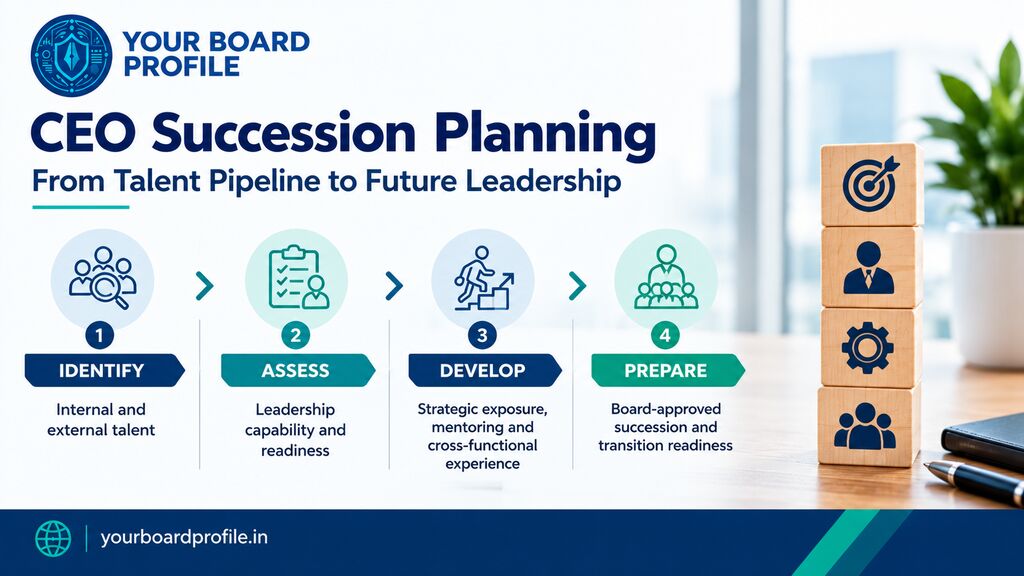
A structured CEO succession planning process helps the NRC evaluate internal and external candidates against consistent leadership criteria, future business needs, and demonstrated readiness for the role.
| Assessment dimension | What the NRC should examine | Evidence of readiness |
| Strategic judgement | Ability to make long-term choices under uncertainty | Clear decisions supported by sound assumptions |
| Financial understanding | Capital allocation, cash flow, profitability and risk | Evidence of disciplined financial decisions |
| People leadership | Ability to build capable teams and manage conflict | Strong succession below the candidate’s own role |
| Risk and governance | Willingness to challenge assumptions and address weaknesses | Examples of accountable decision-making |
| Transformation capability | Ability to lead technology and operating-model change | Measurable outcomes from complex initiatives |
| Stakeholder communication | Ability to build trust with employees, investors and directors | Credible communication during difficult decisions |
The table is a practical assessment framework, not a prescribed regulatory checklist.
The NRC should also document development actions for each candidate. A high-potential executive might need a cross-functional assignment, a profit-and-loss responsibility, exposure to investor discussions or experience leading a difficult transformation. Progress should be reviewed against specific milestones.
This is where executive talent pipeline resilience becomes a strategic advantage. A company with several prepared leaders has greater flexibility when circumstances change. It can choose the candidate who best fits the business’s needs rather than the person who happens to be available.
For executives who want to understand how their experience can be communicated more effectively, Your Board Profile’s resources on executive personal branding beyond the job title offer a complementary perspective on credibility and leadership visibility.
5. Emergency Succession and Leadership Transition
Long-term succession and emergency succession solve different problems. Long-term planning prepares the next generation of leadership; emergency planning ensures that someone capable can assume authority immediately if the CEO becomes unavailable.
Both are essential components of CEO succession planning.
An emergency plan should identify an interim successor and an alternate, define the scope of their authority, and clarify who activates the plan. The organisation should also consider practical issues such as access to essential information, communication with the board, relationships with regulators where applicable, and continuity of critical decisions.
The choice of interim leader must reflect the business context. A CFO may be well placed to protect financial stability, while a COO may understand operational dependencies. Neither role automatically makes its holder the best candidate for the permanent CEO position. The board should distinguish between the ability to stabilise the organisation temporarily and the capabilities required to lead it over the long term.
A planned transition requires a different but equally deliberate process. The board should agree on the outgoing CEO’s responsibilities, the incoming leader’s mandate, stakeholder communication and the transfer of important relationships. If the outgoing CEO remains as an adviser for a limited period, the board should clearly define decision rights to avoid creating two centres of authority.
Onboarding matters just as much as selection. A newly appointed CEO needs a structured introduction to the board’s expectations, the organisation’s strategic priorities, its financial position, its key risks and its leadership team. Directors should provide support without compromising their independent oversight responsibilities.
The objective is not to make a transition invisible. It is to make the transition orderly, credible and consistent with the company’s strategic priorities.
6. Mitigating Leadership Fatigue in Boards
Leadership fatigue deserves more attention in the 2026 NRC agenda. As KPMG highlights in its report, experienced leaders are operating in demanding environments, while directors and committee chairs may carry responsibilities across multiple boards and committees.
The result can be a fragile leadership pipeline. A company may identify talented executives but fail to create sustainable conditions for them to succeed. Alternatively, highly experienced directors may be reluctant to accept additional chair or committee responsibilities because the workload, scrutiny and personal exposure have increased.
Mitigating leadership fatigue in boards does not mean lowering accountability or making senior roles less demanding. It means designing leadership responsibilities so that high performance can be sustained without creating unnecessary operational or governance risks.
Boards can begin by reviewing workloads, overlapping committee assignments, meeting schedules and the quality of information provided before meetings. They should also examine whether executive expectations are realistic, whether decision-making authority is clear and whether leadership teams have adequate support during periods of transformation.
For CEOs, fatigue may appear through persistent decision overload, difficulty delegating, reduced engagement with colleagues or a growing tendency to focus on immediate performance at the expense of long-term capability building. These indicators do not, on their own, establish that a leader is unfit for office. They should prompt thoughtful discussion about workload, support, performance and organisational resilience.
The NRC should also examine the consequences of leadership concentration. If one executive controls too many relationships, critical decisions and institutional knowledge, their departure becomes much more disruptive.
A healthy succession system distributes knowledge, develops deputies and makes accountability visible across the leadership team. That is better for the incumbent CEO, the prospective successor and the organisation as a whole.
7. Remuneration, Performance and Accountability
CEO succession planning cannot be separated from executive remuneration. Compensation influences which behaviours are rewarded, which risks leaders are prepared to take and how attractive senior positions appear to potential successors.
A poorly designed incentive structure may encourage short-term performance at the expense of sustainable value creation. If a CEO is rewarded primarily for immediate revenue growth, for example, the organisation may underinvest in controls, workforce capability or long-term resilience. The consequences may emerge well after the executive has received the reward.
The NRC should therefore assess remuneration against a balanced view of performance. Financial outcomes remain important, but they should be considered alongside risk management, leadership development, ethical conduct and the achievement of strategic milestones.
| Remuneration element | Succession-related consideration |
| Fixed compensation | Does it support attraction and retention of capable leaders? |
| Annual incentives | Are the targets aligned with responsible execution and business performance? |
| Long-term incentives | Do they encourage durable value creation rather than short-term gains? |
| Deferred compensation | Does the structure reflect the longer-term consequences of executive decisions? |
| Clawback provisions | Are accountability mechanisms appropriate to the company’s circumstances and applicable requirements? |
| Retention arrangements | Do they address a genuine transition risk without creating unhealthy dependence on one individual? |
These considerations should be assessed against the applicable legal framework, the company’s remuneration policy and its actual business circumstances.
The NRC should also be alert to the difference between rewarding a successful incumbent and preparing a successor. A strong performance record is relevant, but it does not guarantee that an executive will be ready for a larger role. The capabilities required to lead an entire enterprise may differ substantially from those needed to manage a particular function.
Good governance aligns incentives with the organisation’s long-term interests while ensuring that leadership appointments are based on capability, judgement and readiness.
8. A Practical CEO Succession Planning Framework for 2026
How can boards translate these principles into an agenda that produces meaningful outcomes? The answer is to establish a repeatable process with clear responsibilities, documented decisions and regular reviews.
The following framework is a practical recommendation for boards, rather than a mandatory regulatory timetable.
This CEO succession planning framework provides boards with a structured approach to identifying leadership needs, assessing candidates, preparing for emergencies, and reviewing succession readiness regularly.
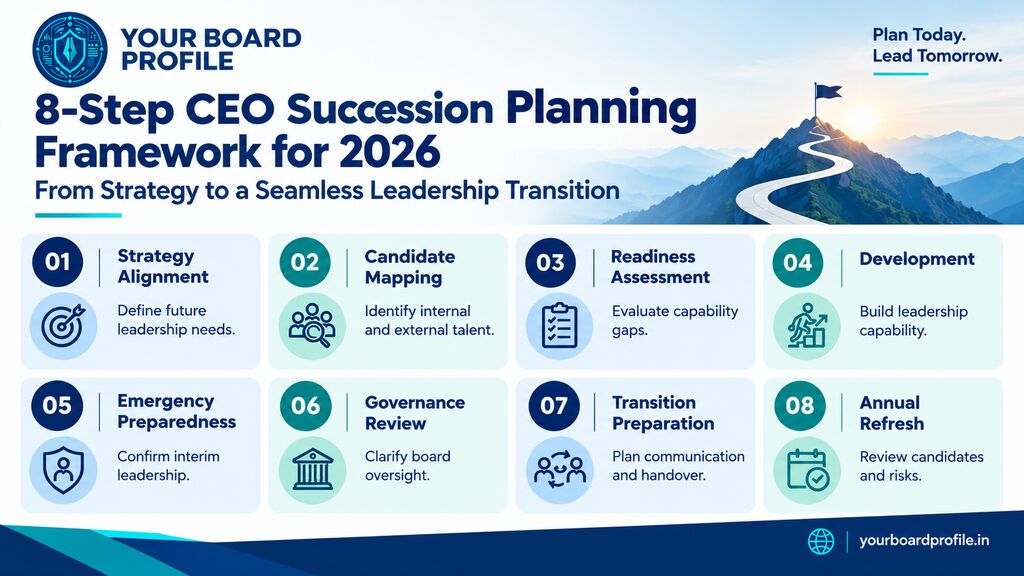
| Stage | Key action | Expected outcome |
| 1. Strategy alignment | Define the future CEO profile using the company’s strategic priorities | Agreed leadership requirements |
| 2. Candidate mapping | Assess internal talent and benchmark external candidates | Credible candidate pool |
| 3. Readiness assessment | Evaluate candidates against consistent criteria | Clear readiness gaps |
| 4. Development | Assign targeted roles, experiences and mentoring | Stronger leadership capability |
| 5. Emergency preparedness | Confirm interim successor, alternate and decision rights | Immediate continuity arrangements |
| 6. Governance review | Review the plan with the NRC and full board as appropriate | Clear accountability and oversight |
| 7. Transition preparation | Define communication, onboarding and knowledge transfer | More orderly leadership change |
| 8. Annual refresh | Reassess strategy, candidates, risks and readiness | Current, usable succession plan |
The process should not be treated as a once-a-year paperwork exercise. Candidate readiness can change as business conditions shift, executives leave, strategic priorities evolve or new risks emerge. Boards should therefore establish a suitable review cadence, with additional discussions when significant changes make them necessary.
Confidentiality is important, but excessive secrecy can undermine execution. The board must protect sensitive candidate information while ensuring that the people responsible for implementing the plan understand their roles.
Documentation should capture the rationale for decisions, development actions, identified risks and outstanding questions. This gives the board a basis for evaluating progress rather than relying on memory or informal impressions.
Boards may also benefit from examining established governance practices, including the National Association of Corporate Directors’ 2026 governance outlook, which identifies CEO succession planning among the board practices requiring improvement.
The real measure of success is not whether a succession document exists. It is whether the board can explain who is ready, what development is still required and how the organisation would respond if a transition happened sooner than expected.
9. What Aspiring Board Directors Should Understand
For aspiring independent directors and senior executives preparing for board-level roles, CEO succession planning offers an important lesson: board effectiveness depends on the quality of judgement, not simply the seniority of the people in the room.
Directors must be able to challenge assumptions respectfully, assess leadership capability objectively and recognise the difference between personal confidence and organisational readiness. They should understand how strategy, risk, remuneration, culture and talent development influence one another.
A candidate for a board role should also appreciate the importance of evidence. When discussing leadership capability, broad statements about experience are less useful than clear examples of difficult decisions, risk oversight, organisational transformation and accountability.
Developing this perspective requires continuous learning. Professionals can explore Your Board Profile’s resources on the IICA Independent Director Proficiency Test, strategic networking for independent directors and governance signalling.
These resources address complementary aspects of board readiness: governance knowledge, relationship-building and the ability to make professional credibility visible through relevant evidence.
For aspiring directors, the key lesson is to approach CEO succession as an enterprise-level responsibility. It requires strategic thinking, independence of judgement, an understanding of human behaviour and the ability to ask difficult questions without turning governance discussions into personal conflicts.
For current directors, it is a reminder that preparing the next leader is one of the most consequential contributions a board can make to an organisation’s long-term resilience.
Conclusion: Make CEO Succession Planning a Boardroom Strength
The most effective boards do not wait for a leadership vacancy to begin thinking about the next CEO. They prepare continuously, assess candidates objectively and ensure that the organisation can maintain its strategic direction even when circumstances change.
In 2026, CEO succession planning must be understood as a core element of corporate resilience. Rising leadership turnover, evolving technology, changing stakeholder expectations and the demands placed on senior executives make it essential for boards to prepare for both expected and unexpected transitions. The NRC has an important role in building this discipline, but successful succession ultimately requires engagement from the full board and a clear understanding of the organisation’s future leadership needs.
KPMG India’s On the Nomination and Remuneration Committee Agenda 2026 offers a useful starting point for this discussion, particularly its emphasis on leadership continuity, succession and leadership fatigue. Its insights reinforce the importance of looking beyond individual appointments towards the strength of the organisation’s leadership system. Read the KPMG Board Leadership Center’s governance insights for further context on the evolving board agenda.
For Indian companies, the practical priority is clear: develop a credible pipeline, test emergency arrangements, connect remuneration with sustainable performance and review leadership readiness regularly. The board should be able to explain not only who might succeed the current CEO, but also why those candidates are suitable, what experience they still need and how the organisation will manage a transition.
For aspiring board directors, this is an opportunity to deepen governance knowledge and demonstrate strategic judgement. For incumbent directors, it is an opportunity to strengthen the organisation before a crisis tests its preparedness.
A company’s leadership resilience is measured not only by the CEO it has today, but also by the leaders it is preparing for tomorrow.
Frequently Asked Questions (FAQs)
1. What is CEO succession planning?
CEO succession planning is the structured process through which a board identifies, assesses and prepares potential successors to the chief executive officer. It covers both planned transitions and unexpected departures, helping the organisation maintain leadership continuity and strategic momentum.
2. Why is CEO succession planning important in 2026?
It is important because businesses face changing technology, geopolitical uncertainty, heightened stakeholder expectations and demanding leadership responsibilities. A credible plan helps boards prepare for transitions before they disrupt business performance or stakeholder confidence.
3. What is the role of the Nomination and Remuneration Committee in CEO succession planning?
The NRC helps oversee senior leadership identification, evaluation, development and remuneration-related matters within its mandate. It should establish a structured succession process, review candidate readiness and ensure appropriate reporting and engagement with the full board.
4. What does Indian law say about succession planning?
Section 178 of the Companies Act, 2013 sets out important NRC responsibilities relating to director and senior management appointments, evaluation and remuneration policy. Companies must also consider applicable SEBI LODR requirements and other relevant provisions. The precise legal obligations depend on the company’s status and circumstances.
5. How often should a board review its CEO succession plan?
Boards should review succession regularly, with a formal review cadence appropriate to the business and additional reviews following significant changes in strategy, leadership or risk. Emergency arrangements should remain current rather than being revisited only when a crisis occurs.
6. What is the difference between emergency and long-term CEO succession planning?
Emergency succession identifies an interim leader who can assume responsibility immediately if the CEO becomes unavailable. Long-term succession develops and evaluates candidates for a permanent appointment, often over several years.
7. Should companies prefer internal or external CEO candidates?
Neither approach is universally superior. Internal candidates may offer institutional knowledge and continuity, while external candidates can bring new capabilities and perspectives. The board should compare candidates objectively against the organisation’s future leadership requirements.
8. How can companies build a stronger executive talent pipeline?
Companies can identify high-potential executives, provide cross-functional experience, expand profit-and-loss responsibilities, develop strategic and governance capabilities, and regularly assess readiness against defined criteria.
9. What is leadership continuity?
Leadership continuity is an organisation’s ability to maintain effective decision-making, strategic execution and stakeholder confidence when senior leaders change. It depends on prepared successors, clear responsibilities, effective knowledge transfer and credible transition arrangements.
10. How does CEO succession planning support corporate governance?
It strengthens accountability by making leadership appointments more structured, evidence-based and aligned with long-term strategy. It also helps boards manage key-person dependency and demonstrate preparedness to stakeholders.
11. How can boards mitigate leadership fatigue?
Boards can review workloads, committee assignments, decision-making responsibilities and executive expectations. Developing additional leaders, distributing institutional knowledge and providing appropriate support can reduce excessive dependence on a small number of individuals.
12. What role does executive remuneration play in CEO succession planning?
Remuneration influences the attraction, retention and behaviour of senior leaders. Boards should assess whether fixed pay, incentives and long-term rewards support sustainable performance, responsible risk-taking and the organisation’s strategic objectives.
13. What skills should a future CEO possess?
A future CEO may need strategic judgement, financial understanding, people leadership, risk awareness, stakeholder communication and the ability to lead transformation. The exact combination depends on the company’s business model, strategy and operating environment.
14. How can aspiring independent directors prepare for succession-related board discussions?
They should develop knowledge of corporate governance, executive assessment, strategic risk, remuneration and board responsibilities. They should also learn to ask objective questions, challenge assumptions constructively and evaluate leadership decisions using credible evidence.
15. What should a CEO succession plan include?
A practical plan should include the future CEO profile, candidate assessments, development priorities, emergency successors, decision-making authority, board responsibilities, transition communication, onboarding arrangements and a regular review process.
Ready to Strengthen Your Boardroom Readiness with Your Board Profile?
Build your governance understanding, professional credibility, and boardroom visibility to prepare for meaningful board-level opportunities. Whether you are a CXO, senior executive, entrepreneur, or aspiring Independent Director, strengthen your boardroom capabilities, enhance your leadership positioning, and develop the confidence to contribute effectively to board discussions.
Explore our Board-Readiness Portfolio, discover our Professional Services, and explore our Boardroom Governance & Leadership Articles to take the next step in your boardroom journey.
Start strengthening your board profile today:
https://yourboardprofile.in/
Share this post: Facebook | X | LinkedIn