
Why Risk Oversight Belongs at the Centre of the Board Agenda
Business risks are no longer confined to financial statements, operational breakdowns or compliance failures. A geopolitical development can disrupt sourcing overnight. An artificial intelligence (AI) system can make thousands of flawed decisions before anyone notices. A cyberattack on a technology provider can interrupt services across an entire business ecosystem. Meanwhile, a leadership decision, employee action or poorly handled public statement can damage stakeholder confidence in a matter of hours.
This changing environment makes board risk oversight a strategic priority rather than a periodic governance exercise.
The April 2026 report On the Risk Agenda 2026 by KPMG India highlights the growing importance of agility under uncertainty, regional resilience, digital continuity, responsible AI, cyber resilience, workforce culture and third-party dependencies. Its central message is relevant to boards across industries: risks increasingly interact, and organisations need the visibility and leadership discipline to respond effectively when several challenges emerge together.
For Indian businesses operating amid changing trade relationships, technology adoption, regulatory expectations and competitive pressures, the challenge is not simply to identify risks. It is to understand how those risks could affect business strategy, capital allocation, stakeholder trust and long-term value creation.
Effective board risk oversight helps directors ask the right questions before a disruption becomes a crisis. It connects risk information with strategic choices and ensures management has clear accountability for prevention, response and recovery.
The objective is not to eliminate every uncertainty. It is to build an organisation capable of recognising threats early, making informed decisions and remaining resilient when assumptions change.
Table of Contents
What Is Board Risk Oversight?
Board risk oversight is the responsibility of directors to understand the organisation’s significant risks, evaluate whether management is addressing them appropriately, and ensure that risk-taking remains consistent with the company’s strategy, values and risk appetite.
It does not mean that directors should manage every operational risk themselves. Management is responsible for implementing controls and running the business. The board provides direction, challenge and supervision, ensuring that the systems used to identify and manage risk are appropriate for the organisation.
The distinction matters. A board may receive a comprehensive risk report every quarter and still lack meaningful oversight if the report contains historical data, fails to highlight emerging threats or does not explain how risks could affect strategic decisions.
The G20/OECD Principles of Corporate Governance 2023 recognise risk management oversight as an important board responsibility, alongside guiding corporate strategy and exercising independent judgement.
Strong board risk oversight therefore involves three connected responsibilities:
- Understanding exposure: Knowing which developments could materially affect the business, its stakeholders or its long-term plans.
- Challenging preparedness: Examining whether management has credible mitigation plans, adequate resources and clear accountability.
- Monitoring resilience: Assessing whether the organisation can withstand disruption, make timely decisions and recover without unacceptable harm.
The board’s contribution is particularly valuable when management must balance competing priorities, such as pursuing innovation while protecting customer data, expanding internationally while reducing supply-chain concentration, or improving efficiency without weakening operational resilience.
Why Emerging Risks Belong on the Board Agenda
Traditional risk registers remain useful, but they may not capture the speed and interconnected nature of emerging risks. A risk that appears manageable in isolation can become significant when combined with another vulnerability.
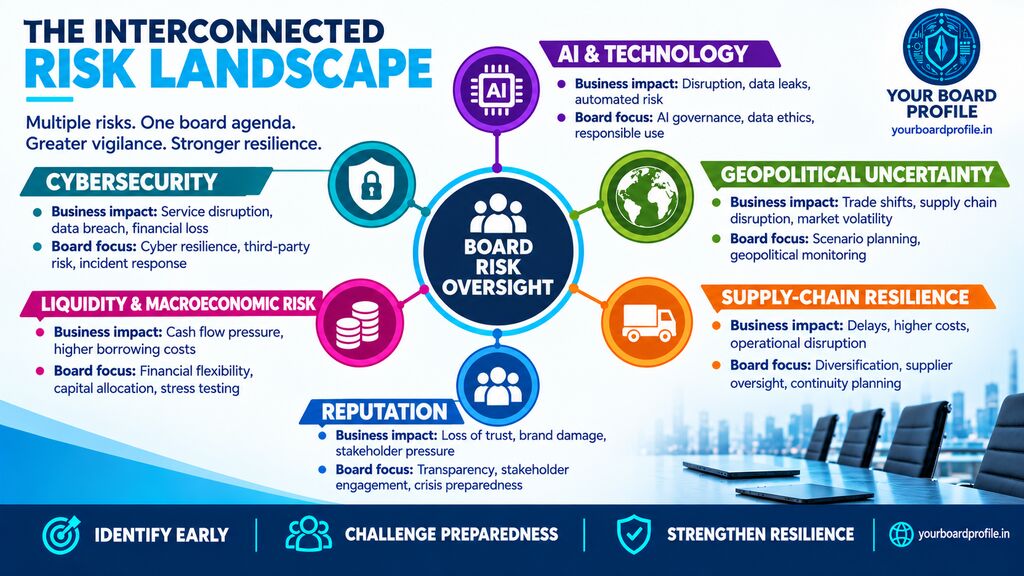
Consider a manufacturer dependent on a single overseas supplier. A geopolitical dispute may delay shipments, increase freight costs and raise working-capital requirements. If the business is already facing slower customer payments, the supply-chain problem can become a liquidity crisis. If it then fails to meet delivery commitments, reputational damage may follow.
This example demonstrates why emerging risks on board agenda discussions should focus on relationships between risks, not merely individual risk ratings.
Three changes make this approach increasingly important.
First, risk moves faster. Digital incidents, misinformation and automated decisions can affect customers and operations before conventional reporting processes identify a problem.
Second, dependencies are less visible. Businesses rely on cloud providers, software vendors, logistics networks, data platforms and specialist suppliers whose vulnerabilities may extend beyond direct contractual relationships.
Third, the consequences cross functional boundaries. A technology problem can become a regulatory issue, a customer-trust issue, a financial exposure and a strategic setback simultaneously.
Boards should therefore move from asking, “What went wrong last quarter?” to asking, “What could change our strategic assumptions, how soon would we know, and what would we do next?”
The Major Risks Boards Must Examine in 2026
1. AI-Led Disruption Risk and the Governance of Automated Decisions
Artificial intelligence can improve productivity, accelerate analysis and create new revenue opportunities. However, AI-led disruption risk extends beyond whether a technology project delivers its expected return.
AI systems can produce inaccurate outputs, reproduce historical bias, expose confidential information or make decisions that are difficult to explain. They may influence lending, recruitment, customer service, fraud detection, pricing and other decisions with material business or stakeholder consequences.
Boards need visibility into where AI is being used, which applications are high impact and who remains accountable when an automated decision produces an unacceptable outcome.
The NIST AI Risk Management Framework offers a useful voluntary reference for managing AI risks and promoting trustworthy systems. Its approach encourages organisations to consider risk throughout the AI lifecycle rather than treating governance as a one-time approval.
For boards, practical priorities include:
- Maintaining an inventory of material AI applications.
- Establishing approval requirements for high-impact use cases.
- Requiring appropriate validation, monitoring and human oversight.
- Reviewing model performance, bias, security and explainability.
- Defining escalation procedures when an AI system fails or behaves unexpectedly.
The key question: Can the board explain where AI materially influences business decisions and how management assures the quality, fairness and accountability of those decisions?
2. Generative AI Intellectual Property and Data Leakage Risks
Generative AI creates a different set of challenges. Employees may unknowingly submit confidential business plans, customer information, source code or proprietary research to external tools. AI-generated content may also create questions about ownership, licensing, accuracy and the use of protected material.
These are not merely IT concerns. They can affect competitive advantage, contractual obligations, legal exposure and reputation.
Boards should ask management to establish clear rules governing approved AI tools, sensitive data, access permissions and the review of generated content. The organisation should also understand how third-party AI providers store, process and potentially reuse submitted information.
Intellectual property governance should cover the entire lifecycle: creation, ownership, protection, licensing, monitoring and enforcement across relevant jurisdictions.
A practical starting point is to classify data by sensitivity and define which categories may be used with approved AI systems. Employees also need training that explains why seemingly harmless prompts can expose commercially sensitive information.
3. Geopolitical Risk Oversight for Boards
Geopolitical uncertainty is reshaping sourcing decisions, investment plans, logistics networks and access to international markets. Tariffs, sanctions, export restrictions, regional conflicts and changing industrial policies can alter the economics of a business faster than annual planning cycles anticipate.
Geopolitical risk oversight for boards means examining how political developments could affect suppliers, customers, critical materials, energy inputs, currencies and market access.
The objective is not to predict every international event. It is to understand exposure and prepare credible alternatives.
For example, an Indian business that sources a critical component from one country may face production delays if trade restrictions or transport disruptions interrupt supplies. A second supplier, alternative route or redesigned product may reduce that exposure, although each option carries costs.
Directors should challenge management on whether the company has identified its most consequential dependencies and assessed the financial and operational implications of disruption.
4. Regional Resilience and Supply Chain Fragmentation
Supply chains designed solely for cost efficiency can become fragile when they depend on one supplier, geography, transport corridor or technology platform.
Regional resilience and supply chain fragmentation are therefore increasingly important strategic considerations. Businesses may need to balance lower procurement costs against the value of alternative suppliers, buffer capacity, local sourcing and flexible manufacturing arrangements.
This does not mean every organisation should duplicate its entire supply chain. Excessive redundancy can tie up capital and reduce efficiency. The board’s role is to understand which dependencies are critical enough to justify additional resilience investment.
Useful measures include mapping critical suppliers, identifying single points of failure, assessing fourth-party dependencies and periodically testing alternative sourcing arrangements.
Management should also explain how quickly the company could switch suppliers or redirect logistics if its preferred option became unavailable.
5. Macroeconomic Volatility and Liquidity Risk
Macroeconomic volatility can affect funding costs, demand, exchange rates, commodity prices and customer payment cycles. Even a profitable business can encounter financial distress if cash inflows weaken while funding obligations rise.
Liquidity risk deserves particular attention where organisations have significant borrowing requirements, concentrated customer exposures, long receivable cycles or dependence on short-term funding.
Boards should look beyond base-case forecasts. Stress scenarios should examine what happens when several pressures occur together: slower sales, delayed collections, higher interest costs and reduced access to financing.
Directors should review liquidity buffers, debt maturities, covenant headroom, funding diversification and triggers for corrective action. Management should know when it would reduce discretionary spending, defer capital expenditure or activate alternative funding arrangements.
The important distinction is between knowing the current cash position and understanding how quickly it could deteriorate under stress.
6. Trust by Design and Cyber Resilience
Cybersecurity has become a business continuity and governance concern. Ransomware, compromised credentials, insecure application interfaces, cloud misconfigurations and supplier vulnerabilities can interrupt critical operations and expose sensitive information.
A strong board risk oversight approach considers more than the number of cyber incidents or vulnerabilities reported. It examines the organisation’s ability to detect, contain and recover from a serious event.
Directors should understand which services are essential, how long those services can remain unavailable, and whether recovery plans have been tested under realistic conditions.
Trust by design means incorporating privacy, security and responsible data handling into products, processes and third-party arrangements from the beginning. It is more effective than trying to add safeguards after a system has been deployed.
For Indian organisations, management should also assess applicable requirements under the relevant cyber and data-protection frameworks. The official CERT-In cybersecurity directions provide an important reference for applicable incident-reporting and information-security requirements.
Board-level indicators can include recovery-test results, time to contain significant incidents, critical vulnerabilities, backup restoration success and remediation of repeated control failures.
7. Third-Party Concentration and Ecosystem Fragility
Outsourcing can improve scale and efficiency, but reliance on a small number of technology providers, cloud platforms, payment processors or logistics partners creates concentration risk.
Third-party concentration and ecosystem fragility become especially serious when several business-critical services depend on the same provider or underlying infrastructure. A disruption at one organisation can then affect multiple operations simultaneously.
Boards should ask which suppliers are effectively too critical to lose, how much visibility the company has into subcontractors, and whether contractual protections would remain useful during a major disruption.
A credible exit strategy requires more than a clause in a contract. It may depend on data portability, alternative providers, documented processes, compatible systems and the practical ability to migrate services within an acceptable period.
Supplier resilience should be reviewed alongside financial stability, cybersecurity, service continuity and concentration across the wider ecosystem.
8. Reputational Risk Governance
Reputation can be damaged by product failures, leadership misconduct, data breaches, misleading claims, poor employee treatment or a slow response to public criticism.
Reputational risk governance should therefore be integrated with operational, compliance, people and cyber risk management.
Boards need to understand how the company monitors stakeholder concerns, verifies public claims and escalates incidents that could undermine trust. They should also evaluate whether the organisation can communicate accurately and consistently when facts are still emerging.
A useful discipline is to test how a major incident would appear to customers, employees, regulators, investors and the wider public. These groups may interpret the same event differently, and an organisation’s response can either rebuild confidence or deepen the damage.
9. People as Control Infrastructure
Policies and technology cannot compensate fully for a culture in which employees are afraid to raise concerns, incentives reward excessive risk-taking or managers discourage challenge.
People as control infrastructure means recognising that workforce behaviour determines whether many controls work in practice. Employees identify suspicious requests, escalate emerging problems, follow data-handling procedures and make judgement calls when formal guidance is incomplete.
Boards should examine whistleblower protections, issue-escalation trends, staff turnover in critical functions, training effectiveness and the relationship between performance incentives and responsible conduct.
The most important question is whether people can raise difficult issues early without fear of retaliation. A healthy risk culture makes it easier to identify weak signals before they become major failures.
Summary Table: Emerging Risks on the Board Agenda
| Risk area | Potential business impact | Board oversight priority |
| AI-led disruption | Biased or unreliable decisions, operational errors | AI inventory, accountability and independent validation |
| Generative AI and intellectual property | Confidential data leakage, ownership disputes | Approved tools, data controls and IP governance |
| Geopolitical uncertainty | Trade restrictions, higher costs and market disruption | Scenario planning and exposure mapping |
| Supply-chain fragmentation | Delays, shortages and concentrated dependencies | Supplier alternatives and regional resilience |
| Macroeconomic volatility | Funding pressure and reduced liquidity | Stress testing, cash buffers and trigger points |
| Cyber and data risk | Service outages, breaches and loss of trust | Recovery testing and security accountability |
| Third-party concentration | Cascading service failures and vendor lock-in | Dependency mapping and tested exit plans |
| Reputation and workforce culture | Stakeholder distrust and delayed escalation | Ethical leadership, communications and speak-up mechanisms |
Integrating Strategic Risk Governance with Business Strategy
Risk oversight is most effective when it informs decisions before capital is committed, rather than appearing only after a problem has emerged.
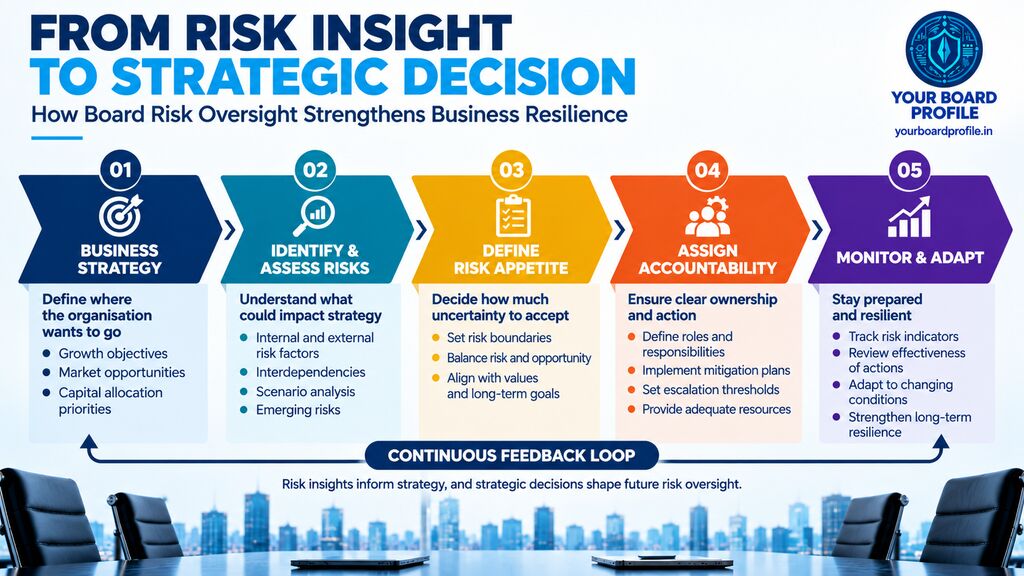
The COSO Enterprise Risk Management framework emphasises the relationship between risk, strategy-setting and performance. This is a useful principle for boards: risk discussions should influence what the company chooses to pursue, how much uncertainty it accepts and how it measures success.
For example, before approving a major digital transformation, directors should understand not only its expected productivity gains but also its data dependencies, cybersecurity requirements, implementation risks and reliance on external providers.
Before approving an international expansion, the board should consider market access, geopolitical exposure, regulatory differences, currency sensitivity and supply-chain implications.
Strategic risk governance can be strengthened through four practices.
Connect risk appetite to strategic choices. Management should explain which risks the organisation is willing to accept, which require mitigation and which fall outside its tolerance.
Use scenarios rather than a single forecast. Alternative scenarios help directors examine how strategy performs when important assumptions change.
Assign clear ownership. Every material risk should have an accountable executive, agreed mitigation actions, measurable indicators and escalation thresholds.
Link risk reporting to performance. Boards should understand whether risk exposure is changing as the organisation grows, enters new markets or adopts new technologies.
This approach makes Enterprise Risk Management (ERM) for boards a practical decision-making discipline rather than a compliance document.
Building an Effective Board Risk Oversight Framework
An effective framework should be proportionate to the organisation’s size, sector, complexity and risk profile. It should also distinguish clearly between the board’s oversight responsibilities and management’s operational responsibilities.
Establish a Forward-Looking Risk Agenda
The board or risk committee should review the principal risks regularly and make space for emerging issues that may not yet appear prominently on the corporate risk register.
A rolling agenda can combine financial resilience, cyber and technology risk, geopolitical developments, third-party dependencies, regulatory change, workforce culture and sustainability-related exposures.
Improve the Quality of Risk Information
A long list of red, amber and green indicators does not necessarily provide useful insight. Directors need to understand what has changed, why it matters, how uncertainty could affect strategic objectives and what management recommends.
Risk reporting should combine relevant quantitative indicators with management judgement, scenario analysis and clear explanations of assumptions.
Test Preparedness Through Realistic Scenarios
Tabletop exercises can reveal gaps that written policies miss. A board might examine a severe ransomware incident, an AI-related decision failure, a sudden loss of a critical supplier or a liquidity shock.
These exercises should clarify who makes decisions, when the board is informed, which services must continue and how communications are coordinated.
Review Accountability and Independent Assurance
Risk owners should be able to demonstrate that mitigation actions are implemented and effective. Internal audit and other independent assurance functions can help the board assess whether critical controls work as intended.
Directors should also examine recurring audit findings, overdue remediation and weaknesses that appear across multiple business units.
Develop Board-Level Risk Capability
No individual director needs to be an expert in every emerging technology or geopolitical issue. However, the board collectively needs enough knowledge and independence of judgement to challenge management constructively.
Board education, specialist briefings and access to credible independent advice can strengthen this capability. For aspiring independent directors, demonstrating risk literacy, strategic judgement and the ability to ask informed questions can also strengthen their readiness for board-level responsibilities.
Questions Directors Should Ask Management
The quality of board risk oversight often depends on the questions directors ask, especially when management reports that a risk is under control.
| Board question | What the question helps reveal |
| Which emerging risk could most disrupt our strategy over the next 12 months? | Whether management is looking forward |
| What assumptions in our business plan are most vulnerable to change? | Exposure hidden within strategic forecasts |
| Where are our most significant supplier, technology or geographic concentrations? | Dependencies that may amplify disruption |
| How would we maintain critical services during a major cyber incident? | Practical resilience and recovery capability |
| Which decisions are influenced by AI, and who is accountable for their outcomes? | Gaps in AI governance and assurance |
| What could cause our liquidity position to deteriorate rapidly? | Financial triggers and contingency readiness |
| Are employees able to raise concerns without fear? | The effectiveness of risk culture |
| Which mitigation actions are overdue, and what is preventing completion? | Accountability and control weaknesses |
| What evidence supports our key sustainability and public claims? | Disclosure integrity and reputation exposure |
| What would make us change course, and who has authority to act? | Decision rights and response speed |
These questions should lead to decisions, owners and follow-up—not simply longer meeting minutes.
A Practical 12-Month Board Risk Oversight Agenda
Boards can organise oversight across the year while retaining the flexibility to respond to unexpected events.
| Period | Illustrative focus | Expected outcome |
| Quarter 1 | Enterprise risk profile, risk appetite, liquidity and resilience | Updated priorities and escalation thresholds |
| Quarter 2 | AI governance, cyber resilience and third-party concentration | Confirmed controls and remediation plans |
| Quarter 3 | Geopolitical exposure, supply chains and macroeconomic scenarios | Resilience actions and alternative operating options |
| Quarter 4 | Risk culture, assurance findings and strategy alignment | Accountability review and next-year agenda |
The exact sequence should reflect the organisation’s sector, regulatory obligations and current exposures. A material incident or rapid change in the external environment may require immediate attention rather than waiting for the next scheduled review.
Boards should receive concise quarterly indicators showing changes in exposure, emerging warning signals, scenario-test outcomes, control failures and progress against agreed actions.
Conclusion: From Risk Reporting to Strategic Resilience
The business environment in 2026 demands a more connected approach to risk. Artificial intelligence, geopolitical uncertainty, cyber threats, liquidity pressure, third-party dependencies and workforce behaviour can interact in ways that challenge conventional risk management practices.
Effective board risk oversight is not about predicting every disruption or eliminating uncertainty. It is about ensuring that the organisation understands its most significant exposures, makes deliberate choices about risk, and has the capability to respond when circumstances change.
For directors, this means looking beyond compliance reports and asking how emerging risks could alter strategy, capital allocation, business continuity and stakeholder confidence. For senior executives, it means providing clear evidence, accountable ownership and realistic response plans. For aspiring board members, it means developing the judgement and governance knowledge required to challenge assumptions constructively.
At Your Board Profile, we believe that board readiness involves more than professional experience. It also requires the ability to communicate strategic judgement, demonstrate governance understanding and contribute meaningfully to boardroom decisions.
Frequently Asked Questions
1. What is board risk oversight?
Board risk oversight is the process through which directors supervise the organisation’s risk management approach, assess major exposures and ensure management’s actions remain consistent with strategy and risk appetite.
2. Why is board risk oversight important in 2026?
Businesses face interconnected risks involving AI, cyber threats, geopolitical developments, liquidity, supply chains and stakeholder trust. Board oversight helps organisations anticipate disruption and make better-informed strategic decisions.
3. What are the emerging risks on the board agenda?
Common priorities include AI governance, generative AI data leakage, cyber resilience, geopolitical uncertainty, supplier concentration, macroeconomic volatility, reputational risk and workforce culture.
4. What is the difference between risk management and board risk oversight?
Management identifies, assesses and manages risks in daily operations. The board oversees whether the overall framework, risk appetite, accountability and response capabilities are appropriate and effective.
5. What is strategic risk governance?
Strategic risk governance connects risk assessment with corporate strategy, investment decisions, performance objectives and long-term value creation. It helps directors evaluate whether the organisation’s plans remain viable under changing conditions.
6. How does Enterprise Risk Management support boards?
Enterprise Risk Management provides a coordinated view of risks across the organisation. It helps boards assess interconnected exposures, monitor risk appetite and connect risk information with strategic decisions.
7. How should boards oversee AI-led disruption risk?
Boards should understand material AI use cases, establish accountability, review high-impact applications, require suitable validation and monitor issues involving bias, privacy, security and reliability.
8. What are generative AI intellectual property and data leakage risks?
These risks arise when AI tools expose confidential information or create uncertainty about ownership, licensing and the use of protected content. Clear policies, approved tools, access controls and employee training help reduce exposure.
9. How can boards strengthen geopolitical risk oversight?
Directors can review geographic and supplier concentration, assess trade and sanctions exposure, consider alternative sourcing arrangements and test scenarios involving market access or logistics disruption.
10. What is regional resilience in supply-chain management?
Regional resilience involves building the flexibility to maintain operations when particular countries, suppliers or transport routes become unavailable. Measures may include alternative suppliers, diversified sourcing and contingency inventory.
11. Why is liquidity risk a board-level concern?
Liquidity problems can threaten business continuity even when a company appears profitable. Boards should examine cash-flow forecasts, debt maturities, funding access, covenant headroom and stress scenarios.
12. What does trust by design mean in cyber resilience?
Trust by design means integrating security, privacy and responsible data handling into systems and business processes from the outset, rather than relying only on corrective action after an incident.
13. How should boards assess third-party concentration risk?
They should identify critical providers, understand subcontractor dependencies, assess the consequences of provider failure and ensure that practical exit, migration and continuity plans exist.
14. What role does organisational culture play in risk oversight?
Culture influences whether employees follow controls, challenge unsafe decisions and report concerns. Boards should examine leadership behaviour, incentives, whistleblower protections and evidence of timely issue escalation.
15. How can aspiring independent directors demonstrate risk oversight capability?
Aspiring directors can develop governance knowledge, financial understanding, strategic judgement and familiarity with enterprise risk management. They should also practise asking evidence-based questions and explaining how their experience supports independent board-level challenge.
Ready to Strengthen Your Boardroom Readiness in Risk Oversight?
Build the ability to identify emerging risks, challenge assumptions, strengthen risk governance, and support strategic decision-making. Whether you are a CXO, senior executive, entrepreneur, or aspiring Independent Director, enhance your boardroom capabilities to navigate uncertainty, improve organisational resilience, and protect long-term business value.
Schedule your complimentary session today:
https://calendly.com/dramitnagpal
Share this post: Facebook | X | LinkedIn