

Why Shareholder Activism Matters Today
Corporate governance is no longer simply about meeting regulatory requirements, approving financial statements, or conducting board meetings according to a fixed calendar. Investors increasingly expect companies to explain how they create long-term value, manage risk, allocate capital, and respond to changes in the business environment. This shift has made Shareholder Activism an important force in modern corporate governance. Investors are no longer always content with receiving annual reports and attending annual general meetings. They may question strategic decisions, challenge board composition, request better disclosures, or push companies to address environmental, social, and governance (ESG) concerns.
At its core, Shareholder Activism is about using ownership rights and investor influence to encourage changes in how a company is managed or governed. Some campaigns focus on financial performance, while others address leadership accountability, executive compensation, succession planning, or sustainability. The methods can range from constructive engagement with directors to public campaigns that attract media attention and other investors. For senior executives, CXOs, aspiring board directors, and governance professionals, understanding these dynamics is essential because investor expectations can influence board priorities, strategic choices, and corporate reputation.
Transparency is central to this relationship. When companies communicate clearly about their decisions, risks, performance, and governance practices, investors have a stronger foundation for evaluating management. When disclosure is incomplete or communication is inconsistent, unanswered questions can create distrust and encourage more confrontational engagement. The real challenge for boards is therefore not simply to respond when investors raise concerns. It is to establish a governance culture in which meaningful dialogue, accountability, and long-term value creation are part of everyday decision-making.
Effective Shareholder Activism encourages boards to address investor concerns proactively, strengthen transparency, and demonstrate accountability for decisions that affect long-term corporate performance. This article explores how Shareholder Activism intersects with transparency, institutional investor influence, ESG expectations, shareholder rights, and boardroom leadership. It also explains how organisations can prepare for investor scrutiny without losing sight of their long-term strategic objectives.
Table of Contents
Understanding Shareholder Activism
Shareholder Activism refers to actions taken by shareholders to influence a company’s strategy, governance, leadership, or financial decisions. Activists may be individual investors, institutional shareholders, pension funds, investment firms, or other shareholders who believe that changes are necessary to protect or increase the value of their investments. Their influence depends not only on the number of shares they hold but also on their ability to build support, present credible arguments, and persuade other investors that a proposed change is in the company’s best interests.
Investor activism is not automatically hostile. A shareholder might privately ask the board to improve its succession planning, explain an acquisition, review executive compensation, or disclose more information about business risks. If the company does not respond satisfactorily, the shareholder may escalate the matter through public letters, shareholder resolutions, voting campaigns, or proposals to change board composition. In each case, the underlying question is whether the company’s current direction adequately serves its shareholders and, more broadly, supports sustainable business performance.
The global landscape is evolving quickly. Lazard’s Review of Shareholder Activism – H1 2026 reported 184 new activist campaigns worldwide during the first half of 2026, with activity up 20% year over year and 38% above the five-year first-half average. Campaigns increasingly addressed capital allocation, mergers and acquisitions, and the use of artificial intelligence.
These developments demonstrate why boards must look beyond traditional financial reporting. Investors increasingly want to understand the reasoning behind strategic decisions, how management evaluates emerging risks, and whether the board has the expertise to challenge assumptions effectively.
What Drives Activist Investors?
The motivations behind Shareholder Activism vary according to the investor’s objectives, investment horizon, and assessment of the company’s performance. Some investors believe that a company is undervalued because it holds underperforming assets, maintains an inefficient capital structure, or lacks a convincing growth strategy. Others may question whether the board has the right mix of skills, whether executive pay is linked to meaningful results, or whether management communicates openly about risks and setbacks.
Activists may also believe that a business is overlooking opportunities. For example, a technology company might be investing heavily in several unrelated ventures without demonstrating how those investments support its long-term strategy. An activist investor could request clearer capital allocation criteria, stronger performance measures, or an independent review of the company’s portfolio. The proposal may be uncomfortable for management, but it can create a valuable opportunity to reconsider assumptions that have gone unchallenged for years.
Other investors focus on environmental, social, and governance issues. They may ask companies to explain climate-related risks, improve workforce disclosures, strengthen supply-chain oversight, or clarify how sustainability commitments connect with financial performance. These campaigns are often described as ESG investor campaigns, although investors can disagree sharply about which ESG issues deserve priority.
For boards, understanding the motivation behind an activist’s demands is more productive than immediately labelling the investor as disruptive. The essential task is to examine the evidence, assess the proposal’s long-term implications, and determine whether the investor has identified a genuine weakness in the company’s strategy or governance.
Common Shareholder Activist Strategies
Activist investors choose their approach based on the company’s circumstances, the strength of their arguments, the regulatory environment, and the likelihood of attracting support from other shareholders. Some begin with confidential discussions; others move quickly towards public engagement.
| Strategy | What it involves | Potential governance impact |
| Private engagement | Direct discussions with management and directors | Creates an opportunity to resolve concerns before a dispute escalates |
| Public campaigns | Publishing letters, presentations, or strategic proposals | Increases visibility and pressure for a response |
| Shareholder resolutions | Proposing matters for consideration or voting, where permitted | Brings specific governance issues before shareholders |
| Proxy contests | Seeking shareholder votes for alternative board candidates | Can change board composition and oversight |
| Capital allocation proposals | Challenging acquisitions, divestments, dividends, or buybacks | Encourages scrutiny of financial priorities |
| ESG engagement | Requesting improved sustainability policies or disclosures | Strengthens accountability for material non-financial risks |
Shareholder Activism can take different forms depending on investor objectives, from constructive engagement with directors to formal campaigns seeking changes in corporate strategy, board composition, or disclosure practices. The approaches differ in tone, cost, and potential consequences. A confidential discussion may help both sides identify a practical solution, while a public campaign can place significant pressure on the board and affect its reputation. Proxy contests may be especially disruptive because they force shareholders to evaluate competing visions for the company’s future.
The important distinction is between the method of activism and the quality of the underlying proposal. A confrontational investor can raise a legitimate concern, just as a well-presented campaign can promote a short-term solution that damages long-term competitiveness. Directors must evaluate both the argument and the evidence rather than allowing the campaign’s tone to determine the board’s response.
Shareholder Activism and Transparency in Corporate Governance
Transparency is the foundation on which investors assess corporate credibility. Shareholders need reliable information about financial performance, business risks, strategic priorities, executive remuneration, related-party transactions, and board oversight. When this information is clear, consistent, and accessible, investors can make informed decisions and challenge management on substantive issues rather than relying on speculation.
Shareholder activism and transparency are closely connected because information gaps can increase investor frustration. Consider a company that announces an expensive acquisition but provides little explanation of the expected synergies, integration risks, or returns on invested capital. Investors may reasonably question whether the board has evaluated the transaction rigorously. If management responds with generic assurances rather than explaining its decision-making framework, the concern may develop into a broader debate about governance quality.
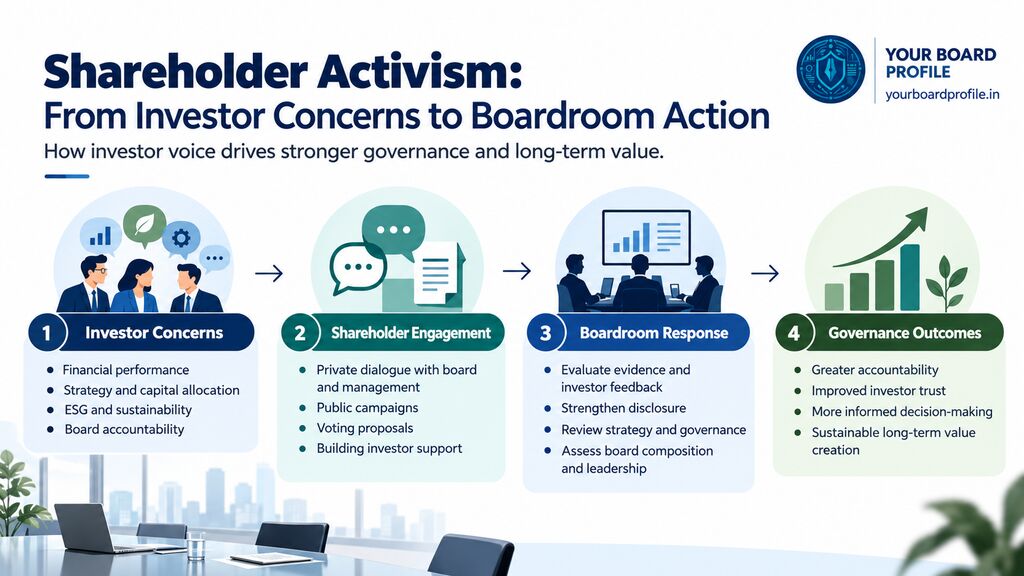
Transparency does not mean revealing every internal discussion or commercially sensitive detail. Boards must protect confidential information, comply with disclosure requirements, and ensure that material information is communicated fairly. The objective is to explain significant decisions and their implications without compromising legitimate business interests.
This requires a shift from treating disclosure as a compliance exercise to treating it as a governance responsibility. An annual report can satisfy formal requirements while still leaving investors uncertain about the company’s strategic direction. Effective communication connects reported numbers with the decisions, risks, and assumptions behind them. It also acknowledges uncertainty instead of presenting every management decision as unquestionably correct.
For directors, this means asking whether shareholders can understand not only what the company has done but also why it has done it, what alternatives were considered, and how the board will evaluate the results. That level of transparency can improve the quality of investor dialogue and help the board identify emerging concerns before they become public disputes.
The Role of Corporate Governance Disclosure
Corporate governance disclosure provides investors with information about how a company is directed, monitored, and held accountable. It covers areas such as board composition, director independence, committee responsibilities, executive compensation, risk oversight, related-party transactions, and shareholder voting arrangements.
High-quality disclosure should be understandable as well as technically accurate. A lengthy document filled with formal language may satisfy a reporting requirement without helping an investor understand the board’s priorities. Similarly, describing a risk without explaining how the company manages it offers limited insight into the effectiveness of oversight.
Boards can strengthen disclosure by connecting governance information to actual business decisions. If cybersecurity is a major enterprise risk, for example, shareholders may need to understand how responsibility is allocated, how management reports incidents to the board, and how directors assess the adequacy of preparedness. If a company is expanding internationally, investors may want clarity on geopolitical exposure, regulatory compliance, and the oversight of overseas operations.
For listed companies in India, the Securities and Exchange Board of India’s Listing Obligations and Disclosure Requirements framework is an important reference point for disclosure and governance obligations. SEBI’s updated LODR Master Circular consolidates compliance provisions for listed entities. Companies should consult the applicable current regulations and professional advisers when determining their specific obligations.
Strong disclosure practices also help boards prepare for difficult questions. When investors ask why a company has changed its strategy or why results have fallen short of expectations, the organisation should be able to explain its assumptions, accountability mechanisms, and corrective actions. Transparent communication cannot eliminate disagreement, but it can make disagreement more informed and constructive.
Shareholder Rights and Communication
Shareholder rights provide the formal mechanisms through which investors can participate in corporate governance. Depending on the applicable law and a company’s governing documents, these rights may include voting on director appointments, considering certain corporate transactions, participating in general meetings, receiving prescribed information, and raising questions through established procedures.
However, the existence of shareholder rights does not guarantee effective communication. Investors may receive meeting notices and statutory disclosures yet still struggle to understand the board’s reasoning or obtain meaningful responses to their concerns. A company that communicates only when a regulation requires it may miss opportunities to develop trust with its shareholders.
Effective shareholder rights and communication involve timely disclosures, accessible explanations, well-managed investor relations, and appropriate opportunities for engagement. Boards should also ensure that communication is fair and consistent. Selective disclosure of material information to a favoured investor can create regulatory and reputational risks.
Consider a company whose investors have raised concerns about executive remuneration. A constructive response would explain the compensation framework, the performance measures used, the relationship between rewards and outcomes, and the board committee responsible for oversight. If the company believes its existing policy is appropriate, it should be prepared to explain the evidence supporting that position.
Directors can learn more about the changing expectations of board oversight through Your Board Profile’s article on the independent director role and the governance shift. The central lesson is that accountability requires more than formal independence: directors must exercise informed judgment, ask relevant questions, and ensure that management’s explanations withstand scrutiny.
How Institutional Investors Influence Board Decisions
Institutional investors—including asset managers, pension funds, insurance companies, and investment institutions—can have significant influence because of the scale of the assets they manage and the voting power associated with their holdings. Their decisions may affect director elections, remuneration proposals, governance resolutions, and the level of support available to management during a contested situation.
Institutional investors are not a single, uniform group. Their investment horizons, mandates, governance policies, and views on sustainability can differ considerably. One institution may prioritise operational improvements and capital returns, while another may focus on long-term resilience, human capital, or climate-related financial exposure. Even investors holding similar positions can disagree about how a company should respond to a strategic challenge.
The influence of these shareholders is not limited to voting at annual general meetings. Institutions may engage privately with directors, communicate expectations through stewardship policies, or explain publicly why they support or oppose a particular proposal. When several investors independently reach similar conclusions, their collective position can create substantial pressure for change.
The board’s responsibility is not to agree automatically with the largest shareholders. It is to understand their concerns, evaluate the evidence, and act in accordance with its duties and the company’s long-term interests. A well-governed board can disagree with investors while demonstrating that its decisions are informed, transparent, and defensible.
This is particularly important when investor preferences conflict. For instance, some shareholders may support a large dividend, while others may prefer reinvestment in research, technology, or international expansion. The board must explain the trade-offs, demonstrate how capital allocation supports its strategy, and communicate the performance measures that will guide future decisions.
Senior executives seeking board-level positions should recognise that institutional investor influence is a governance issue, not merely an investor-relations concern. Directors must be able to interpret financial information, understand shareholder perspectives, challenge management assumptions, and communicate decisions clearly.
ESG Investor Campaigns and Corporate Accountability
ESG investor campaigns have broadened the discussion about corporate accountability by bringing environmental, social, and governance considerations into strategic and financial decision-making. Investors may question a company’s exposure to climate-related disruption, labour practices across its supply chain, board diversity, cybersecurity arrangements, or the credibility of its sustainability commitments.
The quality of these campaigns varies. Some are supported by detailed analysis of financial exposure and operational risks. Others may reflect competing political, social, or investment priorities. Boards should therefore assess ESG proposals based on their relevance to the company’s circumstances, the reliability of the evidence, applicable legal requirements, and their potential effects on long-term value.
Imagine a manufacturing company that has announced ambitious environmental targets but provides limited information about implementation costs, milestones, or accountability. Investors may ask how the targets relate to capital expenditure, operational efficiency, supply-chain resilience, and regulatory exposure. A credible response would connect the commitments to measurable actions and explain how the board monitors progress.
Companies can also face competing demands. One investor may push for faster investment in emissions reduction, while another may question the cost or timing. Rather than treating these positions as a communications problem alone, directors should examine the assumptions behind each argument and explain how the chosen strategy balances risk, investment, competitiveness, and long-term resilience.
For further perspective on how leaders communicate their professional credibility, see Your Board Profile’s discussion of executive personal branding beyond a job title. In the boardroom, credibility comes from the ability to connect commitments with evidence, sound judgment, and accountable action.
ESG engagement is most effective when it is integrated into the company’s broader risk-management and strategy processes. It should not become a separate reporting exercise that produces attractive statements without changing operational priorities. Investors increasingly want to understand who is responsible, how progress is measured, and what happens when targets are missed.
Benefits and Risks of Shareholder Activism
Shareholder Activism can improve corporate governance by bringing overlooked issues into the boardroom. It can encourage directors to question long-standing assumptions, review underperforming assets, strengthen accountability, and improve communication with investors. However, activism can also create pressure to prioritise immediate financial outcomes over investments whose benefits may take years to materialise. The governance challenge is to distinguish valuable scrutiny from demands that could weaken the business over time.
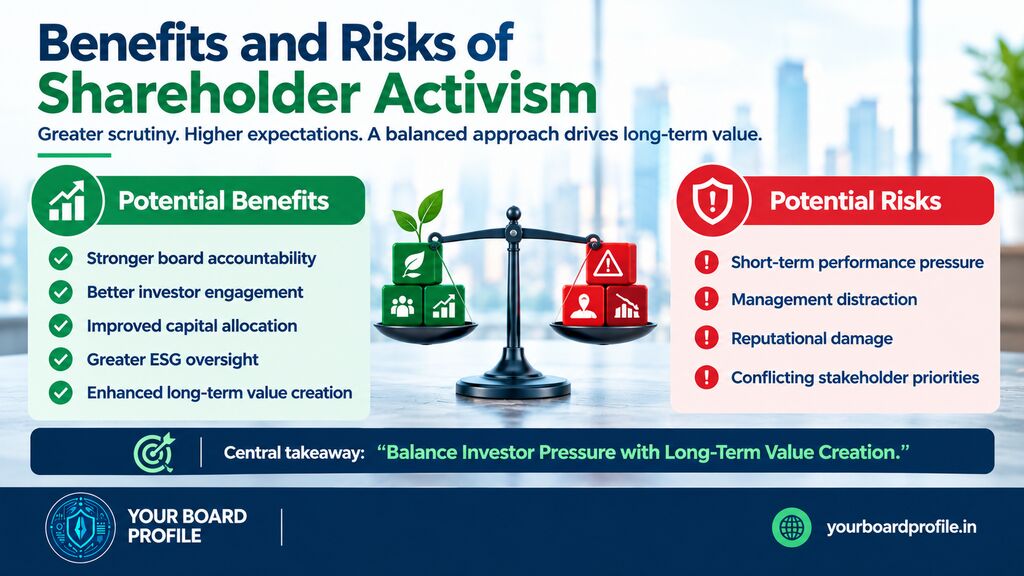
| Potential benefits | Potential risks |
| Stronger board accountability | Disruption to management and board priorities |
| More meaningful corporate disclosures | Pressure to reveal sensitive information |
| Improved capital allocation | Excessive focus on short-term returns |
| Better investor engagement | Public disputes that damage reputation |
| Greater scrutiny of ESG risks | Disagreement over competing stakeholder priorities |
| Board refreshment and new expertise | Loss of institutional knowledge during rapid leadership changes |
The benefits are most likely to emerge when activists present credible evidence and boards respond with an open mind. An investor who identifies a weak acquisition strategy may help a company reconsider its priorities. A campaign that exposes unclear executive incentives may encourage better remuneration practices. In these circumstances, activism becomes a catalyst for stronger oversight rather than an obstacle to effective management.
The risks become more significant when decision-making is driven by pressure rather than analysis. For example, selling a business unit may improve short-term cash generation but remove capabilities that support future growth. Cutting research expenditure may improve current margins while reducing innovation. Replacing directors without carefully assessing the board’s existing expertise can create gaps in oversight during a critical period.
Directors should therefore evaluate activist proposals against the company’s strategy, financial position, risk appetite, stakeholder obligations, and long-term prospects. The objective is neither to resist every challenge nor to accept every demand. It is to make decisions that can withstand informed scrutiny.
For a deeper understanding of the connection between boardroom reputation and governance, explore why boardroom branding begins with credibility. The same principle applies to corporate institutions: credibility is built when actions consistently support the organisation’s stated values and strategic priorities.
How Boards Can Respond to Shareholder Activism
A company’s response to activism should begin long before an activist investor launches a public campaign. Boards that maintain regular investor dialogue, review governance practices, and identify strategic vulnerabilities are better positioned to respond thoughtfully when difficult questions arise.
1. Identify investor concerns early
Boards should understand how shareholders view the company’s performance, strategic direction, leadership, and disclosure practices. Investor-relations teams can help identify recurring concerns, but directors should also receive meaningful summaries of investor feedback. Patterns matter: several shareholders asking similar questions about capital allocation or board succession may indicate an issue that deserves board-level attention.
Early engagement does not mean promising changes before the evidence has been assessed. It means creating a reliable process for listening, investigating, and responding. When investors believe their questions are being considered seriously, the company has a better chance of resolving disagreements before they escalate.
2. Evaluate proposals independently
An activist’s proposal should be assessed on its merits, regardless of the investor’s reputation or communication style. Directors should ask whether the proposal addresses the underlying problem, what assumptions support it, what alternatives are available, and how success would be measured. They should also consider the potential effects on employees, customers, creditors, suppliers, and other relevant stakeholders.
Independent directors have an important role in challenging management’s perspective. They should be willing to question whether the company has overlooked a risk or become too attached to an established strategy. At the same time, they must test the activist’s assumptions with the same rigour.
3. Strengthen disclosure and communication
When responding to investor concerns, companies should explain their reasoning with sufficient detail to support informed assessment. A generic statement that the board is confident in its strategy rarely answers a substantive question about returns, risk, or execution.
A stronger response might describe the criteria used to evaluate investments, the milestones against which management is measured, and the governance process for reviewing results. Where the board disagrees with an activist, it should explain why the proposed alternative may be less effective and identify the evidence supporting its position.
Communications must also comply with applicable disclosure rules. A company should not selectively share material non-public information with one investor simply because that investor is influential or vocal.
4. Review board composition and succession planning
Activist campaigns frequently raise questions about whether directors have the appropriate experience to oversee the company’s strategy. Boards should regularly assess their collective capabilities, including financial expertise, technology, risk management, international business, industry knowledge, and leadership succession.
Board refreshment should be based on a clear assessment of future needs rather than a reaction to public pressure alone. However, directors should not dismiss a legitimate challenge simply because it questions existing appointments. A well-designed board evaluation process helps demonstrate that composition decisions are grounded in the company’s evolving requirements.
5. Establish a clear response framework
Companies can prepare for activism by defining responsibilities among the board, management, legal advisers, investor-relations teams, and communications professionals. The framework should cover how an activist approach is assessed, who coordinates information, how directors receive updates, and how the organisation avoids inconsistent public statements.
A response framework is particularly valuable during a proxy contest or a high-profile dispute. It allows directors to focus on substantive decisions rather than improvising under pressure.
Boards can also draw on external governance resources, such as the Harvard Law School Forum on Corporate Governance, which publishes analysis of activism, board oversight, shareholder engagement, and governance developments. The objective is to prepare intelligently, not to treat every shareholder question as a threat.
Shareholder Activism in India: A Governance Perspective
In India, Shareholder Activism operates within a corporate governance environment shaped by company law, securities regulation, institutional investors, promoter ownership structures, and the growing expectations of public shareholders. The balance between controlling shareholders and minority investors is particularly important because ownership concentration can influence how strategic decisions are made and how effectively concerns are addressed.
For listed companies, disclosure obligations and shareholder protections are governed by applicable provisions of the Companies Act, 2013, SEBI regulations, and other relevant requirements. The precise rights and procedures depend on the issue involved and the company’s circumstances. Boards should ensure that their practices are reviewed against current legal requirements rather than relying on informal conventions or historical practices.
One important area is equitable treatment of shareholders. Investors need confidence that significant decisions are taken through appropriate processes, that material information is disclosed fairly, and that conflicts of interest are identified and managed. SEBI’s disclosure framework and related guidance provide an important reference for listed entities. Its official regulatory resources should be consulted for current requirements and amendments.
Consider a hypothetical listed company in which public shareholders question a major related-party transaction. The board should ensure that the transaction is evaluated under the applicable legal framework, that relevant conflicts are managed, and that required disclosures and approvals are completed. If the company communicates only after investors begin questioning the transaction, it risks turning a governance issue into a wider credibility problem.
Institutional investors can also influence governance through voting and engagement. Their participation may encourage stronger board evaluations, clearer remuneration policies, improved risk disclosures, and greater scrutiny of strategic transactions. Yet the effectiveness of activism depends on the quality of the arguments, the rights available to shareholders, and the willingness of boards to consider reasonable concerns.
For senior professionals aspiring to board roles in India, this environment makes governance literacy essential. Directors must understand financial statements, shareholder rights, regulatory responsibilities, related-party transactions, and the practical implications of disclosure decisions. They must also be capable of asking difficult questions without losing sight of commercial realities.
Building Boardroom Credibility Through Transparency
Boardroom credibility is developed through consistent judgment, sound oversight, and the ability to explain difficult decisions. It cannot be established simply by holding a senior title or having an impressive professional history. Investors want to see whether directors understand the business, recognise risks, challenge assumptions, and ensure that management is accountable for results.
For aspiring independent directors and senior executives, Shareholder Activism offers a useful perspective on what modern boards expect from their members. Directors must be comfortable engaging with financial and strategic information, interpreting investor concerns, and distinguishing between short-term market pressure and genuine long-term risks.
This requires a combination of capabilities. Financial understanding helps directors evaluate performance, liquidity, capital allocation, and investment returns. Strategic thinking allows them to assess whether management’s decisions support the company’s future. Governance knowledge helps them identify conflicts, clarify accountability, and evaluate whether decisions are being made through appropriate processes. Communication skills enable them to challenge respectfully and explain their reasoning clearly.
Professionals can strengthen these capabilities by developing a clear account of the value they bring to a board. Your Board Profile’s portfolio provides a reference point for understanding board-oriented professional positioning, while its services outline support for board CVs, personal branding, and board readiness. Readers can also explore the board value proposition and board bio to understand how professional experience can be translated into a credible board-level contribution.
The key is to connect achievements with governance relevance. Instead of describing only revenue growth or operational improvements, a prospective director should be able to explain how that experience supports risk oversight, strategic challenge, ethical judgment, or resource allocation. A compelling board profile demonstrates not only what a professional has achieved but also how that experience can strengthen board deliberations.
Transparency also matters at the individual level. Directors should communicate their expertise accurately, acknowledge the boundaries of their knowledge, and remain open to new information. The strongest boardroom contributors are not those who claim to have every answer. They are those who ask the right questions and help the board reach better decisions.
For additional perspectives on governance, leadership, and professional visibility, readers can explore the Your Board Profile blog.
Conclusion
Shareholder Activism has become an important influence on corporate governance because investors increasingly want more than financial results. They want to understand how companies make decisions, allocate capital, manage risks, select leaders, and remain accountable for their commitments. Transparency enables this scrutiny to become more constructive by giving shareholders the information they need to assess performance and challenge decisions on an informed basis.
For boards, the right response is neither automatic resistance nor unquestioning acceptance. Directors must examine activist proposals independently, communicate their reasoning clearly, protect legitimate confidentiality, and remain focused on sustainable value creation. Strong corporate governance disclosure, effective shareholder communication, thoughtful board composition, and disciplined risk oversight can help companies address concerns before they become major disputes.
For senior executives, CXOs, and aspiring board directors, the lesson is equally clear: boardroom credibility depends on judgment, accountability, and the ability to connect strategy with evidence. As investor expectations evolve, professionals who understand both the financial and governance dimensions of business will be better prepared to contribute to effective board oversight.
Ready to strengthen your boardroom readiness? Your experience can create greater value when you can translate it into strategic insight, governance judgment, and clear communication. Explore Your Board Profile’s board-readiness services to understand how you can position your expertise for board-level opportunities.
Frequently Asked Questions (FAQs)
1. What is Shareholder Activism?
Shareholder Activism is the practice of investors using their ownership rights to influence a company’s strategy, governance, leadership, or financial decisions. It can involve private discussions with management, shareholder resolutions, public campaigns, or proposals to change board composition.
2. Why is Shareholder Activism important for corporate governance?
Shareholder Activism can strengthen accountability by encouraging boards to review strategic decisions, improve disclosures, evaluate executive performance, and address governance weaknesses. Its effectiveness depends on the quality of the proposals and the board’s willingness to consider them objectively.
3. How does transparency influence Shareholder Activism?
Transparency gives investors reliable information about company performance, risks, strategy, and governance. Clear disclosures can build trust and reduce uncertainty, while incomplete or inconsistent communication may increase shareholder dissatisfaction and encourage more forceful engagement.
4. What are the common strategies used by activist investors?
Common strategies include private engagement with directors, public letters, shareholder resolutions, proxy contests, capital allocation proposals, and ESG campaigns. Investors choose their approach according to their objectives, the company’s circumstances, and the support they expect from other shareholders.
5. What is the role of corporate governance disclosure?
Corporate governance disclosure explains how a company is directed and monitored. It covers matters such as board composition, director independence, remuneration, risk oversight, related-party transactions, and shareholder rights. Effective disclosure helps investors evaluate the quality of board oversight.
6. How do institutional investors influence board decisions?
Institutional investors can influence director elections, remuneration policies, shareholder resolutions, and strategic discussions through voting and engagement. Their influence depends on their ownership, investment mandates, governance policies, and ability to build support among other shareholders.
7. What are ESG investor campaigns?
ESG investor campaigns seek changes relating to environmental, social, or governance issues. Examples include requests for better climate-risk disclosures, stronger workforce policies, supply-chain accountability, board diversity, or improved sustainability oversight.
8. Can Shareholder Activism benefit a company?
Yes. Shareholder Activism can identify weaknesses in strategy, encourage more disciplined capital allocation, improve accountability, and bring new perspectives to the boardroom. The benefits depend on whether the proposed changes support sustainable business performance rather than simply short-term gains.
9. What risks can Shareholder Activism create?
Potential risks include management distraction, public disputes, reputational damage, short-term decision-making, and pressure to change strategy prematurely. Boards should assess activist proposals carefully and consider their long-term financial and operational implications.
10. How should boards respond to activist investors?
Boards should listen to investor concerns, investigate the evidence, evaluate proposals independently, and communicate their reasoning clearly. They should also review board composition, risk oversight, succession planning, and disclosure practices to identify areas that require improvement.
11. How does Shareholder Activism work in India?
In India, shareholder engagement and activism operate within the applicable company law, SEBI regulations, listing requirements, and a company’s governing documents. Investors may raise concerns through voting, engagement, resolutions, and other legally available mechanisms. The precise procedures depend on the issue and applicable rules.
12. What is the difference between Shareholder Activism and institutional investor engagement?
Shareholder Activism generally refers to efforts by shareholders to bring about specific changes in a company. Institutional investor engagement is the broader process through which institutions communicate with companies about governance, strategy, performance, and risk. Engagement may be constructive and ongoing without becoming a formal activist campaign.
13. Does Shareholder Activism always involve replacing directors?
No. Many campaigns focus on strategy, capital allocation, executive remuneration, disclosures, or sustainability. Although some activist investors seek board representation or changes in leadership, replacing directors is only one possible approach.
14. Why should aspiring independent directors understand Shareholder Activism?
Understanding Shareholder Activism helps aspiring independent directors appreciate investor expectations, shareholder rights, transparency, and board accountability. It also strengthens their ability to challenge management assumptions, assess strategic proposals, and contribute to informed governance decisions.
15. How can senior executives prepare for board-level responsibilities?
Senior executives can prepare by developing financial literacy, governance knowledge, strategic judgment, risk oversight capabilities, and effective boardroom communication. Building a clear board value proposition and translating professional achievements into governance contributions can also strengthen board readiness.