

Most senior executives believe that once they accumulate enough experience, a board invitation will naturally arrive. Unfortunately, that assumption no longer holds true. Today’s boards are operating in an environment shaped by digital disruption, cybersecurity concerns, ESG expectations, geopolitical uncertainty, and heightened stakeholder scrutiny. Simply being a successful CEO, CFO, CHRO, or business leader is no longer sufficient. Boards increasingly look for leaders whose expertise, judgement, governance mindset, and strategic perspective are already visible long before they enter a boardroom. This is where Boardroom Branding becomes critical.
Modern search committees rarely start with your résumé. They begin with your reputation, your digital footprint, your published ideas, and the conversations surrounding your leadership. Executive search professionals routinely evaluate online visibility, governance engagement, and thought leadership while assessing board candidates. In fact, recent governance research suggests that boards are increasingly prioritising expertise in emerging areas such as technology, cyber risk, human capital, and transformation alongside traditional leadership credentials.
Executives aspiring to board roles must recognise a simple truth: credibility is established before nomination discussions even begin. Writing articles, participating in governance discussions, speaking at industry events, mentoring future leaders, and cultivating meaningful networks all contribute to Boardroom Branding. These activities demonstrate how you think, challenge assumptions, govern, and create long-term value.
Table of Contents
- Why Boardroom Branding Matters Today
- Understanding Boardroom Branding
- Writing as a Boardroom Branding Tool
- Speaking Opportunities and Pre-Boardroom Credibility
- Networking Beyond Traditional Relationship Building
- Mentoring as a Strategic Governance Asset
- Governance Conversations Shape Board Positioning
- Digital Footprint for Board Directors
- Common Boardroom Branding Mistakes
- Building a Sustainable Branding Strategy
- Conclusion
- FAQs
Why Boardroom Branding Matters Today
Boards Recruit Reputation, Not Just Resumes
A résumé explains where you worked. Boardroom Branding explains why your experience matters in a governance setting. Board appointments are rarely transactional. They are trust-based decisions involving significant fiduciary responsibility. Search committees want confidence that a director can challenge management constructively, oversee risk, and contribute strategic insight.
Reputation now travels faster than ever. Search firms, nomination committees, and existing directors frequently review articles, interviews, podcasts, conference appearances, and online discussions before engaging potential candidates. According to PwC and The Conference Board, only 32% of executives believe their boards possess the right expertise for today’s challenges, highlighting why boards are seeking differentiated leadership capabilities.
The Shift in Executive Search for Directors
The landscape of Executive Search for Directors has evolved dramatically. Recruiters are no longer evaluating candidates solely on operational success. They assess governance readiness, digital fluency, stakeholder stewardship, and thought leadership.
A strong profile on Your Board Profile combined with visible governance contributions significantly enhances discoverability. Executives who consistently share strategic insights demonstrate qualities boards increasingly value: independent judgement, foresight, and oversight capability.
Understanding Boardroom Branding
What Boardroom Branding Really Means
Boardroom Branding is not self-promotion. It is strategic credibility building. It involves intentionally communicating your governance philosophy, board-relevant expertise, and leadership perspective to stakeholders who influence board appointments.
Effective branding answers questions such as:
| Question | What Boards Want to Know |
| What unique value do you bring? | Strategic insight and oversight capability |
| How do you think? | Independent judgement and governance mindset |
| What topics do you influence? | Risk, ESG, transformation, cybersecurity |
| How visible is your expertise? | Published content and industry recognition |
Board Positioning vs Personal Branding
Traditional executive branding often focuses on achievements. Board Positioning focuses on governance contribution.
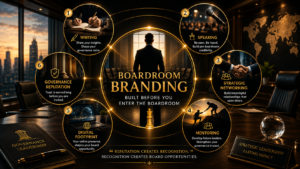
A board candidate should be recognised as a Strategic Governance Asset, not merely an accomplished executive. This distinction matters enormously. While personal branding emphasises accomplishments, board positioning demonstrates governance competence, stakeholder awareness, and strategic oversight.
Writing as a Boardroom Branding Tool
Publishing Governance Insights Builds Trust
Writing remains one of the most powerful forms of Boardroom Branding. Articles allow executives to showcase thinking rather than merely listing achievements.
Publishing commentary on governance, risk oversight, ESG, succession planning, cyber resilience, or organisational transformation signals board readiness. Thought leadership platforms, professional publications, and corporate blogs provide opportunities to demonstrate expertise.
Research on thought leadership for directors indicates that executives who consistently share valuable governance insights strengthen credibility and increase board visibility.
Executives can strengthen visibility by creating governance-focused content alongside resources such as Digital Footprint for Board Directors guidance.
Thought Leadership Creates Visibility
Thought leadership acts like compound interest. A single article may have limited impact. Twenty thoughtful articles over two years can transform how the market perceives you.
Subjects worth exploring include:
- Cybersecurity oversight
- Human capital governance
- AI governance
- Succession planning
- Stakeholder stewardship
- Enterprise risk management
Publishing regularly helps create a visible archive of your governance perspective.
Speaking Opportunities and Pre-Boardroom Credibility
Conferences, Panels, and Webinars Matter
Speaking engagements amplify Boardroom Branding because they demonstrate confidence, communication capability, and strategic insight simultaneously.
When executives participate in panels discussing industry disruption, regulatory developments, or governance challenges, they showcase board-level thinking in real time.
Participation in governance forums hosted by organizations such as OECD Corporate Governance resources can further strengthen credibility.
Speaking Demonstrates Strategic Thinking
Boards need directors who communicate complex issues clearly. Public speaking reveals whether executives can simplify ambiguity, challenge assumptions diplomatically, and inspire confidence.
Even moderate participation in webinars, podcasts, and leadership forums can significantly elevate board visibility.
Networking Beyond Traditional Relationship Building
Strategic Networking for Board Aspirants
Networking for board appointments differs from conventional career networking. The objective is not job seeking. The objective is relationship cultivation within governance ecosystems.
Executives should intentionally connect with:
- Existing directors
- Governance professionals
- Search consultants
- Investors
- Industry association leaders
- Audit and risk committee members
Professional networking expands social capital, which research identifies as a significant contributor to director effectiveness.
Building Influence Through Professional Associations
Associations create valuable opportunities to establish governance credibility. Serving on advisory councils, committees, and non-profit boards demonstrates oversight capability.
Meaningful engagement matters more than passive membership.
Mentoring as a Strategic Governance Asset
Why Mentoring Signals Board Readiness
Mentoring often receives insufficient attention in discussions about Boardroom Branding.
Yet mentoring demonstrates several qualities boards highly value:
- Leadership development
- Talent stewardship
- Stakeholder orientation
- Long-term thinking
- Organisational perspective
Executives who mentor emerging leaders exhibit a governance mindset extending beyond personal success.
Reverse Mentoring and Digital Awareness
Modern directors must understand technology and evolving stakeholder expectations. Reverse mentoring programmes help senior leaders remain digitally informed.
Research increasingly highlights the growing importance of digital expertise in board composition and governance effectiveness.
Governance Conversations Shape Board Positioning
Participating in Governance Discussions
Board candidates should actively engage in governance conversations.
This does not require controversial commentary. Instead, executives can thoughtfully discuss:
- Risk oversight
- AI governance
- Organisational resilience
- Board effectiveness
- Stakeholder capitalism
Resources discussing Independent Director roles and responsibilities provide useful frameworks for developing governance perspectives.
Demonstrating Independent Thinking
Boards value directors who challenge constructively.
Participation in governance conversations demonstrates whether executives can:
- Analyse complexity.
- Balance competing stakeholder interests.
- Exercise sound judgement.
- Challenge respectfully.
Digital Footprint for Board Directors Cannot Be Ignored
Your Online Presence Is Your Silent Interview
Your Digital Footprint for Board Directors represents a continuous interview process.
Search consultants routinely examine:
- LinkedIn presence
- Published content
- Conference participation
- Interviews
- Governance commentary
- Professional affiliations
An incomplete or outdated digital presence may unintentionally signal limited governance engagement.
Executive Search for Directors Starts Online
Most Executive Search for Directors assignments begin with digital research.
A strong online profile supported by services available through Board positioning services can improve visibility considerably.
Digital credibility increasingly influences board opportunities because leadership visibility often precedes formal conversations.
Common Boardroom Branding Mistakes
Overemphasising Titles Instead of Governance Value
Many executives list achievements without explaining governance relevance.
Instead of saying:
“Managed a $500 million business.”
Say:
“Oversaw capital allocation, enterprise risk, stakeholder engagement, and strategic transformation.”
Remaining Invisible in Industry Conversations
Silence creates invisibility.
Executives who avoid writing, speaking, or participating in governance discussions may inadvertently weaken their Boardroom Branding.
Visibility does not require celebrity status. It requires consistency.
Building a Sustainable Boardroom Branding Strategy
Practical Actions for the Next 90 Days
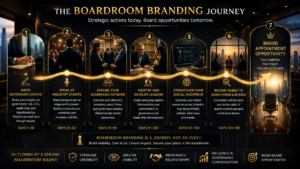
| Timeframe | Action |
| First 30 Days | Optimise LinkedIn and board profile |
| Days 30–60 | Publish one governance article |
| Days 60–90 | Participate in one panel or webinar |
| Ongoing | Mentor emerging leaders and engage in governance conversations |
Conclusion
The boardroom door rarely opens because of experience alone. It opens because decision-makers trust your judgement, recognise your expertise, and believe you can contribute meaningfully to governance.
That trust is built outside the boardroom—through writing, speaking, mentoring, networking, and participating in governance conversations. Effective Boardroom Branding ensures that long before a nomination committee reviews your profile, your reputation is already working in your favour.
FAQs
- What is Boardroom Branding?
Boardroom Branding is the strategic process of building governance credibility and visibility before securing a board role.
- Why is Boardroom Branding important?
It helps executives demonstrate governance readiness, strategic thinking, and oversight capabilities.
- How does writing support Boardroom Branding?
Publishing governance insights showcases thought leadership and board-level thinking.
- Does networking influence board appointments?
Yes, many board opportunities emerge through trusted professional relationships.
- Why does digital presence matter for directors?
Executive search firms frequently assess online credibility during board searches.
- How long does it take to build effective Boardroom Branding?
Boardroom Branding is an ongoing process, but consistent efforts over 6 to 12 months can significantly improve board visibility.
- Can Boardroom Branding help executives secure their first board role?
Yes, strong Boardroom Branding helps executives demonstrate governance readiness and stand out to nomination committees and search firms.
- What role does LinkedIn play in Boardroom Branding?
LinkedIn serves as a key platform for showcasing governance expertise, thought leadership, and board-level credibility.
- How does mentoring contribute to Boardroom Branding?
Mentoring signals leadership maturity, talent stewardship, and a long-term governance mindset—all qualities valued in board directors.
- Is public speaking important for Boardroom Branding?
Yes, speaking at conferences, webinars, and industry events helps executives establish credibility and demonstrate strategic thinking.
- What are the biggest mistakes executives make in Boardroom Branding?
Common mistakes include focusing only on job titles, lacking governance content, and maintaining a weak digital presence.
- How can executives improve their Boardroom Branding strategy?
Executives can improve Boardroom Branding by publishing governance insights, expanding strategic networks, and strengthening their digital footprint.
- Why is a Digital Footprint important in Boardroom Branding?
A strong digital footprint increases visibility, enhances credibility, and helps executive search firms assess board readiness.
- How does Executive Search for Directors evaluate Boardroom Branding?
Executive search professionals assess thought leadership, governance engagement, digital presence, and strategic positioning when evaluating candidates.
- Can Boardroom Branding influence board committee opportunities?
Yes, effective Boardroom Branding can highlight committee-specific expertise and improve alignment with board committee requirements.
Ready to Strengthen Your Board Presence and Unlock New Board Opportunities?
Your board journey begins long before the nomination committee meets. If your expertise, governance perspective, and strategic value are not visible, opportunities may quietly pass by. Ready to strengthen your Boardroom Branding and position yourself for meaningful board opportunities? Connect with the experts at Your Board Profile Contact Page and start building your board-ready presence today.
Whether you’re an aspiring Independent Director, CXO, Founder, or senior executive, a well-positioned board profile can make all the difference in today’s competitive board landscape.
Book a complimentary strategy session with Your Board Profile today.