

Why Corporate Governance Needs a New Perspective
Corporate governance rarely becomes the most exciting topic in a boardroom discussion. Business leaders would often rather discuss expansion, market share, profitability, innovation, acquisitions or the next big growth opportunity. Governance, by comparison, can appear to be a collection of regulatory filings, board meetings, audit requirements and compliance deadlines. But is that really all it represents? Consider what happens when a business faces a financial crisis, a cybersecurity incident, an unexpected leadership transition or a sudden loss of investor confidence. At that moment, the quality of its Corporate Governance becomes much more than an administrative concern. It becomes a determining factor in whether the organisation can respond effectively, protect its stakeholders and continue creating value.
The business environment has changed considerably. Investors are asking more challenging questions, regulators are strengthening disclosure requirements, and stakeholders increasingly expect organisations to demonstrate responsible leadership. In India, requirements under SEBI’s Listing Obligations and Disclosure Requirements (LODR) Regulations and sustainability-related disclosures have brought greater attention to accountability and transparency. However, simply meeting regulatory requirements does not necessarily make an organisation well governed. A company can complete every compliance checklist and still have weak decision-making, inadequate risk oversight or an ineffective board.
The real opportunity lies in changing this mindset. Corporate Governance should not be treated as a defensive exercise designed only to avoid penalties. It should be approached as a strategic capability that improves decision-making, strengthens organisational discipline and builds confidence among investors, employees, customers and business partners. Companies that understand this distinction are better positioned to manage uncertainty and pursue sustainable growth.
For CXOs, senior executives and aspiring Independent Directors, this shift is particularly important. Understanding governance today means understanding how businesses create long-term value, how boards challenge management constructively and how leadership decisions influence institutional credibility. Governance is no longer a question of necessity; it is an essential organisational priority. The question is whether organisations are using it to their competitive advantage.
Table of Contents
1. The Importance of Corporate Governance in Today’s Business Environment
The Importance of Corporate Governance becomes clearer when we look at how modern businesses operate. Organisations are no longer judged only by their quarterly financial performance. Investors examine leadership quality, board independence, disclosure practices, risk management, succession planning and the organisation’s ability to respond to unexpected challenges. Employees want ethical leadership, customers expect responsible business practices, and regulators expect companies to demonstrate accountability. These expectations have changed the role of governance from an internal control mechanism into an important part of business strategy.
The OECD’s revised G20/OECD Principles of Corporate Governance, endorsed in September 2023, recognise the relationship between effective governance, market confidence, access to finance, sustainability and financial stability. They also highlight the responsibilities of boards in overseeing sustainability-related risks and opportunities. This reinforces an important point: governance is not simply about ensuring that management follows established procedures. It is about creating an environment in which sound decisions can be made, challenged and monitored.
From Regulatory Obligation to Strategic Business Asset
Think about two companies operating in the same industry, with similar revenues, comparable products and access to similar markets. One has clearly defined board responsibilities, an independent audit committee, transparent reporting and a reliable risk-management framework. The other depends heavily on the judgement of a few senior executives, maintains limited board-level oversight and treats compliance as an annual exercise.
Both companies may appear equally successful during favourable market conditions. However, when an unexpected disruption occurs, their differences become visible. The first organisation can identify risks earlier, bring the right decision-makers together and respond through established processes. The second may struggle with unclear accountability, delayed information and conflicting management priorities.
This is where Corporate Governance becomes a strategic asset. It creates clarity around who makes decisions, who challenges them and who remains accountable for their outcomes. It also helps businesses avoid excessive dependence on individual leaders. A well-governed organisation can scale its operations without losing control over financial discipline, ethical standards or operational performance.
For a growing company, this distinction is particularly important. Expansion often introduces new subsidiaries, international operations, external investors, larger workforces and more complex supply chains. Without appropriate governance structures, growth can create organisational confusion. Effective governance provides the foundation that allows a company to expand while maintaining oversight and institutional discipline.
Corporate Governance and Investor Confidence
Investor confidence is rarely built through financial results alone. Investors also want to understand how those results are achieved, whether the reported information is reliable and whether leadership decisions protect long-term shareholder interests.
Consider a company seeking to raise capital for expansion. Potential investors will examine its financial statements, but their assessment will not necessarily stop there. They may also evaluate board composition, related-party transactions, internal controls, succession arrangements, litigation exposure and the quality of disclosures. If the company demonstrates transparency and responsible oversight, investors have stronger reasons to trust its leadership.
This is why Corporate Governance and Investor Confidence are closely connected. Good governance reduces information gaps between management and investors, strengthens accountability and creates a more predictable decision-making environment. It cannot eliminate business risk or guarantee investment returns, but it can make the organisation easier to assess and understand.
The OECD identifies investor protection, access to capital markets and market confidence as important objectives of effective governance.
For senior professionals aspiring to board positions, this relationship deserves attention. A board director must understand more than financial performance. The ability to assess management credibility, question strategic assumptions and evaluate governance risks is central to responsible board stewardship.
2. Corporate Governance Best Practices That Create Long-Term Value
Strong governance does not happen because a company has an impressive boardroom, a lengthy policy manual or a calendar filled with meetings. It develops through consistent behaviour, meaningful oversight and a culture in which accountability is taken seriously. The most effective Corporate Governance Best Practices connect board responsibilities with the organisation’s actual business priorities.
A governance framework should be proportionate to the company’s size, ownership structure, regulatory environment and risk profile. A large listed organisation may require sophisticated committees and reporting arrangements, while a growing private company may need a simpler structure with clearly defined responsibilities. The objective is not to create unnecessary layers of approval. It is to ensure that important decisions receive appropriate attention.
Board Independence and Accountability
An effective board needs the right balance of experience, independence and business understanding. Executive directors contribute operational knowledge, while non-executive and Independent Directors bring external perspectives and constructive challenge.
Independence matters because boards must be able to question management decisions without undue influence. However, independence should not be viewed only as a regulatory classification. An Independent Director must also demonstrate intellectual independence, professional judgement and the confidence to raise difficult questions.
For example, imagine a company considering a major acquisition. Management presents an attractive growth projection, but the proposed transaction involves significant debt, an unfamiliar market and potential related-party concerns. A strong board does not approve the proposal simply because the financial projections look promising. It examines the assumptions, evaluates alternative scenarios, considers integration risks and asks whether the acquisition supports the company’s long-term objectives.
Board accountability also requires clearly defined responsibilities. The audit committee, nomination and remuneration committee, risk management committee and other applicable committees must have meaningful mandates. Their effectiveness should be assessed through the quality of their work, not simply the number of meetings conducted.
Professionals interested in developing their boardroom capabilities can explore Your Board Profile’s board readiness and professional portfolio, which highlights the importance of presenting relevant expertise in the context of board expectations.
Risk Management and Ethical Leadership
Risk management is one of the most practical ways governance contributes to business resilience. Organisations face financial, operational, technological, regulatory, reputational, environmental and geopolitical risks. These risks are often interconnected, which means a problem in one area can quickly affect several others.
A cybersecurity incident, for example, may initially appear to be an IT issue. However, it can create regulatory exposure, disrupt customer services, damage reputation and affect investor confidence. A board that treats cybersecurity as a purely technical responsibility may overlook its wider business implications.
Good governance encourages management to identify significant risks, evaluate their potential impact and communicate them to the board. It also ensures that risk appetite is aligned with the organisation’s strategy.
Ethical leadership is equally important. Policies against bribery, fraud, harassment and conflicts of interest must be supported by leadership behaviour. Employees need confidence that concerns can be reported without retaliation and that misconduct will be investigated fairly.
A useful question for directors is this: Does our organisation reward responsible decision-making, or does it reward results regardless of how they are achieved?
The answer can reveal more about governance culture than several pages of policy documentation.
Transparency and Stakeholder Engagement
Transparency is not simply the publication of annual reports. It involves communicating relevant information accurately, consistently and at the appropriate time. Investors should be able to understand the organisation’s financial position, strategic direction, material risks and governance arrangements.
Stakeholder engagement adds another dimension. Employees may identify operational problems before senior management becomes aware of them. Suppliers may recognise supply-chain vulnerabilities. Customers may highlight changing expectations that influence future competitiveness. Effective governance creates channels through which these perspectives can inform business decisions.
The following table illustrates how governance practices can translate into practical organisational benefits.
| Governance practice | Business value | Long-term impact |
| Independent board oversight | Objective decision-making | Stronger accountability |
| Effective risk management | Early identification of threats | Greater resilience |
| Transparent disclosures | Better investor understanding | Stronger stakeholder confidence |
| Ethical leadership | Responsible workplace culture | Reduced misconduct exposure |
| Succession planning | Leadership continuity | Organisational stability |
| ESG oversight | Better understanding of sustainability risks | Sustainable value creation |
| Board performance evaluation | Improved effectiveness | Better strategic oversight |
The important distinction is that these practices should influence actual business decisions. A company that documents risk management but ignores early warning signals has not created meaningful resilience.
3. SEBI LODR Compliance: Beyond Regulatory Checklists
For Indian listed companies, SEBI LODR Compliance is an important part of the governance framework. The Securities and Exchange Board of India (SEBI) Listing Obligations and Disclosure Requirements Regulations, 2015, establish requirements relating to corporate governance, disclosures, board composition, committees, shareholder rights and other obligations applicable to listed entities.
However, regulatory compliance should be the starting point rather than the final objective. Companies that approach SEBI LODR requirements as a routine filing exercise may miss the broader purpose of these provisions: improving transparency, protecting investors and strengthening accountability.
The regulatory framework also evolves. As of November 2026, SEBI’s official regulations listing includes the LODR Regulations amended up to 15 October 2026, alongside the Third Amendment Regulations, 2026. Companies should therefore work with the latest applicable regulatory text and circulars rather than relying exclusively on older compliance manuals.
How Listed Companies Can Strengthen Governance
An effective approach begins with understanding the regulatory requirements that apply to the organisation. These include relevant obligations relating to board composition, independent directors, committee responsibilities, financial results, material event disclosures, related-party transactions and shareholder communication.
The next step is to connect these requirements with internal business processes. For example, timely disclosure of a material event requires more than a company secretary’s knowledge of filing deadlines. It requires an internal mechanism through which relevant information reaches the appropriate decision-makers quickly and accurately.
Similarly, related-party transaction oversight should not become a last-minute approval process. Companies need systems to identify potential conflicts, evaluate commercial rationale, obtain the required approvals and maintain appropriate documentation.
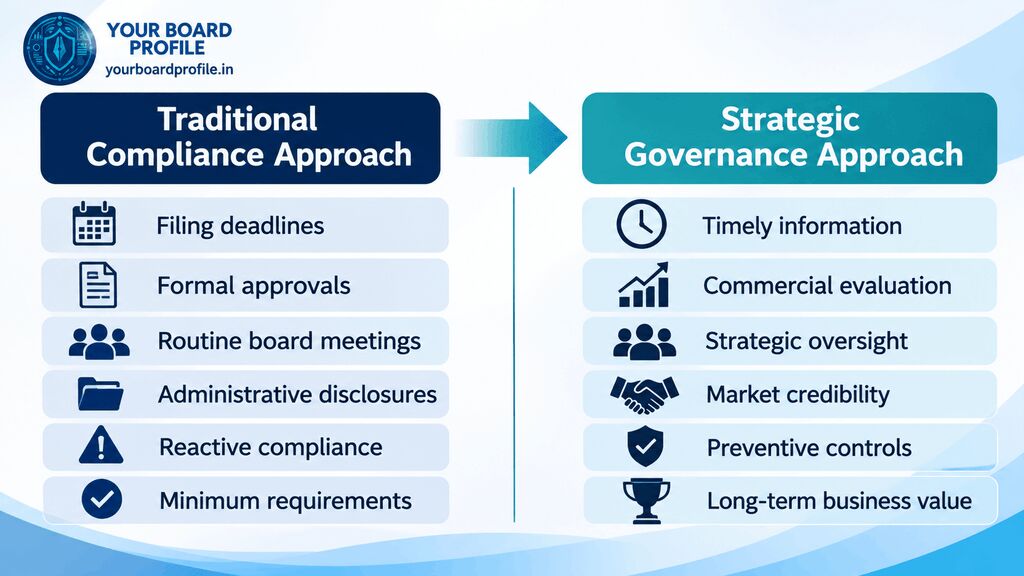
Consider the difference between two approaches:
| Checklist-driven approach | Strategic governance approach |
| Focuses on filing deadlines | Focuses on timely and reliable information |
| Reviews transactions for formal approval | Evaluates commercial rationale and conflicts |
| Conducts board meetings to fulfil requirements | Uses meetings for meaningful strategic oversight |
| Treats disclosures as administrative tasks | Uses disclosures to build market credibility |
| Addresses compliance failures after they occur | Builds preventive controls and escalation systems |
The strategic approach does not replace statutory compliance. It makes compliance more effective by connecting it with business objectives.
For companies operating in complex regulatory environments, a well-designed compliance calendar, clear ownership of disclosures, documented escalation procedures and periodic internal reviews can reduce avoidable errors.
The official SEBI LODR Regulations and amendments should be treated as the primary reference for applicable requirements. Companies should also review relevant SEBI circulars and stock exchange guidance before making compliance decisions.
4. ESG and Corporate Governance: Building Sustainable Businesses
Environmental, Social and Governance considerations have become increasingly relevant to corporate strategy. Climate-related disruptions, resource constraints, labour practices, data privacy, supply-chain responsibility and community expectations can all influence an organisation’s long-term performance.
The relationship between ESG and Corporate Governance is particularly important because sustainability cannot be managed effectively without accountability. An organisation may publish ambitious environmental targets, but who is responsible for achieving them? How are those targets measured? What happens when performance falls short? These are governance questions.
ESG should not be treated as a separate public relations exercise. It should be integrated into business planning, risk assessment, capital allocation and performance monitoring.
Integrating ESG into Boardroom Decisions
Boards need to understand which environmental and social issues are financially and strategically material to their organisations. A manufacturing company may face energy, emissions, water and workplace safety risks. A technology company may need to focus more heavily on data privacy, cybersecurity, artificial intelligence and workforce practices.
The board’s responsibility is not to manage every operational sustainability activity. Rather, it should oversee whether management has appropriate policies, resources, performance indicators and accountability mechanisms.
In India, SEBI’s Business Responsibility and Sustainability Reporting framework has increased the importance of structured sustainability disclosures for applicable listed entities. Organisations must pay attention to the relevant reporting requirements, applicability thresholds and subsequent regulatory changes.
A practical board-level ESG review could examine:
- Whether sustainability-related risks are incorporated into the organisation’s overall risk management framework.
- Whether environmental and social targets are measurable.
- Whether reported information is supported by reliable data.
- Whether supply-chain practices align with stated commitments.
- Whether executive incentives encourage responsible long-term performance.
- Whether material ESG issues are reflected in strategic and capital allocation decisions.
The OECD’s 2023 governance principles explicitly include sustainability and resilience, recognising that boards have an important role in overseeing these issues.
The real benefit emerges when ESG considerations improve operational decisions. For instance, investing in energy efficiency may reduce operating costs and exposure to energy price volatility. Strengthening workplace safety may reduce disruptions, improve employee confidence and support productivity. Responsible supply-chain management may reduce reputational and continuity risks.
This is how ESG becomes part of a business resilience strategy rather than a reporting obligation.
5. How Strong Corporate Governance Creates a Competitive Advantage
The relationship between Corporate Governance and Competitive Advantage is often underestimated. Businesses generally compete through products, pricing, technology, customer experience and market reach. Yet, behind these visible advantages lies something equally important: the quality of the organisation’s decision-making.
Two companies may have similar financial resources and market opportunities, but the one with stronger governance may be better equipped to identify emerging threats, allocate capital responsibly and maintain stakeholder confidence. It can make decisions with greater clarity because responsibilities are understood, information flows more effectively and management is accountable for execution.
Good governance also reduces the risk of decisions being driven entirely by short-term performance pressures. Boards can challenge aggressive expansion plans, question unrealistic projections and ensure that management considers the long-term consequences of strategic choices.
This does not mean that a well-governed company will always outperform its competitors. Markets are unpredictable, and even responsible organisations can experience setbacks. However, effective governance can improve the quality of decisions and help companies respond more effectively when circumstances change.
Business Resilience Strategy and Crisis Preparedness
Business resilience is the ability to withstand disruption, adapt to changing circumstances and continue delivering value. It is not simply about recovering after a crisis. It is about preparing the organisation before the crisis arrives.
A strong governance framework contributes to resilience in several ways.
First, it improves early warning systems. Boards that receive meaningful information about financial performance, operational dependencies and emerging risks can identify problems before they become serious. Management should not wait for a quarterly board meeting to communicate a significant development that requires immediate attention.
Second, it creates accountability during difficult decisions. When responsibilities are clearly defined, organisations can respond more quickly. Directors understand their oversight responsibilities, management knows its decision-making authority and escalation channels are established.
Third, it protects financial discipline. During periods of uncertainty, companies may need to reconsider investments, manage liquidity, renegotiate contracts or revise expansion plans. Effective board oversight helps ensure that these decisions are based on credible information rather than panic or personal preferences.
Fourth, it protects organisational reputation. An organisation’s response to a crisis often influences how stakeholders perceive its leadership. Transparent communication, responsible action and timely corrective measures can help preserve credibility even when the underlying situation is difficult.
Imagine a company experiencing an unexpected disruption in its supply chain. A business without a structured risk-management framework may discover that it depends excessively on one supplier or one geographical market. By contrast, a company that regularly reviews supply-chain concentration, contingency arrangements and alternative sourcing options may be better prepared to maintain operations.
The difference is not necessarily the amount of money invested in risk management. It is whether the board and management have made resilience part of their regular decision-making process.
Corporate Governance and Long-Term Business Growth
Growth can expose weaknesses that remain invisible during the early stages of a company’s development. A founder-led business may function effectively when decisions are made by a small leadership team. But as the company enters new markets, attracts institutional investors or expands internationally, informal decision-making may become inadequate.
This is where governance becomes an enabler of scale.
A structured board can provide strategic guidance, challenge expansion assumptions and help management evaluate acquisitions. Defined financial controls can reduce the risk of resource misallocation. Succession planning can prevent leadership dependency from becoming a business continuity problem.
For example, a company planning to enter three new international markets may need to evaluate local regulatory requirements, foreign exchange exposure, cultural differences and supply-chain risks. A board with relevant international experience can help management examine these factors before committing significant capital.
In this sense, Corporate Governance provides the organisational foundation for sustainable expansion. It allows businesses to become more complex without becoming less accountable.
6. Real-World Lessons from Leading Companies
The benefits of governance become easier to understand when we examine how established organisations approach board oversight, transparency and institutional accountability. Real-world examples also demonstrate that governance is not a single formula. Different businesses may adopt different structures, but the underlying principles remain relevant.
Infosys: Transparency as a Foundation of Trust
CASE STUDY 1
Infosys offers a useful example of how governance can become part of an organisation’s institutional identity. Its published governance philosophy emphasises transparency, ethical conduct, accountability and the protection of long-term stakeholder interests.
The company’s governance disclosures describe a board structure with independent directors and committees overseeing important areas such as audit, remuneration, nominations and risk management. Its stated philosophy also places emphasis on communicating accurately and going beyond the minimum requirements of law.
What lessons can other businesses draw from this approach?
Transparency becomes valuable when it is embedded in everyday decisions. Investors should not have to depend on rumours or incomplete information to understand how an organisation is performing. Similarly, employees and business partners should be able to trust that leadership decisions are guided by established principles.
For growing Indian companies, the lesson is clear: credibility should be developed before the organisation needs external capital or faces a difficult business situation.
Read more in the Infosys Corporate Governance Report.
Tata Group: Institutional Values and Long-Term Stewardship
CASE STUDY 2
Tata Group provides another useful example of the importance of institutional values, ethical leadership and long-term stewardship. Its history demonstrates how organisational reputation, leadership principles and a focus on stakeholder relationships can influence business credibility over generations.
The lesson for governance professionals is not that a particular ownership structure guarantees success. Rather, long-term institutions need systems and values that extend beyond the tenure of individual leaders.
A company may have a respected founder or a successful CEO, but its long-term stability depends on whether its values, accountability mechanisms and leadership processes can continue beyond that individual.
This is particularly relevant to family-owned businesses and founder-led organisations. As these companies grow, they need to distinguish family interests, ownership responsibilities and professional management decisions. Clear governance arrangements can help manage these relationships and reduce the risk of disputes affecting business continuity.
Lessons from Corporate Failures: When Governance Breaks Down
CASE STUDY 3
The collapse of Enron remains an important international governance lesson. The company’s failure demonstrated how weaknesses in financial reporting, conflicts of interest, inadequate oversight and unethical leadership can undermine an organisation.
Enron’s collapse also contributed to wider regulatory reform in the United States, including the Sarbanes-Oxley Act of 2002, which strengthened corporate accountability and financial reporting requirements.
The broader lesson is that financial performance without reliable governance can create an illusion of organisational strength. When accountability fails, problems that might have been addressed earlier can develop into a crisis affecting employees, shareholders, creditors and markets.
What These Examples Teach Business Leaders
| Organisation or example | Governance lesson | Strategic relevance |
| Infosys | Transparency and independent oversight | Builds institutional credibility |
| Tata Group | Long-term values and stewardship | Supports continuity across leadership generations |
| Enron collapse | Weak oversight and unethical practices can destroy trust | Highlights the cost of governance failure |
These examples should not be interpreted as proof that governance alone determines business performance. They illustrate how governance practices, institutional culture and leadership accountability can influence organisational outcomes.
For aspiring board directors, studying both successful governance frameworks and corporate failures is an important way to develop practical judgement.
7. Corporate Governance Challenges Facing Indian Businesses
India’s corporate environment includes listed companies, family-owned businesses, startups, public-sector enterprises and rapidly expanding privately held organisations. Their governance requirements differ, but many face common challenges.
One major challenge is the tendency to concentrate decision-making authority in a small group of senior leaders. Founder-led organisations may initially benefit from speed and centralised control. However, this model can create difficulties when the business expands and decisions become more complex.
Another challenge is treating compliance as a separate function rather than integrating it into organisational strategy. Companies may have qualified compliance teams but still lack effective communication between departments. As a result, important risks may not reach the board in time.
The following challenges deserve particular attention:
1. Promoter influence and board independence: In organisations with concentrated ownership, independent directors must be able to exercise objective judgement and protect the interests of the company and its shareholders.
2. Related-party transactions: Inadequate identification, evaluation or approval of related-party transactions can create conflicts of interest and damage stakeholder confidence.
3. Cybersecurity and technology risks: Boards increasingly need to understand the strategic implications of data breaches, digital infrastructure failures, artificial intelligence and technology dependencies.
4. Succession planning: Businesses that depend excessively on one founder, promoter or senior executive can face significant disruption when leadership changes unexpectedly.
5. ESG reporting and accountability: Companies must ensure that sustainability disclosures are supported by reliable information and meaningful internal accountability.
6. Board effectiveness: A board may meet all formal requirements but still lack the diversity of expertise, constructive debate and industry knowledge needed for effective oversight.
These challenges highlight why Corporate Governance requires continuous attention rather than an annual compliance review.
Senior executives should also recognise that governance expectations are changing. Financial expertise remains essential, but boards increasingly benefit from experience in cybersecurity, technology, sustainability, human capital, strategy and regulatory risk.
This creates opportunities for professionals who can demonstrate relevant expertise and translate their experience into board-level value.
8. A Practical Corporate Governance Framework for CXOs and Board Directors
How can an organisation move from a compliance-driven mindset to a governance-led business strategy? The transition does not necessarily require an expensive restructuring exercise. It begins with understanding where the existing governance framework is effective and where it needs improvement.
The following framework can help CXOs, senior executives and directors assess their organisation’s readiness.
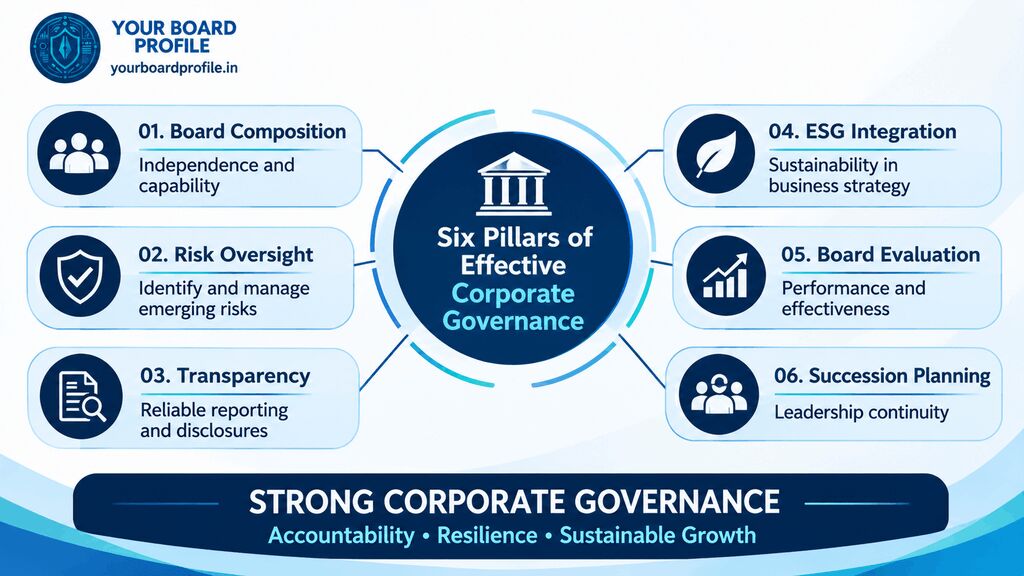
Step 1: Evaluate Board Composition and Capability
Start by reviewing whether the board has the knowledge and experience required to oversee the organisation’s strategy and risks. A board should not simply be a collection of impressive professional profiles. Its members should collectively bring the right combination of financial, operational, legal, technological, strategic and industry expertise.
Board diversity should also extend beyond demographic representation. Different professional backgrounds and perspectives can improve the quality of discussions and reduce the risk of groupthink.
Step 2: Strengthen Risk Oversight
Identify the organisation’s most significant risks and assess whether they are regularly discussed at board level. The risk register should reflect current business realities, not simply repeat last year’s concerns.
For example, a technology company may need to review cybersecurity, intellectual property protection, data privacy and AI-related risks. A manufacturing company may need to focus on energy costs, workplace safety, environmental obligations and supply-chain continuity.
Step 3: Improve Transparency and Reporting
Board members need reliable information to make informed decisions. Management reports should explain not only what has happened but also why it happened, what risks are emerging and what corrective action is being considered.
A useful board report should distinguish between routine operational updates and issues requiring strategic intervention.
Step 4: Integrate ESG into Business Strategy
Assess the sustainability issues that could materially influence the organisation’s financial performance, reputation and long-term operations. Assign clear responsibility for monitoring these issues and ensure that relevant information reaches the board.
Step 5: Review Board Effectiveness
Board evaluations should examine the quality of discussions, committee performance, director participation, information availability and follow-through on important decisions.
An effective evaluation should identify practical improvements rather than simply confirm that meetings were conducted as scheduled.
Step 6: Build Leadership and Succession Readiness
Companies should identify critical leadership positions and develop succession arrangements. This is particularly important for businesses where strategic knowledge or customer relationships are concentrated in a few individuals.
Succession planning should be considered a business continuity priority, not just an HR activity.
Corporate Governance Readiness Checklist
| Assessment area | Questions boards should ask | Desired outcome |
| Board independence | Can directors challenge management objectively? | Independent judgement |
| Financial oversight | Are financial controls and reporting reliable? | Financial accountability |
| Risk management | Are emerging risks identified and escalated? | Early intervention |
| Regulatory compliance | Are applicable obligations monitored continuously? | Reduced compliance exposure |
| ESG oversight | Are material sustainability issues integrated into strategy? | Responsible growth |
| Technology oversight | Does the board understand critical digital risks? | Greater cyber resilience |
| Succession planning | Are leadership continuity arrangements in place? | Organisational stability |
| Board evaluation | Are board performance gaps addressed? | Continuous improvement |
The checklist is a starting point, not a substitute for a detailed governance assessment. Its purpose is to encourage directors to ask better questions and connect governance processes with actual business outcomes.
Developing the Right Boardroom Perspective
For professionals aiming to transition into board-level roles, understanding these governance dimensions can create a meaningful professional advantage.
A strong executive profile may demonstrate impressive revenue growth, operational achievements or leadership experience. However, a board-ready professional must also explain how their experience contributes to oversight, strategic judgement, risk assessment and long-term value creation.
This is where board positioning becomes important. Your professional story should communicate not only what you have achieved but also how your experience can help an organisation make better decisions.
Professionals can explore board profile development and related services to understand how their experience can be aligned with board expectations.
Those preparing for their first appointment may also find these resources useful:
- How to get your first board seat without prior board experience
- Understanding the IICA Independent Directors Proficiency Test
- Strategic networking for aspiring Independent Directors
- Governance signalling and independent director credibility
The ability to connect professional expertise with governance responsibilities is increasingly valuable. Organisations need directors who can understand complex business situations, ask relevant questions and contribute constructively without becoming involved in day-to-day management.
Conclusion: Making Corporate Governance a Strategic Priority
The way we approach Corporate Governance needs to evolve. It should no longer be limited to compliance calendars, regulatory filings, board meeting procedures and statutory obligations. These activities remain essential, but they represent only one part of a much larger responsibility.
Effective governance helps organisations build accountability, improve strategic decision-making, manage emerging risks and maintain stakeholder confidence. It can support business expansion by creating clearer responsibilities, strengthen resilience by improving risk oversight and enhance investor confidence through transparency and responsible leadership.
The experiences of organisations such as Infosys and Tata Group, alongside lessons from failures such as Enron, demonstrate why institutional credibility and ethical leadership matter. They also remind us that governance cannot depend on the reputation or judgement of one individual. It must be supported by systems, culture and collective responsibility.
For Indian businesses, this is an especially important opportunity. As organisations expand, attract investment and compete in increasingly complex markets, their governance capabilities must evolve alongside their commercial ambitions.
For CXOs and aspiring board directors, this message holds equal significance. Governance knowledge is not merely an additional qualification. It is an essential part of understanding how organisations are directed, controlled and sustained.
Effective boards look beyond simply asking whether the company has met its compliance requirements. They ask whether the organisation is making responsible decisions, preparing for future risks and creating value that can endure.
Compliance may protect a company from avoidable regulatory consequences. Good governance can help build an organisation that investors trust, employees believe in and markets respect. That is when governance moves from a checklist to a genuine competitive advantage.
Frequently Asked Questions (FAQs)
1. Understanding Corporate Governance and Its Significance
Corporate Governance refers to the systems, processes and relationships through which an organisation is directed and controlled. It defines the responsibilities of the board, management and shareholders while establishing mechanisms for accountability and transparency. It is important because it supports responsible decision-making, protects stakeholder interests, improves risk oversight and strengthens investor confidence. Effective governance also helps organisations pursue sustainable growth.
2. How does Corporate Governance create a competitive advantage?
Good governance improves decision-making, strengthens risk management and builds credibility with investors and stakeholders. It helps companies identify emerging challenges, allocate capital responsibly and maintain accountability during periods of uncertainty. These capabilities can improve organisational resilience and support sustainable business expansion.
3. What are the key Corporate Governance best practices?
Important best practices include maintaining an effective and independent board, establishing strong internal controls, ensuring transparent disclosures, managing conflicts of interest, conducting regular risk assessments and integrating ESG considerations into strategy. Companies should also evaluate board performance and establish clear succession plans.
4. What is the role of SEBI LODR compliance in Corporate Governance?
SEBI LODR establishes regulatory requirements for listed entities in India concerning disclosure, board composition, committee responsibilities, shareholder rights and other governance matters. Compliance supports transparency, investor protection and accountability. Companies should refer to the latest applicable regulations, amendments and circulars.
5. How does Corporate Governance improve investor confidence?
Investors are more likely to understand and assess companies that communicate transparently and maintain effective oversight. Strong governance improves the reliability of disclosures, establishes accountability and provides greater clarity about strategic and financial risks. It does not guarantee returns but can strengthen institutional credibility.
6. What is the relationship between ESG and Corporate Governance?
ESG covers environmental, social and governance considerations that influence business sustainability. Corporate Governance provides the accountability framework through which organisations oversee ESG risks, establish responsibilities, monitor performance and communicate progress. Effective board oversight helps integrate sustainability into long-term business decisions.
7. Why are Independent Directors important for good governance?
Independent Directors bring objective judgement, external perspectives and constructive challenge to board discussions. They help oversee management decisions, protect shareholder interests and contribute to committees dealing with audit, remuneration, nominations and risk management, as applicable. Their effectiveness depends on genuine independence and informed participation.
8. Can good Corporate Governance help a company survive an economic downturn?
Yes, effective governance can improve preparedness by strengthening financial controls, risk oversight, liquidity monitoring and strategic decision-making. Boards can help management evaluate cost structures, capital allocation and alternative business scenarios. Although governance cannot eliminate economic risks, it can improve an organisation’s ability to respond.
9. How does Corporate Governance support business resilience?
It establishes clear responsibilities, improves communication, encourages early risk identification and creates accountability during disruptions. These arrangements help companies respond to operational, financial, technological and reputational challenges. Governance also supports continuity through succession planning and crisis-management oversight.
10. What are the major Corporate Governance challenges facing Indian companies?
Common challenges include promoter influence, inadequate board independence, related-party transaction risks, weak internal controls, insufficient technology oversight, inconsistent ESG reporting and inadequate succession planning. Companies also need to ensure that compliance processes translate into meaningful board-level oversight.
11. How can startups benefit from Corporate Governance?
Startups can benefit from governance even before becoming listed companies. Clear financial controls, documented decision-making, defined responsibilities and transparent investor communication help establish credibility. These practices can also make fundraising, scaling and leadership transitions easier to manage.
12. What is the difference between compliance and Corporate Governance?
Compliance involves following applicable laws, regulations and prescribed requirements. Corporate Governance is broader and includes the structures, principles and behaviours through which an organisation is directed and controlled. Compliance is an essential component of governance, but effective governance also requires ethical leadership, strategic oversight and accountability.
13. How often should a company review its Corporate Governance framework?
Governance frameworks should be monitored continuously and reviewed periodically. The frequency and depth of formal reviews depend on applicable legal requirements, business complexity and organisational risk. Reviews should also follow significant changes such as acquisitions, leadership transitions, regulatory developments or major operational disruptions.
14. What key competencies should aspiring board directors focus on developing?
Future board directors should strengthen their understanding of finance, strategic decision-making, risk management, corporate governance, and ethical leadership. They should also cultivate effective communication skills and the confidence to question management constructively. Industry expertise, cybersecurity awareness, ESG understanding and stakeholder management are also increasingly relevant. Equally important is the ability to understand the distinction between board oversight and executive management.
15. How can professionals position themselves for board-level opportunities?
Professionals should identify their distinctive board-relevant expertise, understand governance expectations and communicate their strategic contributions clearly. A board-ready CV, a credible LinkedIn presence, relevant governance knowledge and purposeful networking can strengthen their positioning. They should also develop a clear board value proposition explaining how their experience can contribute to organisational oversight and long-term value creation.