

By Dr Amit Nagpal
The Changing Power Equation in Corporate Governance
Corporate governance is experiencing a significant shift. For years, shareholders were often viewed primarily as investors who supplied capital, received dividends and evaluated company performance through annual reports and financial results. Boardrooms largely retained control over strategic decisions, executive appointments and management compensation, while shareholder participation was frequently concentrated around annual general meetings. That relationship is changing. Investors increasingly expect companies to explain their decisions, demonstrate accountability and establish a clear connection between leadership performance and long-term value creation.
This changing relationship has brought Shareholder Activism into the centre of modern corporate governance. Institutional investors are no longer satisfied with simply reviewing financial statements or voting in favour of management recommendations. They are asking difficult questions about executive compensation, board independence, capital allocation, succession planning, environmental commitments and business strategy. When explanations fall short, they may oppose resolutions, demand board changes or publicly challenge management decisions.
The magnitude of this development is becoming increasingly apparent. According to Lazard’s July 2026 review, global shareholder activism campaigns increased by 20% year-on-year during the first half of 2026, reaching a record level for a six-month period. The report also highlighted growing attention to artificial intelligence, capital allocation and mergers and acquisitions.
For boards and senior executives, this development is not simply about responding to investor criticism. It is about understanding a fundamental change in the expectations surrounding corporate leadership. A board that listens carefully, communicates transparently and welcomes constructive challenge is better positioned to maintain investor confidence. Equally, professionals aspiring to become independent directors must understand that effective governance now requires the ability to engage with shareholders, defend strategic decisions and demonstrate sound judgement.
Table of Contents
1. Understanding Shareholder Activism in Modern Corporate Governance
Shareholder activism refers to actions taken by investors to influence how a company is governed, managed or strategically directed. These actions can range from private discussions with management to formal shareholder resolutions, voting against directors and public campaigns seeking changes in corporate strategy. The central objective is to ensure that company leadership acts in the interests of shareholders while protecting the organisation’s long-term sustainability.
However, it would be a mistake to associate shareholder activism exclusively with aggressive investors seeking immediate financial returns. Many institutional investors engage with companies because they believe stronger governance, better risk management and responsible leadership contribute to sustainable business performance. In practice, activism can serve as an important mechanism for identifying weaknesses that management may overlook or underestimate.

The OECD’s 2026 Asia Capital Markets Report identifies shareholder rights, strategic alternatives and board representation among the important themes influencing investor activism. It also highlights the significant participation of institutional investors in activism across Asian markets.
From Passive Ownership to Active Shareholder Engagement
Traditionally, many investors exercised their influence through buying or selling shares. If they disagreed with management, they could simply reduce their investment. Today, however, large shareholders increasingly recognise that selling their holdings is not always the most effective solution, particularly when they have substantial investments in a company.
Instead, they may engage directly with the chairperson, independent directors, nomination and remuneration committees or senior management. These discussions can address issues such as poor capital allocation, weak succession planning, inadequate board diversity or compensation packages that do not reflect business performance.
This evolution has made Shareholder Activism an important part of the wider corporate governance conversation. Investors increasingly want to understand not only what decisions a company makes but also how those decisions are reached, who is accountable and whether the board has challenged management assumptions.
The Different Forms of Shareholder Activism
Activism can take several forms depending on the investor’s objectives, the company’s response and the seriousness of the governance concerns.
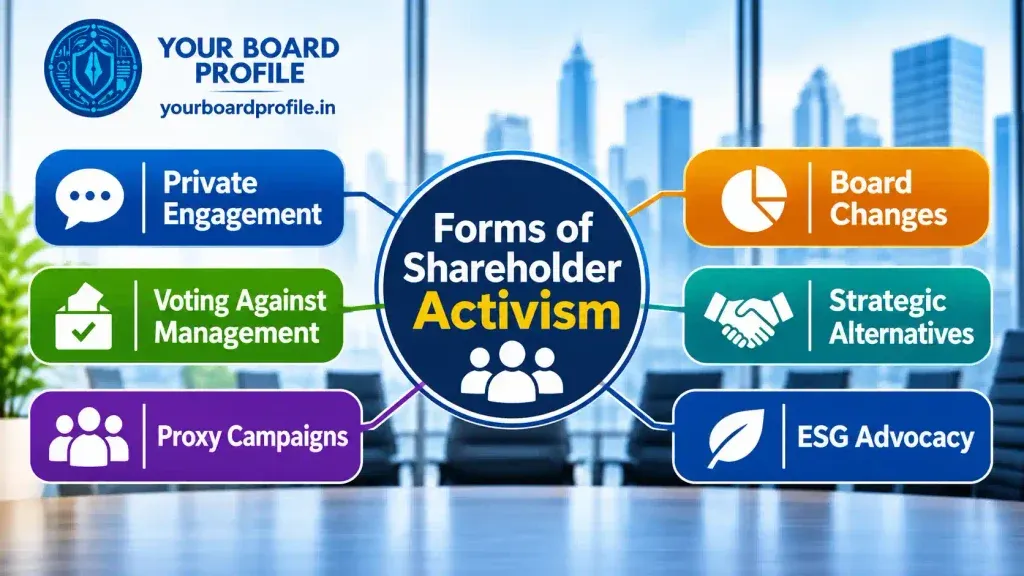
| Form of activism | What investors seek | Possible board-level impact |
| Private engagement | Direct discussions with management and directors | Greater transparency and corrective action |
| Voting against resolutions | Opposition to specific management proposals | Increased accountability |
| Director-related campaigns | Changes in board composition or independence | Board refreshment |
| Executive pay challenges | Better alignment between compensation and performance | Revised remuneration policies |
| Shareholder proposals | Formal consideration of governance matters | Policy and disclosure changes |
| Public campaigns | Wider investor support for proposed changes | Strategic or leadership reconsideration |
The important distinction is that activism does not always need to become confrontational. In many situations, meaningful dialogue can resolve concerns before they develop into public disputes.
2. Why Institutional Investors Are Becoming More Vocal
Institutional investors manage substantial pools of capital on behalf of pension funds, insurance policyholders, mutual fund investors and other beneficiaries. Their responsibilities extend beyond monitoring short-term share-price movements. They must also consider whether companies are managed responsibly, whether boards exercise appropriate oversight and whether business strategies support long-term investment objectives.
The growing influence of these investors is changing the relationship between ownership and corporate leadership. When an institution holds a significant investment in a listed company, its voting decisions and engagement priorities can carry considerable weight. Management teams therefore need to recognise that investor communication is not simply an annual reporting exercise.
According to the OECD’s 2026 analysis, institutional investors accounted for 47% of total global equity holdings at the end of 2024. The same report identifies institutional investors as major participants in Asian activism campaigns.
Growing Expectations Around Transparency and Accountability
Investors increasingly want clear explanations about how management decisions affect business performance and long-term value. They may question why a company continues to invest in an underperforming business segment, why executive compensation has increased despite weak results or why the board has retained directors whose skills no longer match the organisation’s strategic requirements.
These questions reflect a broader expectation that boards should demonstrate independent judgement rather than automatically support management recommendations.
Consider a company that announces a significant acquisition. Management may present the transaction as an opportunity for expansion, but institutional investors may want to examine the financial assumptions, integration risks, funding structure and expected return on investment. If the board cannot explain why the acquisition creates sustainable value, shareholders may challenge the decision.
For directors, the lesson is straightforward: board oversight must be supported by evidence, clear reasoning and effective communication.
3. The Growing Influence of Proxy Advisory Firms
An important development in modern corporate governance is the growing influence of Proxy Advisory Firms. These organisations provide research, analysis and voting recommendations to institutional investors on matters placed before shareholders. Their work often covers director elections, executive remuneration, shareholder proposals, mergers, governance structures and other significant corporate decisions.
Two prominent names in this industry are Institutional Shareholder Services (ISS) and Glass Lewis. Their recommendations can influence how institutional investors assess shareholder resolutions, particularly when investors manage large portfolios and must evaluate numerous companies during the annual proxy season.
The influence of these firms has also attracted regulatory attention. The OECD’s 2026 research highlights their role in supporting institutional investors while identifying concerns around transparency, potential conflicts of interest and the need for independent voting decisions.
How Proxy Advisory Firms Influence Shareholder Decisions
Proxy advisory firms analyse company disclosures, governance practices and shareholder meeting resolutions. They then provide recommendations that help their clients evaluate whether a proposal deserves support.
For example, suppose a listed company proposes a substantial increase in executive remuneration. A proxy advisory firm may examine the company’s financial performance, compensation structure, peer comparisons and the relationship between executive rewards and shareholder returns.
If the proposed package appears excessive or poorly justified, the firm may recommend that investors vote against the relevant resolution.
However, a recommendation is not the same as a binding decision. Institutional investors retain responsibility for determining how they vote. They must consider their own investment policies, fiduciary responsibilities and assessment of the company’s circumstances.
Why Boards Must Pay Attention
For boards, proxy advisory reports can provide an early indication of potential shareholder concerns. A negative recommendation may encourage investors to question management proposals, scrutinise director appointments or demand additional explanations.
Rather than treating these reports as administrative documents, directors should view them as useful inputs into governance discussions.
A well-prepared board should be able to explain its position with supporting evidence, particularly when its decisions differ from the recommendations of influential proxy advisers.
Useful reading: The OECD’s research on proxy advisory regulation and corporate governance provides further insight into the evolving responsibilities of these market participants.
4. Executive Compensation Under Greater Shareholder Scrutiny
Executive compensation has become one of the most visible areas of shareholder scrutiny. Investors increasingly question whether senior leaders are being rewarded for creating genuine long-term value or simply for meeting short-term financial targets.
A compensation package may include fixed salary, annual bonuses, performance-linked incentives, stock options, restricted shares and long-term benefits. The challenge is not necessarily the size of the package but whether the rewards are justified by performance, leadership quality and the organisation’s long-term results.
This is where Shareholder Activism can become particularly influential. Investors may oppose remuneration resolutions when executive rewards appear disconnected from company performance or when compensation structures encourage excessive risk-taking.
What Investors Examine in Executive Compensation
Investors generally look beyond the headline salary figure. They examine the underlying philosophy of the remuneration structure and whether it encourages responsible leadership.
| Area of scrutiny | Questions investors may ask |
| Fixed remuneration | Is the salary appropriate for the executive’s responsibilities? |
| Annual incentives | Are bonuses linked to measurable performance? |
| Long-term incentives | Do rewards encourage sustainable value creation? |
| Performance targets | Are targets sufficiently challenging and transparent? |
| Risk adjustments | Are rewards adjusted for significant business failures? |
| Disclosure | Can shareholders understand how compensation is calculated? |
Imagine a company that reports declining profitability for two consecutive years but increases its CEO’s annual bonus. Even if management has a reasonable explanation, shareholders may question the fairness and credibility of that decision.
Boards must therefore ensure that remuneration committees operate independently and establish transparent performance measures.
The ISS Governance and Stewardship Outlook for 2026 identifies executive compensation alignment, corporate risk oversight and board accountability among the important governance priorities for the year.
For aspiring independent directors, understanding remuneration structures is no longer an optional specialist skill. It is an essential part of effective board oversight.
5. Board Appointments and Board Accountability
A company’s board is responsible for providing strategic direction, supervising management and protecting the organisation’s long-term interests. The quality of its decisions depends significantly on the experience, independence, judgement and collective capabilities of its directors.
This explains why investors increasingly pay attention to board appointments and director elections. They want to know whether directors possess the right expertise, whether independent directors can challenge management effectively and whether the board has the necessary capabilities to address emerging risks.
Board Accountability becomes especially important when investors believe that directors have failed to respond to persistent governance weaknesses.
What Investors Expect from Board Appointments
Investors may examine several factors before supporting a director’s appointment or reappointment.
- Independence: Can the director exercise objective judgement without inappropriate influence?
- Competence: Does the candidate possess relevant financial, strategic, technological or industry expertise?
- Board diversity: Does the board benefit from different professional experiences and perspectives?
- Time commitment: Can the director devote sufficient attention to the organisation?
- Performance: Has the director demonstrated meaningful contribution and effective oversight?
A board appointment should never become a ceremonial exercise. Directors must bring relevant capabilities and a willingness to question decisions when necessary.
For example, a company undergoing digital transformation may require directors who understand technology strategy, cybersecurity, data governance and artificial intelligence. Appointing directors without these capabilities could create significant oversight gaps.
The Importance of Board Independence
Independent directors serve as a vital safeguard for shareholder interests. They must evaluate management proposals objectively, challenge assumptions and ensure that important decisions receive appropriate scrutiny.
Investors may oppose board appointments when they believe that candidates lack independence or that the board has not adequately addressed conflicts of interest.
This makes board succession planning and director evaluation important governance priorities.
Professionals seeking their first appointment can explore the path to securing a first board seat without prior board experience. Developing a clear board value proposition, understanding governance expectations and demonstrating relevant oversight experience can help strengthen their readiness.
6. Strategic Decisions That Attract Shareholder Activism
Shareholders do not necessarily challenge companies because their financial results are temporarily disappointing. Sometimes, the concern is that management is pursuing a strategy that does not make the best use of the organisation’s resources.
Capital allocation, mergers and acquisitions, business restructuring, digital investments and market expansion can all attract investor attention.
The growing interest in strategic decision-making was particularly visible during the first half of 2026. Lazard reported that activist campaigns increasingly focused on areas such as artificial intelligence implementation, capital allocation and mergers and acquisitions.
When Investors Challenge Strategic Pivots
Consider a company that decides to enter a new market through a major acquisition. Management believes the transaction will create growth opportunities, but shareholders question the purchase price, expected synergies and potential integration difficulties.
Investors may request additional information, challenge the board’s assumptions or argue that the company should consider alternative uses of its capital.
Similar questions arise when companies:
- Continue investing in consistently underperforming business units.
- Delay necessary restructuring despite changing market conditions.
- Pursue acquisitions without a convincing strategic rationale.
- Underinvest in technology and digital capabilities.
- Ignore emerging competitive threats.
- Retain business models that no longer support sustainable growth.
Such challenges do not automatically mean that investors are right and management is wrong. Boards must evaluate the merits of competing arguments independently.
The responsibility of directors is to ensure that strategic decisions are properly assessed, supported by credible evidence and aligned with the company’s long-term objectives.
7. The Role of Shareholder Activism in ESG and Sustainability
Environmental, social and governance considerations have become increasingly relevant to corporate strategy. Investors want to understand how companies manage climate-related risks, workforce issues, supply-chain responsibilities, business ethics and sustainability commitments.
However, shareholder expectations are not always uniform. Some investors prioritise financial materiality and measurable returns, while others place greater emphasis on environmental and social performance. Boards must understand these different perspectives without losing sight of the organisation’s business objectives and regulatory responsibilities.
Shareholder Activism can encourage companies to improve sustainability disclosures, strengthen oversight and address gaps between public commitments and actual performance.
ESG Commitments Must Be Supported by Evidence
Consider a company that announces ambitious sustainability targets but provides limited information about its implementation. Investors may question whether the targets are realistic, whether the board monitors progress and whether management has allocated sufficient resources.
This is particularly important when companies communicate environmental performance through annual reports, sustainability disclosures and investor presentations.
For Indian listed companies, the SEBI Business Responsibility and Sustainability Reporting framework has made sustainability-related disclosures an important part of corporate reporting for applicable entities.
Companies should also ensure that sustainability commitments are supported by reliable data, appropriate internal controls and clear accountability.
Explore our related article on the SEBI BRSR framework and ESG credibility to understand how sustainability reporting contributes to stronger governance.
8. Seven Ways Boards Can Respond to Shareholder Activism
An increasingly active shareholder environment requires boards to move beyond reactive communication. Directors must establish processes that help them understand investor expectations, identify emerging concerns and respond constructively.
The objective should not be to satisfy every investor demand. Instead, the board must demonstrate that it has listened, evaluated the concerns independently and acted in the organisation’s long-term interests.
Here are seven practical approaches.
1. Build Continuous Relationships with Institutional Investors
Investor engagement should not begin only when the annual general meeting approaches. Boards should encourage regular, meaningful communication with major shareholders.
These discussions can help directors understand investor expectations, identify potential disagreements and address governance concerns before they become formal disputes.
2. Strengthen Board Independence
A board should have the right combination of executive knowledge, independent judgement and specialist expertise.
Regular board evaluations, succession planning and director development can help maintain an appropriate balance of capabilities.
3. Improve Executive Compensation Transparency
Remuneration committees should establish clear performance measures and explain how compensation aligns with organisational results.
Directors should be prepared to justify significant remuneration decisions through transparent disclosures.
4. Review Strategic Decisions More Rigorously
Major acquisitions, divestments, capital investments and restructuring decisions should be supported by detailed financial analysis and risk assessment.
Boards should challenge optimistic assumptions and consider alternative scenarios before approving significant transactions.
5. Strengthen Governance and Risk Oversight
Investors increasingly expect boards to understand emerging risks, including cybersecurity, artificial intelligence, geopolitical uncertainty and supply-chain vulnerabilities.
Risk oversight should be an ongoing board responsibility rather than a periodic compliance exercise.
6. Improve Shareholder Communication
Annual reports, investor presentations and shareholder meetings should communicate the reasoning behind important decisions.
Clear explanations can reduce misunderstandings and build confidence in board judgement.
7. Establish a Constructive Response Mechanism
Boards should have a defined process for evaluating activist proposals, reviewing investor concerns and deciding when additional engagement is appropriate.
The board must distinguish between legitimate governance concerns and proposals that may undermine long-term organisational value.
These seven approaches are practical governance recommendations, not a substitute for applicable securities laws or company-specific regulatory advice.
9. The Indian Corporate Governance Landscape
India’s corporate governance environment is evolving alongside the growing participation of institutional investors, domestic mutual funds, foreign portfolio investors and proxy advisory firms.
Listed companies are facing increasing expectations around shareholder rights, disclosure quality, board independence and responsible decision-making. Regulatory developments have also strengthened the framework within which investors exercise their voting rights.
The Securities and Exchange Board of India (SEBI) plays an important role in this environment through its regulations governing listed entities and proxy advisory firms.
SEBI and the Role of Proxy Advisory Firms in India
Proxy advisory firms registered with SEBI provide research and voting recommendations to investors on matters placed before shareholders. Their work can influence discussions concerning director appointments, remuneration policies, related-party transactions and other governance matters.
SEBI’s framework recognises the importance of proxy advisers in helping shareholders participate effectively in corporate governance decisions. Its regulatory approach also provides for grievance resolution where listed entities have concerns regarding the conduct of registered proxy advisers.
For Indian boards, this means that shareholder engagement must be supported by accurate disclosures, consistent governance practices and well-documented decision-making.
Why Indian Companies Need Stronger Board Preparedness
The Indian market presents several governance considerations that boards must understand.
| Governance area | What investors increasingly examine |
| Related-party transactions | Transparency, fairness and appropriate approvals |
| Director appointments | Independence, experience and suitability |
| Executive remuneration | Alignment with performance and long-term value |
| ESG disclosures | Credibility and consistency of sustainability information |
| Financial reporting | Accuracy, transparency and internal controls |
| Risk management | Cybersecurity, operational and regulatory preparedness |
| Shareholder rights | Equal treatment and effective participation |
Companies should also recognise that regulatory compliance alone does not guarantee investor confidence. Investors want evidence that the board understands its responsibilities and exercises meaningful oversight.
For professionals seeking board-level opportunities, understanding the board of directors vacancy landscape and the expectations associated with director appointments can be a useful starting point.
10. Challenges and Risks Associated with Shareholder Activism
Although shareholder engagement can strengthen governance, it also presents challenges. Not every activist proposal necessarily supports the long-term interests of a company. Some investors may prioritise short-term financial returns, while others may advocate strategic changes that introduce additional operational or financial risks.
Boards must therefore balance responsiveness with independent judgement.
Short-Termism Versus Long-Term Value Creation
One of the most significant concerns arises when investors demand immediate improvements in profitability or shareholder returns.
For example, a company may be investing heavily in research, technology or employee development. These investments may temporarily reduce margins but create substantial long-term opportunities.
If shareholders focus exclusively on quarterly performance, management may feel pressured to reduce investments that are important for future competitiveness.
The board must evaluate such demands carefully and communicate why certain strategic investments remain necessary.
Conflicting Shareholder Expectations
Institutional investors are not a single group with identical objectives. Different funds may have different investment horizons, voting policies and governance priorities.
One investor may support a proposed acquisition, while another may oppose it. Similarly, shareholders may disagree about executive remuneration, board leadership structures or sustainability investments.
This diversity makes shareholder engagement more complex.
Increased Pressure on Directors
Activist campaigns can create additional responsibilities for directors, particularly independent directors and committee chairs.
They may need to review proposals, examine financial information, participate in investor discussions and explain the board’s position.
The ability to remain objective under pressure is therefore an essential boardroom capability.
Research on the 2026 proxy season also highlights changes in voting influence and the increasingly complex relationship between companies, investors and proxy advisers.
A strong board does not automatically accept or reject activist demands. It evaluates them through the lens of fiduciary responsibilities, organisational purpose and long-term value creation.
11. Preparing Future Board Directors for an Era of Active Shareholders
The growing influence of shareholders is changing what organisations expect from their directors. Technical expertise and senior management experience remain valuable, but they are no longer sufficient on their own.
Directors must understand how institutional investors assess governance, how proxy advisory firms evaluate shareholder resolutions and how board decisions influence investor confidence.
For aspiring independent directors, this creates an opportunity to develop a more comprehensive understanding of boardroom responsibilities.
The Skills Modern Board Directors Need
1. Financial and commercial understanding
Directors must understand financial statements, capital allocation, profitability, executive remuneration and business performance. They should be able to question financial assumptions and evaluate whether management decisions support sustainable value creation.
2. Governance and regulatory knowledge
An effective director must understand the legal and regulatory framework applicable to the organisation. Knowledge of board responsibilities, shareholder rights, disclosure requirements and committee oversight is particularly important.
3. Strategic thinking
Shareholders expect directors to evaluate business strategy rather than simply approve management proposals. Directors should understand competitive positioning, market developments, technology disruption and long-term business risks.
4. Communication and stakeholder engagement
Directors must communicate clearly with fellow board members, management teams and relevant stakeholders. They should be able to explain complex decisions in a way that demonstrates sound judgement and accountability.
5. Constructive challenge
Perhaps most importantly, directors must be comfortable questioning management assumptions. Effective oversight requires the ability to challenge decisions respectfully, request additional information and encourage alternative perspectives.
Building a Strong Boardroom Value Proposition
Senior executives and professionals aspiring to become independent directors should start identifying how their experience translates into board-level value.
A senior finance professional, for example, may bring expertise in financial oversight, audit committees and capital allocation. A technology executive may contribute to cybersecurity, digital transformation and AI governance. Similarly, a business leader may offer experience in strategy, organisational transformation and risk management.
The important point is to communicate this experience in the language of board responsibilities rather than simply describing previous job titles.
This is where a well-structured board CV and a credible professional profile become valuable.
Professionals can explore Your Board Profile’s portfolio and professional board-readiness and personal branding services to understand how relevant leadership experience can be positioned for board-level opportunities.
They can also use the board due diligence checklist to understand the importance of evaluating governance structures, organisational risks and board responsibilities.
For additional perspectives on board readiness, governance and leadership, visit the Your Board Profile blog.
Conclusion: Shareholder Activism Is Reshaping the Future of Corporate Governance
The growing influence of shareholders represents an important development in corporate governance. Investors are becoming more vocal about executive compensation, board appointments, strategic decisions, transparency and organisational accountability. Institutional investors and proxy advisory firms are contributing to this change by making shareholder participation more informed and influential.
However, stronger governance is not achieved simply because shareholders challenge management. It emerges when companies respond to legitimate concerns, evaluate competing perspectives and make decisions that protect long-term organisational value.
For boards, the message is clear: effective oversight requires openness, independence, strategic judgement and meaningful engagement with shareholders. Directors must be prepared to explain their decisions, question management assumptions and demonstrate that governance is more than a compliance obligation.
For senior executives and aspiring independent directors, this changing environment also creates an important opportunity. Professionals who understand investor expectations, financial oversight, board accountability and strategic governance will be better positioned to contribute meaningfully in the boardroom.
Ultimately, Shareholder Activism should not be viewed merely as a challenge to management authority. When approached constructively, it can become a powerful mechanism for improving corporate accountability, strengthening board effectiveness and building lasting stakeholder confidence.
Ready to Strengthen Your Boardroom Value Proposition?
The evolving relationship between shareholders and corporate boards makes effective governance leadership more important than ever.
Whether you are a senior executive preparing for your first independent director appointment, an experienced CXO looking to strengthen your boardroom positioning or a professional seeking greater visibility among board stakeholders, presenting your experience strategically matters.
Your Board Profile helps senior professionals translate their leadership experience into a compelling boardroom value proposition through:
- Customised Board CVs and professional positioning.
- LinkedIn profile optimisation and personal branding.
- Board readiness assessments.
- One-to-one coaching and mentorship.
- Thought leadership and professional visibility.
Explore Your Board Profile’s services and take the next step towards strengthening your boardroom presence.
Book a complimentary discussion with me:
https://calendly.com/dramitnagpal
Frequently Asked Questions (FAQs)
1. What is Shareholder Activism?
Shareholder activism involves investors seeking to influence a company’s corporate governance practices, managerial decisions, or strategic priorities. It may involve voting against resolutions, questioning executive compensation, seeking board changes or engaging directly with company leadership.
2. Why is Shareholder Activism becoming more important?
Investors increasingly expect transparency, accountability and responsible decision-making from corporate boards. Growing institutional ownership, improved access to governance information and the influence of proxy advisory firms have made shareholder participation more significant.
3. How do Institutional Investors influence corporate governance?
Institutional investors influence governance through voting rights, direct engagement with directors, shareholder proposals and public campaigns. Their decisions can affect director appointments, executive remuneration, strategic decisions and governance policies.
4. What is the role of Proxy Advisory Firms?
Proxy advisory firms analyse shareholder meeting resolutions and provide voting recommendations to institutional investors. They evaluate matters such as director elections, executive compensation, shareholder rights and corporate governance practices.
5. How does Shareholder Activism affect Executive Compensation?
It encourages boards to justify remuneration packages through transparent performance measures. Investors may challenge excessive compensation, poorly designed incentives or rewards that are disconnected from long-term business performance.
6. Can Shareholder Activism lead to changes in board composition?
Yes. Investors may question director independence, board diversity, professional expertise and overall board effectiveness. In some cases, activism can result in new director appointments, board refreshment or changes in committee leadership.
7. What is the difference between Institutional Investors and Activist Investors?
Institutional investors are organisations that manage investments on behalf of clients or beneficiaries, such as pension funds and mutual funds. Activist investors specifically seek to influence company decisions through engagement, voting, proposals or campaigns. Institutional investors can also undertake activist activities.
8. Is Shareholder Activism beneficial for companies?
It can be beneficial when it identifies governance weaknesses, encourages transparency and improves strategic decision-making. However, boards must carefully evaluate proposals to ensure that they support long-term organisational value rather than only short-term financial gains.
9. How does SEBI regulate Proxy Advisory Firms in India?
SEBI has established a regulatory framework for proxy advisers, including registration requirements, a code of conduct and mechanisms for addressing grievances. These provisions aim to support transparency and responsible participation in corporate governance.
10. What is the relationship between Shareholder Activism and ESG?
Investors may use shareholder engagement and voting rights to encourage companies to improve environmental, social and governance practices. Common areas include climate-risk disclosures, sustainability reporting, workforce practices and ethical business conduct.
11. How can boards prepare for Shareholder Activism?
Boards can prepare through regular investor engagement, independent board evaluations, transparent remuneration policies, robust risk oversight and effective shareholder communication. They should also establish clear procedures for assessing activist proposals.
12. What challenges does Shareholder Activism create for independent directors?
Independent directors may face greater scrutiny of their judgement, independence and oversight responsibilities. They must evaluate investor concerns objectively, challenge management assumptions and ensure that board decisions remain aligned with the company’s long-term interests.
13. How can aspiring independent directors prepare for increased shareholder scrutiny?
They should develop financial literacy, governance knowledge, strategic thinking, risk oversight capabilities and stakeholder communication skills. Understanding investor expectations and proxy voting processes can also strengthen their boardroom readiness.
14. Can Shareholder Activism influence mergers and acquisitions?
Yes. Investors may challenge acquisition valuations, financing arrangements, strategic rationale and expected returns. They may also encourage divestments, restructuring or alternative capital allocation strategies when they believe these would create greater long-term value.
15. What is the future of Shareholder Activism in corporate governance?
Shareholder engagement is likely to remain an important governance mechanism. Investors will continue examining board effectiveness, executive compensation, technology oversight, sustainability, capital allocation and corporate accountability. Boards that combine transparency with independent judgement will be better prepared for these expectations.