
Why ESG Reporting Is Becoming a Boardroom Priority
Sustainability is no longer a subject that companies can comfortably leave to their corporate communications or public relations teams. Investors, regulators, employees, customers and business partners increasingly want to understand how an organisation creates value, manages environmental and social risks, and maintains responsible governance. A company’s financial performance still matters, of course, but stakeholders are also asking difficult questions. How much carbon does the organisation generate? Is it managing energy and water responsibly? Are employees treated fairly? Does its leadership demonstrate accountability when sustainability commitments are not being met?
This changing business environment has made the SEBI BRSR framework an important development in India’s corporate governance landscape. The Business Responsibility and Sustainability Report (BRSR) moves sustainability reporting towards measurable, comparable and structured disclosures. Its evolution, particularly through BRSR Core, signals a shift from broad statements of corporate responsibility towards greater scrutiny of non-financial performance.
For senior executives and board directors, this development has a wider implication. ESG information is becoming part of the board’s oversight responsibilities, rather than remaining an annual reporting exercise managed by one department. The quality of sustainability data can influence investor confidence, business reputation, risk assessments and long-term strategic decisions. The SEBI BRSR framework is therefore becoming an important tool for businesses seeking to connect sustainability commitments with measurable performance, transparent reporting and stronger stakeholder relationships.
The real opportunity lies in understanding the SEBI BRSR framework as more than a regulatory requirement. When implemented thoughtfully, it can help organisations strengthen internal accountability, identify operational weaknesses and demonstrate that their sustainability commitments are supported by evidence. That is where ESG reporting begins to create genuine business value.
Table of Contents
1. Understanding the SEBI BRSR Framework
The SEBI BRSR framework represents a significant change in how listed companies communicate their environmental, social and governance performance. Introduced by the Securities and Exchange Board of India, the Business Responsibility and Sustainability Report requires companies to move beyond conventional financial reporting and explain how their business activities affect the wider economy, society and environment.
For Indian companies, the SEBI BRSR framework provides a common reporting structure that helps demonstrate how environmental responsibility, social impact and corporate governance are integrated into business operations.
The framework is designed to make sustainability disclosures more structured and meaningful. Rather than simply stating that a company supports environmental protection or employee welfare, businesses are expected to provide information that helps stakeholders understand what they are actually doing. This includes policies, measurable indicators, governance arrangements and the outcomes of sustainability initiatives.
The framework is particularly relevant because non-financial performance can have direct financial consequences. Poor environmental management may expose a company to regulatory penalties, operational disruptions and reputational damage. Weak workforce practices can affect productivity and employee retention, while inadequate governance can undermine investor confidence.
For boards, the SEBI BRSR framework creates an opportunity to connect sustainability commitments with business strategy. It encourages directors to ask whether management has the right systems, resources and accountability structures to support responsible business practices.
From Business Responsibility Reporting to BRSR
India’s sustainability reporting journey did not begin with BRSR. SEBI previously introduced Business Responsibility Reporting (BRR), which encouraged listed companies to disclose their performance against responsible business principles. Over time, however, stakeholders required more detailed information, particularly regarding measurable sustainability outcomes.
The SEBI BRSR framework has consequently made sustainability reporting a more structured exercise, encouraging companies to move from general policy statements towards measurable disclosures and greater accountability.
BRSR was introduced as a more comprehensive reporting framework. The top 1,000 listed entities by market capitalisation were brought within its mandatory reporting requirements from FY 2022–23.
The change was important because it shifted attention from describing responsible business policies to reporting measurable performance. Companies were expected to explain how their operations aligned with responsible business principles and how they managed material environmental and social issues.
The framework also reflects the Indian business environment. It considers areas such as employment generation, gender diversity, natural resource consumption, community development and responsible supply chains.
What Makes BRSR Core Different?
While the full BRSR covers a broad range of sustainability disclosures, BRSR Core identifies a smaller set of critical performance indicators requiring more focused assessment or assurance. Through the SEBI BRSR framework, companies are encouraged to establish stronger reporting mechanisms that allow investors and other stakeholders to evaluate sustainability performance with greater confidence.
The SEBI BRSR framework therefore has two important dimensions:
- BRSR provides a broader picture of a company’s sustainability policies, practices and performance.
- BRSR Core concentrates on selected quantitative indicators that can be assessed more systematically.
This distinction matters because sustainability statements are only useful when stakeholders can evaluate their reliability. A company may announce ambitious carbon reduction targets, but investors also want to understand the underlying emissions data, measurement methods and progress against those targets.
The original BRSR Core framework was introduced through SEBI’s circular dated 12 July 2023. Its subsequent modifications have provided greater flexibility in implementation.
Companies should refer to the official SEBI BRSR circular and regulatory updates when determining their applicable reporting obligations.
2. BRSR Core Assurance: Moving from Disclosure to Accountability
One of the most important developments in sustainability reporting is the growing emphasis on independent assessment and assurance of reported information.
The SEBI BRSR framework places greater emphasis on the quality of reported information, making reliable data collection, internal verification and independent assessment important elements of corporate sustainability reporting.
Consider a company that reports a 15% reduction in its carbon footprint. That sounds encouraging. But how was the reduction calculated? Were all relevant facilities included? Were emissions measured consistently? Were changes in production volumes considered?
Without reliable measurement and verification, even an impressive sustainability claim may raise questions.
This is why BRSR Core assurance is important. It strengthens confidence in selected sustainability indicators by introducing a more disciplined approach to data collection, measurement and independent evaluation.
SEBI’s July 2023 circular introduced a phased requirement for the top listed entities to obtain reasonable assurance of BRSR Core disclosures. Subsequent regulatory changes introduced the terminology of assessment or assurance, providing flexibility in the implementation of these requirements.
For board members, the underlying principle remains important: sustainability information must be supported by appropriate evidence, transparent methodologies and accountable reporting systems.
Nine ESG Attributes That Matter
BRSR Core identifies nine ESG attributes covering important aspects of corporate sustainability.
| ESG attribute | What companies need to examine |
| Greenhouse gas footprint | Emissions generated by business operations |
| Water footprint | Water consumption and management |
| Energy footprint | Energy consumption and efficiency |
| Embracing circularity | Waste management and resource efficiency |
| Enhancing employee well-being | Employee welfare and workplace practices |
| Enabling gender diversity | Gender representation and inclusion |
| Enabling inclusive development | Social and economic development indicators |
| Fairness in engaging with customers and suppliers | Responsible business relationships |
| Openness of business | Transparency and ethical business practices |
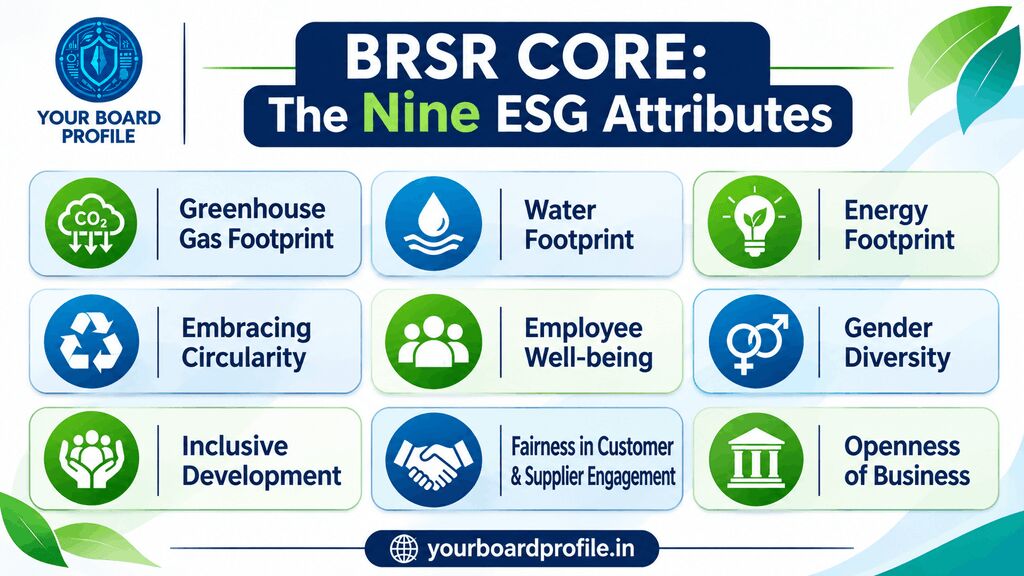
These indicators demonstrate that sustainability cannot be measured through environmental performance alone. Workforce welfare, gender diversity, supplier relationships and business transparency are equally relevant to the credibility of an organisation.
For example, an energy-intensive company may invest heavily in renewable electricity. However, if it ignores employee safety or responsible supplier practices, its overall sustainability performance remains incomplete.
Understanding the Applicability Timeline
The implementation of BRSR Core follows a phased approach based on market capitalisation.
The original SEBI framework prescribed the following glide path:
| Financial year | Listed entities covered by the original BRSR Core glide path |
| FY 2023–24 | Top 150 |
| FY 2024–25 | Top 250 |
| FY 2025–26 | Top 500 |
| FY 2026–27 | Top 1,000 |
The terminology and implementation requirements were subsequently modified. Companies should consult the latest applicable SEBI circulars rather than treating the original schedule as a complete description of current requirements.
A significant development came through SEBI’s circular dated 28 March 2025. It introduced measures to facilitate implementation, including changes concerning assessment or assurance and value-chain disclosures.
For FY 2025–26, value-chain ESG disclosures by the top 250 listed entities became voluntary rather than operating under the earlier comply-or-explain approach. Associated assessment or assurance is also voluntary under the revised provisions.
SEBI’s BRSR-related FAQs provide additional clarification on these changes.
The key takeaway is that companies must distinguish between mandatory BRSR reporting, applicable BRSR Core requirements and voluntary value-chain disclosures.
3. Board-Level ESG Governance: Why Directors Must Take Ownership
Sustainability reporting becomes meaningful when it influences how a company is governed. The SEBI BRSR framework also reinforces the importance of board oversight by encouraging directors to examine whether ESG policies are supported by measurable targets, effective controls and management accountability.
In many organisations, ESG responsibilities are distributed across departments. The sustainability team manages environmental initiatives, human resources handles workforce welfare, finance collects relevant numbers and compliance teams coordinate regulatory disclosures.
While this division of responsibilities is practical, it can create a serious problem: no single function may have a complete understanding of the organisation’s ESG exposure.
This is where board-level ESG governance becomes essential.
Directors must understand whether sustainability risks are being identified, measured and integrated into strategic decisions. They do not need to personally calculate emissions or prepare every disclosure. Their responsibility is to ensure that the organisation has suitable oversight, reliable reporting processes and clear management accountability.
The Board’s Role in Sustainability Oversight
An effective board should treat ESG information as part of its broader responsibility for strategy, risk management and organisational performance.
This requires directors to examine more than the final sustainability report. They should understand how the information was collected, which departments contributed to it, what assumptions were used and whether reported performance reflects actual operational improvements.
For example, a manufacturing company may announce an ambitious energy conservation programme. The board should ask whether the investment has produced measurable efficiency improvements, whether the targets are realistic and whether operational teams are accountable for delivery.
Similarly, directors should examine workforce welfare metrics beyond headline employee satisfaction scores. Safety incidents, employee turnover, gender representation, training opportunities and grievance resolution can provide a more meaningful picture.
A board that regularly reviews these indicators is better positioned to identify problems before they become serious business risks.
Integrating ESG into Enterprise Risk Management
ESG risks rarely operate independently. Environmental regulation can influence operating costs, workforce concerns can affect business continuity, and governance failures can damage investor relationships.
Companies should therefore connect sustainability reporting with their enterprise risk management systems.
| ESG risk | Potential business consequence | Board oversight priority |
| Climate-related risks | Higher operating costs and physical disruption | Climate resilience and investment planning |
| Poor energy management | Inefficiency and rising energy expenditure | Energy conservation targets |
| Weak workforce welfare | Attrition, disputes and productivity losses | Employee safety and engagement |
| Supplier misconduct | Reputational and supply-chain exposure | Supplier screening and monitoring |
| Weak governance | Regulatory and investor confidence concerns | Accountability and internal controls |
This integrated approach helps directors understand the relationship between sustainability performance and long-term enterprise value.
A useful practice is to include material ESG indicators in periodic board and committee discussions. The objective should not be to create another reporting burden but to improve the quality of strategic decisions.
4. Beyond Environmental Metrics: The Social and Governance Dimensions
Environmental performance often receives the most attention in sustainability discussions. Carbon emissions, renewable energy and water conservation are visible indicators, and rightly so.
However, the SEBI BRSR framework recognises that responsible business performance also depends on how organisations treat people, engage with communities and conduct their business.
A company cannot claim to be genuinely sustainable if its environmental initiatives are impressive but its employment practices are questionable or its governance arrangements lack transparency.
Carbon Footprint and Energy Conservation Reporting
Carbon footprint reporting enables organisations to measure, assess, and track the greenhouse gas emissions generated by their business activities.
Companies generally need to consider:
- Scope 1 emissions are the direct greenhouse gas emissions released from assets, facilities, and activities that an organisation owns or has operational control over.
- Scope 2 emissions associated with purchased electricity, steam, heating and cooling.
- Scope 3 emissions arising across relevant value-chain activities.
The distinction is important. A company may improve its factory-level energy efficiency while continuing to depend on carbon-intensive suppliers and transportation networks.
A complete understanding of carbon footprint reporting helps management identify where emissions originate and where reduction efforts can have the greatest impact.
The SEBI BRSR framework encourages companies to examine their environmental footprint more closely by improving emissions measurement, energy efficiency monitoring and resource management practices.
Energy conservation compliance is another important consideration. Companies should evaluate electricity consumption, energy intensity, renewable energy adoption and the effectiveness of efficiency programmes.
For directors, the important question is whether these initiatives are producing measurable improvements rather than simply generating positive publicity.
Workforce Welfare and Social Responsibility Metrics
The social aspect of sustainability is equally important and warrants the same level of focus and commitment. The SEBI BRSR framework recognises that employee well-being, workplace safety and inclusive employment practices are important indicators of responsible corporate performance.
Employees are central to business performance. Their safety, well-being, professional development and working conditions influence productivity, organisational culture and the company’s ability to attract talent.
Relevant workforce welfare metrics may include employee turnover, gender diversity, remuneration patterns, occupational health and safety, training, grievance mechanisms and employee engagement.
For example, an organisation may report strong revenue growth but experience high employee attrition. This could indicate deeper problems relating to management practices, workplace culture or employee development.
Similarly, gender diversity should not be measured only through overall workforce representation. Leadership participation, remuneration practices and opportunities for career progression provide additional insight.
Boards should encourage management to treat employee welfare as a strategic performance indicator.
A credible ESG programme also considers the communities affected by business operations. Companies should examine whether their activities support inclusive development, create meaningful employment and manage social impacts responsibly.
5. ESG Disclosures in India: Building Trust Through Reliable Data
The growth of ESG disclosures in India reflects a broader shift in how businesses communicate their performance to stakeholders. The SEBI BRSR framework is helping improve the quality of ESG disclosures in India by promoting structured reporting practices and greater transparency around corporate sustainability performance.
Investors increasingly consider non-financial information when evaluating a company’s resilience, risk exposure and long-term prospects. Customers and business partners also want to understand whether the organisations they engage with follow responsible business practices.
However, more disclosure does not automatically mean greater credibility.
The quality of information matters more than the volume of statements. Inconsistent measurement methods, unsupported sustainability claims and incomplete data can weaken stakeholder confidence.
The SEBI BRSR framework addresses this challenge by encouraging standardised disclosures and more systematic measurement of sustainability indicators.
Companies should develop appropriate data ownership arrangements, maintain supporting documentation and establish clear review procedures before publishing their reports.
For instance, emissions data should have defined organisational boundaries and documented calculation methods. Workforce statistics should be consistent with reliable HR records, while energy consumption figures should be traceable to relevant operational records.
The following distinction helps explain the difference between ordinary disclosure and credible reporting:
| Basic ESG disclosure | Credible ESG reporting |
| General sustainability statements | Quantifiable performance indicators |
| Broad environmental commitments | Defined targets and measurement methods |
| Unverified internal estimates | Appropriate assessment or assurance |
| Limited departmental involvement | Cross-functional accountability |
| Annual reporting focus | Continuous performance monitoring |
| Reputation-driven communication | Evidence-based transparency |
The objective is to establish confidence that published information reflects actual business performance.
Companies should also examine the Ministry of Corporate Affairs’ National Guidelines on Responsible Business Conduct to understand the broader principles supporting responsible business practices in India.
For organisations developing more comprehensive sustainability reporting systems, internationally recognised resources such as the Global Reporting Initiative and the International Sustainability Standards Board can provide useful reference points. These frameworks should complement, not replace, applicable Indian regulatory requirements.
6. Common Challenges in Corporate Sustainability Reporting
Despite growing awareness, many organisations still struggle to develop reliable ESG reporting systems.
The difficulty is not always a lack of commitment. Often, it is the absence of integrated processes, clearly assigned responsibilities and dependable information. Effective implementation of the SEBI BRSR framework requires organisations to address these operational gaps through better data management, cross-functional coordination and clearly defined reporting responsibilities.
One common challenge is fragmented data. Environmental information may be maintained by operations, employee information by HR and governance information by the company secretary or compliance team. Bringing these different datasets together requires coordination and consistent definitions.
Another challenge is the absence of specialised expertise. Sustainability reporting involves technical subjects such as emissions measurement, energy accounting, resource efficiency and social performance assessment. Companies may need external specialists to develop suitable methodologies and review their systems.
The independence of the assurance or assessment provider is also important. SEBI’s original framework emphasised that the board should ensure the provider has the necessary expertise and that conflicts of interest are appropriately addressed.
Companies should avoid treating external assessment as a substitute for internal accountability. Management remains responsible for the accuracy and completeness of its disclosures.
A further concern is greenwashing. This occurs when organisations present an exaggerated or misleading picture of their environmental or social performance.
For example, announcing a net-zero ambition without a credible transition strategy, measurable milestones or transparent reporting can create questions rather than confidence.
The solution is to ensure that sustainability claims are supported by documented evidence and realistic performance targets.
7. A Practical Roadmap for Stronger ESG Credibility
Organisations looking to strengthen their sustainability reporting should approach the exercise as a management improvement programme rather than an annual compliance project. Companies that approach the SEBI BRSR framework strategically can use its reporting requirements to strengthen internal governance, improve sustainability performance and build lasting stakeholder confidence.
The following roadmap can help companies build more reliable processes.
Step 1: Establish board oversight.
Assign clear responsibility for ESG supervision at board or appropriate committee level. Ensure that directors receive relevant updates and understand the organisation’s material sustainability risks.
Step 2: Identify material ESG issues.
Examine the environmental, social and governance matters most relevant to the organisation’s operations, industry and stakeholders. A manufacturing business, for instance, may have significant energy, water and emissions exposure, while a technology company may face different workforce, data and supply-chain considerations.
Step 3: Develop reliable data systems.
Identify the source of every important metric. Establish ownership, calculation methodologies, reporting frequency and documentation standards.
Step 4: Set measurable targets.
Avoid broad commitments that cannot be evaluated. Establish realistic objectives for emissions, energy efficiency, workforce welfare and other material indicators.
Step 5: Strengthen internal controls.
Introduce appropriate checks, reconciliations, management reviews and escalation procedures. These controls help identify inconsistencies before information reaches the board.
Step 6: Arrange appropriate independent assessment or assurance.
Select competent and independent professionals in accordance with applicable SEBI requirements. The scope should be clearly understood, and management should address identified gaps.
Step 7: Communicate transparently.
Publish sustainability information that explains performance, progress, limitations and areas requiring improvement. Credibility increases when companies are willing to acknowledge challenges rather than presenting an unrealistically positive picture.
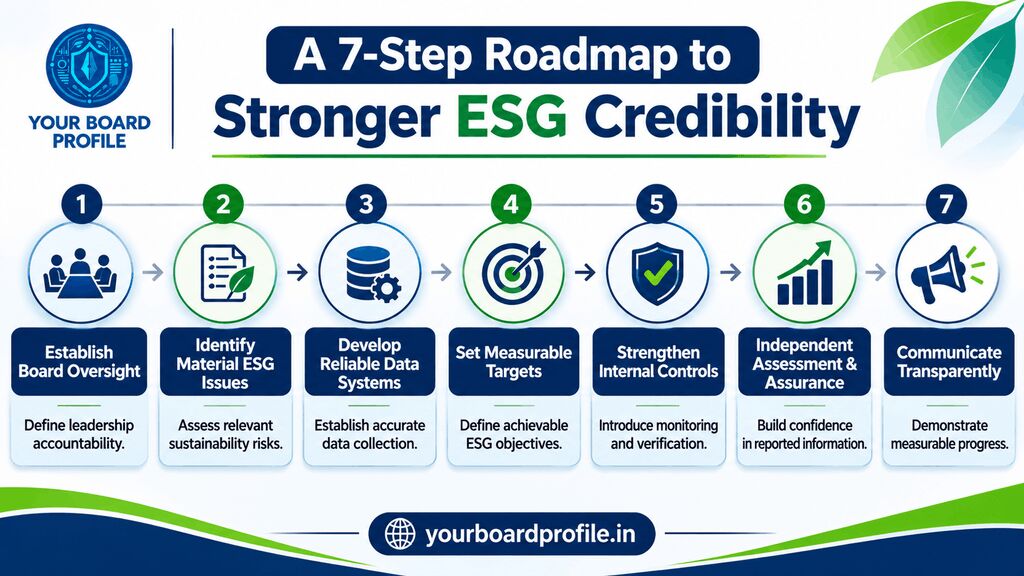
This roadmap should be supported by regular management reviews. Sustainability performance needs to be monitored throughout the year, not assembled hurriedly before annual reporting deadlines.
8. How ESG Expertise Is Becoming Important for Future Board Directors
The growing importance of sustainability reporting is also changing the expectations placed on board directors. Understanding the SEBI BRSR framework can help aspiring independent directors evaluate sustainability disclosures, identify governance gaps and contribute more effectively to boardroom discussions.
Boards increasingly need members who can understand the relationship between business strategy, environmental risks, workforce issues, regulatory developments and stakeholder expectations.
A director does not necessarily need to be a climate scientist or sustainability consultant. However, the ability to ask informed questions about ESG performance is becoming an important element of effective board oversight.
Consider a board evaluating a major expansion project. Financial projections may look attractive, but the decision could also involve water availability, environmental approvals, community impact, energy requirements and supply-chain sustainability.
A director with a broader understanding of ESG governance can help the board examine these issues before committing organisational resources.
For aspiring independent directors and senior executives, developing this knowledge can strengthen their overall boardroom value proposition.
Some important capabilities include:
- Understanding sustainability regulations and corporate governance requirements.
- Interpreting non-financial performance indicators.
- Evaluating climate-related and social risks.
- Asking informed questions about ESG targets and management accountability.
- Understanding sustainability assurance and internal control processes.
- Connecting ESG performance with long-term business strategy.
Professionals preparing for board opportunities should also ensure that their experience is communicated effectively. A well-structured board-ready CV highlighting governance oversight can demonstrate how their strategic, operational and leadership experience contributes to board effectiveness.
Those exploring their first appointment can also read how to secure your first board seat without prior board experience.
Understanding board of directors vacancies and the expectations associated with board appointments can help professionals prepare for changing governance priorities.
The ability to assess ESG disclosures should also form part of broader board due diligence. Our board due diligence checklist provides a useful starting point for understanding the importance of informed board-level evaluation.
At Your Board Profile, professionals can explore board profile development and positioning services and review relevant boardroom branding and professional portfolios to strengthen their readiness for governance-focused opportunities.
For further perspectives on board effectiveness, leadership and governance, explore the Your Board Profile blog.
Conclusion: Making ESG Credibility a Boardroom Commitment
The future of corporate sustainability will not be determined by how many ESG statements an organisation publishes. It will depend on whether those statements reflect measurable progress, responsible leadership and transparent business practices.
The SEBI BRSR framework is not simply changing reporting practices; it is encouraging a deeper shift towards evidence-based sustainability, responsible leadership and long-term corporate value creation.
The SEBI BRSR framework is helping move Indian companies in that direction. By encouraging structured disclosures and greater scrutiny of selected sustainability indicators, it is strengthening the connection between non-financial performance and corporate accountability.
For businesses, this is an opportunity to improve operational efficiency, identify emerging risks, strengthen stakeholder relationships and build long-term trust. For boards, it creates a responsibility to ensure that sustainability considerations are integrated into strategic discussions rather than treated as a separate reporting exercise.
The transition also requires a change in leadership mindset. Directors must be comfortable examining carbon footprint reporting, energy conservation, workforce welfare and governance practices with the same seriousness they bring to financial performance and enterprise risk.
Ultimately, ESG credibility is earned through evidence, not announcements. Companies that build reliable reporting systems, encourage accountability and connect sustainability with business strategy will be better positioned to earn stakeholder confidence.
For aspiring board directors and senior executives, this is an equally important development. Understanding ESG governance, non-financial reporting and sustainability oversight can strengthen their ability to contribute meaningfully to boardroom discussions.
Ready to Strengthen Your Boardroom Readiness and Governance Profile?
The expectations from modern board directors are evolving. Financial expertise and business leadership remain essential, but boards also need professionals who understand sustainability, regulatory developments, risk oversight and responsible corporate leadership.
At Your Board Profile, we help senior executives, CXOs, entrepreneurs and aspiring independent directors articulate their boardroom value proposition through customised Board CVs, LinkedIn profile enhancement, personal branding and board readiness support.
If you want to position your professional experience for emerging boardroom expectations, explore our services or portfolio.
Book a complimentary discussion with Dr. Amit Nagpal:
https://calendly.com/dramitnagpal
Build your credibility. Strengthen your boardroom visibility. Prepare for the next generation of governance leadership.
Frequently Asked Questions (FAQs)
1. What is the SEBI BRSR framework?
SEBI’s Business Responsibility and Sustainability Reporting (BRSR) framework provides a structured approach for organisations to disclose their environmental, social, and governance (ESG) performance. It requires applicable listed companies to disclose information about their environmental, social and governance performance through a structured Business Responsibility and Sustainability Report.
2. What is the main objective of BRSR?
The main objective is to improve transparency and accountability in corporate sustainability reporting. It encourages companies to disclose measurable information about environmental impact, employee welfare, governance practices and responsible business operations.
3. Which organisations must comply with BRSR reporting requirements?
BRSR disclosure is compulsory for India’s top 1,000 listed companies, ranked according to their market capitalisation. The requirement was made mandatory from FY 2022–23.
4. What is BRSR Core?
BRSR Core comprises a specific set of essential sustainability-related indicators extracted from the broader BRSR framework, enabling organisations to report on their key ESG performance metrics. It focuses on key ESG performance indicators across nine attributes and introduces a phased approach to assessment or assurance of these indicators.
5. How does BRSR Core differ from the overall BRSR framework?
BRSR provides a comprehensive overview of a company’s sustainability policies, practices and performance. BRSR Core focuses on selected quantitative indicators that require more structured assessment or assurance.
6. What are the nine attributes of BRSR Core?
The nine attributes cover greenhouse gas footprint, water footprint, energy footprint, embracing circularity, employee well-being, gender diversity, inclusive development, fairness in engaging with customers and suppliers, and openness of business.
7. Is BRSR Core assurance mandatory for listed companies?
SEBI introduced a phased requirement for the top listed entities. Subsequent regulatory changes introduced the option of assessment or assurance. Applicability depends on the relevant financial year and the latest SEBI requirements.
8. What is the role of the board in BRSR compliance?
The board is responsible for ensuring appropriate oversight of sustainability reporting. This includes reviewing ESG performance, monitoring material risks, ensuring accountability and overseeing the reliability of reported information.
9. Why is carbon footprint reporting important under BRSR?
Carbon footprint reporting enables organisations to assess, monitor, and communicate the greenhouse gas emissions generated through their business operations. It supports better climate-risk management, emissions reduction planning and transparency regarding environmental performance.
10. What are workforce welfare metrics in ESG reporting?
Workforce welfare metrics include employee health and safety, gender diversity, employee turnover, remuneration, training, workplace conditions and grievance redressal. These indicators help stakeholders understand how an organisation treats its workforce.
11. How does BRSR improve ESG credibility?
It encourages standardised disclosures, measurable indicators and appropriate independent assessment or assurance. This makes sustainability information more transparent and helps stakeholders evaluate actual corporate performance.
12. What key obstacles do organisations encounter when adopting and implementing BRSR requirements?
Common challenges include fragmented data, inconsistent measurement methodologies, limited ESG expertise, inadequate internal controls, supply-chain information gaps and difficulties in obtaining reliable sustainability information.
13. Are ESG value-chain disclosures mandatory under SEBI’s revised framework?
SEBI’s March 2025 circular made value-chain ESG disclosures voluntary for the top 250 listed entities from FY 2025–26. Associated assessment or assurance is also voluntary under the revised provisions, subject to subsequent regulatory changes.
14. Why should independent directors understand ESG reporting?
Independent directors need to understand ESG reporting because sustainability risks can influence business strategy, financial performance, reputation and regulatory compliance. ESG knowledge helps them ask informed questions and strengthen board-level oversight.
15. How can senior executives prepare for ESG-related board responsibilities?
Senior executives can develop knowledge of sustainability regulations, BRSR requirements, ESG risk management, non-financial reporting and corporate governance. They should also learn to interpret sustainability metrics and demonstrate how their leadership experience contributes to responsible business decisions.