

The boardroom door is notoriously difficult to open. You have spent years scaling organizations, navigating complex market disruptions, and leading high-performing teams. Your operational track record is impeccable. Yet, when you look toward the next logical step in your career, you hit a frustrating, seemingly impenetrable wall: the requirement for prior governance experience.
If you are asking, “How do I get my first board seat with no prior board experience?” you are confronting the most common paradox in executive leadership. It is the classic “chicken-and-egg” dilemma. Nominating committees want directors who already understand fiduciary duties, yet every director had to start somewhere.
Let us be candid: the modern corporate landscape is evolving rapidly. Boards today are grappling with unprecedented complexity, from artificial intelligence integration and geopolitical supply chain fractures to stringent ESG mandates. They no longer exclusively seek retired CEOs with traditional governance pedigrees. Instead, forward-thinking nominating committees actively hunt for diverse, dynamic perspectives.
Your operational expertise is not a liability; it is highly transferable, board-ready capital. Securing your first board seat requires more than an impressive executive career; it requires demonstrating how your professional experience translates into strategic oversight, governance and long-term organisational value.
Table of Contents
Decoding the “Chicken-and-Egg” Cycle of Board Experience
To solve a problem, you must first define it accurately. The hesitation to appoint a first-time director stems from a perceived risk. Traditional governance models prioritize individuals who already understand the delicate balance between strategic oversight and management execution. Gatekeepers worry that an operational leader might micromanage or fail to grasp the legal nuances of fiduciary duty.
However, this perspective is fundamentally shifting. Learning how to break the board experience chicken and egg cycle requires a mental pivot. You must stop viewing your lack of formal governance titles as a deficit. Instead, reframe your operational leadership as a unique asset.
Think of it this way: veteran directors often possess deep governance knowledge but may lack recent, ground-level experience in digital transformation, agile scaling, or modern talent retention. Your goal is not to pretend you have decades of board experience. Your objective is to articulate how your specific operational scars and victories translate directly into effective governance. When you approach the search for a first board seat, shift the narrative from “what I haven’t done” to “the unique, forward-looking value I bring to the table today.”
For professionals pursuing their first board seat, recognising the governance potential within their existing leadership experience is an important starting point.
Strategic Pathways: How to Land Your First Board Position
Breaking into the boardroom requires a deliberate, multi-pronged approach. Relying solely on traditional executive search firms or waiting for an invitation is rarely enough for a first-time director. You must proactively engineer opportunities. A successful first board seat strategy involves exploring different entry points, building governance exposure and developing relationships with people who influence board appointments.
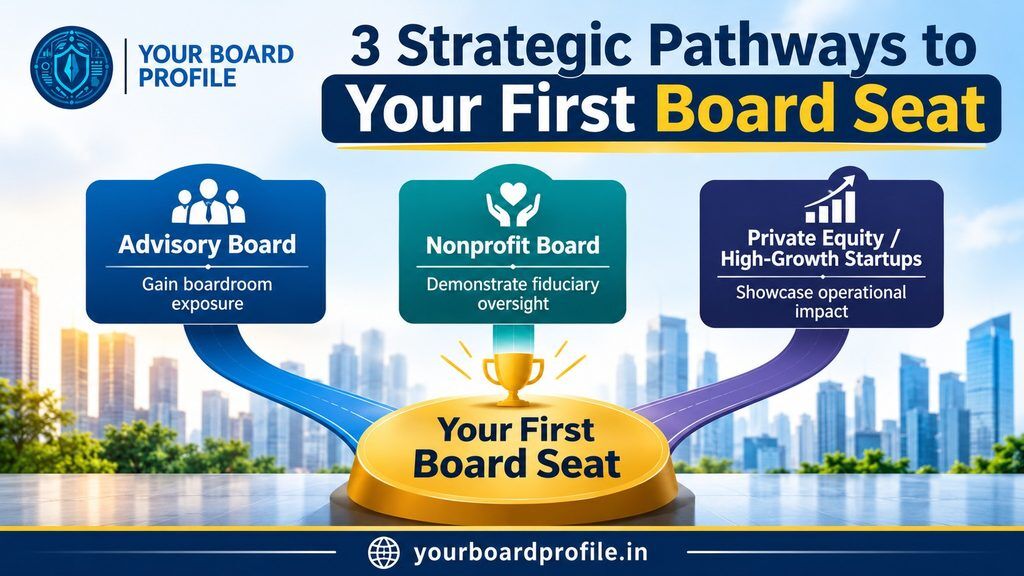
The Advisory Board vs Board of Directors Stepping Stone
One of the most effective, low-risk ways to build governance credibility is by joining an advisory board. Understanding the distinction between an advisory board vs board of directors is critical for your strategy. Unlike a fiduciary board, an advisory board carries no legal liability or voting power. Its sole purpose is to provide strategic, non-binding guidance to the C-suite.
Securing an advisory role allows you to learn boardroom etiquette, observe how seasoned directors interact with management, and build relationships with governance professionals. Many leaders use advisory roles as a strategic stepping stone, proving their value before transitioning to a formal, fiduciary first board seat. For excellent frameworks on how advisory contributions translate to governance readiness, resources from the Deloitte Center for Board Effectiveness offer invaluable insights.
This experience can strengthen your credibility and help position you for your first board seat in a company where your expertise addresses a genuine boardroom requirement.
Joining a Nonprofit Board for Experience
Do not underestimate the transformative power of the nonprofit sector. Joining a nonprofit board for experience is a highly respected and practical pathway. Nonprofit boards frequently face complex challenges related to fundraising, community impact, regulatory compliance, and resource optimization, all of which require sharp strategic minds.
Serving in this capacity demonstrates your commitment to fiduciary oversight and mission-driven leadership. It also expands your network into circles that frequently intersect with corporate governance. As noted by Forbes, nonprofit board service is increasingly viewed by corporate nominating committees as a valid, rigorous testing ground for future corporate directors.
For aspiring directors, nonprofit board experience can become a meaningful stepping stone towards a first board seat in the corporate sector.
Targeting Private Equity and High-Growth Startups
Large public corporations often have rigid, traditional director selection criteria. In contrast, private equity-backed firms, family-owned businesses, and high-growth startups are highly agile in their director selection. They frequently seek directors with specific operational expertise—such as international market expansion, supply chain resilience, or SaaS monetization—rather than a pristine, decades-long governance resume.
Targeting these organizations can significantly accelerate your first time board member path. These dynamic environments value immediate, actionable impact over traditional governance pedigrees, making them ideal proving grounds for getting a board seat with no prior experience. These organisations may provide a practical route towards a first board seat, particularly for executives whose specialised expertise can address immediate business and strategic challenges.
Crafting Your Board-Ready Profile
Your executive resume is not your board resume. A board-ready profile speaks the language of governance, focusing on oversight, strategy, and risk, rather than day-to-day operational execution. When preparing for your first board seat, your profile should communicate not only what you have achieved as an executive but also how your judgement and experience can contribute to board-level decisions.
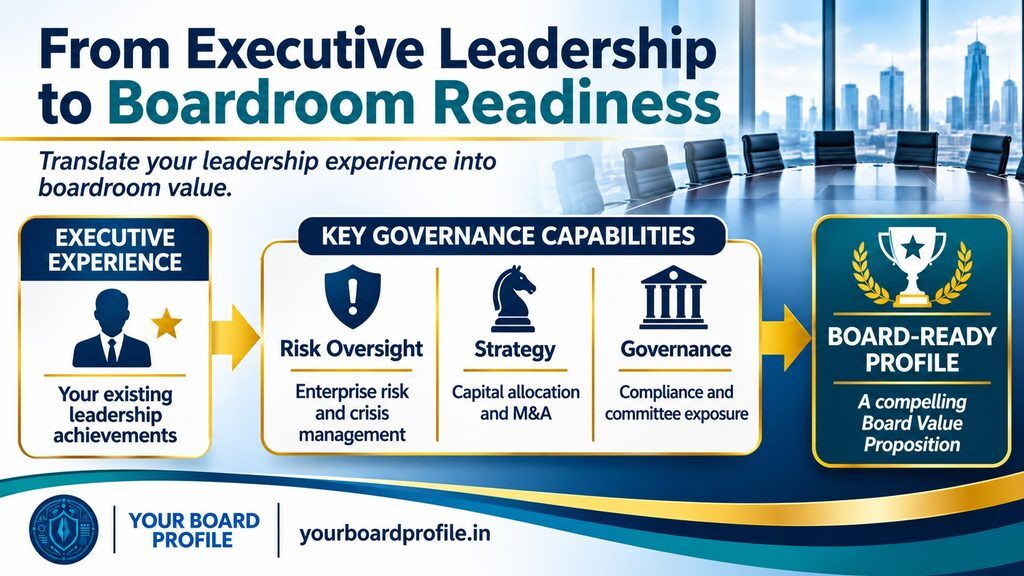
How to Write a Board Ready Resume
Learning how to write a board ready resume requires a fundamental shift in perspective. You must move from “I managed a team of 500 and increased sales by 20%” to “I oversaw enterprise risk, guided long-term strategic capital allocation, and ensured regulatory compliance during a major market expansion.”
Highlight your experience with:
- Direct interactions with audit, compensation, or governance committees.
- Crisis management, business continuity planning, and turnaround strategies.
- Mergers, acquisitions, or major corporate restructuring.
Keep the document to two pages maximum. Include a “Board Value Proposition” section at the very top, summarizing the specific governance gaps you fill. If you need professional assistance in refining this critical document, you can explore our specialized board readiness services to ensure your profile resonates powerfully with nominating committees.
Board Biography Example for First Time Directors
A board biography is a concise, third-person narrative (typically 150–250 words) used in board materials, proxy statements, and company websites. It must project authority and governance alignment. Here is a structural board biography example for first time directors:
“Priya Sharma is a strategic technology executive with over 15 years of experience scaling enterprise SaaS platforms and driving digital transformation. Currently serving as Chief Technology Officer at Nexora Technologies Pvt. Ltd., Bengaluru, she has successfully guided the company through a ₹1,600 crore Series C funding round and expanded operations into three new international markets. Priya brings deep, actionable expertise in cyber risk oversight, enterprise data governance, and agile product development. She holds an MBA from IIM Ahmedabad and is an active member of the Institute of Directors (IoD) India. Priya is passionate about leveraging technology to drive sustainable, long-term shareholder value while maintaining robust compliance frameworks.”
Notice how this example emphasizes strategic oversight, specific domain expertise, and governance alignment, rather than daily managerial tasks.
How to Position Yourself for a Board Seat
Positioning is about deliberate visibility and targeted networking. You must be seen as a thought leader in your specific domain. Publish authoritative articles, speak at industry conferences, and engage meaningfully with governance-focused content on LinkedIn. When you clearly articulate your independent director board value proposition, headhunters and board chairs will begin to recognize your name precisely when a specific skill gap arises on their roster. Just as a designer has a portfolio, a modern director should have a professional summary of their governance capabilities. Consider building a compelling board portfolio to tangibly demonstrate your strategic impact to potential nominating committees.
Building a credible professional reputation before pursuing your first board seat can improve your visibility among board chairs, investors and executive search professionals.
Navigating Modern Boardroom Expectations (2026 and Beyond)
Boards are not looking for generic leaders; they are looking for specific solutions to emerging, existential threats. Understanding the current macro-environment is crucial to positioning yourself as an indispensable candidate for a first board seat.
The Imperative of Cyber Security and Risk Oversight
Cyber risk is no longer just an IT issue; it is a top-tier boardroom concern. Directors are expected to understand the basics of cyber resilience, data privacy regulations, and incident response protocols. Demonstrating literacy in cyber security board governance instantly elevates your profile, as this remains a critical, widespread skill gap on many traditional boards.
CEO Succession and Strategic Risk Planning
Similarly, boards are intensely focused on long-term organizational viability. This includes implementing robust modern board risk oversight frameworks that anticipate market disruptions before they occur. Furthermore, understanding CEO succession planning and NRC agendas is vital. If you have experience mentoring C-suite talent, building leadership pipelines, or participating in executive transitions, highlight this prominently. It signals to the board that you understand one of their most fundamental, high-stakes responsibilities.
For ongoing education and to stay ahead of these macro trends, regularly reviewing the latest governance insights on our blog can keep your boardroom knowledge sharp, relevant, and highly competitive.
Comparative Analysis: Advisory Board vs Board of Directors
To help you decide where to focus your initial efforts, review this detailed comparison of governance structures. Understanding this distinction is vital when figuring out how to join a board of directors effectively.
| Feature | Advisory Board | Governing Board of Directors |
| Fiduciary Duty | None. Provides non-binding, strategic advice only. | High. Legally bound to act in the company’s best interest (Duty of Care, Duty of Loyalty). |
| Legal Liability | Minimal to none. Protected from corporate liabilities. | Significant. Subject to regulatory, shareholder, and legal scrutiny. |
| Voting Power | None. Cannot vote on corporate actions or executive compensation. | Yes. Votes on major corporate actions, audits, and CEO appointments. |
| Ideal For | First-time directors building governance credibility, networks, and boardroom fluency. | Experienced directors ready for formal oversight, legal accountability, and strategic voting. |
| Compensation | Often unpaid, or modest stipends, equity grants, or expense coverage. | Typically includes substantial cash retainers, meeting fees, and equity grants. |
Source: Adapted from McKinsey & Company insights on corporate governance and the PwC Annual Corporate Directors Survey.
Conclusion and Strategic Next Steps
The journey to your first board seat does not require you to magically manufacture years of fictional governance experience. It requires a strategic reframing of your existing executive achievements, a deliberate approach to networking, and a willingness to start with advisory or nonprofit roles to build undeniable credibility.
The “chicken-and-egg” cycle is broken not by waiting for permission, but by proactively demonstrating the unique, forward-looking value you bring to a modern boardroom. Whether your expertise lies in digital transformation, financial restructuring, or global market expansion, there is a board that desperately needs your specific perspective.
Ready to accelerate your board journey? Do not leave your board readiness to chance or generic advice. Partner with experts who understand the nuanced realities of board placement. Explore our specialized board readiness services today, and let us help you craft a compelling, undeniable narrative that turns your executive experience into your first board seat.
Frequently Asked Questions (FAQs)
1. How do I get my first board seat with no prior board experience?
Focus on reframing your executive experience as board-ready capital. Start by joining advisory boards or nonprofit boards to build governance credibility, network actively with specialized search firms, and tailor your resume to highlight strategic oversight rather than daily operational management.
2. What is the fastest way to land your first board position?
Leveraging your existing professional network is the fastest route. Inform your current CEO, investors, legal advisors, and auditors of your aspirations. Additionally, targeting private equity-backed firms or high-growth startups can accelerate the process, as they often prioritize specific operational expertise over traditional governance pedigrees.
3. Is joining a nonprofit board for experience really valued by corporate boards?
Yes, absolutely. Corporate nominating committees increasingly view nonprofit board service as a rigorous, legitimate testing ground. It demonstrates your commitment to fiduciary oversight, mission-driven leadership, and complex stakeholder management without the immediate, intense pressure of a public company environment.
4. What is the core difference between an advisory board vs board of directors?
An advisory board provides non-binding strategic advice and carries no legal fiduciary duty or liability. A governing board of directors has legal accountability, voting power on major corporate actions, and a strict fiduciary duty to act in the shareholders’ best interests.
5. How do I write a board ready resume?
Shift the focus entirely from operational management to strategic oversight. Highlight your experience with enterprise risk mitigation, capital allocation, M&A integrations, and interactions with existing board committees. Keep it to two pages maximum and lead with a clear, impactful “Board Value Proposition.”
6. Can you provide a board biography example for first time directors?
Certainly. A strong example reads in the third person, is under 250 words, and emphasizes strategic impact. For instance: “Priya Sharma is a strategic technology executive with 15 years of experience scaling SaaS enterprises. She brings deep expertise in cyber risk oversight and enterprise growth, holding an MBA from IIM Ahmedabad and actively contributing to Institute of Directors (IoD) India governance initiatives.”
7. How do I break the board experience chicken and egg cycle?
Break the cycle by substituting formal board titles with adjacent governance experiences. Serve on nonprofit boards, industry advisory councils, or steering committees. Document these experiences to prove your practical understanding of board dynamics and fiduciary responsibilities.
8. What skills are most in demand for a first time board member path?
Currently, boards highly seek expertise in cybersecurity, artificial intelligence/digital transformation, ESG (Environmental, Social, and Governance) strategy, international market expansion, and CEO succession planning.
9. How do I position myself for a board seat?
Position yourself by becoming a visible, credible thought leader. Publish authoritative articles on governance trends, speak at industry conferences, and clearly articulate your specific value proposition on professional networks like LinkedIn.
10. Should I get certified before seeking my first board seat?
While not strictly mandatory, certifications from recognized bodies like the NACD (National Association of Corporate Directors) or attending prestigious programs like the Stanford Directors College significantly enhance your credibility and demonstrate a serious, tangible commitment to governance.
11. How long does it typically take to get a first board seat?
The timeline varies based on proactivity, but a strategic, well-executed approach typically yields results within 12 to 24 months. This includes time spent building your board resume, networking, and potentially serving in an advisory capacity first.
12. Do I need to be a current C-suite executive to get a board seat?
No. While C-suite experience is common, senior vice presidents, successful founders, and specialized subject-matter experts (like Chief Information Security Officers or Chief Risk Officers) are increasingly sought after for their specific, high-value domain knowledge.
13. What is the role of executive search firms in board placements?
Specialized board search firms (e.g., Spencer Stuart, Korn Ferry, Heidrick & Struggles) act as gatekeepers for many corporate board roles. Building relationships with their partners and ensuring your profile is prominently featured in their database is a critical step in your search strategy.
14. How can I demonstrate my understanding of modern board risk oversight?
Highlight specific, quantifiable instances in your career where you identified, mitigated, or managed enterprise-level risks. Familiarize yourself with current governance frameworks and consider taking targeted courses on topics like cyber security board governance.
15. Is it possible to get a first board seat in a public company without prior experience?
It is challenging but entirely possible, particularly if you possess a highly specialized, rare skill set that the current board lacks (e.g., deep AI expertise or specific regulatory knowledge in a heavily regulated industry). However, starting with private or nonprofit boards is generally the more realistic and highly recommended path.
Turn Your Executive Experience into Your First Board Seat with Your Board Profile
Your years of leadership, strategic decision-making, and business experience may already hold the qualities that boards seek in a director. The challenge is demonstrating how your professional achievements translate into effective boardroom contribution, even if you have never held a formal board position.
At Your Board Profile, we help senior executives, CXOs, entrepreneurs, and aspiring Independent Directors build a credible pathway to board opportunities through customised board CVs, LinkedIn profile enhancement, board readiness assessments, and personalised coaching and mentoring.
Whether you are preparing for your first board appointment, exploring advisory board opportunities, or strengthening your understanding of governance and fiduciary responsibilities, a structured approach can help you identify your boardroom strengths, articulate your unique value proposition, and improve your visibility among relevant decision-makers.
Ready to take your first step towards a board seat?
Book a complimentary discussion with Dr. Amit Nagpal to explore how your executive experience can be positioned for boardroom opportunities and how you can build a compelling profile for your first board appointment.
Schedule a Complimentary Session with Dr. Amit Nagpal
Your leadership experience is your foundation. Your governance understanding builds readiness. Your board value proposition opens the door to your first boardroom opportunity.