
A successful executive career can open many doors, but entering the boardroom requires a different kind of preparation. Senior executives, CXOs, entrepreneurs, and experienced professionals often assume that decades of leadership experience will naturally translate into board opportunities. Yet the journey to becoming an Independent Director involves more than professional seniority, impressive qualifications, or a distinguished corporate title. It requires a clear understanding of what boards need, how your experience supports effective governance, and why your contribution would matter to a particular organisation.
Consider two senior executives with similar professional backgrounds. Both have managed large businesses, led transformation initiatives, and worked with complex stakeholder groups. The first introduces himself by highlighting his career achievements, revenue responsibilities, and leadership positions. The second explains how his experience in capital allocation, enterprise risk, and business transformation can help a board evaluate strategic decisions, challenge management assumptions, and protect long-term shareholder value. Although both may be equally accomplished, the second professional communicates a much clearer board value proposition.
This difference lies at the heart of strategic positioning for board roles. Boards are not simply looking for another successful executive. They are seeking individuals whose experience, judgement, independence, and expertise can strengthen collective decision-making. A compelling board value proposition helps the Nomination and Remuneration Committee (NRC), chairperson, and board search professionals understand the specific contribution a candidate can make.
For aspiring directors in India, this positioning becomes particularly important because board appointments involve both regulatory eligibility and an assessment of professional suitability. The Indian Institute of Corporate Affairs (IICA) maintains the Independent Directors Databank, while the Securities and Exchange Board of India (SEBI) provides governance requirements for applicable listed entities. These frameworks establish important expectations, but regulatory readiness alone does not communicate a candidate’s distinctive value.
The central question is therefore not simply, “How do I become an Independent Director?” It is, “What distinctive value can I bring to a board, and how can I demonstrate that value credibly?”
Table of Contents
What Is a Board Value Proposition for an Independent Director?
A board value proposition is a clear explanation of the knowledge, experience, judgement, and perspectives that a professional can contribute to a company’s board of directors. It connects an individual’s career achievements with the strategic, governance, and oversight requirements of a board. Rather than presenting a general professional biography, it answers a more specific question: why should this particular board consider this particular candidate?
For example, a Chief Financial Officer may have extensive experience managing financial operations, raising capital, and overseeing corporate reporting. These accomplishments establish executive credibility, but they become more meaningful in a board context when linked to financial oversight, capital allocation, acquisition evaluation, and risk management. The professional is no longer presenting financial leadership merely as an achievement. Instead, the candidate is demonstrating how that experience could strengthen the board’s ability to evaluate financial decisions and challenge assumptions.
A strong value proposition also recognises that boards operate collectively. An individual director does not independently determine corporate strategy or manage daily operations. The director contributes to discussions, evaluates management proposals, exercises independent judgement, and supports responsible governance. The most compelling candidates understand this distinction and position their expertise as a contribution to the board’s overall effectiveness.
The value proposition should therefore be specific, evidence-based, and relevant to the organisations being targeted. Broad statements such as “experienced business leader” or “strategic thinker” offer limited differentiation. A more convincing proposition might explain how experience in digital transformation, regulatory compliance, or international expansion equips a candidate to contribute to particular governance challenges.
Why Professional Experience Alone Is Not Enough
Professional experience is essential, but it does not automatically establish board readiness. A senior executive may have spent 25 years managing business operations without developing sufficient familiarity with director duties, governance frameworks, or the responsibilities of board committees. Similarly, an individual may possess exceptional industry knowledge but struggle to demonstrate independent judgement or the ability to challenge management constructively. These gaps matter because board responsibilities differ fundamentally from executive responsibilities.
The distinction becomes clearer when we examine how boards assess candidates. Under the applicable SEBI governance framework, the NRC evaluates the balance of skills, knowledge, and experience on the board and identifies the capabilities required for an independent director appointment. This creates a practical reason for candidates to explain their relevance to specific board needs rather than relying on their professional standing alone.
Imagine a technology executive who has successfully led several enterprise-wide digital initiatives. Her operational experience may be impressive, but a board considering her appointment may be more interested in whether she can evaluate technology investment risks, question cybersecurity assumptions, and assess the governance implications of artificial intelligence. These capabilities translate executive experience into board-level relevance.
The challenge for aspiring directors is therefore to move beyond describing what they have accomplished and demonstrate how those accomplishments have developed their judgement. This is also why governance signalling and professional credibility are important. Credible evidence of independent thinking, responsible decision-making, and effective oversight can communicate much more than a lengthy list of achievements.
The Three Pillars of a Distinctive Board Value Proposition
A compelling Independent Director value proposition can be built around three interconnected pillars: governance competence, strategic relevance, and credible differentiation. Together, they explain whether a professional understands board responsibilities, possesses capabilities relevant to a company’s challenges, and offers something distinctive compared with other qualified candidates.
Governance competence refers to an understanding of director responsibilities, ethical conduct, accountability, risk oversight, and the relationship between the board and management. It involves recognising the boundaries of board authority and knowing how to ask questions that improve decision-making without interfering unnecessarily in operational matters.
Strategic relevance concerns the connection between a candidate’s expertise and the company’s present or emerging priorities. A professional with experience in global supply chains may be particularly relevant to a manufacturing company facing geopolitical disruption. A cybersecurity leader may offer important perspectives to a financial institution dealing with technology concentration and digital risk.
Credible differentiation comes from evidence of judgement, professional conduct, and meaningful contribution. It is not enough to claim expertise in strategy or governance. Candidates should be able to describe situations where they evaluated competing priorities, questioned assumptions, managed uncertainty, or influenced important decisions.
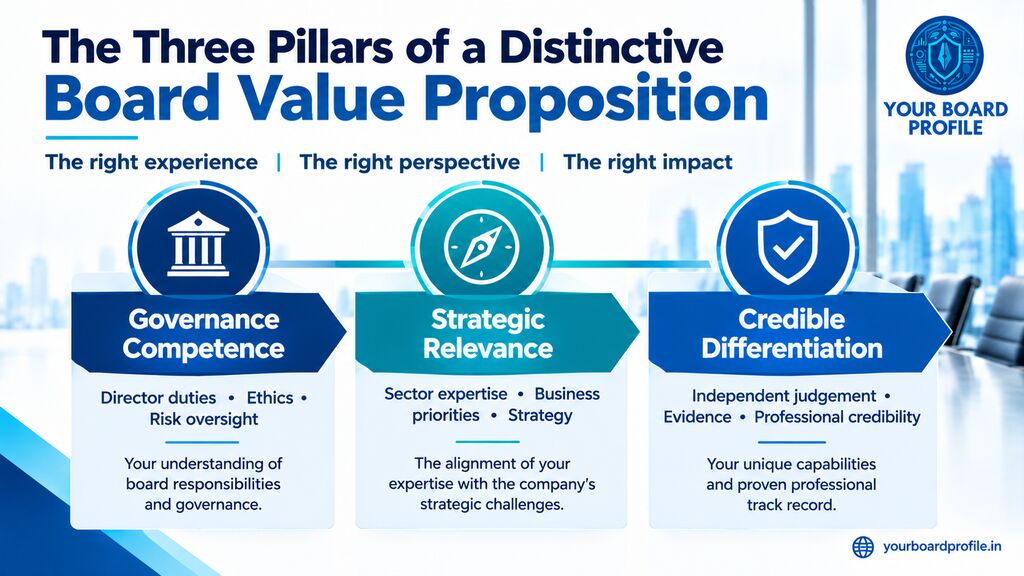
| Pillar | What it demonstrates | Evidence candidates can present |
| Governance competence | Understanding of board duties and oversight | Governance education, committee exposure, ethical decisions |
| Strategic relevance | Alignment with business priorities | Sector experience, transformation leadership, risk expertise |
| Credible differentiation | Distinctive judgement and contribution | Verified achievements, decision examples, professional reputation |
These pillars should reinforce one another. Governance knowledge without relevant expertise may limit a candidate’s contribution, while technical expertise without sound judgement may weaken board effectiveness. A well-developed proposition combines both with credible professional evidence.
Strategic Positioning for Board Roles
Strategic positioning for board roles involves identifying the types of organisations where your expertise is most relevant and communicating your contribution in terms that board decision-makers understand. It is not about presenting yourself as suitable for every board. It is about establishing a clear connection between your professional capabilities and the governance needs of specific companies.
This distinction matters because boards face different challenges depending on their sector, ownership structure, growth stage, and strategic priorities. A rapidly expanding technology company may need deeper expertise in cybersecurity, digital business models, and regulatory developments. A manufacturing company entering new international markets may benefit from directors experienced in geopolitical risk, supply-chain resilience, and capital investment. A financial services organisation may place particular emphasis on risk governance, regulatory understanding, and financial oversight.
Effective positioning begins with research. Aspiring directors should study company annual reports, corporate governance disclosures, strategic announcements, and board composition. These sources provide useful information about business priorities, existing director capabilities, committee structures, and potential areas where additional expertise may strengthen oversight.
A candidate who understands these factors can move from generic networking to more meaningful conversations about board contribution. Instead of saying, “I am looking for an independent directorship,” the professional can explain the governance challenges where their experience may be particularly useful.
Understanding What Boards Actually Need
Boards need a combination of capabilities rather than a collection of impressive individual profiles. Their effectiveness depends on whether directors collectively possess the knowledge, judgement, diversity of perspectives, and experience necessary to oversee the organisation. This means a highly qualified candidate may still be unsuitable for a particular vacancy if their expertise duplicates existing capabilities or does not address the company’s current priorities.
For an aspiring Independent Director, understanding board requirements starts with examining the organisation’s business model and risk environment. What strategic decisions is the company likely to face over the next three to five years? Is it entering new markets, making acquisitions, adopting artificial intelligence, or managing regulatory complexity? Does its existing board have sufficient expertise to evaluate these developments independently?
Candidates should also examine board composition and committee responsibilities. Publicly available governance disclosures can provide insights into director backgrounds, committee memberships, and skills identified by the company. This research helps professionals assess whether their experience offers a meaningful addition to the board rather than simply another senior management perspective.
The SEBI Listing Obligations and Disclosure Requirements Regulations provide an important regulatory reference for governance expectations applicable to listed entities. Understanding these requirements can help candidates interpret how boards are structured and evaluated.
A useful positioning exercise is to identify three categories of companies where your capabilities could be particularly relevant. These might include organisations within your primary industry, companies facing strategic challenges you have previously managed, and businesses entering areas where you possess specialised knowledge. This approach creates a more focused board-career strategy.
Moving from Executive Achievements to Board-Level Contribution
One of the most important aspects of strategic positioning for board roles is translating executive achievements into evidence of board-level contribution. Senior professionals often describe their careers through operational metrics such as revenue growth, cost reduction, market expansion, team size, or project delivery. These achievements demonstrate leadership effectiveness, but boards need to understand the judgement and oversight capabilities developed through those experiences.
Consider a hypothetical Chief Operating Officer who successfully managed a large manufacturing network. An executive-focused profile might emphasise production improvements, operational efficiency, and cost savings. A board-focused profile would explain how the executive evaluated operational concentration risks, assessed major capital investments, strengthened business continuity, and balanced efficiency with long-term resilience. The underlying experience remains the same, but the narrative changes to reflect board responsibilities.
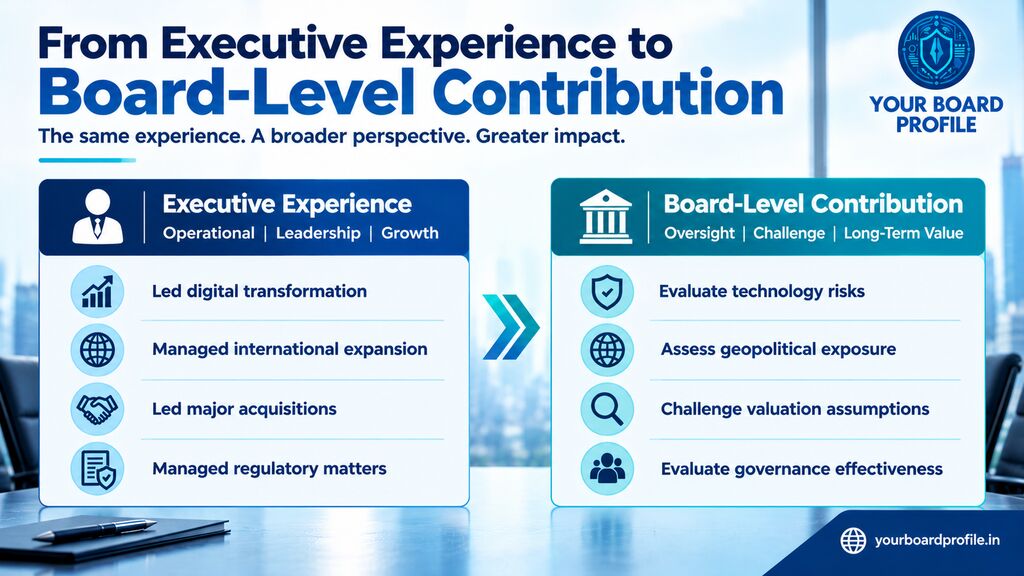
| Executive achievement | Board-level interpretation |
| Led a ₹3,000 crore business division | Experience evaluating scale, financial performance, and strategic trade-offs |
| Implemented enterprise-wide AI systems | Ability to assess AI investment, accountability, and technology risk |
| Managed international expansion | Understanding of geopolitical exposure and market-entry risks |
| Led major acquisitions | Experience in due diligence, valuation assumptions, and integration risk |
| Improved organisational culture | Perspective on leadership accountability, succession, and conduct risk |
| Managed complex regulatory matters | Ability to question compliance systems and governance effectiveness |
This translation should not exaggerate a candidate’s authority or imply previous board experience where none exists. The purpose is to show how executive decisions have developed capabilities relevant to governance. A strong candidate can explain not only what happened, but also what was questioned, which risks were considered, and how competing stakeholder interests were balanced.
Professionals seeking a deeper understanding of this transition can explore boardroom branding for aspiring independent directors, which connects professional positioning with board-level credibility.
Building an Independent Director Skill Matrix
An independent director skill matrix is a structured assessment of the capabilities that a candidate can contribute to a board. It helps professionals move beyond broad descriptions of expertise and identify specific areas where their knowledge, experience, and judgement can support governance. For an aspiring director, the matrix also provides a practical way to evaluate readiness, identify development priorities, and determine which board opportunities are most relevant.
The first step is to assess existing capabilities across areas such as financial literacy, strategy, risk management, digital transformation, regulatory understanding, stakeholder management, and organisational leadership. Each capability should be supported by evidence rather than self-assessment alone. For example, someone claiming expertise in enterprise risk should be able to explain how they identified material risks, evaluated possible consequences, and influenced decisions involving uncertainty.
The second step is to consider how these capabilities relate to the requirements of target companies. An experienced banking professional may have strong financial and regulatory expertise but limited exposure to manufacturing operations. Similarly, a technology leader may understand digital transformation exceptionally well but need additional preparation in financial reporting and audit oversight.
An effective matrix makes these strengths and limitations visible, allowing candidates to pursue opportunities where they can make a meaningful contribution while strengthening areas that require further development.
| Board capability | Evidence of expertise | Potential board contribution |
| Financial oversight | CFO experience, financial reporting, capital allocation | Evaluate financial performance and investment assumptions |
| Enterprise risk management | Risk leadership, crisis management, internal controls | Challenge risk assessments and resilience strategies |
| Digital transformation | AI adoption, cybersecurity, technology investment | Assess digital opportunities and technology-related risks |
| Corporate strategy | Business expansion, mergers, acquisitions | Evaluate long-term strategic choices |
| People and culture | CHRO experience, succession planning | Support leadership accountability and talent oversight |
| ESG and sustainability | Sustainability programmes, environmental risk | Assess material sustainability risks and opportunities |
| Regulatory governance | Compliance leadership, regulatory engagement | Evaluate governance and compliance frameworks |
Identifying Board Skills Gaps and Sector Relevance
A board skills gap represents a capability that a board needs but may not sufficiently possess within its existing composition. These gaps can arise from changes in business strategy, technological disruption, regulatory expectations, leadership transitions, or emerging risks. Identifying them is important because director appointments are increasingly considered in relation to collective board effectiveness rather than individual professional reputation alone.
Sector relevance is equally important. An executive who understands the commercial realities, competitive pressures, and regulatory environment of an industry can often contribute valuable context to board discussions. However, sector expertise should not be confused with familiarity alone. Boards benefit when directors combine industry knowledge with the ability to challenge established assumptions and consider developments outside the organisation.
For example, a pharmaceutical company entering international markets may benefit from expertise in regulatory affairs, cross-border operations, and intellectual property risk. A retail organisation undergoing digital transformation may require stronger capabilities in customer data governance, cybersecurity, and platform economics. In both cases, the candidate’s relevance depends on whether their experience addresses identifiable strategic challenges.
The G20/OECD Principles of Corporate Governance emphasise the board’s responsibility for strategic guidance, management oversight, and independent judgement. These responsibilities provide a useful framework for evaluating whether professional expertise can translate into meaningful board contribution.
An aspiring director should therefore review the strategic priorities of target organisations and identify where their capabilities may complement existing directors. This exercise can produce a focused shortlist of companies rather than an unfocused search for appointments.
Board Committee Fit and Strategic Contribution
Board committee fit is an important consideration when developing an Independent Director value proposition. Board committees support the board by examining particular governance matters in greater depth. Depending on the company’s legal requirements, size, and risk profile, these may include audit, nomination and remuneration, risk management, stakeholder relationships, and corporate social responsibility.
For candidates, committee relevance can provide a clearer explanation of their potential contribution. A financial professional may bring useful perspectives to an Audit Committee, while a human resources leader may offer experience relevant to succession planning and executive remuneration. A professional with deep cybersecurity experience may contribute to risk oversight discussions, even where the organisation does not have a dedicated technology committee.
However, professional background alone does not establish committee eligibility or suitability. Committee composition requirements, independence criteria, relevant expertise, and company-specific governance arrangements must also be considered.
Audit and Risk Committee Fit
Audit and Risk Committee fit is particularly relevant for professionals with experience in financial reporting, internal controls, enterprise risk management, regulatory compliance, cybersecurity, and business resilience. These areas involve evaluating whether management has identified significant risks, established appropriate controls, and provided reliable information to decision-makers.
An aspiring Independent Director with financial expertise should be able to demonstrate more than familiarity with accounting statements. Boards need individuals who can question financial assumptions, understand the implications of complex transactions, and evaluate whether reporting and assurance processes are sufficiently robust. Similarly, risk professionals should be able to connect emerging threats with strategic objectives, capital allocation, and organisational resilience.
The OECD guidance on board responsibilities recognises the importance of risk oversight, financial reporting integrity, and effective internal controls. These principles reinforce the need for directors who can exercise informed judgement rather than simply accept management assurances.
For example, consider a hypothetical former Chief Risk Officer from a financial institution. Rather than positioning herself solely as a risk management expert, she could explain how her experience in stress testing, operational resilience, and regulatory engagement helps her evaluate whether management’s risk assumptions remain appropriate under changing conditions.
Nomination and Remuneration Committee (NRC) Fit
The Nomination and Remuneration Committee (NRC) plays an important role in board composition, leadership appointments, remuneration policies, and related governance matters. For aspiring directors, understanding the NRC is essential because it is often central to assessing the skills and experience required for board appointments.
Professionals with experience in leadership development, executive succession, organisational culture, compensation design, and governance may possess capabilities relevant to NRC responsibilities. Yet committee contribution requires more than human resources expertise. Directors must consider how leadership decisions, incentives, and succession arrangements support long-term organisational performance and stakeholder interests.
An experienced CHRO, for example, may have designed executive compensation programmes and succession frameworks across multiple organisations. A board-oriented value proposition would explain how this experience supports the evaluation of leadership continuity, remuneration alignment, executive accountability, and organisational culture.
The NRC’s role in assessing board composition also reinforces why candidates should clearly communicate their distinctive board value. Under SEBI’s governance framework, the committee’s assessment of required capabilities helps connect appointments with board needs.
A candidate who can demonstrate relevant expertise, sound judgement, and an understanding of governance responsibilities is better positioned for meaningful consideration than one relying primarily on seniority.
Executive to Board Mindset Transition
The executive to board mindset transition is one of the most significant changes an aspiring director must make. Executive leadership is largely concerned with delivering results through people, resources, systems, and operational decisions. Board leadership, by contrast, focuses on governance, strategic guidance, oversight, accountability, and independent judgement.
A CEO may be accustomed to making decisions, allocating resources, and directing management teams. As an Independent Director, the same individual must learn to influence outcomes through questions, discussion, constructive challenge, and collective decision-making. This transition requires a different approach to authority.
The board’s role is not to replace management but to evaluate whether management’s decisions are appropriately informed, aligned with strategy, and supported by effective risk controls. A director who repeatedly intervenes in operational details may weaken the distinction between governance and management. Equally, a director who avoids difficult questions may fail to provide effective oversight.
| Executive mindset | Board mindset |
| Deliver operational results | Evaluate strategy and organisational performance |
| Direct teams and resources | Challenge and guide management |
| Make operational decisions | Exercise independent judgement collectively |
| Focus on execution | Focus on oversight and accountability |
| Manage immediate business priorities | Balance short-term performance and long-term value |
| Own business outcomes | Contribute to collective governance responsibility |
This transition also requires stronger listening skills, intellectual independence, and the confidence to disagree respectfully. A director must be willing to challenge assumptions without turning every disagreement into a confrontation. The quality of questions often matters as much as the depth of expertise.
The IICA’s board governance learning programmes include topics such as director duties, board effectiveness, governance of strategy, and due diligence before joining a board. Such learning can support professionals preparing for the responsibilities of independent directorship.
Communicating Your Distinctive Board Value
Developing a compelling value proposition is only part of the journey. Aspiring directors must also communicate their expertise in a manner that is credible, relevant, and easy for board decision-makers to understand. This involves aligning the board CV, LinkedIn profile, professional biography, thought leadership, and networking conversations around a consistent board-level narrative.
A professional profile should explain the candidate’s areas of expertise, relevant governance capabilities, sector experience, and examples of judgement. It should avoid generic claims that cannot be substantiated. Statements such as “visionary leader” or “highly accomplished strategist” communicate little unless supported by specific evidence.
Consider the difference between two introductions. One candidate describes himself as a senior executive with 30 years of experience in multiple industries. Another explains that his career has focused on evaluating large capital investments, managing international business risks, and supporting strategic transformation, capabilities that may be relevant to boards navigating expansion and uncertainty.
The second introduction is more useful because it connects experience with potential board contribution.
Professionals can strengthen this positioning through strategic networking for independent director opportunities. Meaningful relationships with experienced directors, governance professionals, and board search advisers can provide insights into the expectations of boards and the capabilities organisations are seeking.
Building a Credible Board CV and Professional Brand
A board CV should differ from a conventional executive résumé. While an executive résumé typically focuses on career progression, responsibilities, and operational achievements, a board CV should emphasise governance relevance, strategic judgement, committee capabilities, and sector expertise.
The opening section should communicate a concise board value proposition. This can be followed by areas of expertise, relevant leadership experience, examples of strategic contribution, governance education, and other information that supports board suitability. Every significant claim should be accurate and capable of verification.
For example, a candidate might use the following positioning statement:
Senior financial executive with extensive experience in capital allocation, enterprise risk, corporate transformation, and international business operations. Brings perspectives relevant to board oversight of financial strategy, investment decisions, and organisational resilience.
This statement is more effective than a long list of corporate titles because it immediately explains the candidate’s potential contribution.
Professional branding should reinforce the same message across platforms. A LinkedIn profile that emphasises board-relevant expertise, thoughtful professional commentary, and credible achievements can support visibility among relevant stakeholders. However, visibility must be accompanied by substance. Publishing governance-related content does not automatically establish governance competence.
Candidates can review examples of professional positioning through the Your Board Profile portfolio and explore available boardroom branding and profile development services.
A Practical Roadmap to Becoming an Independent Director
A successful transition into the boardroom requires a combination of regulatory readiness, strategic positioning, professional development, and relationship building. While there is no single route to appointment, a structured approach can help aspiring directors prepare more effectively and focus their efforts.
Step 1: Assess regulatory eligibility and governance readiness. Begin by understanding the applicable provisions of the Companies Act, 2013, the independent director eligibility criteria, and relevant SEBI requirements. Review the Independent Directors Databank registration requirements and determine whether the online proficiency self-assessment applies to your circumstances. The IICA proficiency assessment guidance provides information about the assessment process. For additional preparation, refer to this guide to the IICA proficiency test.
Step 2: Identify your strongest board capabilities. Review your professional experience and select three to five areas where you can demonstrate meaningful expertise. These might include strategy, finance, risk management, technology, human capital, or sector-specific knowledge. Focus on capabilities supported by actual decisions and outcomes rather than broad professional descriptions.
Step 3: Define your target board segments. Identify industries and types of organisations where your experience is most relevant. Consider business models, governance requirements, ownership structures, and strategic priorities. A focused approach allows you to develop more credible positioning and pursue opportunities that align with your capabilities.
Step 4: Develop your board value proposition. Create a concise statement explaining the governance challenges you understand, the capabilities you offer, and the evidence supporting your expertise. Your proposition should answer why a board might benefit from your contribution without suggesting that an appointment is guaranteed.
Step 5: Strengthen your governance knowledge. Continue learning about director duties, financial oversight, board committees, risk governance, and emerging business challenges. Professional development should be ongoing because governance expectations and business risks evolve.
Step 6: Build a board-focused professional identity. Update your board CV, LinkedIn profile, and professional biography. Ensure they communicate a consistent narrative supported by credible evidence. Relevant thought leadership and participation in governance discussions can help demonstrate continued engagement with board-level issues.
Step 7: Develop meaningful professional relationships. Engage with experienced directors, governance advisers, board search professionals, and relevant industry networks. Focus on informed conversations about governance and board contribution rather than simply requesting appointments.
Step 8: Evaluate opportunities carefully. Before accepting a potential appointment, examine the organisation’s financial condition, governance culture, board effectiveness, legal exposures, and expectations of directors. An attractive title should never replace appropriate due diligence.
The Ministry of Corporate Affairs’ Independent Directors Databank Rules provide a foundational regulatory reference. Candidates should also verify subsequent amendments and requirements applicable to their individual circumstances.
The objective of this roadmap is not to accumulate credentials or increase visibility without direction. It is to develop the knowledge, judgement, positioning, and credibility necessary to contribute responsibly to a board.
For ongoing perspectives on board readiness, governance, and professional positioning, explore the Your Board Profile blog.
Conclusion
Becoming an Independent Director requires more than professional success, governance qualifications, or an impressive career history. It requires a deliberate transition from executive leadership to board-level contribution, supported by independent judgement, relevant expertise, and a clear understanding of corporate governance responsibilities.
A compelling board value proposition connects professional experience with the strategic and oversight needs of an organisation. It demonstrates how a candidate can strengthen collective decision-making, contribute to relevant committees, address skills gaps, and bring valuable perspectives to emerging business challenges.
For senior executives and aspiring directors, the most effective starting point is to assess their capabilities honestly, identify suitable board opportunities, and develop a credible professional narrative. Regulatory preparation, continued learning, strategic networking, and boardroom branding can support this journey, but none can substitute for sound judgement and genuine governance competence.
The question every aspiring director should ultimately be able to answer is simple: What will this board gain from my presence, perspective, and independent judgement?
A clear, evidence-based answer is the foundation of meaningful strategic positioning.
Frequently Asked Questions
1. What is a board value proposition for an Independent Director?
A board value proposition explains the specific expertise, judgement, and perspectives a professional can contribute to a company’s board. It connects executive experience with governance responsibilities, strategic priorities, and oversight needs. A strong proposition is relevant to the target organisation and supported by credible professional evidence.
2. How can a senior executive become an Independent Director in India?
A senior executive should begin by understanding the applicable legal eligibility requirements, governance responsibilities, and Independent Directors Databank rules. The professional should then assess board-relevant skills, strengthen governance knowledge, prepare a board-focused CV, and build relationships with relevant governance stakeholders. Appointment ultimately depends on the company’s selection process and applicable legal requirements.
3. Why is strategic positioning important for board roles?
Strategic positioning helps candidates explain why their experience is relevant to particular organisations. It connects professional expertise with board priorities such as risk oversight, financial governance, business transformation, and leadership succession. This makes a candidate’s potential contribution easier for decision-makers to evaluate.
4. What should an independent director skill matrix include?
An independent director skill matrix should assess capabilities such as corporate strategy, financial literacy, risk management, technology governance, regulatory understanding, sector knowledge, and leadership experience. Each capability should be supported by evidence of relevant work or decisions. The matrix can also highlight development needs and areas of potential committee contribution.
5. How does board committee fit influence an Independent Director appointment?
Board committee fit helps determine whether a candidate’s expertise is relevant to particular governance responsibilities. Financial and risk professionals may possess capabilities useful to audit or risk oversight, while experienced human capital leaders may contribute perspectives relevant to nomination and remuneration matters. Actual suitability depends on the committee’s responsibilities, eligibility requirements, and the company’s governance needs.
6. What is the difference between executive leadership and board leadership?
Executive leadership focuses primarily on managing operations, directing teams, and delivering business outcomes. Board leadership focuses on strategic guidance, oversight, accountability, and collective decision-making. The transition requires executives to move from directing implementation to evaluating decisions and constructively challenging management.
7. How can a candidate identify board skills gaps?
Candidates can review annual reports, corporate governance disclosures, director biographies, committee composition, and strategic announcements. These sources may indicate areas where additional expertise could be valuable. However, publicly available information cannot always establish an actual vacancy or an internally identified skills gap.
8. Why does sector relevance matter for an Independent Director?
Sector relevance enables directors to understand industry-specific risks, regulatory pressures, competitive developments, and business models. This knowledge can improve the quality of strategic discussions and management oversight. It is particularly valuable when combined with independent thinking and the ability to challenge established assumptions.
9. Can a professional without previous board experience become an Independent Director?
Yes, previous board experience is not necessarily required for every independent director appointment. A professional may bring relevant executive expertise, governance knowledge, sound judgement, and appropriate eligibility. However, the candidate must satisfy applicable legal requirements and demonstrate suitability for the particular board.
10. How important is a board-focused CV?
A board-focused CV helps communicate a candidate’s strategic expertise, governance capabilities, and professional credibility. Unlike a conventional executive résumé, it highlights potential board contribution rather than concentrating mainly on operational achievements. It should be concise, relevant, and supported by verifiable information.
11. What role does the Nomination and Remuneration Committee play in board appointments?
The NRC helps assess board composition, required capabilities, and the suitability of candidates in accordance with applicable governance requirements. It may consider the balance of skills, knowledge, experience, and diversity within the board. Candidates benefit from understanding these expectations when preparing their board value proposition.
12. Is registration with the Independent Directors Databank sufficient to secure a board appointment?
No. Registration supports compliance with applicable requirements but does not guarantee appointment. Companies must undertake appropriate selection and due diligence, while candidates must demonstrate relevant expertise, judgement, and suitability. The online proficiency assessment and any applicable exemptions should also be considered separately.
13. How can professionals demonstrate distinctive board value?
Professionals can demonstrate distinctive board value by presenting credible examples of strategic decisions, risk evaluation, ethical judgement, and leadership accountability. Their board CV, professional profile, and discussions should connect these experiences with specific governance responsibilities. Clear evidence is more persuasive than generic claims of leadership excellence.
14. What are the most common mistakes aspiring Independent Directors make?
Common mistakes include relying entirely on executive seniority, using a conventional résumé for board opportunities, pursuing every available directorship without considering fit, and neglecting governance education. Candidates may also overstate committee expertise or confuse professional visibility with board readiness. A focused, evidence-based positioning strategy helps address these weaknesses.
15. How can Your Board Profile help aspiring Independent Directors?
Your Board Profile helps senior professionals strengthen their boardroom positioning through customised board CVs, LinkedIn profile enhancement, board readiness assessments, and coaching. These services can help candidates identify their distinctive strengths and communicate their professional experience in a board-relevant manner. The objective is to improve clarity, credibility, and preparedness rather than promise appointments.
Strengthen Your Board Value Proposition with Your Board Profile
Your executive experience may already contain the foundations of meaningful boardroom contribution. The challenge is identifying those capabilities, translating them into governance relevance, and communicating them with clarity and credibility.
At Your Board Profile, we help senior executives, CXOs, entrepreneurs, and aspiring directors strengthen their strategic positioning through customised board CVs, LinkedIn profile enhancement, board readiness assessments, and personalised coaching and mentoring.
Whether you are exploring your first board opportunity or refining your existing boardroom presence, a structured assessment can help you identify your distinctive strengths, potential committee relevance, and areas requiring further development.
Ready to strengthen your Independent Director positioning?
Book a complimentary discussion with Dr. Amit Nagpal to explore how your professional experience can be translated into a credible and compelling board value proposition.
Schedule a Complimentary Session with Dr. Amit Nagpal
Your experience establishes your foundation. Your judgement builds credibility. Your board value proposition explains why your contribution matters.