

Why SEBI Related-Party Transaction Rules Matter More Than Ever
A company’s financial performance does not tell the entire story of its governance. Investors also need to understand how the company makes decisions, who benefits from its business arrangements and whether transactions are conducted in the best interests of all shareholders. This becomes particularly important when a listed company enters into commercial arrangements with its promoters, directors, subsidiaries or other connected entities. Such arrangements are known as related-party transactions (RPTs).
Related-party transactions are not necessarily inappropriate. In many business groups, companies regularly share resources, technology, infrastructure, management expertise and services. These arrangements can improve operational efficiency and create commercial value. The concern arises when the relationship between the parties influences the terms of a transaction. For example, could a listed company be paying an unusually high price to a promoter-controlled entity for services? Could valuable business opportunities be transferred to another company within the promoter group? These are precisely the kinds of questions that investors and regulators need to examine.
The growing importance of the SEBI Related-Party Transaction Rules reflects a wider shift towards stronger accountability, particularly where promoter interests and public shareholder interests may not always align.
This is where the SEBI Related-Party Transaction Rules become important. Through Regulation 23 of the SEBI (Listing Obligations and Disclosure Requirements) Regulations, 2015, and subsequent amendments and circulars, SEBI has established a framework for reviewing, approving and disclosing related-party transactions.
Recent regulatory developments have also focused on improving the quality of information available to audit committees and shareholders, while rationalising compliance requirements. The October 2025 relaxation and the subsequent regulatory developments in 2026 make it particularly important for directors and investors to understand the current framework rather than rely on older summaries.
For investors, the central issue is straightforward: a transaction should create value for the listed company, not simply benefit the people connected to its promoters.
This article examines five important ways the SEBI Related-Party Transaction Rules strengthen investor protection, explains the regulatory framework and explores what senior executives and aspiring independent directors should understand before taking on boardroom responsibilities.
Table of Contents
Understanding SEBI Related-Party Transaction Rules
Before looking at the five ways these regulations empower investors, it is useful to understand what the rules actually cover. A related-party transaction is not simply a deal between two companies that know each other. It is a transaction in which an existing relationship could influence commercial decisions, pricing, financial arrangements or the distribution of economic benefits. Understanding the SEBI Related-Party Transaction Rules is therefore essential for evaluating how listed companies manage conflicts of interest and protect shareholder value.
The SEBI Related-Party Transaction Rules are designed to ensure that such relationships do not become a route for transferring value away from public shareholders. They establish approval, disclosure and oversight requirements so that transactions involving connected parties receive appropriate scrutiny. The framework is particularly relevant in India, where several listed companies operate within promoter-led business groups with multiple subsidiaries, associate companies and interconnected business interests.
What Qualifies as a Related-Party Transaction?
Under Regulation 2(1)(zb) and Regulation 2(1)(zc) of the SEBI LODR Regulations, the definitions of related parties and related-party transactions extend beyond the immediate directors and promoters of a company.
Depending on the applicable provisions, related parties can include:
- Directors and their relatives.
- Key managerial personnel and their relatives.
- Members of the promoter and promoter group.
- Entities connected through ownership, management or control.
- Persons or entities meeting the applicable shareholding threshold.
- Other parties whose transactions are intended to benefit a related party, even where the listed company does not transact directly with that related party.
One important aspect is that the framework also considers the purpose and effect of a transaction. A company cannot necessarily avoid RPT requirements simply by routing an arrangement through an apparently independent intermediary.
For example, imagine a listed manufacturing company purchasing consultancy services from an independent-looking firm. However, the firm is effectively controlled by a promoter’s family member. Even if the agreement does not directly name the promoter as a contracting party, the underlying relationship and benefit may bring the arrangement within the RPT framework.
This broader approach makes the SEBI Related-Party Transaction Rules relevant to both direct and indirect business arrangements. The broad scope of the SEBI Related-Party Transaction Rules ensures that companies examine the substance of commercial relationships rather than relying only on the names appearing in contractual agreements.
The Role of SEBI LODR Regulation 23
Regulation 23 is the principal provision governing related-party transactions for listed entities. It requires companies to establish an RPT policy, obtain prescribed approvals and maintain appropriate disclosures.
Its major governance requirements include:
| Regulatory requirement | What it means for companies |
| RPT policy | The board must approve a policy covering materiality and the handling of related-party transactions. |
| Audit committee approval | Related-party transactions generally require prior approval, subject to specified exemptions. |
| Independent director oversight | Only independent directors serving on the audit committee can approve RPTs under the prescribed framework. |
| Shareholder approval | Material RPTs require prior shareholder approval, subject to applicable exemptions. |
| Disclosure | Listed companies must provide prescribed information about their related-party transactions. |
| Material modifications | Subsequent material modifications also require the prescribed approval. |
An important safeguard is the voting restriction applicable to material RPT approvals. Related parties cannot vote to approve such transactions, whether they are related parties to the particular transaction or not, subject to the applicable regulatory provisions. Through these provisions, the SEBI Related-Party Transaction Rules establish a structured approval mechanism that connects regulatory compliance with board accountability.
This restriction is important because it prevents interested shareholders from using their voting strength to approve arrangements that may not be in the interests of public shareholders.
The official regulatory framework can be consulted through the SEBI LODR Regulations and amendments.
5 Essential Ways SEBI RPT Regulations Empower Investors
The importance of the SEBI Related-Party Transaction Rules lies in how they change the decision-making environment within listed companies. They make it harder for companies to treat promoter-connected arrangements as routine commercial decisions without explaining their rationale and obtaining the necessary approvals.
Here are five important ways these regulations strengthen investor protection.
1. Greater Transparency in Promoter Group Transactions
Transparency is the starting point of investor protection. An investor cannot evaluate whether a company is being managed responsibly if important financial arrangements remain difficult to understand.
In promoter-led organisations, transactions between group companies are common. One company may lease property from another, purchase raw materials from a promoter-connected supplier, provide financial assistance to an associate entity or pay royalties for using a brand owned by a group company.
Such arrangements may be commercially justified. However, investors need enough information to assess whether the terms are fair and whether the listed entity is receiving an appropriate economic benefit.
The SEBI Related-Party Transaction Rules strengthen this process by requiring companies to provide relevant transaction information to their audit committees and shareholders. The information framework covers details such as the identity of the related party, the nature of the relationship, transaction value, tenure, commercial justification and other relevant particulars.
SEBI’s June 26, 2025 circular introduced industry standards specifying minimum information for RPT approvals. Its October 13, 2025 circular subsequently provided certain relaxations and a revised approach to the information requirements.
Consider a company proposing a substantial royalty payment to an entity belonging to its promoter group. Instead of examining only the total amount, investors should be able to evaluate the business rationale, the value received, the relevant financial implications and the basis on which the arrangement has been proposed. This is one of the most practical ways the SEBI Related-Party Transaction Rules help investors evaluate whether promoter group transactions genuinely serve the interests of the listed company.
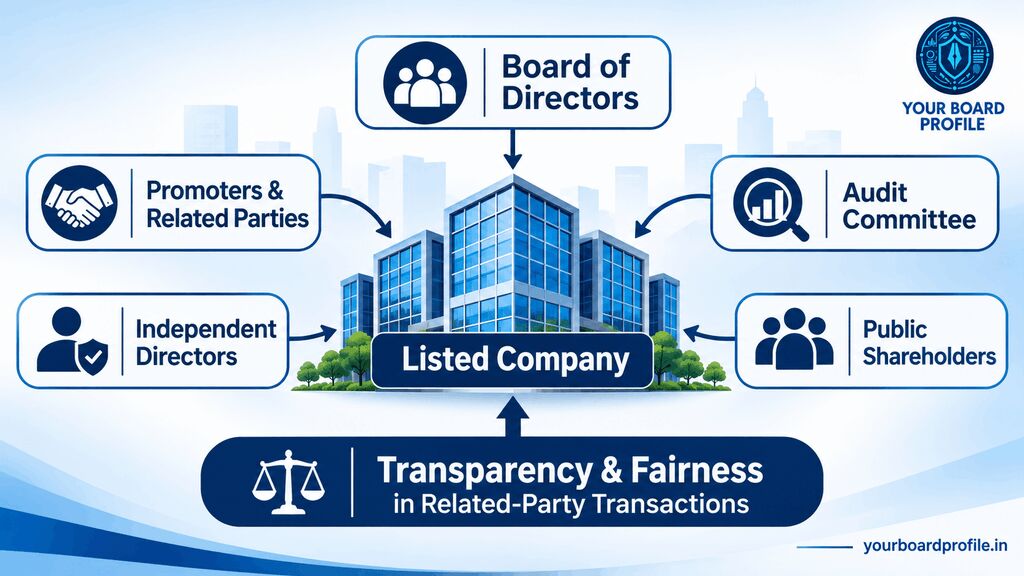
That is the real value of transparency. It gives investors the information needed to distinguish a legitimate commercial relationship from a potentially unfavourable arrangement.
What this means for investors: Better information makes it easier to question unusual transactions, compare commercial terms and evaluate whether management decisions support the interests of the listed company.
2. Stronger Minority Shareholder Protection Through Approval Rights
A company may have a strong promoter group holding a significant percentage of its shares. Public shareholders, including retail investors and institutional investors, may collectively hold the remaining stake. However, their interests are not always identical. The SEBI Related-Party Transaction Rules consequently give minority shareholders a stronger voice in decisions involving material transactions with connected parties.
This creates an important governance question: how can minority shareholders be protected when a transaction involves the same people who exercise considerable influence over the company?
The SEBI Related-Party Transaction Rules address this concern through prescribed shareholder approval requirements for material related-party transactions.
Under Regulation 23(4), material RPTs generally require prior approval through a shareholder resolution. Related parties are restricted from voting to approve such transactions, subject to the applicable provisions.
This is particularly important because it prevents interested parties from relying on their own voting influence to approve transactions involving their economic interests.
For example, consider a listed company proposing to purchase a substantial business asset from an entity controlled by its promoter group. Minority shareholders should be able to examine the proposed arrangement and participate in the approval process without the related parties determining the outcome through their votes.
Institutional investors can play an especially important role here. Mutual funds, insurance companies and other significant public shareholders can examine transaction terms, seek clarification and vote according to their assessment of the company’s interests.
However, shareholder approval should not become a substitute for proper board oversight. Investors need sufficient information before voting, and the audit committee must independently examine the transaction before it reaches shareholders.
What this means for investors: Minority shareholders receive a meaningful approval mechanism rather than being limited to observing decisions made by promoter-controlled management.
3. Stronger Audit Committee Oversight and Independent Director Accountability
A strong audit committee is one of the most important safeguards against inappropriate related-party transactions.
The committee is expected to examine whether a proposed transaction is commercially justified, whether its terms are reasonable and whether it creates any conflict of interest. Its responsibility goes beyond checking whether documents have been submitted or whether a transaction complies with a numerical threshold.
The SEBI Related-Party Transaction Rules require prior audit committee approval for RPTs, subject to specified exemptions. Under Regulation 23(2), only independent directors who are members of the audit committee can approve related-party transactions.
This provision gives independent directors an important role in protecting the interests of the listed entity and its public shareholders.
An effective review should consider questions such as:
- What is the underlying commercial rationale for the transaction?
- Why has the company selected this particular related party?
- Are comparable transactions available with independent third parties?
- Is the proposed pricing reasonable?
- Could the transaction affect the company’s financial position?
- Are there any conflicts of interest involving directors or senior management?
- Does the arrangement benefit the listed company or primarily another group entity?
An effective understanding of the SEBI Related-Party Transaction Rules allows independent directors to assess these questions with greater regulatory awareness and commercial judgment. The October 2025 SEBI circular also specifies information to be considered by audit committees. This includes transaction particulars, the related party’s relationship with the company, transaction value, tenure, financial information and justification for the arrangement. For specified financial transactions, additional information about funding sources, costs, repayment terms and the ultimate use of funds is relevant.
For an aspiring independent director, this is an important lesson. Boardroom effectiveness is not measured by how frequently a director attends meetings. It is measured by the quality of questions, independent judgment and willingness to challenge management when necessary.
What this means for investors: Independent oversight creates another layer of scrutiny before potentially sensitive transactions are approved.
4. Greater Accountability for Material Related-Party Transactions
Not every transaction with a related party carries the same financial or governance risk. A routine service agreement and a substantial asset transfer involving a promoter-controlled entity should not automatically receive identical scrutiny.
This is why materiality thresholds matter.
The SEBI Related-Party Transaction Rules establish a framework for identifying material transactions and determining when shareholder approval becomes necessary. The framework was revised through the SEBI LODR Fifth Amendment Regulations, 2025, introducing a scale-based approach under Schedule XII.
The revised thresholds are linked to the annual consolidated turnover of the listed entity.
| Annual consolidated turnover | Material RPT threshold |
| Up to ₹20,000 crore | 10% of annual consolidated turnover |
| More than ₹20,000 crore and up to ₹40,000 crore | ₹2,000 crore + 5% of turnover exceeding ₹20,000 crore |
| More than ₹40,000 crore | ₹3,000 crore + 2.5% of turnover exceeding ₹40,000 crore, subject to a maximum of ₹5,000 crore |
The thresholds are calculated using the last audited annual consolidated financial statements.
Example: Suppose a listed company has annual consolidated turnover of ₹30,000 crore.
Its materiality threshold would be:
₹2,000 crore + 5% of ₹10,000 crore = ₹2,500 crore.
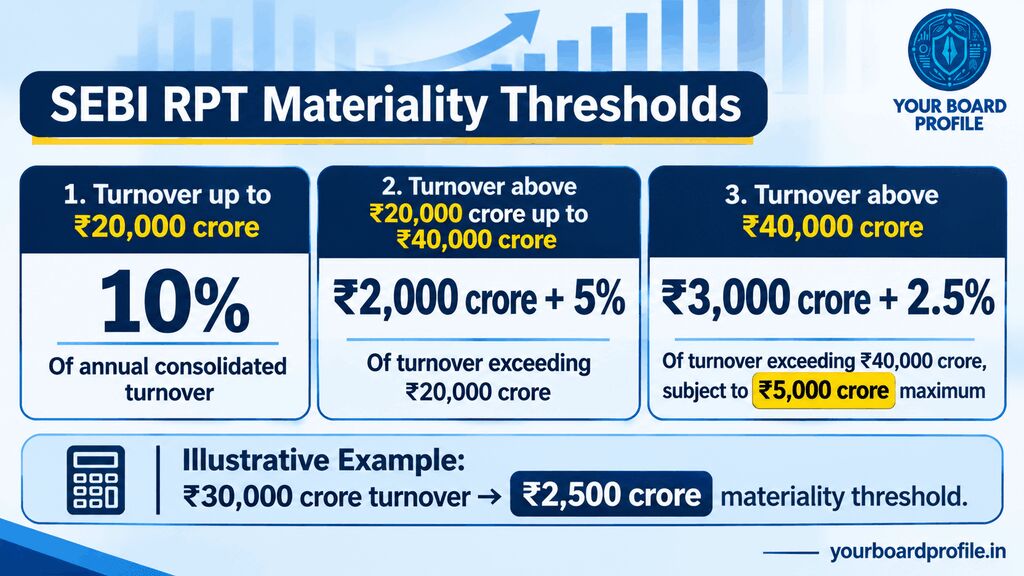
A transaction exceeding the applicable threshold, individually or together with previous transactions during the financial year, would be considered material under the relevant provision.
This approach replaces the earlier general threshold of ₹1,000 crore or 10% of annual consolidated turnover, whichever was lower.
The revised framework became effective on December 19, 2025, for the relevant RPT provisions.
The changes also address transactions undertaken by subsidiaries where the listed entity itself is not a direct party. This is important because group-level transactions should not escape appropriate oversight simply because the contractual arrangement takes place at the subsidiary level.
An important distinction is necessary: the materiality threshold is not a blanket exemption for transactions below it. Applicable audit committee approval, subsidiary-level requirements, disclosure obligations and other provisions continue to matter.
What this means for investors: A more proportionate materiality framework helps direct attention towards financially significant transactions without removing the need for appropriate scrutiny of smaller arrangements.
5. Improved Investor Confidence and Corporate Governance in India
Investor confidence depends on more than quarterly earnings, revenue growth or dividend announcements. Investors also want assurance that the organisation’s decision-making processes are fair, transparent and accountable.
A company may report impressive financial results, but concerns about promoter influence, unexplained related-party arrangements or weak board oversight can undermine market confidence.
The SEBI Related-Party Transaction Rules support stronger corporate governance in India by making companies more accountable for transactions involving connected parties.
This is particularly relevant for institutional investors, who increasingly evaluate governance quality alongside financial performance. Their investment decisions may consider board independence, audit committee effectiveness, disclosure quality, capital allocation and the company’s approach to conflicts of interest.
Consider two listed companies with similar financial performance. The first provides detailed information about its promoter-related transactions, explains the commercial rationale and demonstrates meaningful independent oversight. The second offers limited explanations and repeatedly enters into transactions with group entities without adequately addressing investor concerns.
Even if both companies report comparable profits, investors may view the first company as having a stronger governance framework.
That difference matters.
For senior executives and board directors, governance is not merely a compliance exercise. It influences reputation, access to capital, institutional investor relationships and the long-term credibility of the organisation.
Companies that demonstrate transparent decision-making are better positioned to build trust with shareholders and other stakeholders.
What this means for investors: Stronger governance standards can improve confidence in the quality of corporate decision-making and help investors assess risks that financial statements alone may not reveal.
Understanding the Revised SEBI RPT Materiality Framework
The revised materiality framework deserves particular attention because it reflects an important shift in India’s approach to corporate governance. Rather than applying one fixed monetary ceiling to all listed companies, SEBI has introduced thresholds linked to the size of the organisation.
This is intended to make the framework more proportionate. A transaction that represents a significant portion of a smaller company’s business may have a very different impact on a large diversified organisation.
However, the revised thresholds should not be interpreted as permission to conduct smaller transactions without oversight.
What Changed Under the Revised SEBI RPT Norms?
The Fifth Amendment Regulations, 2025 introduced several changes to the RPT framework, including:
| Area | Regulatory development | Governance significance |
| Materiality threshold | Scale-based thresholds under Schedule XII | More proportionate assessment of material transactions |
| Subsidiary transactions | Revised approval requirements for specified subsidiary RPTs | Better visibility into group-level arrangements |
| Minimum information | Relaxed and revised information requirements | More practical compliance while retaining essential disclosures |
| Omnibus approvals | Provisions concerning the validity of shareholder approvals | Greater clarity around approval periods |
| Applicability | Clarifications concerning listed holding companies | Reduced ambiguity in applying exemptions |
The subsidiary provisions are particularly important. Under the revised framework, certain transactions entered into by a subsidiary, where the listed parent is not itself a party, require prior approval from the listed entity’s audit committee when the applicable thresholds are crossed. The provisions also distinguish between the value of the transaction and the subsidiary’s financial scale.
Companies must therefore examine their group structures carefully rather than focusing only on transactions entered into directly by the listed parent.
Understanding the October 2025 Relaxation
Another development worth understanding is SEBI’s circular dated October 13, 2025.
Earlier in 2025, SEBI introduced industry standards prescribing minimum information to be provided to audit committees and shareholders for RPT approvals. Following industry representations and stakeholder consultation, SEBI approved certain relaxations.
The October circular established the following approach:
- Where transactions during a financial year do not exceed 1% of annual consolidated turnover or ₹10 crore, whichever is lower, the specified minimum information format in Annexure 13A applies.
- Transactions not exceeding ₹1 crore, individually or together with previous transactions during the financial year, are exempt from those particular minimum-information requirements.
- Transactions above these limits remain subject to the applicable information requirements and approval provisions.
These are relaxations concerning the prescribed information framework. They should not be confused with a general exemption from Regulation 23 or all applicable approval requirements.
For directors and compliance professionals, this distinction is essential. Regulatory compliance requires understanding not only the thresholds but also what each threshold actually governs.
For the official documents, consult:
- SEBI’s June 2025 circular on minimum RPT information
- SEBI’s October 2025 circular on revised information requirements
- SEBI’s Fifth Amendment Regulations, 2025
- SEBI’s Annual Report 2025–26
What Senior Executives and Independent Directors Should Watch
The SEBI Related-Party Transaction Rules have important implications for professionals who aspire to serve on corporate boards. Understanding financial statements and business strategy is important, but directors must also recognise situations in which commercial decisions could create conflicts of interest.
Professionals preparing for board appointments should understand how the SEBI Related-Party Transaction Rules influence financial oversight, promoter accountability and the protection of minority shareholder interests. A board member should be able to identify the difference between a legitimate business arrangement and a transaction that could compromise the interests of public shareholders.
Here are some practical areas that deserve attention.
1. Examine the Commercial Rationale
A transaction should have a clear business purpose. Directors should understand why the company needs the proposed goods, services, financing or assets and whether the arrangement supports its strategic objectives.
A simple question can be revealing: would the company enter into the same transaction on similar terms with an unrelated third party?
2. Evaluate Pricing and Valuation
Pricing is one of the most important aspects of related-party scrutiny. Directors should examine whether the proposed terms are commercially reasonable and whether comparable market arrangements exist.
Where relevant, independent valuations and external expert reports can provide additional support. However, an external valuation should not replace independent judgment.
3. Identify Conflicts of Interest
Directors should understand the relationships between the listed entity, the promoter group, senior management and the counterparty. Potential conflicts must be identified and addressed through appropriate governance procedures.
4. Strengthen Subsidiary-Level Monitoring
A listed parent company should maintain appropriate oversight of its subsidiaries. Important transactions can take place outside the parent company’s direct contractual arrangements.
Boards should therefore establish reliable reporting mechanisms that provide visibility into subsidiary-level related-party transactions.
5. Assess the Long-Term Impact on Shareholders
A transaction may be legally compliant but still raise questions about its long-term commercial value. Directors should consider whether it affects profitability, liquidity, capital allocation, operational independence or the competitive position of the listed company.
These responsibilities are closely connected with board due diligence. Professionals preparing for independent director positions can explore the Board Due Diligence Checklist to understand the wider questions involved in evaluating a company’s governance and risk environment.
They should also understand how governance oversight connects with sustainability and disclosure credibility. Our article on the SEBI BRSR Framework and ESG Credibility explores another important dimension of board accountability.
Building Boardroom Readiness in a Changing Governance Environment
For aspiring independent directors, the ability to interpret regulatory developments and ask commercially relevant questions is becoming increasingly important.
Companies need directors who can connect regulatory requirements with business strategy, financial discipline and stakeholder interests. Merely knowing the provisions of Regulation 23 is not enough. A director must understand how those provisions influence actual business decisions.
Professionals seeking their first appointment can read How to Get Your First Board Seat with No Board Experience.
Those interested in understanding how board opportunities are evolving can also explore the Board of Directors Vacancy resource.
For senior professionals, a strong board profile should demonstrate more than functional expertise. It should communicate governance understanding, strategic judgment, financial awareness and the ability to exercise independent oversight.
Conclusion: Stronger RPT Oversight Means Better Investor Protection
The growing emphasis on related-party transaction governance reflects an important reality: corporate performance and corporate accountability must go hand in hand.
The SEBI Related-Party Transaction Rules strengthen this relationship by requiring greater transparency, independent audit committee oversight, appropriate shareholder approvals and clearer accountability for material transactions. The revised materiality framework and the changes introduced through the 2025 amendments also demonstrate SEBI’s effort to balance investor protection with practical compliance requirements.
For minority shareholders, these provisions provide important safeguards against transactions that may disproportionately benefit promoter groups. For institutional investors, they create a stronger basis for evaluating governance quality. For boards, they reinforce the importance of independent judgment and informed decision-making.
Yet regulation alone cannot guarantee good governance. The real difference comes from directors who ask difficult questions, audit committees that examine transactions carefully and management teams that recognise their responsibility towards every shareholder.
As corporate governance in India continues to evolve, professionals preparing for board-level responsibilities must develop a deeper understanding of regulatory frameworks, financial oversight and shareholder protection.
At the end of the day, a company’s credibility is not established simply by the profits it reports. It is also reflected in how fairly it treats the people who have invested in its future.
Ready to Strengthen Your Boardroom Readiness?
Understanding regulations such as SEBI’s RPT framework is an important part of becoming an effective board director. But boardroom readiness also requires the ability to demonstrate governance expertise, strategic thinking, financial understanding and independent judgment.
Your Board Profile helps senior executives, CXOs, entrepreneurs and aspiring independent directors communicate their professional value in line with evolving boardroom expectations.
Through customised Board CVs, LinkedIn profile enhancement, board readiness assessments and personalised coaching, the platform helps professionals strengthen their boardroom positioning.
Explore the Your Board Profile portfolio, discover its professional services or browse more insights on boardroom leadership and corporate governance.
Take the next step towards becoming a credible, visible and board-ready professional.
Frequently Asked Questions (FAQs)
1. What are SEBI Related-Party Transaction Rules?
The SEBI Related-Party Transaction Rules are provisions under the SEBI LODR Regulations, particularly Regulation 23, governing transactions between listed companies and their related parties. They establish requirements for audit committee approval, shareholder approval, disclosures and oversight to protect shareholder interests.
2. What is Regulation 23 of SEBI LODR?
Regulation 23 governs related-party transactions undertaken by listed entities. It covers RPT policies, audit committee approvals, shareholder approvals for material transactions, material modifications and applicable disclosure requirements.
3. Who is considered a related party under SEBI regulations?
Related parties can include directors, key managerial personnel, their relatives, promoter group members and entities meeting the applicable ownership or relationship criteria under the Companies Act, accounting standards and SEBI LODR Regulations.
4. Why are related-party transactions important for minority shareholders?
Related-party transactions can create conflicts of interest when promoters or connected entities have influence over both sides of a business arrangement. Regulatory approvals and disclosure requirements help minority shareholders assess whether transactions are fair and beneficial to the listed company.
5. Do all related-party transactions require shareholder approval?
No. All RPTs generally require prior audit committee approval, subject to specified exemptions. Shareholder approval is generally required for material RPTs under Regulation 23(4), subject to applicable exemptions.
6. What is a material related-party transaction under SEBI rules?
A material RPT is a transaction, individually or together with previous transactions during the financial year, that exceeds the applicable turnover-linked thresholds under Schedule XII of the SEBI LODR Regulations.
7. Can promoters vote on material related-party transactions?
Related parties cannot vote to approve material RPTs under Regulation 23(4), whether or not they are related parties to the particular transaction, subject to applicable regulatory provisions.
8. What is the role of an independent director in RPT approval?
Independent directors who are members of the audit committee are responsible for approving related-party transactions under the prescribed framework. They must examine commercial rationale, pricing, conflicts of interest and potential implications for the listed entity.
9. What are the revised materiality thresholds under SEBI RPT norms?
The revised thresholds are 10% of turnover for companies with turnover up to ₹20,000 crore; ₹2,000 crore plus 5% of the excess above ₹20,000 crore for companies with turnover up to ₹40,000 crore; and ₹3,000 crore plus 2.5% of the excess above ₹40,000 crore, capped at ₹5,000 crore, for larger companies.
10. Do transactions involving subsidiaries also fall under SEBI RPT regulations?
Yes. Specified transactions involving subsidiaries are covered, including certain arrangements where the listed parent is not directly a party. Applicable thresholds and approval requirements must be examined under Regulation 23.
11. What is the purpose of SEBI’s 2025 RPT industry standards?
The standards prescribe minimum information to be provided to audit committees and shareholders when considering RPT approvals. Their purpose is to improve consistency, transparency and informed decision-making.
12. What changed through SEBI’s October 2025 RPT circular?
The October 13, 2025 circular introduced relaxations to the minimum-information requirements, including a simplified information format for specified transactions and an exemption from those particular requirements for transactions not exceeding ₹1 crore during the financial year.
13. How do SEBI RPT regulations improve corporate governance in India?
They promote accountability by requiring independent oversight, prescribed disclosures and shareholder participation in material transactions. These safeguards help reduce conflicts of interest and strengthen confidence in listed companies.
14. Why should aspiring independent directors understand SEBI RPT norms?
Independent directors play a significant role in evaluating conflicts of interest, reviewing financial arrangements and protecting shareholder interests. Understanding RPT regulations helps aspiring directors demonstrate regulatory awareness and informed boardroom judgment.
15. How can institutional investors use RPT disclosures?
Institutional investors can examine transaction values, counterparties, commercial justifications, valuations and approval records to assess governance quality. They can also use their shareholder voting rights to question or oppose arrangements that do not adequately protect the interests of the listed company.