
Why Leadership Protection Is Becoming a Boardroom Priority
Corporate leadership in India is becoming more demanding, and the consequences of a boardroom decision can extend well beyond the organisation’s financial statements. A decision involving a merger, a related-party transaction, an employee issue, a cybersecurity incident or a regulatory disclosure can expose directors and senior executives to legal proceedings, financial claims and reputational damage. Even when a decision is taken in good faith, questions about whether the board exercised adequate oversight can place individual leaders under considerable scrutiny. This changing environment has made D&O liability insurance an important consideration for companies that want to strengthen their corporate governance framework while protecting the people responsible for strategic decisions.
The growing attention towards leadership protection is not merely an international trend reaching Indian boardrooms. It reflects developments in India’s regulatory environment, shareholder expectations and corporate accountability standards. According to Policybazaar data reported by Business Standard in May 2025, demand for directors and officers insurance increased by approximately 25–35% in FY2024–25. The report identified board accountability, investor pressure, regulatory interventions, ESG failures and cybersecurity incidents among the factors driving this demand.
For independent directors, the issue carries particular importance. They are expected to exercise objective judgement, question management decisions, examine financial and operational risks and protect stakeholder interests. Yet, they may have limited involvement in the company’s daily operations and may depend heavily on the information provided by management. This creates an important question: how can directors accept significant governance responsibilities without understanding the personal financial exposure attached to their positions?
D&O liability insurance has therefore become an important consideration for Indian companies seeking to balance leadership accountability with adequate financial protection. A well-designed insurance arrangement can help address this concern. It does not replace responsible leadership, due diligence or compliance. Instead, it provides financial support when covered claims arise from alleged wrongful acts committed in an insured managerial or directorial capacity.
For Indian businesses, D&O liability insurance should therefore be viewed as more than a conventional corporate insurance purchase. It is part of a broader approach to board effectiveness, leadership confidence and organisational resilience.
Table of Contents
Understanding D&O Liability Insurance in the Indian Corporate Environment
Directors and Officers (D&O) insurance is a management liability insurance policy designed to protect directors, officers and other eligible individuals against certain financial consequences arising from claims alleging wrongful acts committed in their professional capacities. These allegations may relate to negligence, breach of duty, errors in judgement, misrepresentation, failure of oversight or other management-related decisions, depending on the policy wording.
At its core, D&O liability insurance is designed to address the financial consequences of management-related claims that could otherwise place considerable pressure on an individual’s personal resources.
Unlike general business insurance, which primarily protects physical assets, property or operational activities, D&O liability insurance focuses on the personal liability exposure of individuals responsible for corporate decisions.
Consider a company that experiences a significant financial loss following an acquisition. Investors subsequently allege that the board failed to conduct adequate due diligence before approving the transaction. They initiate legal proceedings against the directors, arguing that the decision was taken without sufficient examination of the financial and commercial risks.
Even if the directors believe that they acted responsibly, they may need experienced lawyers, financial experts and other professional advisers to defend themselves. These expenses can become substantial before a court or regulatory authority reaches any final decision.
This is where insurance protection can become relevant. Subject to the policy’s terms, exclusions, limits and applicable law, the insurer may fund eligible defence expenses, settlements and other covered liabilities.
What Does D&O Liability Insurance Actually Protect?
The central purpose of this insurance is to protect eligible individuals against covered claims arising from their management responsibilities.
Depending on the policy terms, coverage may include:
- Executive directors and managing directors.
- Independent and non-executive directors.
- Whole-time directors.
- Chief Executive Officers and Chief Financial Officers.
- Company secretaries and other key managerial personnel.
- Employees performing specified managerial or supervisory functions.
- Directors serving on outside boards at the company’s request, where included in the policy.
An important distinction is that this insurance generally responds to allegations and claims, not simply to every financial loss suffered by a company.
For example, a commercial decision that produces disappointing results does not automatically create an insured claim. There must be a claim arising from an alleged wrongful act within the policy’s scope.
Who Needs D&O Liability Insurance?
Traditionally, large listed companies and multinational corporations have been significant buyers of this protection. However, the risk landscape has expanded.
Today, organisations that may benefit include:
- Listed companies facing investor and regulatory scrutiny.
- Unlisted public companies with complex governance structures.
- Private companies with institutional investors.
- Startups preparing for venture capital or private equity funding.
- SMEs with professional boards and external directors.
- Family-owned businesses introducing independent governance.
- Companies planning an IPO or major restructuring.
The need becomes particularly relevant when an organisation begins appointing experienced external directors. Such professionals bring strategic knowledge, governance experience and independent judgement. However, they also take on responsibilities that may expose their personal assets to legal claims.
Why D&O Liability Insurance Demand Is Growing Among Indian Companies
The growing interest in D&O liability insurance is connected to a fundamental change in how corporate leadership is evaluated.
Earlier, board-level accountability was often discussed primarily in the context of statutory compliance and financial reporting. Today, the conversation includes cybersecurity, environmental commitments, data privacy, employee welfare, related-party transactions, executive conduct and the quality of strategic oversight.
Directors are expected to understand these risks, ask meaningful questions and ensure that management has appropriate controls in place.
A board cannot simply rely on the fact that management has presented a report. It must also consider whether the information is accurate, whether material risks have been disclosed and whether the proposed decisions are consistent with the organisation’s long-term interests.
Increasing Regulatory Scrutiny and Corporate Accountability
Indian regulators have strengthened their focus on transparency, disclosure and accountability. SEBI’s requirements for listed entities, the Companies Act, 2013, and evolving governance expectations have increased the importance of documented board oversight.
Regulatory scrutiny can arise from several situations, including:
- Inaccurate financial disclosures or misleading statements.
- Allegations of insider trading or non-compliance with securities regulations.
- Improper related-party transactions.
- Inadequate risk management and internal controls.
- Non-compliance with environmental and social commitments.
- Alleged failures in protecting sensitive information.
- Questions concerning the conduct of directors and senior management.
These situations can result in investigations, notices, legal proceedings or shareholder claims.
Marsh’s India D&O claims research identifies regulatory investigations, cybersecurity incidents, securities-related claims and shareholder activism among the evolving exposures facing corporate leaders. Its research also examines the increasing importance of legal expenses and board-level accountability.
For companies, this creates a practical challenge. Even a claim that is ultimately unsuccessful can require considerable time, management attention and financial resources to resolve.
Shareholder Activism, Litigation and Reputational Exposure
Shareholders today are more willing to question decisions that affect their investments. Institutional investors, minority shareholders and activist groups may scrutinise executive remuneration, acquisitions, related-party transactions, capital allocation and environmental commitments.
Suppose a listed company announces an acquisition that subsequently fails to deliver the expected value. Shareholders may question whether the board adequately evaluated the target company’s financial position, commercial prospects and associated risks.
Similarly, if a company makes ambitious sustainability commitments but later faces allegations of misleading environmental disclosures, directors may be questioned about the credibility of the information presented to the board.
This is why governance cannot be separated from reputation.
Organisations looking to strengthen this aspect should also understand how shareholder activism influences corporate governance. It helps explain why boards must be prepared to respond to informed investor questions rather than treating shareholder engagement as a routine communication exercise.
A robust risk-management framework combined with D&O liability insurance can help companies manage the financial consequences of covered claims while maintaining focus on governance responsibilities.
The Legal Landscape Governing Independent Director Liability in India
Understanding the legal environment is essential before evaluating the appropriate insurance arrangement.
India’s corporate governance framework recognises the importance of independent directors and places specific responsibilities on them. At the same time, the law provides certain qualifications concerning when they may be held liable.
Two provisions deserve particular attention: Section 149(12) of the Companies Act, 2013, and Regulation 25(10) of SEBI’s Listing Obligations and Disclosure Requirements Regulations, 2015.
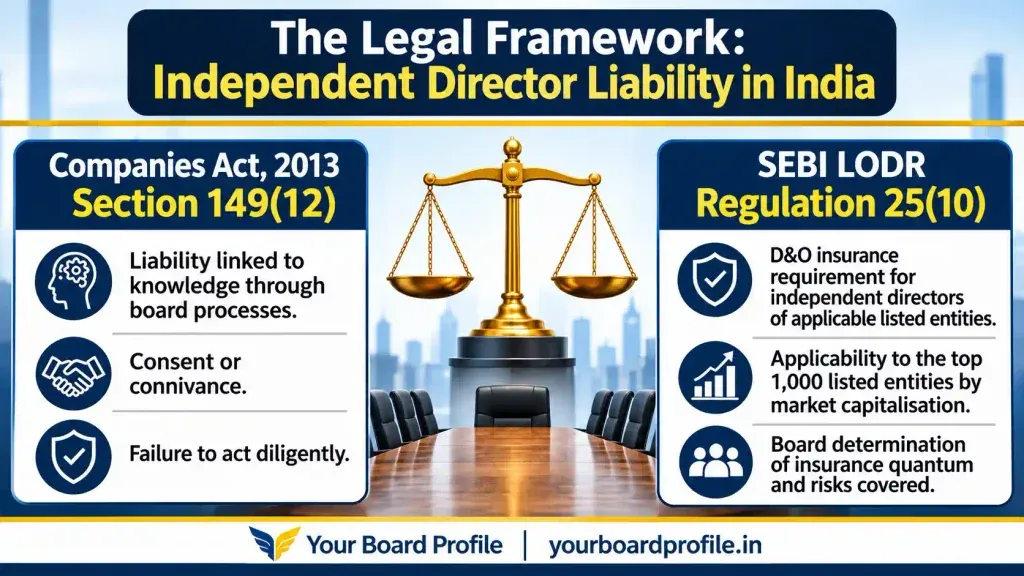
Companies Act 2013 Section 149(12)
Section 149(12) of the Companies Act, 2013, provides a specific liability framework for independent directors and non-executive directors who are not promoters or key managerial personnel.
In general, independent directors may be held liable for the company’s acts or omissions only when these occurred with their knowledge through board processes, involved their consent or connivance, or resulted from a failure to exercise due diligence.
The provision is important because it recognises that independent directors do not manage the company’s daily operations in the same way as executive management.
However, this protection should not be misunderstood as complete immunity.
An independent director cannot simply assume that limited involvement in daily operations will automatically protect them from proceedings. Their conduct, participation in board decisions, access to information and response to warning signs can all become relevant.
For example, imagine that a board receives an internal audit report identifying serious weaknesses in financial controls. The issue is discussed at a meeting, but no meaningful corrective action is taken. If the company later faces an investigation, questions may arise about what individual directors knew and whether they acted diligently.
This is why directors must maintain appropriate documentation, ask relevant questions and ensure that significant concerns are recorded and addressed.
The original statutory text is available through the Ministry of Corporate Affairs’ Companies Act, 2013.
SEBI LODR Regulation 25(10)
Regulation 25(10) of the SEBI (Listing Obligations and Disclosure Requirements) Regulations, 2015, is particularly relevant for independent directors of listed entities.
The regulation requires the applicable listed entities to undertake Directors and Officers insurance for all their independent directors.
An important point for companies to consider is the expansion of the requirement to the top 1,000 listed entities by market capitalisation, rather than relying on the older top-500 threshold found in earlier versions of the regulation.
The quantum of insurance and the risks to be covered are determined by the company’s board of directors.
This makes the selection of an appropriate policy a board-level governance decision, not merely an administrative insurance purchase.
The latest regulatory text should be checked against SEBI’s published amendments and consolidated regulations. Relevant references include the SEBI regulatory documents and its published LODR regulatory text.
The following table summarises the practical significance of the two provisions.
| Regulatory provision | What it addresses | Practical significance |
| Companies Act, 2013, Section 149(12) | Liability of independent and specified non-executive directors | Establishes circumstances in which individual liability may arise |
| SEBI LODR Regulation 25(10) | D&O insurance for independent directors of applicable listed entities | Makes insurance a regulatory requirement for the specified listed entities |
| Board’s determination under Regulation 25(10) | Quantum and risks covered | Requires the board to consider the adequacy of protection |
For aspiring directors, understanding these provisions is equally important. Before accepting a board appointment, professionals should examine the company’s governance framework, indemnification arrangements and insurance protection.
A useful starting point is to review this guide to securing your first board seat without previous board experience, alongside an assessment of the responsibilities associated with the appointment.
An Overview of Side A, Side B and Side C D&O Insurance Coverage
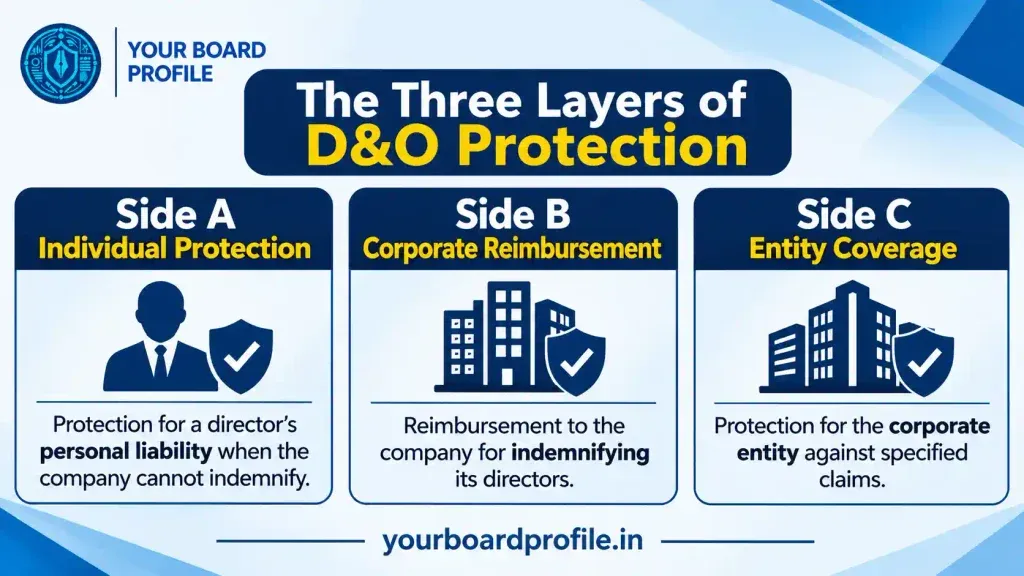
Not every D&O policy protects the same parties in the same manner. One of the most important aspects of policy evaluation is understanding its three principal coverage components: Side A, Side B and Side C.
These coverage sections determine whether the insurance responds to an individual director’s liability, reimburses the company for indemnifying a director or protects the corporate entity itself against specified claims.
Illustrative coverage comparison
| Coverage | Who receives protection? | How it works |
| Side A | Individual directors and officers | Pays covered losses when the company cannot indemnify an insured individual |
| Side B | The company | Reimburses the company for covered amounts it has paid to indemnify directors or officers |
| Side C | The corporate entity | Covers specified claims against the company, commonly securities-related claims |
Side A: Direct protection for directors
Side A is particularly important because it protects individual directors when the company is legally or financially unable to indemnify them.
Consider a situation in which a company becomes insolvent following a major financial crisis. A former director faces a covered legal claim, but the company cannot provide financial support for the defence.
Subject to the policy wording, Side A can respond directly to the insured individual.
For independent directors, this protection can be especially valuable because their personal financial security should not depend entirely on the company’s ability to meet its indemnification obligations.
Side B: Reimbursement to the company
Side B works differently. Companies may indemnify their directors for eligible liabilities and expenses, subject to applicable law and their constitutional documents.
When the company makes such a payment, Side B can reimburse the organisation for the covered amount.
This reduces the financial burden on the company while maintaining protection for eligible directors and officers.
Side C: Entity coverage
Side C provides specified protection to the corporate entity itself. In many D&O arrangements, this is particularly relevant to securities-related claims against listed companies.
However, companies should examine whether entity coverage shares the same aggregate policy limit as individual protection.
A large corporate claim can potentially reduce the remaining limit available to directors.
This is one reason why understanding the difference between individual and entity coverage is essential when purchasing D&O liability insurance.
Additional Side A Limit (ABL): Strengthening Independent Director Protection
A standard D&O policy may provide a combined insurance limit for Side A, Side B and Side C. Although this can be convenient, it may create a concern when multiple claims arise.
Imagine a company facing two separate situations:
- A securities-related claim against the corporate entity.
- A personal liability claim against an independent director.
If both claims draw from a shared policy limit, a substantial payment under the corporate claim may reduce the amount available for the individual director.
An Additional Side A Limit (ABL) can address this concern by providing a separate additional limit for eligible directors and officers, depending on the policy structure.
Some policies also offer dedicated or excess Side A protection, which can be particularly relevant for independent directors.
Before purchasing this extension, companies should examine the following:
- Whether the additional limit is separate from the main policy limit.
- Whether it applies to all insured directors or only specified categories.
- Whether it covers independent and non-executive directors.
- Whether it operates on a non-rescindable basis.
- Whether it provides protection when the company cannot indemnify an individual.
- Whether its exclusions differ from the primary policy.
A dedicated additional limit can make a meaningful difference when the company’s financial condition deteriorates or several claims compete for the same insurance limit.
The objective is not simply to purchase a larger insurance amount. It is to ensure that individual directors have meaningful protection when corporate indemnification is unavailable.
What Does a Comprehensive D&O Liability Insurance Policy Cover?
The exact scope of protection depends on the insurer, policy wording, selected extensions, exclusions and applicable law. Therefore, companies should avoid assuming that every policy described as comprehensive offers identical benefits.
A carefully structured D&O liability insurance arrangement may include the following:
| Coverage component | What it may address |
| Legal defence costs | Lawyers, legal representation and eligible defence expenses |
| Settlements and damages | Covered settlements and legally insurable damages |
| Regulatory investigations | Specified investigation-related defence expenses |
| Employment practices liability | Certain employment-related allegations against insured individuals |
| Securities claims | Specified shareholder and securities-related proceedings |
| Outside directorship liability | Claims relating to certain external board appointments |
| Crisis management expenses | Specified reputation or crisis-response expenses |
| Emergency defence costs | Eligible urgent legal expenses, subject to policy conditions |
Legal Defence Costs and Regulatory Investigation Cover
Legal defence costs are among the most important considerations when evaluating D&O protection.
A director facing an investigation may need to appoint specialised legal counsel, respond to notices, prepare documents and participate in hearings. The process may continue for months or even years.
The financial burden can become significant even when the allegations are ultimately dismissed.
A suitable policy may cover eligible defence expenses incurred in responding to covered claims. Some policies advance these expenses as they are incurred, subject to insurer consent and other conditions.
Companies should pay particular attention to:
- Whether defence expenses are covered within the overall policy limit or provided separately.
- Whether the insurer must approve legal counsel.
- Whether emergency costs can be incurred before formal approval.
- Whether defence expenses are covered for civil, criminal or regulatory proceedings.
- Whether the insurer can recover payments if a final finding establishes an excluded act.
- Whether legal expenses reduce the amount available for settlements.
One common mistake is to focus only on the total insurance limit while overlooking the structure of defence-cost payments.
In practice, a policy with a seemingly high limit may offer less meaningful protection if the defence expenses rapidly erode the available amount.
NCLT, SEBI Investigation and Other Regulatory Proceedings
Indian corporate leaders may face proceedings before different regulatory and adjudicatory bodies.
These can include matters involving the Securities and Exchange Board of India (SEBI), the National Company Law Tribunal (NCLT), the Registrar of Companies and other statutory authorities.
However, it is important to distinguish between the existence of an investigation and the insurance coverage available for responding to it.
Some policies cover specified formal investigations into an insured person’s conduct, including certain pre-claim investigation expenses. Others may require a formal notice, defined investigation trigger or other specific conditions.
A company should therefore examine whether its policy addresses:
SEBI investigations: Whether legal representation and eligible defence costs arising from covered regulatory investigations are included.
NCLT proceedings: Whether specified proceedings involving alleged breaches of directors’ duties, insolvency-related matters or corporate disputes fall within the policy definition of a claim.
Criminal proceedings: Whether defence costs are advanced for covered allegations, subject to exclusions and recovery provisions.
Internal investigations: Whether the policy provides protection for certain formal internal investigations or independent reviews.
Cross-border investigations: Whether claims arising outside India are covered, particularly where the company has overseas subsidiaries or international investors.
Companies should not assume that all NCLT proceedings, penalties or regulatory investigations are automatically covered. Final penalties, disgorgement, fines and other amounts may be uninsurable under applicable law or excluded by the policy.
The insurer’s actual wording is more important than the marketing description of the product.
D&O Policy Exclusions and Coverage: What Leaders Must Examine
Insurance protection is valuable only when the company understands its boundaries.
Every D&O policy contains exclusions, conditions and definitions that determine when the insurer will respond and when it may decline a claim.
Some common exclusions include:
| Exclusion | General meaning |
| Fraud and intentional dishonesty | Proven fraudulent or deliberately dishonest conduct, subject to the wording |
| Personal profit | Improper personal gain or remuneration to which the insured was not legally entitled |
| Prior and pending litigation | Claims or proceedings existing before the relevant policy date |
| Bodily injury and property damage | Certain claims involving physical injury or property damage |
| Insured versus insured | Certain claims brought by one insured party against another |
| Professional services | Certain claims arising from professional services rather than managerial duties |
| Fines and penalties | Amounts that are not legally insurable or are specifically excluded |
A particularly important distinction concerns allegations of fraud.
An individual may be accused of fraud, but the allegation itself does not necessarily mean that the entire claim is excluded from the beginning. Many policy wordings distinguish between defence costs during proceedings and losses arising from established fraudulent or dishonest conduct.
The precise treatment depends on the wording, including any final adjudication requirement.
Directors should also examine the policy’s prior knowledge provisions, continuity clauses and notification requirements.
For example, if a company becomes aware of a potential claim but fails to notify the insurer within the required period, it may face difficulties obtaining coverage.
The policy should also be reviewed whenever there is a major corporate event, such as a merger, acquisition, restructuring, IPO or change in ownership.
An effective approach is to review D&O liability insurance alongside the company’s wider board due diligence checklist. This helps connect individual leadership protection with the broader responsibilities of the board.
D&O Insurance for Startups and SMEs: Protection Beyond Large Corporations
There is a common misconception that D&O protection is necessary only for large listed companies.
In reality, startups and SMEs may face their own set of management liability risks, particularly when they introduce external investors, appoint independent directors or expand their operations.
Consider a startup that has raised funds from venture capital investors. The board approves an ambitious expansion strategy based on management projections. When the business misses its targets, investors question whether the projections were adequately supported and whether the board exercised sufficient oversight.
Another example could involve disagreements between founders and investors over the use of funds, disclosure of financial information or the execution of an agreed business strategy.
These disputes may create personal exposure for directors and senior executives.
For startups, D&O liability insurance can become particularly relevant at the following stages:
- Before or after a significant institutional funding round.
- When appointing an independent director or experienced industry professional.
- During preparation for an IPO.
- When entering new international markets.
- When undertaking a merger, acquisition or restructuring.
- When expanding the company’s senior management team.
SMEs can also benefit from evaluating management liability protection as their business structures become more complex.
The appropriate policy limit will depend on the company’s size, investor profile, industry exposure, governance structure and financial capacity.
Smaller businesses do not necessarily need the same insurance structure as large listed corporations. However, they should not overlook the personal risks their directors may carry.
A practical insurance review can help founders and investors establish clearer expectations about indemnification, board responsibilities and individual protection.
How Indian Companies Can Choose the Right D&O Insurance Policy
Selecting an insurance policy should involve more than comparing premiums and headline coverage limits.
The board should consider the company’s actual risk profile, the nature of its operations and the personal exposure of its directors.
A structured assessment can make this decision more effective.
1. Assess the company’s governance and litigation exposure.
Begin by identifying the risks associated with the organisation’s industry, ownership structure, investor relationships and regulatory obligations. A listed financial services company may face different exposures from a privately held technology startup.
2. Evaluate the coverage limit.
The insurance limit should reflect the potential cost of legal proceedings, the number of insured individuals, the company’s market position and the possibility of multiple claims.
3. Examine Side A, Side B and Side C separately.
Understand how the three coverage sections operate and whether they share an aggregate limit. Consider whether a dedicated Additional Side A Limit is appropriate.
4. Review investigation coverage.
Check whether the policy covers formal investigations, regulatory notices and specified proceedings before Indian authorities.
5. Understand exclusions and notification conditions.
Review the policy’s definitions of claims, wrongful acts, insured persons, prior knowledge, fraud and defence costs. Understand the process for notifying potential claims.
6. Evaluate the insurer’s claims-handling capabilities.
An insurer’s experience in handling complex management liability claims can be as important as the premium. Consider its legal support network, claims response procedures and experience with domestic and international proceedings.
7. Review the policy regularly.
The organisation’s exposure may change after an acquisition, funding round, change in board composition or expansion into new markets. Insurance should evolve with the business.
A Board-Level Checklist Before Purchasing D&O Protection
| Question | Why it matters |
| Are all eligible directors and officers covered? | Prevents gaps in insured-person protection |
| Is the independent director requirement under SEBI LODR addressed? | Supports regulatory compliance |
| Is there an additional Side A limit? | Provides potentially stronger individual protection |
| Are investigation expenses included? | Helps address regulatory exposure |
| Are defence costs advanced? | Supports timely legal representation |
| Are overseas subsidiaries covered? | Addresses cross-border management risks |
| Are past claims and circumstances properly disclosed? | Reduces coverage disputes |
| Are exclusions clearly understood? | Prevents unrealistic coverage expectations |
The board should also recognise that insurance is only one component of governance. It cannot compensate for weak oversight, inadequate disclosure or careless decision-making.
A mature governance framework combines informed directors, effective internal controls, accurate reporting, ethical leadership and suitable financial protection.
For professionals considering board appointments, this also means assessing whether an organisation has the right governance culture before accepting responsibility. A director’s board value proposition and readiness should include an understanding of the risks and protections associated with the position.
Companies looking to strengthen their governance capabilities can also explore board profile development and professional positioning and the broader services offered by Your Board Profile.
Conclusion: Making Leadership Protection Part of Good Governance
The expectations placed on Indian corporate leaders are changing. Directors are increasingly expected to demonstrate informed judgement, effective oversight, transparency and accountability across financial, operational, regulatory and reputational matters. As these responsibilities expand, the potential personal consequences of board-level decisions deserve greater attention.
D&O liability insurance has an important role in this environment. It can help protect eligible directors and officers against covered legal claims, defence expenses and other liabilities arising from their professional responsibilities. For independent directors, the availability of meaningful individual protection can also influence their willingness to accept board appointments and contribute their expertise to corporate decision-making.
However, purchasing a policy should never become a substitute for good governance. Companies must continue to strengthen board processes, improve the quality of management information, document important decisions and encourage directors to question assumptions. Insurance should support these practices, not replace them.
For Indian businesses, the next step is to move beyond viewing D&O protection as a routine compliance expense. It should form part of a broader strategy for building resilient leadership, protecting stakeholder confidence and maintaining responsible corporate governance.
As boards review their risk-management priorities, they should ask a simple question: are we protecting not only the organisation’s assets and reputation but also the individuals entrusted with its leadership?
The answer will increasingly distinguish organisations that treat governance as a statutory obligation from those that understand it as a long-term business advantage.
Ready to Strengthen Your Boardroom Readiness and Leadership Credibility?
Being board-ready involves more than professional experience. It requires a clear understanding of governance responsibilities, regulatory expectations, risk oversight and the ability to contribute meaningfully to strategic decisions.
At Your Board Profile, we help senior executives, CXOs, entrepreneurs and aspiring independent directors strengthen their boardroom positioning through customised Board CVs, LinkedIn profile enhancement, board readiness assessments, personal branding and one-to-one mentorship.
Whether you are preparing for your first board appointment or looking to strengthen your existing boardroom presence, the right professional positioning can make your experience and governance capabilities more visible.
Explore how Your Board Profile can help you prepare for greater boardroom opportunities.
- Website: Your Board Profile
- Services: Explore our professional services
- Insights: Read more articles on boardroom leadership and corporate governance
- Portfolio: Explore our work
Frequently Asked Questions (FAQs)
1. What is D&O liability insurance?
D&O liability insurance is a management liability policy that protects eligible directors and officers against covered claims arising from alleged wrongful acts committed while performing their professional responsibilities. Depending on the policy, it may cover legal defence costs, settlements and certain other financial liabilities.
2. Is D&O liability insurance mandatory in India?
It is not mandatory for every company in India. However, SEBI LODR Regulation 25(10) requires the applicable top 1,000 listed entities by market capitalisation to undertake D&O insurance for all their independent directors. Other companies may purchase it voluntarily based on their governance and risk-management requirements.
3. What is Section 149(12) of the Companies Act, 2013?
Section 149(12) establishes the circumstances in which independent directors and specified non-executive directors may be held liable for acts or omissions by a company. Broadly, liability relates to matters involving their knowledge through board processes, consent or connivance, or failure to act diligently.
4. Does D&O insurance protect independent directors?
Yes. Independent directors are among the principal beneficiaries of D&O protection. Depending on the policy, they may receive coverage for eligible legal defence costs, settlements and other covered liabilities arising from their board responsibilities.
5. What is the difference between Side A, Side B and Side C coverage?
Side A protects individual directors and officers when the company cannot indemnify them. Side B reimburses the company when it indemnifies insured individuals. Side C provides specified protection to the corporate entity, commonly for securities-related claims.
6. What is an Additional Side A Limit (ABL)?
An Additional Side A Limit is a separate additional insurance limit designed to provide further protection to eligible directors and officers. It can be particularly useful when the main policy limit is shared across corporate and individual claims or when the company cannot indemnify its directors.
7. Does D&O insurance cover legal defence costs?
Most D&O policies provide some form of legal defence cost coverage for eligible claims. However, the expenses must satisfy the policy’s definitions, conditions and exclusions. Directors should check whether defence costs are advanced as they are incurred and whether they reduce the overall policy limit.
8. Does D&O insurance cover SEBI investigations?
Certain D&O policies cover eligible defence expenses associated with formal regulatory investigations, including specified SEBI proceedings. However, coverage depends on the investigation definition, triggering conditions and policy wording. It should not be assumed that every regulatory inquiry or penalty is covered.
9. Does D&O insurance cover NCLT proceedings?
Some policies may cover eligible claims and defence expenses associated with specified NCLT proceedings. The precise scope depends on whether the proceeding qualifies as a claim under the policy. Companies should examine insolvency-related exclusions and other relevant conditions carefully.
10. Are fraud and intentional misconduct covered under D&O insurance?
Proven fraud, intentional dishonesty and improper personal profit are generally excluded. However, an allegation alone does not necessarily eliminate all coverage. Some policies may advance defence expenses until a final adjudication establishes excluded conduct, subject to their wording.
11. Do startups and SMEs need D&O liability insurance?
Startups and SMEs may benefit from D&O protection, particularly when they raise institutional capital, appoint independent directors, enter new markets or undertake significant corporate transactions. The appropriate insurance structure should reflect the company’s size, operations and potential management liability exposure.
12. Does D&O insurance protect directors after they leave the company?
Certain policies provide extended reporting periods or run-off coverage for claims arising from wrongful acts committed during the insured period. Such protection is particularly important following mergers, acquisitions, retirement or changes in board composition. The exact terms should be checked before a policy expires.
13. Does D&O insurance cover reputational damage?
Some policies offer limited crisis management or reputation-related expense extensions. However, general reputational damage, lost business opportunities and commercial losses are not automatically covered. Companies should examine the specific extension and its financial limits.
14. How much D&O insurance coverage should an Indian company purchase?
There is no single appropriate insurance limit for every company. The decision should consider the organisation’s size, industry, market capitalisation, number of directors, investor profile, regulatory exposure, international operations and potential litigation costs. The board should assess whether the available limit is sufficient for both corporate and individual claims.
15. Can D&O insurance improve corporate governance in India?
D&O insurance does not directly improve governance, but it can support a stronger governance environment by addressing certain personal financial risks faced by directors. When combined with effective board processes, transparent disclosures, proper risk oversight and director accountability, it can contribute to a more resilient corporate leadership framework.