
Why Board Readiness Begins Before the Appointment
Becoming an Independent Director is not simply the next step in a successful executive career. It represents a shift in how your experience, judgment and professional reputation create value. As a senior executive, you may have led business transformations, managed complex risks, improved financial performance or built high-performing teams. Yet, when a Nomination and Remuneration Committee (NRC) evaluates your suitability for a board position, it looks beyond your achievements. It also considers whether you understand governance, exercise independent judgment, ask the right questions and contribute to long-term organisational value.
Governance signalling is the way an aspiring director makes governance competence, independent judgment and trustworthiness visible through credible actions, evidence and communication. In the board-career context, these signals help a Nomination and Remuneration Committee (NRC), chairperson or board search firm assess whether a candidate can exercise independent judgment under pressure, understand oversight, risk and accountability, challenge assumptions respectfully, and contribute to a particular board or committee. The key distinction is that governance signalling is not simply what you claim about yourself; it is the evidence others can reasonably infer from your decisions, conduct and communication.
For aspiring directors, personal branding is most useful when it makes these signals visible. It explains who you are, what you stand for and the expertise you bring, while a board-focused personal brand connects that expertise to governance responsibilities. A strong executive reputation does not automatically communicate board readiness. The task is to translate career experience into credible evidence of strategic judgment, ethical maturity, stakeholder awareness and the ability to oversee rather than simply operate.
Being qualified is essential, but being understood is equally important. Your Board CV, LinkedIn profile, professional biography, thought leadership and conversations should reinforce a consistent message about how you think and the value you could bring to a board. As Dr. Amit Nagpal puts it: “Your story is your brand. Your signals are your proof.” The story makes your experience memorable; credible evidence makes it trustworthy.
This guide explores how to become an Independent Director by aligning governance capability, professional visibility and board-level positioning. It looks at personal branding as a deliberate way to communicate boardroom readiness through evidence—not as a promotional exercise or a declaration that you are ready.
Table of Contents
Understanding the Independent Director’s Role
An Independent Director contributes objective judgment, oversight and constructive challenge to a company’s board. Unlike an executive director, who may be involved in running the business, an Independent Director is expected to assess management decisions from a broader governance perspective. This involves examining strategic assumptions, questioning risk exposure, understanding financial performance and considering the interests of shareholders and other relevant stakeholders.
In India, the role operates within the framework of the Companies Act, 2013, applicable rules and, where relevant, SEBI’s Listing Obligations and Disclosure Requirements (LODR). Section 149 of the Companies Act addresses independent directors, while Schedule IV outlines their code for professional conduct and responsibilities. Professionals considering an appointment should consult the Ministry of Corporate Affairs and the Securities and Exchange Board of India for applicable requirements. Eligibility, independence criteria and appointment procedures depend on the company’s circumstances and the relevant law.
What Boards Expect Beyond Executive Experience
A successful executive understands how to deliver results. A capable Independent Director must also understand how to evaluate the systems, decisions and assumptions that produce those results. This distinction changes the way you present your experience. Instead of focusing exclusively on revenue growth, team size or operational achievements, explain how your decisions strengthened internal controls, improved capital allocation, addressed risk or supported sustainable performance.
Consider two professionals with similar career histories. One presents a list of business achievements and impressive job titles. The other explains how those achievements demonstrate strategic judgment, financial understanding, ethical leadership and an ability to challenge assumptions constructively. The second professional makes the connection between executive experience and board contribution much clearer.
Boards may seek expertise in areas such as finance, technology, cybersecurity, human resources, legal compliance, sustainability, risk management or international business. However, technical knowledge alone is not sufficient. Directors also need to understand their collective responsibilities, maintain confidentiality, manage conflicts of interest and contribute to effective deliberations.
If you are exploring this transition, start by understanding the changing role of the Independent Director in corporate governance. Your objective is to identify where your experience meets a board’s needs and where further learning is required.
Personal Branding vs Board Branding
Personal branding and board branding are related, but they serve different purposes. Personal branding establishes your professional identity across your career. Board branding narrows that identity to your potential contribution at the governance level. A senior executive may be recognised as a transformation leader, finance expert or technology strategist, but a board needs to understand how that expertise translates into oversight, risk assessment and strategic direction.
Think of personal branding as the foundation of a professional reputation and board branding as the framework that connects that reputation to board responsibilities. Both should be authentic, evidence-based and consistent.
| Dimension | Personal branding | Board branding |
| Primary purpose | Communicates professional identity and expertise | Communicates governance contribution and board readiness |
| Main audience | Employers, clients, peers and professional networks | Boards, NRC members, promoters, shareholders and executive search professionals |
| Core message | What you do well and what you are known for | How your judgment and expertise can strengthen board effectiveness |
| Evidence | Career achievements, projects, leadership and recognition | Risk oversight, strategic decisions, governance exposure and independent judgment |
| Typical assets | LinkedIn profile, professional biography and portfolio | Board CV, board biography, skills matrix and governance-focused thought leadership |
| Success indicator | A clear and credible professional reputation | A clear, credible and relevant proposition for board consideration |
How Independent Director Personal Branding Builds Credibility
Effective independent director personal branding begins with a straightforward question: what do you want decision-makers to understand about your professional contribution?
The answer should not be a collection of adjectives such as visionary, dynamic or results-oriented. Instead, it should connect your expertise to evidence. A finance leader might demonstrate experience in capital allocation, audit oversight and financial controls. A technology executive might highlight cybersecurity governance, digital transformation risks and technology investment decisions. An HR leader might focus on succession planning, remuneration frameworks, leadership continuity and organisational culture.
Your professional identity becomes stronger when these themes appear consistently across your LinkedIn headline, About section, biography, published articles and professional introductions. Consistency does not mean repeating the same sentence everywhere. It means reinforcing the same core message through different examples and formats.
For a deeper perspective, explore executive personal branding beyond the job title. The central lesson is simple: your professional reputation should communicate the value of your judgment, not just the seniority of your position.
How Board Branding Signals Governance Readiness
Board branding makes your potential contribution understandable to people who may not know you personally. It answers three practical questions: what expertise do you bring, which board-level issues can you help address, and what evidence supports your suitability?
Imagine that you have spent two decades leading operations in a manufacturing business. Your executive profile may emphasise production efficiency, expansion and profitability. A board-focused profile could additionally demonstrate your experience with supply-chain resilience, workplace safety, capital expenditure decisions, regulatory exposure and operational risk. These capabilities may be relevant to a board evaluating expansion, resilience or risk oversight.
This is not about exaggerating your governance experience. It is about translating your genuine experience into language that reflects board responsibilities. If you have not served on a board, distinguish clearly between direct board experience, committee exposure, advisory work and transferable executive expertise.
A well-constructed board brand also reflects professional maturity. It demonstrates that you understand the difference between managing a company and overseeing its direction. Learn more about why boardroom branding begins with a clear value proposition.
Governance Signalling: Evidence, Not Assertion
Governance signalling is the evidence a board infers about you, not merely the claim you make about yourself. Saying “I am ready for a board” is a weak signal on its own. Showing how you think about oversight, risk, stakeholders, ethics and long-term value is more persuasive because it gives decision-makers something concrete to assess. The signals should be authentic and verifiable, and they should reflect your actual role rather than imply experience you have not had.
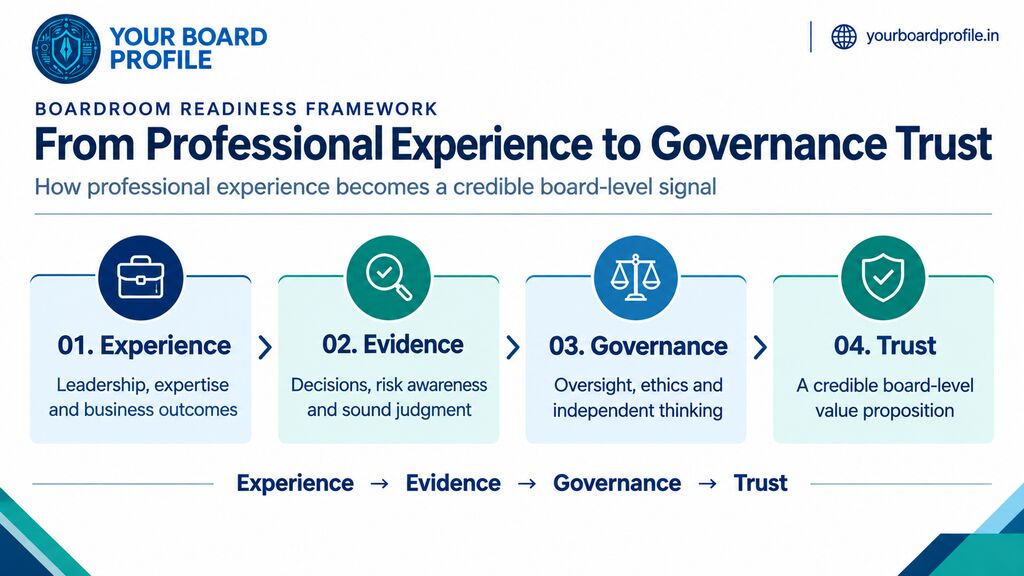
Consider a hypothetical Indian CFO whose profile says she managed a ₹2,000 crore business. That figure communicates scale, but not necessarily governance judgment. She then describes how, during a proposed acquisition, she questioned optimistic assumptions, sought an independent valuation and ensured that downside risks were presented to the decision-makers. This account gives readers a clearer view of how she approached risk and challenged a proposal. It becomes a credible governance signal when her role, actions and outcomes can be substantiated. Storytelling makes the evidence understandable; the underlying conduct gives it credibility.
This is also where governance signalling differs from achievement-led executive branding. Statements such as “scaled the P&L” or “built high-performing teams” may establish operating competence. A governance-oriented story explains what risks were identified, what assumptions were challenged, whose interests were considered and how the decision supported accountability and long-term value. The aim is not to make every executive achievement sound like board service, but to show honestly which parts of that experience are relevant to board oversight.
Governance Signalling in the Digital Age
Before a professional conversation takes place, your public profile may already be shaping perceptions. A search engine result, LinkedIn page, published interview or professional article can help someone understand your expertise. These digital touchpoints form part of your governance signalling because they provide visible evidence of how you think, communicate and engage with important business issues.
The Indian Institute of Corporate Affairs (IICA), under the Ministry of Corporate Affairs, maintains the Independent Directors Databank. The platform supports director capacity-building, learning and the discovery of professionals who may be considered for appointments. Its existence highlights the importance of professional information and governance knowledge, although registration alone does not guarantee an appointment.
A credible digital presence should complement formal eligibility and professional relationships rather than replace them. Your profile needs to demonstrate a coherent combination of experience, expertise, integrity and an understanding of the responsibilities associated with board service.
Search Visibility and Professional Consistency
When someone searches your name, what will they discover? Ideally, the results should reinforce your professional identity rather than create confusion about your expertise or ambitions.
Search visibility is not about publishing content every day or chasing popularity. It is about making relevant professional information discoverable and easy to understand. A complete LinkedIn profile, a well-written biography, relevant articles and an up-to-date professional portfolio can help establish that clarity. Where appropriate, your name, current role, areas of expertise and professional achievements should be presented consistently across these platforms.
Professional consistency also extends to the quality of your public commentary. If you write about corporate governance, your contributions should show balanced reasoning, an understanding of business realities and respect for confidentiality. Avoid commenting on sensitive matters without sufficient information or presenting speculation as fact. Board-level credibility depends on judgment as much as visibility.
Use a simple audit to review your digital presence:
- Accuracy: Are your designations, qualifications, dates and achievements correct?
- Relevance: Does your profile communicate the expertise you want to contribute at board level?
- Consistency: Do your LinkedIn profile, biography and public professional materials tell a coherent story?
- Substance: Do your articles and public comments demonstrate insight rather than merely promote your services?
- Professionalism: Could a board member reasonably interpret your online conduct as evidence of sound judgment?
A strong digital footprint should create confidence, not noise. It should give decision-makers a useful starting point for a deeper professional conversation.
What Your Personal Brand Should Signal to a Board
An aspiring director’s personal brand should make several governance qualities visible over time: strategic altitude rather than operating detail; independence of judgment; ethical maturity; stakeholder sensitivity; committee readiness; familiarity with governance vocabulary; boardroom temperament; and a long-term value orientation. Depending on the candidate’s experience and target roles, relevant signals may also include risk-oversight maturity, ESG awareness, digital-governance understanding and the ability to ask strategic questions. These are not labels to add to a profile without evidence. Each should be supported by examples, learning, decisions or contributions that can withstand reasonable scrutiny.
Content is one way to demonstrate this thinking. A broad article titled “Five Growth Trends in AI” may show awareness of a topic. A piece explaining “Three Questions a Board Should Ask Before Approving a Major AI Capital Investment” is more likely to reveal how the writer considers oversight, risk, accountability and long-term value. The difference is not the subject; it is the governance lens through which the subject is examined.
Building a Board-Ready Professional Identity
A board-ready identity brings together your professional achievements, governance knowledge, specialist expertise and potential contribution. It should help a decision-maker understand your value without having to interpret a long career history. The process begins with identifying your strongest areas of expertise and mapping them against the needs of the organisations you want to serve.
Start by reviewing your career through a governance lens. Which decisions required you to balance competing stakeholder interests? When did you challenge a risky proposal, strengthen a control, question an investment assumption or guide an organisation through uncertainty? These experiences can demonstrate the judgment that boards need, even if your previous position was entirely executive.
Next, identify your knowledge gaps. If you are unfamiliar with board committee responsibilities, financial statements, directors’ duties or applicable governance requirements, invest in structured learning. The IICA’s official resources for independent directors provide information about learning modules, governance resources and capacity-building initiatives.
Your development plan should reflect both the requirements of your intended appointments and your existing professional strengths.
Creating a Board CV and Board Value Proposition
An executive CV and a board CV serve different purposes. An executive CV typically demonstrates your ability to lead teams, deliver projects and manage operations. A Board CV is a governance document, not simply a longer executive résumé: it should help a reader assess how your experience may support strategy, oversight, risk management, accountability and long-term value creation. It should make the connection between your achievements and board-relevant judgment clear without overstating formal governance experience.
A Board CV should generally include a concise professional summary, areas of expertise, significant leadership achievements, relevant governance exposure, committee or advisory experience where applicable, qualifications and professional affiliations. It should be factual and tailored to the kinds of organisations you want to serve. Wherever possible, describe the decision or challenge, the risk or stakeholder consideration involved, your actual contribution and the outcome. Avoid presenting routine management responsibilities as board-level achievements.
Your board value proposition is the central message that connects these elements. It should explain what you bring, where that expertise is useful and how it could support effective governance. It also gives your profile a clear strategic direction: for example, audit-committee risk oversight, stakeholder and ESG oversight, digital governance or financial stewardship. The selected theme should reflect genuine expertise and the needs of the boards you hope to serve.
For example, a technology executive’s value proposition might emphasise experience in digital transformation, cybersecurity risk, technology investment and organisational resilience. A finance leader might focus on financial oversight, capital allocation, audit, internal controls and enterprise risk. These are illustrative positioning approaches, not claims of guaranteed suitability.
From Strategy to Referability: A Practical Chain
A useful way to organise your board-focused personal brand is: Strategy → Story → Signal → Reputation → Referability. Strategy is what you want to be known for, such as audit-committee risk or stakeholder and ESG oversight. Story is the concise, evidence-based account that makes that expertise believable. Signals are the repeated proof points across your Board CV, LinkedIn profile, articles, talks, professional associations and conversations. Reputation is what others come to say about your judgment and contribution. Referability is the point at which a chairperson, director or search professional feels confident putting your name forward for a relevant opportunity.
Each step depends on the one before it. A clear strategy without evidence sounds like positioning; a compelling story without substantiation sounds like promotion. Repeated, consistent signals backed by conduct can build a reputation over time, and a trusted reputation can make a professional easier to recommend. None of this guarantees an appointment, but it can make the candidate’s contribution easier to understand and assess.
The following framework can help you organise your materials.
| Professional asset | What it should communicate | Common weakness to avoid |
| Board CV | Governance-relevant experience and evidence of contribution | Reproducing an executive CV without adaptation |
| Board biography | A concise account of expertise, career and board value | Listing designations without explaining relevance |
| LinkedIn headline | Professional identity and distinctive areas of expertise | Using only a current job title |
| LinkedIn About section | Strategic perspective, achievements and governance interests | Writing a generic career summary |
| Thought leadership | Ability to analyse business and governance issues | Publishing content without substance or context |
| Professional portfolio | Consistent evidence of achievements and expertise | Including outdated or contradictory information |
A structured professional portfolio can help bring these materials together. If you need support with board CVs, LinkedIn positioning and related professional branding services, begin by identifying the gap you need to address rather than simply adding more documents to your profile.
How to Get Appointed to a Corporate Board
There is no single route to becoming an Independent Director. Appointments depend on eligibility, organisational needs, relevant expertise, professional credibility, independence requirements and the company’s selection process. Nevertheless, you can follow a practical sequence to make yourself better prepared for consideration.
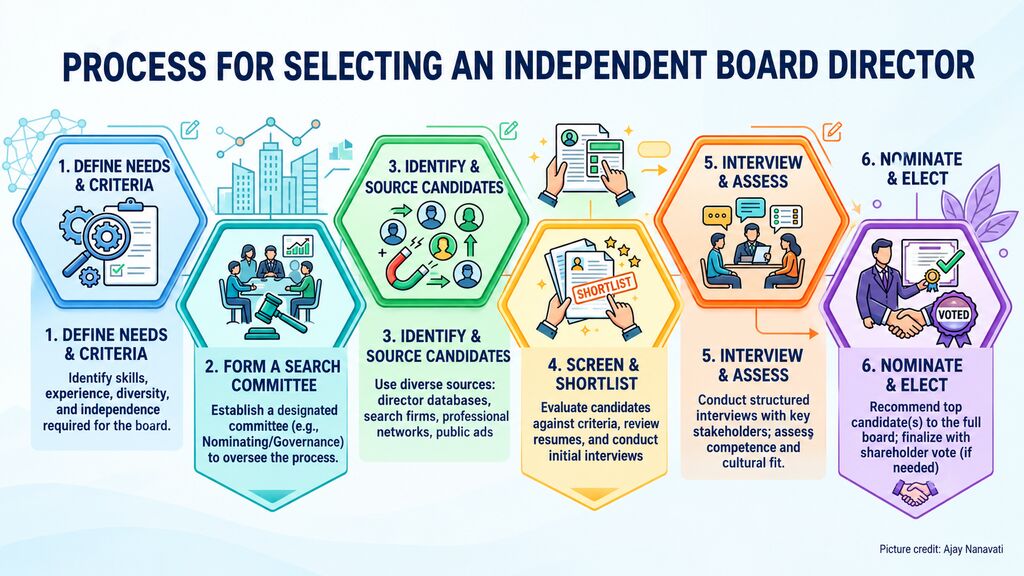
Step 1: Understand the Legal and Governance Requirements
Begin by studying the Companies Act, 2013, the relevant rules and, where applicable, SEBI’s LODR requirements. Understand the conditions relating to independence, eligibility, duties, conflicts of interest and appointment procedures. Seek qualified legal or company-secretarial advice when a particular provision or proposed appointment requires interpretation.
For eligible professionals in India, review the Independent Directors Databank. IICA’s official guidance explains the databank and the applicable online proficiency self-assessment requirements. The requirements include provisions for exemptions and timelines that depend on the individual’s circumstances, so check the current rules rather than relying on general online summaries.
Step 2: Identify the Boards Where Your Expertise Is Relevant
Do not begin by approaching every company with a board vacancy. Identify sectors, company sizes and governance challenges where your experience could be useful. A manufacturing leader may have relevant insights into operational resilience and safety, while a digital executive may be valuable to an organisation navigating technology risk or digital transformation.
Study the company’s business model, strategic priorities, risk exposure and existing board composition using reliable public information. This exercise helps you identify whether your expertise fills a genuine need.
Step 3: Develop Governance Knowledge and Practical Judgment
Board readiness requires more than a certificate or a strong career history. Build your understanding of financial reporting, audit, risk, compliance, strategy, stakeholder interests and directors’ responsibilities. Consider relevant learning programmes, case studies and discussions with experienced directors.
Practise evaluating decisions from an oversight perspective. Instead of asking only whether a project will meet its targets, consider whether its assumptions are sound, risks have been identified, controls are appropriate and management has considered credible alternatives.
Step 4: Build Relationships With Relevant Decision-Makers
Professional relationships can help you learn about board expectations and make your expertise known. Connect thoughtfully with existing directors, governance professionals, company secretaries, executive search consultants and senior leaders who understand the sector you are targeting.
The objective is not to ask every contact for an appointment. Share relevant insights, seek informed feedback and communicate the specific contribution you could make. Relationships are more valuable when they are built on genuine professional exchange rather than repeated requests.
Step 5: Strengthen Your Visibility and Board Branding
Publish thoughtful perspectives on subjects connected to your expertise, but approach each topic through a governance lens. Rather than only describing industry trends, explain the questions a board might ask, the assumptions it should test, the risks it should consider and the stakeholder interests it should weigh. Participate in relevant governance discussions, keep your professional profiles current and ensure that your Board CV supports the same message conveyed by your public presence.
You can study how experienced directors describe their expertise, but the purpose is not to copy their profiles. It is to understand how they communicate board-level value clearly and credibly. The most effective signals are repeated across different settings and remain consistent with the person’s actual experience, conduct and judgment.
Step 6: Prepare for Due Diligence and Board Conversations
An appointment discussion may examine your professional experience, judgment, independence, potential conflicts and understanding of the company’s challenges. Be ready to explain how you would approach difficult decisions, challenge management constructively and maintain confidentiality.
Review any proposed appointment carefully, including time commitments, committee responsibilities, remuneration, indemnity arrangements and potential legal exposure. Before accepting, assess whether you can make a meaningful contribution while meeting your statutory and fiduciary obligations.
The process can be summarised as follows:
| Stage | Priority | Evidence of progress |
| Readiness | Understand governance and eligibility | A clear learning and compliance plan |
| Positioning | Define your board value proposition | A focused board CV and biography |
| Visibility | Establish a credible public profile | Consistent, relevant professional information |
| Relationships | Develop relevant professional connections | Meaningful conversations and informed feedback |
| Opportunity | Match expertise to board needs | Relevant introductions or consideration for a role |
| Appointment | Complete appropriate due diligence | Informed acceptance and readiness to serve |
No stage guarantees an appointment. The objective is to make your capabilities easier to evaluate while ensuring that you are genuinely prepared for the responsibilities involved.
Common Branding Mistakes Aspiring Independent Directors Should Avoid
Even experienced leaders can weaken their board positioning through avoidable mistakes. The first is treating a board appointment as a status symbol rather than a responsibility. A profile that emphasises prestige, titles and recognition but offers little evidence of judgment may fail to communicate the qualities boards need.
The second mistake is confusing visibility with credibility. Frequent posts, large follower counts and impressive engagement metrics may increase attention, but they do not independently establish governance competence. A well-reasoned article about risk oversight may offer more relevant evidence than dozens of generic motivational posts. Your content should demonstrate how you think, not simply how often you publish.
The third mistake is using identical messaging everywhere without adapting it to the audience. Your LinkedIn profile can communicate your broad professional identity, while your board biography should provide a concise account of your governance-relevant expertise. Consistency is about maintaining a coherent message, not copying the same paragraph into every document.
Another common problem is overstating experience. If you have supported a board project as an executive, do not describe that experience in a way that implies you served as an Independent Director. Distinguish clearly between management responsibility, advisory contributions, committee experience and formal directorships. Accuracy is fundamental to professional trust.
Finally, do not neglect the substance behind your brand. Personal branding cannot compensate for weak governance knowledge, inadequate preparation or a poor understanding of directors’ responsibilities. The strongest approach combines professional visibility with continuous learning, sound judgment and ethical conduct.
A useful principle is to make every professional signal support the same conclusion: your experience is relevant, your claims are credible and your approach reflects the responsibilities of board service.
Conclusion
Becoming an Independent Director requires more than a successful executive career or a polished professional profile. It requires governance knowledge, independent judgment and a credible way to communicate how your experience could contribute to a board. Your personal brand should make those capabilities visible through evidence rather than simply announce that you are board-ready.
From Dr. Amit Nagpal’s governance-signalling perspective, personal branding becomes especially meaningful when it helps others assess how you think, how you question, how you challenge without breaking trust, and how you weigh risk, ethics and stakeholder interests. Career achievements can establish competence, storytelling can create recall, but the signals you consistently demonstrate help others decide whether they can trust your contribution in the boardroom.
The method can be expressed as Strategy → Story → Signal → Reputation → Referability. Decide what you want to be known for, choose truthful stories that demonstrate relevant judgment, reinforce them through consistent professional signals and build a reputation grounded in conduct. Visibility should make your expertise discoverable; it should never be treated as a substitute for competence, independence or integrity.
Your next step: Review your LinkedIn profile, board CV and professional biography together. Ask yourself whether they clearly explain the governance challenges you understand, the experience you bring and the contribution you could make as an Independent Director. If the answer is unclear, start there. A credible board brand begins with substance and becomes stronger through consistent, evidence-based communication.
At Your Board Profile, aspiring directors and senior executives can explore ways to strengthen their professional positioning, communicate their board-level value and build a more coherent leadership presence. The aim is not simply to be seen as board-ready, but to develop the capabilities and credibility that make you ready to serve.
Frequently Asked Questions
1. What is an Independent Director?
An Independent Director is a non-executive director who meets the applicable independence criteria and contributes objective judgment, oversight and constructive challenge to a company’s board. The role involves supporting sound governance, evaluating strategy and overseeing relevant risks. In India, the applicable legal framework includes the Companies Act, 2013, and relevant SEBI requirements for listed entities.
2. How can I become an Independent Director in India?
Start by understanding the legal eligibility and independence requirements, strengthening your governance knowledge and identifying the expertise you can contribute to a board. Review the Independent Directors Databank maintained through IICA, check applicable registration and proficiency requirements, and develop a board-focused CV. Building relevant professional relationships and communicating your expertise clearly can also help you become visible to potential appointing organisations.
3. Is registration with the Independent Directors Databank mandatory?
The applicable rules govern registration requirements for individuals seeking to serve as Independent Directors. Review the current provisions and official guidance on the Independent Directors Databank to determine the requirements relevant to your circumstances. Registration does not guarantee an appointment, and companies must conduct appropriate due diligence.
4. Do I need to pass the IICA proficiency self-assessment test?
The requirement depends on the applicable rules and whether you qualify for an exemption. Under the relevant framework, non-exempt individuals are generally required to pass the online proficiency self-assessment within the prescribed period after inclusion in the databank. Check the current official self-assessment guidance for the latest requirements.
5. What is the difference between personal branding and board branding?
Personal branding communicates your professional identity, expertise and reputation across your career. Board branding explains how that expertise translates into board-level contribution, including strategic oversight, risk assessment and governance. Both should be consistent, but board branding places greater emphasis on the value you can bring to an organisation’s governance.
6. Why is independent director personal branding important?
Independent director personal branding helps make your expertise and professional values easier to understand. A clear profile can communicate your sector knowledge, leadership experience and governance interests to people evaluating your suitability. It supports professional visibility but cannot replace eligibility, competence, independence or appropriate due diligence.
7. How is board branding different from executive branding?
Executive branding often focuses on leadership, operational performance, business growth and the ability to deliver results. Board branding focuses more explicitly on strategic judgment, oversight, risk, governance and long-term organisational value. It translates executive achievements into evidence of relevant board-level capabilities.
8. What should an Independent Director’s CV include?
A board CV should include your professional summary, areas of expertise, significant achievements, relevant governance exposure, qualifications and professional affiliations. Highlight experience that demonstrates strategic thinking, financial understanding, risk management and ethical judgment. Keep claims accurate and distinguish formal directorships from executive, advisory or committee-related experience.
9. Can a senior executive become an Independent Director without previous board experience?
A senior executive may be eligible for consideration without having previously served as an Independent Director, provided the applicable requirements are met. However, executive experience alone does not establish suitability for every board. Candidates should demonstrate governance knowledge, sound judgment, independence and expertise relevant to the organisation’s needs.
10. How can LinkedIn help me get appointed to a corporate board?
LinkedIn can help you communicate your expertise, share relevant governance insights and develop relationships with directors, search professionals and other senior leaders. A strong headline, focused About section and evidence-based professional content can make your experience easier to evaluate. LinkedIn is a visibility and networking tool, not a guarantee of appointment.
11. What is governance signalling?
Governance signalling is the evidence an aspiring director makes visible through credible actions, decisions, communication and professional materials. It helps boards, NRCs and search firms assess qualities such as independent judgment, risk awareness, ethical maturity, stakeholder sensitivity and the ability to challenge assumptions respectfully. The signal is strongest when claims are supported by verifiable conduct rather than self-description alone.
12. How can I improve my visibility among board members and NRCs?
Develop a clear board value proposition, maintain accurate professional profiles and share thoughtful perspectives on issues relevant to your expertise. Build genuine relationships with governance professionals, company secretaries, executive search consultants and existing directors. Research organisations where your capabilities may be relevant instead of relying exclusively on general networking.
13. Does publishing articles on corporate governance improve board readiness?
Publishing thoughtful articles can demonstrate your ability to analyse governance challenges, explain complex issues and communicate professional judgment. It may also improve the discoverability of your expertise. However, content should be accurate, relevant and consistent with your actual experience; publication alone does not demonstrate that you are qualified or ready for appointment.
14. What are the most common mistakes in board branding?
Common mistakes include using a generic executive profile, exaggerating governance experience, focusing on prestige rather than contribution and publishing content without meaningful insight. Inconsistent information across professional platforms can also create uncertainty. A credible board brand is evidence-based, accurate and aligned with your actual capabilities.
15. How can Your Board Profile help aspiring Independent Directors?
Your Board Profile offers professional positioning support through services such as customised board CVs, LinkedIn profile enhancement, personal branding, board readiness assessments and coaching. These services can help professionals communicate their experience more clearly and develop a coherent board-focused identity. Explore the Your Board Profile services page to understand the available options.
Ready to Strengthen Your Independent Director Profile?
Becoming an Independent Director is not just about professional experience—it is about demonstrating the governance expertise, independent judgment, credibility, and strategic perspective that boards value. Build a strong personal brand that communicates your boardroom readiness and positions your expertise as meaningful board-level value.
Whether you are a CXO, senior executive, entrepreneur, or aspiring Independent Director, take the next step toward building a credible board-ready profile and strengthening your governance positioning.
Schedule your complimentary session here:
https://calendly.com/dramitnagpal
Share this post: Facebook | X | LinkedIn