

Senior executives often assume that decades of leadership experience naturally qualify them for board positions. Yet many discover that despite an impressive career, their applications fail to generate interest from nomination committees or board recruiters. The problem usually isn’t a lack of experience—it’s the way that experience is presented. A traditional executive resume focuses on execution, operational excellence, and business performance. A Board Director CV, however, must demonstrate strategic oversight, governance thinking, independent judgment, and the ability to safeguard long-term stakeholder value.
Today’s boards operate in an environment shaped by increasing regulatory scrutiny, cybersecurity risks, ESG expectations, and evolving stakeholder demands. Companies no longer appoint directors solely because they have held senior executive titles. They seek individuals who understand corporate governance, enterprise risk, ethics, succession planning, and long-term strategy. If your CV still emphasizes how you managed departments or delivered quarterly targets, it may unintentionally position you as an executive rather than someone ready for the boardroom.
This guide explains why many aspiring directors struggle to make that transition and, more importantly, how to rewrite your Board Director CV so it reflects the mindset boards expect. You’ll learn how to shift from execution-focused language to oversight-focused communication while positioning yourself as a credible candidate for independent director opportunities.
Table of Contents
- Why Most Board Director CVs Miss the Mark
- Executive Thinking vs Board Thinking
- Shifting Your Board Director CV from Execution to Oversight
- What Board Recruiters Look for in a Board Director
- Common Board Director CV Mistakes
- Writing a Board Director CV That Demonstrates Board Readiness
- Executive Resume vs Board Director CV
- Board Director CV Transformation Examples
- Final Board Director CV Checklist
- Conclusion
- Frequently Asked Questions
Why Most Board Director CVs Miss the Mark
One of the biggest misconceptions among senior executives is believing that a successful leadership career automatically translates into board readiness. While operational achievements certainly establish credibility, they rarely convince a board that you can fulfill governance responsibilities. Most board recruiters review dozens of profiles from highly accomplished CEOs, CFOs, CHROs, and business heads. What differentiates successful candidates isn’t who managed the largest business unit or delivered the highest revenue growth. Instead, it’s who demonstrates the ability to think independently, ask strategic questions, oversee risk, and guide organizations through complexity without becoming involved in day-to-day management.
A common executive resume is packed with statements such as “led a team of 2,000 employees,” “increased revenue by 30%,” or “implemented digital transformation initiatives.” These achievements are impressive, but they communicate operational capability rather than board capability. A board member isn’t expected to run departments or execute projects. Their role is to ensure that management’s decisions align with long-term strategy, shareholder interests, regulatory requirements, and ethical business practices. This distinction explains why many experienced leaders receive little response despite having exceptional executive careers.
An effective Board Director CV reframes those same accomplishments through a governance lens. Instead of highlighting execution, it emphasizes strategic influence, oversight, enterprise risk management, stakeholder stewardship, and contributions to sustainable organizational success. That subtle shift changes how nomination committees perceive your profile and immediately signals that you understand what board service truly requires.
Executive Thinking vs Board Thinking
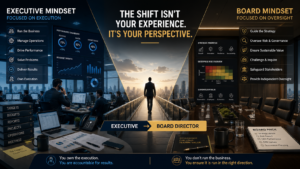
Moving from the executive suite to the boardroom isn’t simply a career progression—it’s a complete shift in perspective. Executives are accountable for delivering business results, while directors are accountable for ensuring those results are achieved responsibly, ethically, and sustainably. Understanding this difference is the foundation of writing an effective Board Director CV.
Executive Responsibilities
Executives spend most of their time making operational decisions. They manage budgets, allocate resources, lead teams, improve efficiency, and execute strategic initiatives approved by the board. Their success is measured through key performance indicators such as revenue growth, profitability, customer satisfaction, operational excellence, and market expansion. Naturally, executive resumes reflect these achievements because they define career success within management roles.
This operational focus often carries into board applications. Candidates instinctively describe how they solved problems, optimized processes, reduced costs, or expanded business operations. Although these accomplishments remain valuable, they don’t answer the question every nomination committee is asking: “Can this individual provide independent oversight rather than operational leadership?”
Board Responsibilities
A Board Director approaches business from a completely different altitude. Rather than managing operations, directors evaluate whether management is making sound decisions that protect the organization’s long-term interests. They challenge strategic assumptions, oversee enterprise risks, monitor executive performance, ensure regulatory compliance, and balance the interests of shareholders with those of employees, customers, regulators, and society.
This distinction should also shape the language of your CV. Instead of describing what you personally executed, explain how you influenced governance frameworks, strengthened decision-making, improved risk oversight, or contributed to strategic direction. These experiences demonstrate board readiness far more effectively than operational achievements alone.
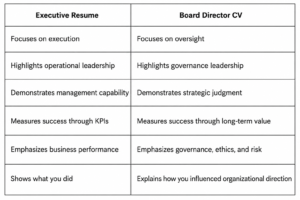
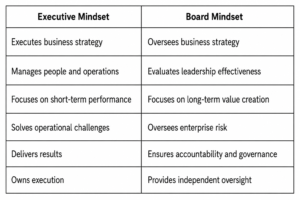
The comparison below highlights the difference:
Shifting Your Board Director CV from Execution to Oversight
The biggest transformation you can make to your Board Director CV isn’t adding more achievements—it’s changing the perspective from which those achievements are described. Many accomplished executives unknowingly write as if they’re applying for another C-suite role. Their CVs are filled with statements about driving growth, managing large teams, launching initiatives, or improving operational efficiency. While these accomplishments demonstrate leadership capability, they don’t necessarily convince a board that the candidate understands governance. Board recruiters are looking for evidence that you’ve progressed beyond execution and developed the ability to oversee, question, guide, and protect the long-term interests of an organization.
Think of it this way: an executive is responsible for steering the ship, while a board director ensures the ship is sailing in the right direction, avoiding risks, complying with regulations, and creating sustainable value for everyone on board. This distinction should be reflected in every section of your CV—from your professional summary to your leadership achievements. Instead of showcasing yourself as someone who personally delivered results, position yourself as a leader who influenced strategic decisions, strengthened governance frameworks, enhanced accountability, and enabled long-term success. When your language consistently reflects oversight rather than management, your profile begins to resonate with nomination committees and organizations seeking board-ready leaders.
Replace Operational Language
Words shape perception. A nomination committee often decides within the first few minutes whether a candidate appears suitable for board service, and the language you use plays a significant role in that impression. Traditional executive resumes rely heavily on action verbs such as “managed,” “implemented,” “executed,” “controlled,” and “supervised.” Although these words accurately describe operational responsibilities, they also signal that your expertise lies in running the business rather than governing it.
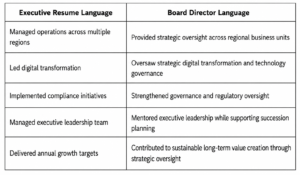
To position yourself as a Board Director, replace operational language with governance-focused terminology. Instead of saying you “managed business operations,” explain that you provided strategic oversight, guided enterprise transformation, strengthened governance practices, or advised executive leadership on long-term priorities. Rather than highlighting how you solved day-to-day business challenges, emphasize how you contributed to better decision-making, improved accountability, or supported organizational resilience. These subtle changes communicate maturity, strategic thinking, and an understanding of board responsibilities without diminishing your executive accomplishments.
The comparison below illustrates how a simple shift in wording can dramatically improve the board relevance of your CV.
Emphasize Governance and Strategy
A strong Board Director CV demonstrates that you’ve consistently thought beyond operational performance. Boards spend their time discussing issues such as long-term strategy, enterprise risk, capital allocation, leadership succession, cybersecurity, ethics, sustainability, and stakeholder confidence. Your CV should naturally reflect your involvement in these conversations, even if your official title was that of an executive rather than a director.
Look back across your career and identify moments where your influence extended beyond execution. Perhaps you regularly presented to the board, participated in audit or risk committee discussions, led governance initiatives, advised on acquisitions, managed regulatory relationships, or contributed to strategic planning sessions. These experiences deserve greater prominence than routine operational responsibilities because they demonstrate board-level exposure. Recruiters understand that not every aspiring director has previous board experience, but they do expect evidence that you’ve developed the mindset required for governance.
When every section of your CV reinforces themes such as strategic oversight, governance excellence, ethical leadership, and stakeholder value, your profile begins to tell a different story. Rather than appearing as an executive seeking a promotion, you present yourself as a trusted advisor capable of contributing meaningful insight in the boardroom.
What Board Recruiters Look for in a Board Director
Many aspiring directors assume that board appointments are awarded primarily on the basis of seniority or executive titles. In reality, nomination committees follow a much more balanced evaluation process. They certainly value leadership experience, but they also look for individuals who can contribute independent thinking, challenge assumptions constructively, oversee complex risks, and strengthen governance. A highly accomplished executive who focuses exclusively on operational achievements may therefore lose out to another candidate whose CV better reflects boardroom capabilities.
Today’s boards face an increasingly complex environment shaped by technological disruption, evolving regulations, geopolitical uncertainty, ESG expectations, cybersecurity threats, and changing investor priorities. As a result, organizations seek directors who bring diverse perspectives while maintaining a strong understanding of corporate governance. Your Board Director CV should therefore demonstrate not only what you’ve achieved but also how you’ve influenced strategic decisions, balanced competing stakeholder interests, and exercised sound judgment under uncertainty.
Strategic Oversight
One of the primary responsibilities of every board is ensuring that the organization’s long-term strategy remains sustainable and aligned with shareholder expectations. Directors don’t create detailed operational plans—they evaluate whether management’s proposed direction supports future growth while protecting the organization from unnecessary risk. Recruiters therefore look for candidates who have participated in high-level strategic discussions rather than those who simply executed business plans.
Your CV should highlight examples where you contributed to enterprise strategy, evaluated investment opportunities, supported mergers or acquisitions, advised leadership during major organizational changes, or influenced long-term business priorities. Even if these responsibilities formed only part of your executive role, they demonstrate the strategic thinking boards value. By emphasizing these experiences, you show that your perspective extends beyond quarterly targets toward sustainable organizational success.
Risk and Governance
Risk oversight has become one of the defining responsibilities of modern boards. Cybersecurity, regulatory compliance, financial resilience, supply chain disruption, artificial intelligence, data privacy, and reputational risk now receive regular attention in board meetings across industries. Recruiters therefore expect aspiring directors to demonstrate familiarity with enterprise risk management rather than operational risk alone.
If you’ve participated in risk committees, strengthened internal controls, improved governance frameworks, supported regulatory compliance, or developed crisis management strategies, ensure those experiences are clearly reflected in your CV. Instead of describing how you responded to operational challenges, explain how you improved oversight, enhanced accountability, or reduced enterprise exposure. This positions you as someone capable of fulfilling the governance responsibilities expected of a Board Director.
Ethics and Stakeholder Value
The role of today’s board extends far beyond protecting shareholder returns. Directors are expected to balance the interests of investors, employees, customers, regulators, business partners, and society while ensuring the organization operates with integrity. Ethical leadership has therefore become an essential quality in board appointments.
Your CV should communicate instances where you strengthened organizational culture, promoted ethical decision-making, improved transparency, supported ESG initiatives, enhanced stakeholder engagement, or guided leadership through sensitive governance challenges. These experiences demonstrate that your leadership philosophy aligns with the broader responsibilities of modern boards. Rather than presenting yourself solely as a business operator, you establish yourself as a leader capable of protecting reputation, building trust, and creating sustainable long-term value—qualities every nomination committee seeks in a future Board Director.
Common Board Director CV Mistakes
If you’ve spent years climbing the corporate ladder, it’s only natural to write your CV the way you’ve always written it. After all, that style has probably helped you secure leadership roles throughout your career. The challenge is that a Board Director CV isn’t simply an upgraded executive resume. It’s a different document written for a different audience with different expectations. Many highly accomplished executives are overlooked for board opportunities not because they lack experience, but because their CV fails to demonstrate board-level thinking.
One of the most common mistakes is treating the CV like a list of operational achievements. Statements such as “managed a team of 3,000 employees,” “delivered quarterly revenue targets,” or “implemented cost-saving initiatives” certainly highlight leadership capability, but they don’t explain how you contributed to governance, strategic oversight, or enterprise decision-making. Boards assume senior executives can execute. What they want to know is whether you can provide independent judgment, challenge management constructively, and help navigate complex business decisions without becoming involved in daily operations.
Another frequent mistake is overlooking governance-related experiences that already exist within your career. Think about the times you presented to the board, participated in audit committee meetings, led enterprise risk reviews, supported regulatory audits, contributed to succession planning, or advised on acquisitions. Many executives leave these experiences buried under operational achievements, even though they’re often the strongest indicators of board readiness. Your CV should bring these governance experiences to the forefront because they’re precisely what nomination committees are searching for.
Candidates also tend to underestimate the importance of language. Board recruiters notice whether your achievements revolve around execution or oversight. A simple shift from “managed business growth” to “provided strategic oversight for sustainable business growth” immediately changes the way your profile is perceived. It’s not about exaggerating your role—it’s about presenting your experience through the lens of governance rather than operations.
Writing a Board Director CV That Demonstrates Board Readiness
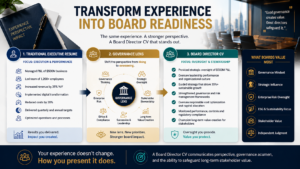
A compelling Board Director CV doesn’t happen by accident. It tells a clear story about your evolution as a leader. Rather than positioning yourself solely as someone who delivered business results, it shows how you’ve developed the judgment, perspective, and governance mindset expected in the boardroom. Every section of your CV should reinforce one simple message: you’re prepared to guide an organization strategically, not manage it operationally.
Board recruiters rarely expect first-time directors to have decades of board experience. What they do expect is evidence that you’ve already operated close to the board, influenced strategic decisions, and developed an understanding of governance responsibilities. The strongest candidates don’t try to sound like professional board members overnight. Instead, they connect their executive experience to board-level responsibilities in a credible and authentic way. That’s what builds confidence with nomination committees.
Showcase Governance Experience
Governance experience often exists in places executives overlook. Perhaps you regularly attended board meetings to present strategic updates, participated in enterprise risk discussions, contributed to ESG initiatives, supported compliance programmes, or worked closely with audit committees. These experiences deserve more visibility because they demonstrate that you’ve operated beyond the boundaries of day-to-day management.
Instead of burying governance contributions among operational achievements, dedicate space within your CV to highlight them. Explain how you influenced policy decisions, strengthened accountability, supported regulatory compliance, or improved governance processes. Even if governance wasn’t your primary responsibility, showing consistent exposure to board-level decision-making significantly strengthens your credibility as an aspiring Board Director.
Highlight Independent Judgment
One quality every board values is independent thinking. Directors are expected to ask difficult questions, evaluate competing viewpoints, and make decisions that serve the organization’s long-term interests rather than short-term operational goals. Your CV should therefore include examples where you demonstrated sound judgment during periods of uncertainty, organizational change, or strategic transformation.
Think back to situations where you challenged existing assumptions, guided leadership through a crisis, advised on major investments, or balanced commercial objectives with regulatory or ethical considerations. These examples show that your leadership extends beyond execution. They illustrate maturity, objectivity, and the confidence to contribute meaningfully during board discussions without becoming emotionally attached to operational decisions.
Quantify Board-Level Impact
Numbers still matter in a Board Director CV—but the story behind those numbers matters even more. Instead of listing financial achievements in isolation, explain the broader organizational impact they created. Did your strategic recommendations reduce enterprise risk? Did governance improvements strengthen compliance across multiple regions? Did your leadership help the organization navigate market uncertainty while protecting shareholder confidence?
Where possible, connect measurable outcomes with strategic influence rather than operational activity. This approach helps nomination committees understand not only what was achieved but also how your leadership contributed to sustainable value creation. Boards think in terms of resilience, governance, and long-term performance, so your achievements should naturally reflect those priorities.
Executive Resume vs Board Director CV
Although the two documents may appear similar at first glance, an executive resume and a Board Director CV serve very different purposes. An executive resume is designed to convince an employer that you can run the business. A board CV is designed to convince a nomination committee that you can govern the business. That distinction affects everything from your professional summary to the language you use when describing achievements.
An executive resume typically focuses on operational excellence, team leadership, profit growth, customer acquisition, business expansion, and execution. These achievements remain valuable because they demonstrate leadership capability. However, if they’re presented without strategic context, they position you as an operator rather than an advisor. A board CV takes those same accomplishments and reframes them around governance, enterprise oversight, stakeholder value, and long-term strategy.
The difference becomes even clearer when you compare the overall emphasis of each document.
If you’re serious about securing board opportunities, don’t make the mistake of submitting your executive resume with a different title at the top. A genuine Board Director CV speaks a different language because it reflects a different responsibility. When your document consistently emphasizes governance, strategy, stakeholder stewardship, and independent thinking, it signals that you’re ready to contribute where it matters most—in the boardroom rather than the executive office.
Board Director CV Transformation Examples
Sometimes the easiest way to understand board-level positioning is to see it in action. The difference between an executive resume and a Board Director CV isn’t about inventing new achievements—it’s about changing the lens through which those achievements are viewed. Think of your career as a photograph. The picture doesn’t change, but the angle does. When recruiters read a board CV, they’re looking for evidence that you’ve influenced strategy, governance, and long-term value creation rather than simply managed operations.
Take a common executive achievement as an example. Many leaders write, “Led a global sales transformation that increased revenue by 35%.” It’s a strong accomplishment, but it leaves one important question unanswered: what does this tell a board about your ability to govern? A board-focused version might read, “Provided strategic leadership for a global transformation programme that strengthened long-term market positioning while improving governance, commercial resilience, and sustainable revenue growth.” The measurable result remains the same, but the emphasis shifts from doing the work to shaping the direction.
The same principle applies across your entire CV. If you describe every accomplishment using operational language, nomination committees naturally assume you’re still thinking like an executive. If your language consistently reflects oversight, accountability, enterprise risk, and stakeholder value, they begin to picture you contributing inside the boardroom. Small changes in wording often create a surprisingly large shift in perception.
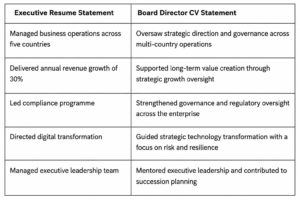
When reviewing your own CV, challenge yourself to ask one simple question after every achievement: Does this sound like someone running the business, or someone helping govern it? That question alone can transform the way your experience is presented.
Final Board Director CV Checklist
Before sending your CV to a recruiter, nomination committee, or board chair, take one final step back and review it from the perspective of someone hiring for governance—not management. Imagine you’re reading two documents. One belongs to a highly successful CEO, while the other belongs to someone prepared to sit around the boardroom table. Which one does your CV resemble? If the answer is the first, there’s still room for refinement.
A strong Board Director CV should immediately communicate strategic maturity. Within the opening summary, readers should understand your governance philosophy, industry expertise, and ability to contribute independently. Throughout the document, every achievement should reinforce themes such as strategy, risk oversight, stakeholder stewardship, ethics, succession planning, and long-term organizational performance. Operational achievements should remain, but they should support your governance narrative rather than dominate it.
Use this checklist before considering your CV complete:
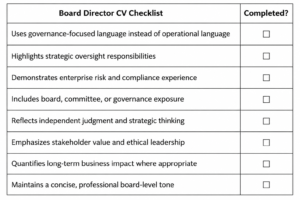
Completing these checks won’t guarantee a board appointment, but they’ll significantly improve the way your profile is perceived. Board recruiters aren’t simply evaluating experience—they’re evaluating perspective. A well-crafted CV allows them to see you as someone who already thinks like a director.
Conclusion
Moving from the executive suite to the boardroom is less about changing your career and more about changing the story you tell about it. Your experience doesn’t suddenly become more valuable because you’re applying for a board role; it becomes more relevant when it’s presented through the lens of governance. That’s the difference between an executive resume that explains what you accomplished and a Board Director CV that demonstrates why you’re ready to provide strategic oversight.
Boards need leaders who can challenge assumptions without managing operations, guide strategy without owning execution, and protect long-term stakeholder value without becoming involved in day-to-day decisions. If your CV still revolves around operational excellence alone, you may unintentionally position yourself for another executive role instead of a board appointment. By emphasizing governance, enterprise risk, ethics, strategic thinking, and independent judgment, you present yourself as someone capable of contributing meaningfully at the highest level of organizational leadership.
If you’re serious about building a successful board portfolio, treat your CV as more than a career document. Think of it as your governance narrative. Every section should reinforce your readiness to advise, oversee, and influence rather than execute. That’s the shift nomination committees notice—and it’s often the difference between being shortlisted for a board interview and being overlooked.
FAQs
- How is a Board Director CV different from an executive resume?
A Board Director CV focuses on governance, strategic oversight, enterprise risk, and stakeholder value, whereas an executive resume primarily highlights operational leadership and business execution.
- Should I include operational achievements in my Board Director CV?
Yes, but present them from a strategic perspective by explaining how they influenced governance, long-term strategy, or organizational resilience rather than daily management.
- Do I need previous board experience to apply for board roles?
Not necessarily. Many first-time directors secure board appointments by demonstrating governance exposure, strategic thinking, regulatory experience, and executive maturity.
- What skills should every aspiring Board Director highlight?
Focus on strategic oversight, corporate governance, enterprise risk management, ethics, stakeholder engagement, succession planning, and independent judgment.
- How often should the keyword “Board Director” appear in my CV or blog?
Use the term naturally throughout the content where it adds value. Avoid keyword stuffing while ensuring it appears in important headings, introductory sections, and relevant discussions for SEO purposes.
- What should a Board Director CV include?
A Board Director CV should highlight governance experience, strategic oversight, enterprise risk management, leadership, ethics, and stakeholder value rather than operational responsibilities.
- How can I make my Board Director CV stand out?
Focus on board-level achievements, governance contributions, independent judgment, and measurable strategic impact instead of day-to-day management accomplishments.
- What qualifications are important for becoming a Board Director?
While qualifications vary, organizations typically value extensive leadership experience, governance knowledge, strategic thinking, financial literacy, and industry expertise in a Board Director candidate.
- Can a CEO become a Board Director?
Yes. Many CEOs transition into Board Director roles by repositioning their executive experience to emphasize governance, oversight, and long-term strategic leadership.
- Why do Board Director CVs focus more on governance than execution?
Because a Board Director is responsible for overseeing strategy, managing enterprise risks, ensuring accountability, and protecting stakeholder interests rather than running daily operations.
- How important is corporate governance for a Board Director?
Corporate governance is one of the most important responsibilities of a Board Director, ensuring ethical leadership, regulatory compliance, transparency, and sustainable business growth.
- What mistakes should I avoid when writing a Board Director CV?
Avoid using operational language, focusing only on revenue growth, ignoring governance experience, and submitting a standard executive resume instead of a board-focused profile.
- How can I prepare for my first Board Director role?
Build governance expertise, expand your professional network, gain committee or advisory experience, and develop a Board Director CV that reflects strategic oversight rather than execution.
- Is previous board experience mandatory to become an independent director?
No. Many professionals secure their first independent director position by demonstrating governance exposure, strategic leadership, and board-ready competencies, even without prior board membership.
- How often should I update my Board Director CV?
Review and update your Board Director CV at least once a year or after significant governance, advisory, leadership, or board-related achievements to keep it relevant and competitive.
Ready to Strengthen Your Board Presence and Unlock New Board Opportunities?
A compelling Board Director CV is only one part of your board journey. The right positioning, executive branding, and governance-focused narrative can significantly improve your visibility with nomination committees and board recruiters.
Explore our services to strengthen your board profile:
- Review your Board Director profile with our portfolio experts
- Build a governance-focused executive brand
- Prepare for independent director opportunities with a board-ready CV and positioning strategy
- Create a long-term roadmap for securing your first or next board appointment
Whether you’re an aspiring Independent Director, CXO, Founder, or senior executive, a well-positioned board profile can make all the difference in today’s competitive board landscape.
Schedule your complimentary Session here: